MARKET INSIGHTS
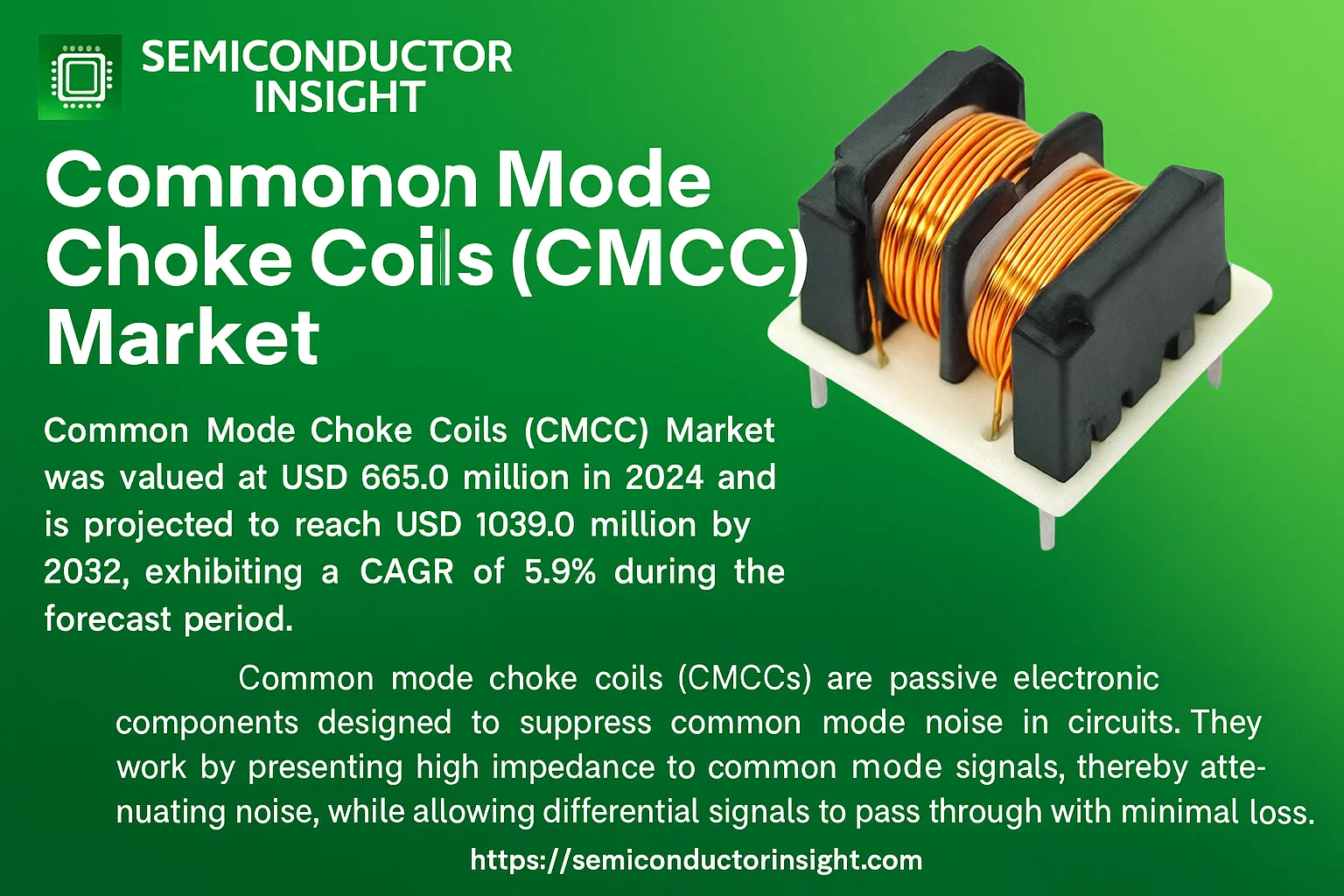
Global Common Mode Choke Coils (CMCC) Market was valued at USD 665.0 million in 2024 and is projected to reach USD 1039.0 million by 2032, exhibiting a CAGR of 5.9% during the forecast period.
Common mode choke coils (CMCCs) are passive electronic components designed to suppress common mode noise in circuits. They work by presenting high impedance to common mode signals, thereby attenuating noise, while allowing differential signals to pass through with minimal loss. This makes them essential for electromagnetic compatibility (EMC) compliance in a wide range of applications.
The market is experiencing steady growth due to several factors, including the increasing adoption of high-speed data communication systems, the proliferation of Internet of Things (IoT) devices, and stringent electromagnetic compatibility (EMC) regulations across various industries. Furthermore, the rising demand for electric vehicles (EVs) and the expansion of 5G infrastructure are creating new opportunities for CMCCs, as these sectors require robust noise suppression solutions to ensure reliable operation.
Key players in the market include Murata, TDK, Chilisin, TAIYO YUDEN, and Cyntec, among others. These companies are focusing on developing high-performance, miniaturized components to meet the evolving needs of modern electronics.
MARKET DRIVERS
Proliferation of High-Speed Data and Power Electronics
The relentless growth in demand for high-speed data transmission and efficient power conversion is a primary driver for the Common Mode Choke Coils (CMCC) market. These components are critical for electromagnetic compatibility (EMC) in devices ranging from 5G infrastructure and data centers to electric vehicles and renewable energy systems. The need to suppress common-mode noise in high-frequency switching power supplies and high-speed data lines is non-negotiable for meeting stringent international regulatory standards.
Stringent Global EMC Regulations
Governments and international bodies continue to enforce increasingly strict electromagnetic compatibility (EMC) and electromagnetic interference (EMI) regulations. Products must comply with standards such as CISPR, FCC, and EN to be sold in global markets. This regulatory pressure compels electronic manufacturers across the automotive, industrial, and consumer sectors to integrate high-performance CMCCs into their designs, directly stimulating market growth.
➤ The global push towards electrification and connectivity is creating an insatiable demand for noise suppression components.
Furthermore, the expansion of the Internet of Things (IoT) and Industrial IoT (IIoT) is creating billions of new connected nodes, each requiring EMI filtering to ensure reliable operation. This mass deployment of connected devices solidifies the long-term demand for Common Mode Choke Coils.
MARKET CHALLENGES
Miniaturization and Performance Trade-offs
A significant challenge facing CMCC manufacturers is the constant demand for smaller components with higher performance. As electronic devices shrink, the available board space for chokes diminishes. Designing chokes that maintain high impedance and current-handling capabilities in a smaller footprint requires advanced materials and complex manufacturing processes, which increases production costs and technical complexity.
Other Challenges
Supply Chain Volatility for Raw Materials
The CMCC market is susceptible to disruptions in the supply of key raw materials, such as specific grades of ferrite cores and copper wire. Price fluctuations and geopolitical factors can lead to increased costs and production delays, challenging manufacturers’ ability to maintain stable pricing and reliable delivery schedules.
Intense Price Competition
The market is highly competitive, with numerous global and regional players. This leads to intense price pressure, particularly for standard, lower-performance chokes. Maintaining profitability while investing in research and development for next-generation products is a persistent challenge for established companies.
MARKET RESTRAINTS
Maturation of Key End-Use Segments
While growth is strong in emerging sectors like EVs and renewable energy, some traditional end-use markets for CMCCs, such as consumer electronics and personal computing, are relatively mature. Growth rates in these segments have slowed, which can act as a restraint on the overall market expansion, as they represent a substantial portion of historical demand.
Design Integration and Alternative Solutions
The increasing integration of functionality into System-on-Chips (SoCs) and power modules presents a restraint. In some applications, EMI filtering functions can be partially addressed through alternative methods or integrated passive devices, potentially reducing the demand for discrete CMCC components in future designs, especially in space-constrained applications.
MARKET OPPORTUNITIES
Explosive Growth in Electric and Autonomous Vehicles
The rapid transition to electric vehicles (EVs) and the development of autonomous driving systems represent a massive opportunity. EVs require numerous high-performance CMCCs for onboard chargers, DC-DC converters, and motor drives to manage EMI. The automotive sector’s stringent reliability requirements create a premium market for advanced, automotive-grade choke coils.
Expansion of Renewable Energy Infrastructure
The global build-out of solar and wind energy infrastructure is a key growth vector. Inverters, converters, and energy storage systems within these installations require robust EMI filtering to ensure grid stability and prevent interference. CMCCs are essential components in these high-power applications, offering significant opportunities for suppliers specializing in industrial-grade products.
Advancements in High-Frequency Materials
Research and development into new magnetic materials, such as nanocrystalline and advanced soft ferrites, opens opportunities for creating CMCCs with superior performance at higher frequencies. These innovations will be critical for next-generation telecommunications (e.g., 6G) and advanced power electronics, allowing companies that pioneer these materials to capture high-value market segments.
Common Mode Choke Coils (CMCC) Market Trends
Sustained Expansion Driven by Global Electronics Demand
The global Common Mode Choke Coils (CMCC) market is on a robust growth trajectory, with its value projected to increase from $665 million in 2024 to approximately $1039 million by 2032, representing a compound annual growth rate (CAGR) of 5.9%. This sustained expansion is primarily fueled by the escalating global demand for electronic devices across various sectors. As essential components for suppressing electromagnetic interference (EMI) and ensuring signal integrity, CMCCs are increasingly critical in an increasingly connected and digital world. The market’s growth is a direct reflection of the proliferation of communication infrastructure, consumer electronics, and automotive electronics.
Other Trends
Dominance of Wire Wound Technology and Regional Market Leadership
Product segmentation reveals a clear market preference, with Wire Wound Type CMCCs dominating the landscape by holding an 84% market share in 2024. This segment’s prominence is attributed to its proven performance and reliability in high-frequency noise suppression applications. Geographically, the Asia-Pacific region is the undeniable leader, accounting for the largest portion of the global market. China stands out as the single largest market, commanding a 41% share, followed by Japan at 21% and North America at 13%. This regional concentration underscores the significance of Asia-Pacific as a global manufacturing and consumption hub for electronics.
Application Diversification and Market Consolidation
The application of CMCCs is widespread, with the Communication sector being the largest end-user field, constituting about 35% of the market. Other significant applications include Consumer Electronics, Household Appliances, Industrial equipment, and the rapidly growing Automotive sector. The competitive landscape is characterized by a degree of consolidation, where the top five manufacturers—including Murata, Chilisin, and TDK—collectively hold a significant 57% market share. This indicates a mature market where technological expertise, scale, and global reach are key competitive advantages.
Future Outlook and Strategic Imperatives
Looking ahead, the CMCC market is expected to continue its growth, driven by trends such as the rollout of 5G technology, the expansion of the Internet of Things (IoT), and the electrification of vehicles. Manufacturers are focusing on developing smaller, more efficient components with higher current ratings to meet the demands of next-generation electronics. The key challenge for industry participants will be managing supply chain dynamics and raw material costs while innovating to stay competitive in a market that is both expanding and consolidating simultaneously.
COMPETITIVE LANDSCAPE
Key Industry Players
Leadership Consolidated Among Japanese Giants, but Global Competition Intensifies
The global Common Mode Choke Coils (CMCC) market is characterized by the dominance of a handful of major Japanese component manufacturers, which together command a significant portion of the market share. The top five players, including Murata, TDK, Chilisin, TAIYO YUDEN, and Cyntec, collectively hold approximately 57% of the global market. Murata and TDK are particularly influential, leveraging their extensive product portfolios, strong R&D capabilities, and global distribution networks to serve a wide array of applications from consumer electronics to the automotive sector. This high level of concentration suggests robust competition based on technological innovation, product reliability, and price, with these leaders continuously investing in developing more efficient and compact components to meet evolving industry demands for EMI suppression.
Beyond the top-tier leaders, the market includes a diverse array of significant players that compete by specializing in niche applications or specific regional markets. Companies such as Vishay, YAGEO, and Eaton bring strong brand recognition and technical expertise, particularly in industrial and automotive power applications. Other important competitors like Sunlord Electronics benefit from the vast manufacturing ecosystem in China, the world’s largest CMCC market. Furthermore, specialized manufacturers like Coilcraft and Schaffner are recognized for their high-performance components tailored for demanding uses in telecommunications and precision equipment. The competitive landscape is further populated by established firms such as Sumida, Bourns, and TAMURA CORPORATION, ensuring a dynamic environment with ample choice for OEMs across different sectors.
List of Key Common Mode Choke Coils (CMCC) Companies Profiled
- Murata
- TDK
- Chilisin
- TAIYO YUDEN
- Cyntec
- Sunlord Electronics
- Vishay
- TAI-TECH Advanced Electronic
- Sumida
- YAGEO Corporation
- Eaton
- Schaffner
- Laird Performance Materials
- Diamond Electric Holdings
- TAMURA CORPORATION
- Proterial
- Coilcraft
Segment Analysis:
| Segment Category | Sub-Segments | Key Insights |
| By Type |
|
Wire Wound Type is the established and most widely adopted technology in the market, prized for its excellent noise suppression characteristics and proven reliability in high-current applications. This type dominates due to its superior performance in filtering out common-mode electromagnetic interference, making it a fundamental component for ensuring signal integrity. Multilayer Type devices are gaining traction for applications requiring miniaturization and surface-mount technology compatibility, offering a smaller footprint that is increasingly valuable in compact electronic designs. The market shows a clear preference for the mature wire wound technology, which continues to be the backbone of noise suppression solutions across a vast array of electronic equipment. |
| By Application |
|
Communication stands as the most significant application area, driven by the relentless global expansion of data networks, 5G infrastructure deployment, and the proliferation of connected devices, all of which require robust EMI filtering to ensure clear data transmission. The Automotive segment is witnessing particularly strong growth momentum, fueled by the increasing electronic content in vehicles, especially with the rise of electric vehicles and advanced driver-assistance systems that are highly sensitive to electromagnetic noise. Consumer Electronics remains a massive and consistent demand driver, as nearly every modern device requires noise suppression for stable operation. The industrial sector relies on these components for motor drives and power equipment, highlighting their critical role across both high-volume and high-reliability segments of the economy. |
| By End User |
|
Original Equipment Manufacturers (OEMs) represent the dominant end-user segment, as they integrate common mode choke coils directly into their final products, ranging from smartphones and laptops to automotive control units and industrial machinery. These manufacturers demand high reliability and consistent performance, often engaging in long-term supply agreements with key component producers. Electronic Manufacturing Services (EMS) providers are a vital channel, procuring these components in bulk to assemble electronic sub-systems or complete products on behalf of various clients, which adds a layer of supply chain complexity and volume purchasing. Component distributors serve a diverse base of smaller manufacturers and repair services, ensuring the availability of these essential parts across the broader market ecosystem. |
| By Performance Specification |
|
General-Purpose / Standard specifications constitute the largest volume segment, catering to the broadest range of applications in consumer electronics and basic industrial controls where standard noise suppression is sufficient. However, there is significant and growing demand for High-Current / Power Rating chokes, which are critical for automotive power systems, industrial motor drives, and power supplies, requiring components that can handle substantial electrical loads without saturation. The High-Frequency segment is increasingly important for advanced communication equipment and high-speed data interfaces, where effective noise filtering at very high frequencies is essential for signal integrity. The market evolution shows a clear trend towards more specialized, high-performance components to meet the demanding requirements of next-generation technologies. |
| By Sales Channel |
|
Direct Sales is the leading channel, particularly for high-volume transactions with major OEMs and EMS providers, facilitating close technical collaboration, customized solutions, and secure long-term supply chains that are crucial for large-scale production. The extensive Distributor Network plays an indispensable role in serving a fragmented base of smaller and medium-sized enterprises, offering logistical efficiency, local inventory, and technical support that would be otherwise unavailable. While a smaller segment, Online Retail is growing in relevance for prototyping, small-batch purchases, and servicing the maker community, providing easy access to a wide variety of components. The dominance of direct relationships underscores the component’s strategic importance and the value placed on technical partnership within the supply chain. |
Regional Analysis: Common Mode Choke Coils (CMCC) Market
Asia-Pacific
Asia-Pacific’s dominance is rooted in its highly concentrated electronics manufacturing ecosystem. The region benefits from established infrastructure, economies of scale, and a skilled workforce dedicated to component-level production. This efficient supply chain allows for rapid production cycles and competitive pricing for CMCCs, catering to both mass-market consumer goods and specialized industrial applications, making it the primary global sourcing hub.
The region’s dynamic demand is driven by its leadership in key CMCC-consuming sectors. The massive consumer electronics industry, burgeoning electric vehicle production, and rapid rollout of 5G and telecommunications infrastructure all require sophisticated noise filtering. Local manufacturers are adept at producing CMCCs tailored to the specific voltage, current, and frequency requirements of these advanced applications.
Leading electronics firms and dedicated component manufacturers in countries like Japan and South Korea are at the forefront of CMCC innovation. They focus on developing smaller, more efficient, and higher-current-rated chokes to meet the miniaturization and power demands of modern devices. Strong collaboration between industry and academic institutions fosters continuous improvement in materials and design.
Governments across the region actively promote the electronics sector through favorable policies, subsidies, and investments in technological hubs. Strict regional EMC regulations also mandate the use of components like CMCCs, creating a compliant market. This supportive environment encourages local production and adoption, further entrenching the region’s market leadership and attracting global investment.
North America
The North American market for Common Mode Choke Coils is characterized by high demand for advanced, high-reliability components, particularly from the aerospace, defense, telecommunications, and automotive sectors. The region has a strong focus on innovation and quality, with significant R&D activities aimed at developing CMCCs for next-generation applications like electric vehicles, renewable energy systems, and high-speed data centers. While much of the volume manufacturing occurs overseas, North America remains a critical hub for design, specification, and high-value manufacturing of specialized chokes. The presence of major technology firms and stringent regulatory standards for electromagnetic interference (EMI) drives the need for superior-performance CMCCs. The market is also influenced by reshoring trends and investments in domestic electronics production, which could strengthen the local supply chain for these essential components in the future.
Europe
Europe holds a significant position in the CMCC market, distinguished by its strong automotive industry and stringent EMC directives. The region is a leader in automotive electronics, where CMCCs are vital for ensuring the EMC of electric and hybrid vehicles, infotainment systems, and advanced driver-assistance systems (ADAS). European manufacturers are known for their expertise in producing high-quality, reliable components that meet rigorous automotive and industrial standards. The industrial automation sector is another major driver, requiring robust CMCCs for motor drives and control systems. Furthermore, the region’s commitment to renewable energy and smart grid technologies creates steady demand for power electronics components. While facing competition from Asia on cost, European suppliers compete effectively through technical superiority, customization, and a focus on high-margin, application-specific solutions.
South America
The South American CMCC market is developing, with growth primarily fueled by the increasing adoption of consumer electronics, industrial automation, and telecommunications infrastructure. Brazil and Argentina are the most prominent markets within the region. Demand is largely met through imports, as local manufacturing capabilities for electronic components like CMCCs are still evolving. The automotive sector, particularly with growing investments in vehicle production, presents a potential growth avenue. However, the market faces challenges such as economic volatility and less developed local supply chains, which can impact steady growth. The focus is predominantly on cost-effective solutions for medium-tier applications, with potential for expansion as industrial and technological development continues across the continent.
Middle East & Africa
The Middle East & Africa region represents an emerging market for Common Mode Choke Coils, with growth driven by infrastructure development, urbanization, and digitalization efforts. The Gulf Cooperation Council (GCC) countries, in particular, are investing heavily in smart city projects, telecommunications (including 5G), and diversification away from oil, which increases the demand for electronic components. The African market is more fragmented, with growth centers in nations like South Africa and Nigeria, driven by telecommunications expansion and gradual industrial growth. The region is almost entirely import-dependent for CMCCs. Market dynamics are influenced by large-scale infrastructure projects rather than local manufacturing, presenting opportunities for international suppliers to cater to the needs of project developers and OEMs establishing a presence in the region.
Report Scope
This market research report provides a comprehensive analysis of the Common Mode Choke Coils (CMCC) Market , covering the forecast period 2025–2032. It offers detailed insights into market dynamics, technological advancements, competitive landscape, and key trends shaping the industry.
Key focus areas of the report include:
- Market Overview: The report begins with an overview outlining its current market scenario, key growth indicators, and industry transformation drivers. It discusses macroeconomic factors, demand–supply balance, regulatory landscape, and the strategic role of semiconductors in powering advancements across industries such as automotive, telecommunications, consumer electronics, and industrial automation.
- Market Size & Forecast: Historical data and future projections for revenue, unit shipments, and market value across major regions and segments.
- Segmentation Analysis: Detailed breakdown by product type, technology, application, and end-user industry to identify high-growth segments and investment opportunities.
- Regional Insights: Insights into market performance across North America, Europe, Asia-Pacific, Latin America, and the Middle East & Africa, including country-level analysis where relevant.
- Competitive Landscape: Profiles of leading market participants, including their product offerings, R&D focus, manufacturing capacity, pricing strategies, and recent developments such as mergers, acquisitions, and partnerships.
- Technology Trends & Innovation: Assessment of emerging technologies, integration of AI/IoT, semiconductor design trends, fabrication techniques, and evolving industry standards.
- Market Drivers & Restraints: Evaluation of factors driving market growth along with challenges, supply chain constraints, regulatory issues, and market-entry barriers.
- Stakeholder Insights: Insights for component suppliers, OEMs, system integrators, investors, and policymakers regarding the evolving ecosystem and strategic opportunities.
Primary and secondary research methods are employed, including interviews with industry experts, data from verified sources, and real-time market intelligence to ensure the accuracy and reliability of the insights presented.
FREQUENTLY ASKED QUESTIONS:
What is the current market size of Common Mode Choke Coils (CMCC) Market?
-> Global Common Mode Choke Coils (CMCC) Market was valued at USD 665 million in 2024 and is projected to reach USD 1039 million by 2032, at a CAGR of 5.9% during the forecast period.
Which key companies operate in Common Mode Choke Coils (CMCC) Market?
-> Key players include Murata, Chilisin, TDK, TAIYO YUDEN, and Cyntec, among others. The top five players hold a share of about 57%.
What are the key growth drivers?
-> Key growth drivers include the increasing demand for noise suppression in electronic circuits, expansion of communication infrastructure, and the proliferation of consumer electronics and automotive electronics.
Which region dominates the market?
-> China is the largest market, with a share of about 41%, followed by Japan and North America with shares of 21% and 13%, respectively.
What are the emerging trends?
-> Emerging trends include the growing adoption of Wire Wound Type CMCCs, which account for 84% of the market, and the expanding application of CMCCs in the Communication sector, which holds a share of about 35%.

Get Sample Report PDF for Exclusive Insights
Report Sample Includes
- Table of Contents
- List of Tables & Figures
- Charts, Research Methodology, and more...
 Download Sample Report PDF