Coaxial Cryogenic Connector Market Insights
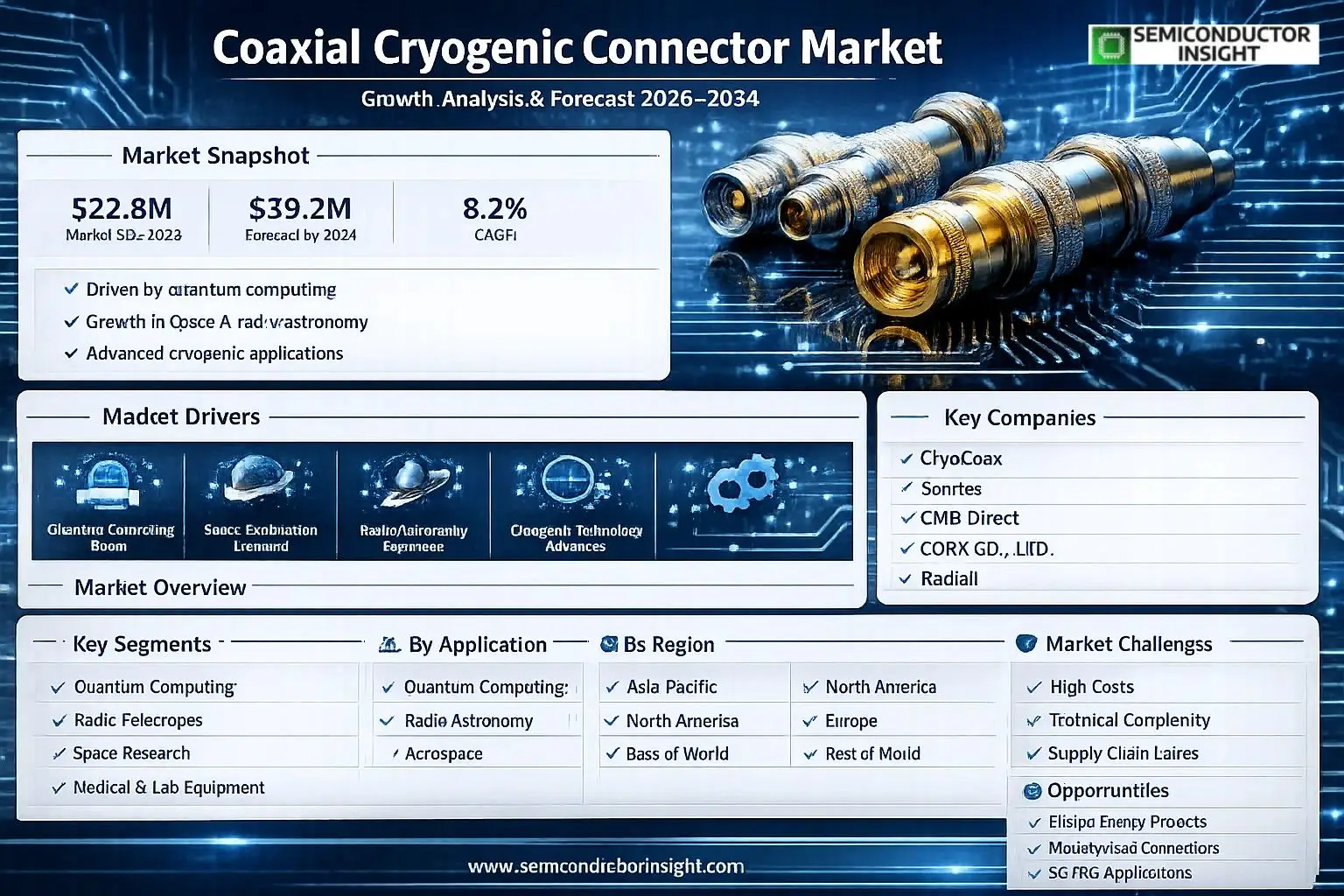
Global Coaxial Cryogenic Connector market size was valued at USD 22.83 million in 2025. The market is projected to grow from USD 24.70 million in 2026 to USD 39.2 million by 2034, exhibiting a CAGR of 8.2% during the forecast period.
Coaxial cryogenic connectors are highly specialized electrical interconnect components engineered to maintain reliable signal transmission and mechanical integrity at extremely low temperatures, typically operating in environments ranging from 4 Kelvin down to near absolute zero. These connectors are designed to accommodate the thermal contraction and material stress inherent to cryogenic conditions, utilizing materials such as stainless steel, beryllium copper, and PTFE-based dielectrics. The product range includes Male/Plug and Female/Jack configurations, catering to precision RF and microwave signal routing in thermally demanding systems.
The market is witnessing robust growth driven by the accelerating global investment in quantum computing infrastructure, expanding radio astronomy programs, and increasing deployment of cryogenic systems in space exploration. Quantum computing, in particular, has emerged as a dominant demand driver, as superconducting qubit architectures require large arrays of cryogenic-compatible coaxial connections operating at millikelvin temperatures. Furthermore, government-backed space agencies and private aerospace companies are scaling up cryogenic payload development, further broadening the addressable market. Leading manufacturers such as CryoCoax, Samtec, CMR-Direct, COAX CO., LTD., Radiall, Phoenix, KEYCOM, and Ardent Concepts are actively innovating to meet the stringent performance and reliability requirements of these end-use applications.
MARKET DRIVERS
Advancements in Quantum Computing and Superconductivity
Coaxial Cryogenic Connector Market is propelled by rising demand in quantum computing applications, where reliable low-temperature signal transmission is essential. Superconducting qubits require connectors that maintain signal integrity at temperatures below 4K, driving innovation in high-frequency performance. Global investments in quantum tech, exceeding $30 billion annually, underscore this trend.
Growth in Medical and Scientific Instrumentation
Expansion of MRI systems and particle accelerators further boosts the market, as these rely on cryogenic coaxial connectors for precise RF signal handling in superconducting magnets. The medical imaging sector alone contributes significantly, with over 40 million MRI scans performed yearly worldwide, necessitating durable cryogenic interfaces.
➤ Key Driver: Aerospace and Space Exploration initiatives are accelerating adoption, with NASA’s cryogenic tech programs projecting a 12% annual increase in demand through 2028.
Additionally, aerospace applications in satellite communications and propulsion systems emphasize the need for lightweight, vacuum-compatible connectors, fostering market growth amid a projected CAGR of 9.5% for the sector.
MARKET CHALLENGES
Technical Complexity in Design and Testing
Maintaining low thermal leakage and high electrical performance at cryogenic temperatures poses significant hurdles in Coaxial Cryogenic Connector Market. Engineers face challenges in material selection, such as niobium-titanium alloys, which must endure repeated thermal cycling without degradation.
Other Challenges
Supply Chain Vulnerabilities
Rare earth materials and specialized fabrication processes lead to extended lead times, impacting scalability. Geopolitical tensions exacerbate shortages, delaying projects in high-stakes fields like fusion research.
Competition from alternative interconnect technologies, including fiber optics for cryogenics, pressures manufacturers to innovate while managing R&D costs averaging 15-20% of revenue.
MARKET RESTRAINTS
High Manufacturing and Material Costs
Premium materials like gold-plated contacts and cryogenic insulators drive up production expenses in Coaxial Cryogenic Connector Market, limiting accessibility for smaller enterprises. Fabrication in cleanroom environments adds to the burden, with unit costs often surpassing $500 for high-end models.
Strict quality assurance standards, including helium leak testing and RF characterization at millikelvin levels, extend development timelines and inflate operational overheads.
Market penetration is further restrained by the niche nature of applications, where end-users prioritize proven reliability over cost reductions, slowing broader commercialization efforts.
MARKET OPPORTUNITIES
Emerging Quantum and Fusion Energy Sectors
Coaxial Cryogenic Connector Market stands to benefit from quantum computing scaling, with companies like IBM and Google expanding dilution refrigerator deployments requiring advanced multi-channel connectors. Fusion energy projects, such as ITER, open avenues for high-power RF handling at extreme lows.
Miniaturization trends enable integration into compact quantum sensors, projected to grow at 15% CAGR by 2030, while 5G/6G backhaul in cryogenic environments presents untapped potential.
Strategic partnerships with research institutions can accelerate standardization, enhancing interoperability and market share in the evolving superconducting ecosystem.
Coaxial Cryogenic Connector Market Trends
Quantum Computing Driving Demand
Coaxial Cryogenic Connector Market is witnessing accelerated growth propelled by the rapid expansion of quantum computing technologies. These connectors, essential for maintaining signal integrity in cryogenic environments below 4 Kelvin, support superconducting qubits and quantum processors. As leading research labs and corporations scale up quantum systems, demand surges for reliable male/plug and female/jack variants that minimize thermal noise and ensure low insertion loss. This trend underscores the market’s alignment with next-generation computing paradigms, where precision connectivity at extreme low temperatures is paramount.
Other Trends
Expansion in Radio Astronomy and Space Sectors
Coaxial cryogenic connectors play a pivotal role in radio astronomy, enabling ultra-sensitive receivers for deep-space signal detection through integration with low-noise amplifiers cooled to cryogenic levels. In the space sector, they facilitate instruments on satellites and deep-space probes, enduring launch vibrations while preserving performance in vacuum conditions. This dual application fosters innovation in durable, high-frequency designs, broadening Coaxial Cryogenic Connector Market footprint across scientific and aerospace domains as global observatories upgrade and space missions proliferate.
Evolving Competitive Landscape
Key players including CryoCoax, Samtec, CMR-Direct, COAX CO., LTD., Radiall, Phoenix, KEYCOM, and Ardent Concepts dominate Coaxial Cryogenic Connector Market, with the top five holding a substantial revenue share. These firms are intensifying R&D for enhanced product types and applications, alongside strategic expansions into high-growth regions like North America and Asia. Mergers, new launches, and customized solutions address challenges such as thermal management and miniaturization, shaping a dynamic ecosystem responsive to industry drivers like quantum advancements and space exploration needs.
COMPETITIVE LANDSCAPE
Key Industry Players
Top Manufacturers Shaping Coaxial Cryogenic Connector Market
Coaxial Cryogenic Connector Market is characterized by a concentrated structure dominated by a handful of specialized manufacturers, with the global top five players holding a significant revenue share in 2025. CryoCoax emerges as the leading player, renowned for its innovative cryogenic RF solutions tailored for quantum computing, radio astronomy, and space applications. This leadership stems from CryoCoax’s extensive portfolio of high-performance connectors operating at millikelvin temperatures, supported by robust R&D investments. The market, valued at US$22.83 million in 2025 and projected to reach US$39.2 million by 2034 at a CAGR of 8.2%, reflects an oligopolistic landscape where established firms leverage technical expertise and supply chain integration to maintain barriers to entry, particularly in niche segments like male/plug and female/jack types.
Beyond the frontrunners, several niche players contribute meaningfully through specialized offerings and regional strengths, fostering innovation in applications such as quantum computing and space exploration. Companies like Samtec and Radiall provide versatile cryogenic connector solutions with strong adoption in research institutions, while CMR-Direct and COAX CO., LTD. focus on custom low-loss designs for radio astronomy. Emerging competitors including Ardent Concepts, Phoenix, and KEYCOM are gaining traction via advanced materials and miniaturization, addressing challenges in signal integrity at cryogenic temperatures. This diverse ecosystem drives competitive dynamics, with mergers, acquisitions, and partnerships influencing market shares amid growing demand in North America, Europe, and Asia-Pacific regions.
List of Key Coaxial Cryogenic Connector Companies Profiled
- CryoCoax
- Samtec
- CMR-Direct
- COAX CO., LTD.
- Radiall
- Phoenix
- KEYCOM
- Ardent Concepts
- Teledyne Reynolds
- Douglas Electrical Components
- Southwest Research Institute
- Millimeter Wave Products Inc.
- UI-See Inc.
- Cryomagnetics
Segment Analysis:
| Segment Category | Sub-Segments | Key Insights |
| By Type |
|
Male / Plug
|
| By Application |
|
Quantum Computing
|
| By End User |
|
Research Institutions
|
| By Material |
|
Beryllium Copper
|
| By Frequency Range |
|
DC to 18 GHz
|
Regional Analysis: Coaxial Cryogenic Connector Market
North America
North America’s edge in Coaxial Cryogenic Connector Market arises from pioneering low-loss materials and precision engineering. Innovations in multi-pin configurations and vacuum-tight designs cater to quantum computing needs, enhancing signal fidelity at millikelvin temperatures. Research institutions drive hybrid connector solutions blending coaxial and fiber optics for versatile cryogenic setups.
Dominant uses span superconducting magnets in medical imaging and high-energy physics experiments. Aerospace cryogenic systems for propulsion testing rely on these connectors for robust thermal management. Growing quantum technology integration expands opportunities, with North America at the forefront of practical deployments in research and commercial prototypes.
A mature ecosystem ensures availability of cryogenic-grade components, from insulators to plating. Local fabrication reduces lead times, supporting custom orders for specialized frequencies. Strategic partnerships with material suppliers bolster resilience, minimizing disruptions in the North American Coaxial Cryogenic Connector Market.
Substantial funding from government agencies and venture capital fuels cryogenic connector evolution. Focus areas include scalability for industrial cryostats and compatibility with dilution refrigerators. This influx sustains innovation pipelines, reinforcing North America’s pivotal role in global market leadership.
Europe
Europe exhibits strong growth in Coaxial Cryogenic Connector Market, anchored by world-class research facilities like CERN and leading particle physics collaborations. Demand surges from large-scale accelerators and fusion energy projects requiring high-reliability cryogenic interfaces. Medical sector applications in advanced MRI and NMR spectroscopy drive adoption of specialized connectors withstanding repeated thermal shocks. European firms emphasize sustainability through eco-friendly materials and efficient manufacturing processes. Collaborative EU-funded initiatives accelerate standardization, enhancing interoperability across borders. Aerospace and defense sectors contribute via satellite thermal management systems. The region’s skilled engineering talent pool supports customization for niche cryogenic applications, positioning Europe as a hub for precision-engineered solutions in Coaxial Cryogenic Connector Market.
Asia-Pacific
Asia-Pacific emerges as a dynamic force in Coaxial Cryogenic Connector Market, fueled by rapid industrialization and expanding R&D in quantum technologies and semiconductors. Japan and China lead with investments in superconducting infrastructure for high-speed rail and data centers requiring cryogenic cooling. Growing medical device manufacturing boosts need for cost-effective, high-performance connectors. Local production capabilities lower barriers to entry, fostering innovation in compact designs for portable cryostats. Government-backed initiatives in fusion research and space programs amplify demand. Supply chain localization enhances accessibility, while partnerships with global players transfer advanced cryogenic expertise, propelling the region’s ascent in this specialized market.
South America
South America presents emerging potential in Coaxial Cryogenic Connector Market, primarily through nascent research in biotechnology and energy sectors. Brazil’s growing focus on superconducting applications in power grids and medical facilities sparks initial demand. Limited infrastructure challenges adoption, but international collaborations introduce advanced connector technologies. Aerospace ventures in satellite development offer incremental opportunities. Educational institutions drive skill development, laying groundwork for localized manufacturing. Strategic imports bridge gaps, with emphasis on durable solutions for harsh environmental conditions, gradually building market presence in cryogenic applications.
Middle East & Africa
The Middle East & Africa region shows preliminary development in Coaxial Cryogenic Connector Market, centered on oil and gas cryogenic processes and budding scientific research. Gulf nations invest in LNG facilities requiring robust low-temperature connections, alongside quantum computing pilots. Africa’s research universities explore superconductivity for sustainable energy. Challenges include import dependencies and skill shortages, yet strategic alliances with established suppliers foster growth. Defense and space initiatives in select countries heighten interest in reliable cryogenic interfaces, marking a foundational phase for expanded regional engagement.
Report Scope
This market research report provides a comprehensive analysis of Coaxial Cryogenic Connector Market, covering the forecast period 2026–2034. It offers detailed insights into market dynamics, technological advancements, competitive landscape, and key trends shaping the industry.
Key focus areas of the report include:
- Market Overview: The report begins with an overview outlining its current market scenario, key growth indicators, and industry transformation drivers. It discusses macroeconomic factors, demand–supply balance, regulatory landscape, and the strategic role of Coaxial Cryogenic Connectors in powering advancements across industries such as quantum computing, radio astronomy, space, and scientific research.
- Market Size & Forecast: Historical data and future projections for revenue, unit shipments, and market value across major regions and segments.
- Segmentation Analysis: Detailed breakdown by product type, technology, application, and end-user industry to identify high-growth segments and investment opportunities.
- Regional Insights: Insights into market performance across North America, Europe, Asia-Pacific, Latin America, and the Middle East & Africa, including country-level analysis where relevant.
- Competitive Landscape: Profiles of leading market participants, including their product offerings, R&D focus, manufacturing capacity, pricing strategies, and recent developments such as mergers, acquisitions, and partnerships.
- Technology Trends & Innovation: Assessment of emerging technologies, integration of AI/IoT, semiconductor design trends, fabrication techniques, and evolving industry standards.
- Market Drivers & Restraints: Evaluation of factors driving market growth along with challenges, supply chain constraints, regulatory issues, and market-entry barriers.
- Stakeholder Insights: Insights for component suppliers, OEMs, system integrators, investors, and policymakers regarding the evolving ecosystem and strategic opportunities.
Primary and secondary research methods are employed, including interviews with industry experts, data from verified sources, and real-time market intelligence to ensure the accuracy and reliability of the insights presented.
FREQUENTLY ASKED QUESTIONS:
What is the current market size of Coaxial Cryogenic Connector Market?
-> Global Coaxial Cryogenic Connector market was valued at USD 22.83 million in 2025 and is projected to reach USD 39.2 million by 2034, at a CAGR of 8.2% during the forecast period.
Which key companies operate in Coaxial Cryogenic Connector Market?
-> Key players include CryoCoax, Samtec, CMR-Direct, COAX CO., LTD., Radiall, Phoenix, KEYCOM, Ardent Concepts, among others.
What are the key growth drivers?
-> Key growth drivers include demand from quantum computing, radio astronomy, and space applications, along with advancements in cryogenic technologies and industry trends.
Which region dominates the market?
-> North America, particularly the U.S., holds significant market share, while Asia, including China, is expected to show strong growth.
What are the emerging trends?
-> Emerging trends include innovations in Male/Plug and Female/Jack types, expansion in quantum computing and space segments, and developments by key manufacturers.

Get Sample Report PDF for Exclusive Insights
Report Sample Includes
- Table of Contents
- List of Tables & Figures
- Charts, Research Methodology, and more...
 Download Sample Report PDF