
CMOS Digital Isolators Market Insights
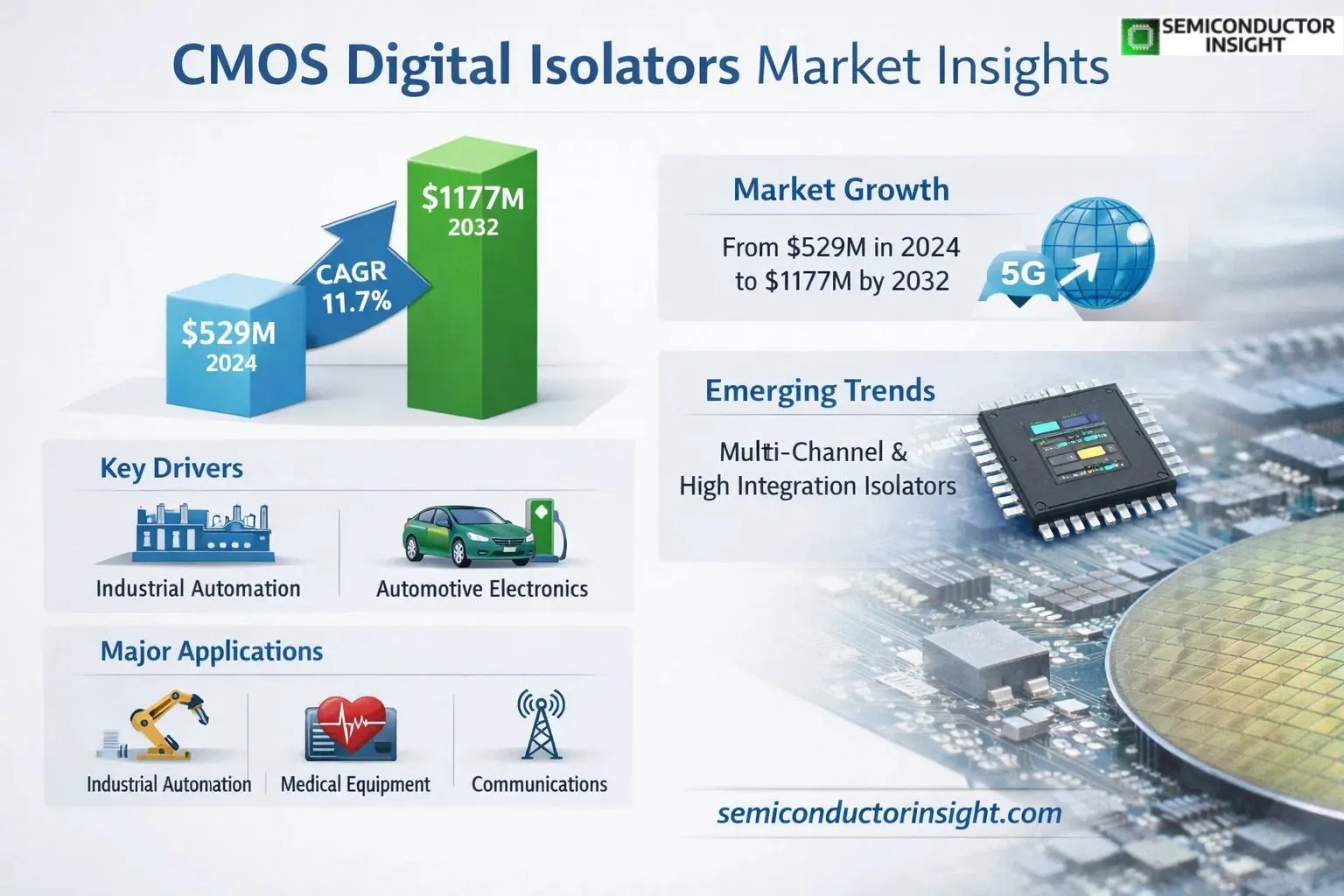
Global CMOS Digital Isolators market was valued at USD 529 million in 2024. The market is projected to grow from USD 592 million in 2025 to USD 1,177 million by 2032, exhibiting a CAGR of 11.7% during the forecast period.
CMOS digital isolators are high-performance electrical isolation devices manufactured using Complementary Metal-Oxide-Semiconductor (CMOS) technology, designed to isolate and transmit digital signals. Compared with traditional optocouplers, CMOS digital isolators offer advantages such as smaller size, faster data transmission, lower power consumption, higher reliability, and stronger resistance to interference. These isolators typically utilize capacitive or magnetic coupling to achieve signal isolation and are widely used in industrial automation, automotive electronics, medical equipment, and communication systems.
The market is experiencing rapid growth due to increasing demand for efficient isolation solutions in sectors such as industrial automation and automotive electronics. Furthermore, advancements in IoT applications and the expansion of 5G infrastructure are accelerating adoption. Key players like Texas Instruments, Analog Devices, and Infineon Technologies are driving innovation with multi-channel and high-integration designs to meet evolving industry requirements.
MARKET DRIVERS
Rising Demand for Robust Noise Immunity in Industrial Automation
The expansion of Industry 4.0 and smart factories is a primary driver for the CMOS Digital Isolators Market. These components are critical for protecting sensitive control circuitry from high-voltage transients and ground loop currents prevalent in harsh industrial environments. The superior common-mode transient immunity (CMTI) offered by CMOS-based isolators, often exceeding 100 kV/µs, ensures reliable data transfer in motor drives, PLCs, and robotic systems. This reliability is paramount for maintaining operational efficiency and safety.
Accelerated Adoption in Electric Vehicles and Charging Infrastructure
The global push towards electrification in the automotive sector is creating substantial demand. CMOS digital isolators are extensively used in battery management systems (BMS), onboard chargers (OBC), and traction inverters within electric vehicles (EVs). They provide the necessary high-voltage isolation between the battery pack and the low-voltage control domain, ensuring both functional safety and compliance with stringent automotive standards like ISO 26262. Furthermore, the deployment of EV charging stations relies on these isolators for safe and efficient power conversion.
➤ Integration of advanced CMOS processes enables higher data rates, lower power consumption, and smaller form factors, making them ideal for space-constrained and power-sensitive applications.
The trend towards miniaturization and higher integration across all electronics sectors further fuels market growth. Compared to traditional optocouplers, CMOS digital isolators offer a significantly smaller footprint, higher reliability, and better performance stability over temperature and time, which is crucial for modern compact designs in consumer electronics, medical devices, and communication systems.
MARKET CHALLENGES
Navigating Complex and Evolving Safety Standards
Manufacturers in the CMOS Digital Isolators Market face the ongoing challenge of designing products that comply with a complex web of international safety standards, such as UL, VDE, CSA, and CQC. These standards govern isolation voltage, creepage, and clearance distances, and they frequently undergo updates. Achieving and maintaining certifications across different geographical regions requires significant investment in testing and qualification, which can delay time-to-market and increase development costs.
Other Challenges
Price Sensitivity in High-Volume Consumer Segments
While CMOS technology offers cost advantages at scale, the market remains highly competitive, especially for high-volume consumer applications. Competing on price with older isolation technologies and low-cost alternatives pressures profit margins, demanding continuous innovation in manufacturing efficiency.
Thermal Management in High-Density Designs
As power densities increase in applications like server power supplies and compact motor drives, managing heat dissipation through the isolator’s package becomes a critical design challenge. Ensuring long-term reliability under high thermal stress requires sophisticated packaging solutions and materials.
MARKET RESTRAINTS
Economic Volatility and Supply Chain Constraints
Global economic uncertainties and fluctuations in semiconductor demand can lead to uneven growth patterns for the CMOS Digital Isolators Market. Furthermore, the industry is susceptible to supply chain disruptions affecting the availability of raw materials and fab capacity. Such constraints can lead to increased lead times and component shortages, hindering the ability of manufacturers to meet customer demand promptly and potentially stalling product development cycles for end-users.
Design Inertia and Legacy System Integration
A significant restraint is the reluctance to redesign existing systems that currently utilize established isolation technologies like optocouplers. Engineers often face hurdles related to footprint compatibility, differing supply voltages, and validation requirements when attempting to replace legacy components with modern CMOS digital isolators. This design inertia slows down the adoption rate in mature markets and long-lifecycle industrial equipment.
MARKET OPPORTUNITIES
Expansion in Renewable Energy and Energy Storage Systems
The global transition to renewable energy sources presents a significant growth avenue for the CMOS Digital Isolators Market. These isolators are essential components in solar inverters, wind turbine converters, and grid-scale battery energy storage systems (BESS). They ensure safe and reliable operation by providing galvanic isolation between high-power circuits and control systems, a critical requirement for managing the variable and high-voltage nature of renewable power generation.
Proliferation of 5G and Advanced Telecommunications Infrastructure
The rollout of 5G networks and the modernization of telecommunications infrastructure create robust opportunities. CMOS digital isolators are used in base station power supplies, network servers, and data center equipment to protect sensitive digital signal processors and controllers from power surges and noise. The demand for higher bandwidth and network reliability directly correlates with the need for more advanced and robust isolation solutions.
Advancements in Medical Electronics and Patient Monitoring
The medical electronics sector offers promising opportunities, driven by the increasing adoption of portable diagnostic equipment, wearable health monitors, and advanced patient monitoring systems. CMOS digital isolators are critical for meeting the stringent safety standards (e.g., IEC 60601-1) for patient protection, ensuring complete galvanic isolation between the patient-connected side and the main processing unit. The trend towards telehealth and connected medical devices further amplifies this demand.
CMOS Digital Isolators Market Trends
Accelerated Market Growth Driven by Displacement of Optocouplers
The global CMOS Digital Isolators market, valued at $529 million in 2024, is on a trajectory to reach $1,177 million by 2032, representing a compound annual growth rate (CAGR) of 11.7%. This robust expansion is primarily fueled by the widespread displacement of traditional optocouplers. CMOS digital isolators offer superior advantages including significantly smaller size, faster data transmission speeds, lower power consumption, and higher reliability, making them the preferred isolation solution in modern electronic systems. The inherent benefits of CMOS technology are driving adoption across critical sectors, solidifying the market’s upward trend.
Other Trends
Evolution Towards Multi-Channel and High-Integration Designs
A key trend shaping the CMOS Digital Isolators Market is the shift towards multi-channel and highly integrated products. As systems in industrial automation, automotive, and communications become more complex, there is a growing demand for isolators that can handle multiple signal paths within a single package. Multi-channel digital isolators optimize board space and reduce overall system cost. High-integration designs enhance system reliability by minimizing component count and simplifying the design process, which is crucial for meeting the performance requirements of next-generation applications.
Expansion Fueled by 5G, IoT, and Green Energy Applications
The proliferation of new technologies is a major driver for the CMOS Digital Isolators Market. The deployment of 5G infrastructure, the exponential growth of the Internet of Things (IoT), and the global push for renewable energy and energy storage systems are creating substantial demand. These applications require the high-speed, low-power, and robust isolation that CMOS digital isolators provide. Furthermore, the trend towards intelligent features, such as built-in self-diagnosis and fault detection capabilities, is gaining traction, adding value and meeting the demands of smart manufacturing and automated systems.
COMPETITIVE LANDSCAPEKey Industry Players
A Market Shaped by Technological Innovation and Strategic Positioning
The CMOS digital isolators market is characterized by intense competition, with dominance exercised by established global semiconductor leaders. Skyworks Solutions, Broadcom, and Texas Instruments are pivotal players, leveraging their extensive portfolios, significant R&D investments, and strong supply chain relationships to capture a substantial market share. Their products are critical across high-growth sectors like industrial automation, automotive electronics, and communications infrastructure. The competitive structure is further complicated by ongoing technological transitions, as these major players actively drive the shift from traditional optocouplers to advanced CMOS-based solutions, emphasizing higher integration, multi-channel capabilities, and enhanced reliability to meet evolving application demands.
Beyond the top-tier giants, the landscape includes a diverse array of significant niche and regional specialists. Companies such as NVE Corporation and Würth Elektronik focus on specialized coupling technologies and magnetic components, carving out strong positions in specific application areas. Concurrently, the market is witnessing the rapid ascent of several key Chinese manufacturers, including NOVOSENSE Microelectronics, 3PEAK, and Shanghai Chipanalog Microelectronics. These companies are increasingly competitive, offering cost-effective alternatives and securing growing market presence, particularly within the expansive Asia-Pacific region, thereby adding a dynamic layer of regional competition to the global market structure.
List of Key CMOS Digital Isolators Companies Profiled
- Skyworks Solutions
- Broadcom
- Texas Instruments
- Analog Devices
- Infineon
- Renesas Electronics
- Onsemi
- NVE Corporation
- Würth Elektronik
- Vicor
- STMicroelectronics
- Toshiba
- NOVOSENSE Microelectronics
- 2Pai Semiconductor
- Shanghai Chipanalog Microelectronics
Segment Analysis:
| Segment Category | Sub-Segments | Key Insights |
| By Type |
|
Multi-Channel Digital Isolators are leading, driven by the demand for greater system integration and space optimization in modern electronics.
|
| By Application |
|
Industrial Automation represents the most significant application segment, driven by the relentless push for smarter, safer, and more connected manufacturing environments.
|
| By End User |
|
Original Equipment Manufacturers (OEMs) are the dominant end users, as they integrate CMOS digital isolators directly into their final products across various industries.
|
| By Isolation Technology |
|
Capacitive Coupling is a leading isolation technology, favored for its excellent performance in high-speed data transmission applications and robust integration capabilities.
|
| By Performance Tier |
|
High-Speed / High-Performance isolators are leading the market, driven by the escalating demand for rapid data transfer in advanced applications like 5G infrastructure and automotive ADAS.
|
Regional Analysis: CMOS Digital Isolators Market
The region’s dominance is anchored by its unparalleled semiconductor manufacturing infrastructure. Leading foundries and assembly facilities enable rapid prototyping and high-volume production of CMOS digital isolators. A mature supply chain for raw materials and components reduces lead times and costs, providing a significant competitive advantage. This ecosystem supports both local demand and global exports.
A massive wave of industrial automation across China, Japan, and South Korea is a primary growth driver. The adoption of Industry 4.0 standards and smart manufacturing practices increases the need for reliable signal isolation in programmable logic controllers, motor drives, and robotic systems, directly boosting demand for high-performance CMOS digital isolators.
Government-led pushes for clean energy and electric mobility create substantial opportunities. The proliferation of solar and wind farms requires sophisticated power conversion systems where CMOS digital isolators are critical for safety and noise immunity. Similarly, the booming electric vehicle market demands advanced battery management and charging infrastructure, further propelling market growth.
Local manufacturers excel at driving down costs while incorporating advanced features, making CMOS digital isolators accessible for a wider range of applications. This focus on value engineering, combined with significant investments in R&D for higher integration and better performance, ensures the region remains a hub for both innovation and cost-effective production.
North America
North America represents a highly advanced and mature market for CMOS digital isolators, characterized by stringent safety regulations and early adoption of cutting-edge technologies. The region, particularly the United States, has a strong presence of leading semiconductor companies and aerospace and defense contractors that demand high-reliability components. The well-established automotive industry’s shift towards electric and autonomous vehicles is a significant driver, requiring robust isolation solutions for battery systems and advanced driver-assistance systems (ADAS). Furthermore, the continuous modernization of the power grid and investments in data centers and telecommunications infrastructure contribute to steady demand. The market is defined by a focus on high-performance, ruggedized isolators that meet rigorous quality standards for industrial, medical, and military applications.
Europe
The European CMOS Digital Isolators Market is propelled by its strong industrial base and ambitious green energy initiatives. The region’s automotive sector, with giants in Germany and France, is rapidly electrifying, creating substantial demand for isolators in vehicle powertrains and charging stations. Strict industrial safety norms and the push for energy efficiency in manufacturing processes underpin the adoption of advanced isolation technologies. Europe’s leadership in renewable energy, especially wind power, necessitates reliable power conversion systems where CMOS digital isolators are essential components. The presence of several major industrial automation suppliers also fuels the market, with a focus on precision and reliability in harsh industrial environments, ensuring sustained growth.
South America
The South American market for CMOS digital isolators is in a growth phase, driven by gradual industrial modernization and infrastructure development. Brazil is the largest market in the region, with its industrial and automotive sectors showing increasing interest in adopting automation technologies. The expansion of renewable energy projects, particularly in wind and solar power, presents emerging opportunities for isolation components. While the market is smaller compared to other regions, it benefits from the global trend of digitalization in industrial controls. The adoption rate is influenced by economic conditions, but the long-term outlook is positive as industries seek to improve efficiency and safety, creating a gradually expanding base for CMOS digital isolator applications.
Middle East & Africa
The Middle East & Africa region exhibits nascent but promising growth potential for the CMOS Digital Isolators Market. The growth is primarily driven by infrastructure development, particularly in the Gulf Cooperation Council (GCC) countries, where investments in smart city projects, power generation, and oil & gas automation are increasing. The region’s focus on diversifying economies away from oil is leading to investments in manufacturing and industrial sectors, which will subsequently drive demand for industrial control systems requiring isolation. In Africa, urbanisation and the gradual development of the industrial and energy sectors create a foundation for future market expansion. The market is currently characterized by specific project-driven demand rather than broad-based adoption.
Report Scope
This market research report provides a comprehensive analysis of the CMOS Digital Isolators market, covering the forecast period 2024–2032. It offers detailed insights into market dynamics, technological advancements, competitive landscape, and key trends shaping the industry.
Key focus areas of the report include:
- Market Overview: The report begins with an overview outlining its current market scenario, key growth indicators, and industry transformation drivers. It discusses macroeconomic factors, demand–supply balance, regulatory landscape, and the strategic role of digital isolators in industries such as industrial automation, automotive electronics, medical equipment, and communications.
- Market Size & Forecast: Historical data and future projections for revenue, unit shipments, and market value across major regions and segments.
- Segmentation Analysis: Detailed breakdown by product type, technology, application, and end-user industry to identify high-growth segments and investment opportunities.
- Regional Insights: Insights into market performance across North America, Europe, Asia-Pacific, Latin America, and the Middle East & Africa, including country-level analysis where relevant.
- Competitive Landscape: Profiles of leading market participants, including their product offerings, R&D focus, manufacturing capacity, pricing strategies, and recent developments such as mergers, acquisitions, and partnerships.
- Technology Trends & Innovation: Assessment of emerging technologies like multi-channel isolators, high integration designs, and intelligent features for self-diagnosis.
- Market Drivers & Restraints: Evaluation of factors driving market growth along with challenges, supply chain constraints, regulatory issues, and market-entry barriers.
- Stakeholder Insights: Insights for component suppliers, OEMs, system integrators, investors, and policymakers regarding the evolving ecosystem and strategic opportunities.
Primary and secondary research methods are employed, including interviews with industry experts, data from verified sources, and real-time market intelligence to ensure the accuracy and reliability of the insights presented.
FREQUENTLY ASKED QUESTIONS:
What is the current market size of CMOS Digital Isolators?
-> Global CMOS Digital Isolators market was valued at USD 529 million in 2024 and is expected to reach USD 1177 million by 2032.
What is the expected CAGR for CMOS Digital Isolators market?
-> The market is projected to grow at a CAGR of 11.7% during 2024-2032.
Which key companies operate in CMOS Digital Isolators market?
-> Key players include Skyworks Solutions, Broadcom, Texas Instruments, Analog Devices, Infineon, Renesas Electronics, and STMicroelectronics, among others.
What are the key growth drivers?
-> Key growth drivers include increasing demand in industrial automation and automotive electronics, replacement of optocouplers, IoT expansion, and 5G base station deployment.
What are the major application areas?
-> Major applications include industrial automation, medical equipment, automotive electronics, and communication systems.
What are the emerging technology trends?
-> Emerging trends include multi-channel designs, high integration, intelligent isolators with self-diagnosis, and sustainable solutions.
Get Sample Report PDF for Exclusive Insights
Report Sample Includes
- Table of Contents
- List of Tables & Figures
- Charts, Research Methodology, and more...
 Download Sample Report PDF





