Ceramic Vacuum Interrupter for Circuit Breaker Market Insights
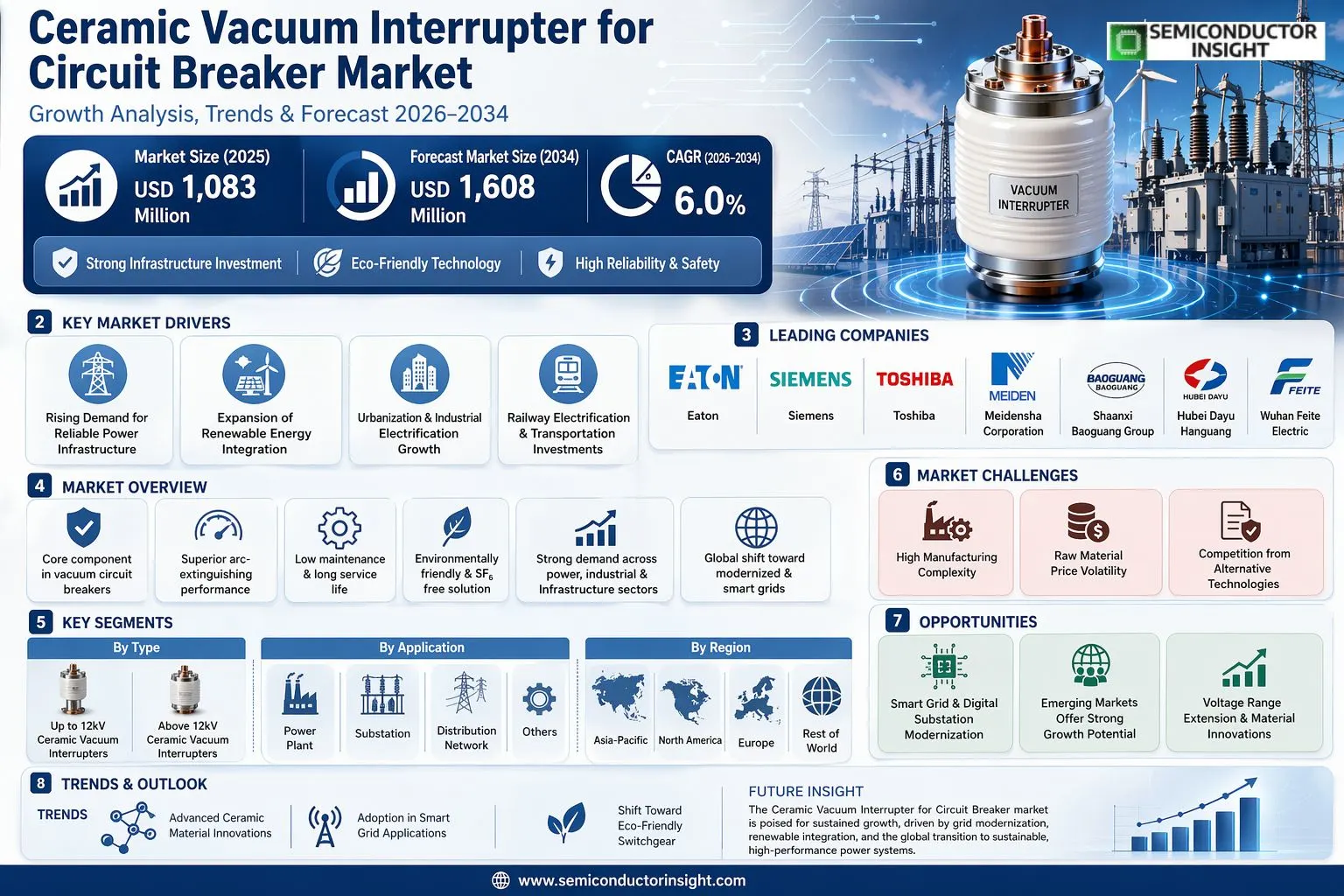
Global Ceramic Vacuum Interrupter for Circuit Breaker market size was valued at USD 1,083 million in 2025. The market is projected to grow from USD 1,148 million in 2026 to USD 1,608 million by 2034, exhibiting a CAGR of 6.0% during the forecast period.
Ceramic vacuum interrupters are core components used in circuit breakers within power systems, specially designed to safely interrupt circuits under high voltage and high current conditions. Each unit consists of a vacuum-sealed shell made of advanced ceramic material enclosing an arc-extinguishing chamber, which houses movable and fixed contacts capable of reliably extinguishing arcs in a vacuum environment. This ceramic-based construction offers superior dielectric strength, thermal stability, and long operational life compared to conventional interrupter technologies.
The market is gaining steady momentum driven by accelerating investments in grid modernization, expanding electricity transmission and distribution infrastructure, and Global push toward reliable and low-maintenance switching equipment. Eaton, Siemens, Toshiba, Meidensha Corporation, and Shaanxi Baoguang Group Co., Ltd. are among the key players operating in the market, collectively accounting for a significant share of global revenue in 2025. Other notable manufacturers include HUBEI DAYU HANGUANG VACUUM ELECTRIC CO., LTD., Wuhan Feite Electric Co., Ltd., Zhejiang Volcano Electrical Technology Co., Ltd., Xiamen Hongfa Electroacoustic Co., Ltd., and Chengdu Xuguang Electronics Co., Ltd., contributing to a competitive and innovation-driven market landscape.
MARKET DRIVERS
Rising Demand for Reliable Power Infrastructure Fueling Growth in Ceramic Vacuum Interrupter for Circuit Breaker Market
Global Ceramic Vacuum Interrupter for Circuit Breaker Market is experiencing sustained growth, driven primarily by increasing investments in electricity transmission and distribution infrastructure across emerging and developed economies. Governments worldwide are prioritizing grid modernization initiatives to reduce transmission losses and improve power reliability, directly elevating demand for high-performance vacuum interrupters encased in ceramic envelopes. Ceramic-based vacuum interrupters are preferred in medium-voltage circuit breakers due to their superior dielectric strength, thermal stability, and long operational lifespan compared to glass counterparts.
Expansion of Renewable Energy Integration Accelerating Adoption of Advanced Circuit Breaker Components
The rapid integration of renewable energy sources such as wind and solar into national grids is creating significant demand for switching devices capable of handling variable and intermittent power flows. Ceramic vacuum interrupters used in circuit breakers offer reliable arc-quenching performance under such dynamic load conditions, making them a critical component in substations and distribution networks connected to renewable generation assets. Global push toward decarbonization and clean energy transition is therefore acting as a strong structural driver for this market.
➤ Urbanization and industrial expansion across Asia-Pacific, particularly in China and India, continue to be among the most significant demand catalysts for Ceramic Vacuum Interrupter for Circuit Breaker Market, as both nations are investing heavily in smart grid infrastructure and industrial electrification programs.
Additionally, the industrial sector’s growing reliance on uninterrupted power supply for manufacturing operations, data centers, and process industries is compelling facility operators and utilities to adopt medium-voltage switchgear equipped with ceramic vacuum interrupters. Their maintenance-free design and ability to perform tens of thousands of switching operations without contact degradation make them particularly attractive for critical applications where downtime carries significant economic consequences.
MARKET CHALLENGES
High Manufacturing Precision Requirements Posing Technical and Cost-Related Challenges for Market Participants
One of the foremost challenges facing Ceramic Vacuum Interrupter for Circuit Breaker Market is the complexity and precision required in the manufacturing process. Producing ceramic envelopes with exact dimensional tolerances, achieving hermetic sealing between ceramic and metal components, and maintaining consistent vacuum levels within the interrupter assembly demands advanced manufacturing capabilities and rigorous quality control protocols. These technical requirements limit the number of qualified manufacturers globally and create significant barriers to entry for new participants attempting to compete in this specialized segment.
Other Challenges
Raw Material Price Volatility
The ceramic vacuum interrupter manufacturing process relies on high-purity alumina ceramics and specialized contact materials such as copper-chromium alloys. Fluctuations in the prices of these raw materials can compress profit margins for manufacturers, particularly smaller producers who lack the economies of scale to absorb input cost variability. This challenge is compounded by supply chain disruptions that have affected specialty materials procurement across the broader electronics and electrical components industry.
Competition from Alternative Technologies
While ceramic vacuum interrupters hold a dominant position in medium-voltage circuit breaker applications, they face competitive pressure from SF6 (sulfur hexafluoride) gas-insulated switchgear in certain high-voltage segments. Although environmental regulations are increasingly restricting SF6 use, the transition timelines vary by region, creating a period of technological competition that may affect the pace of ceramic vacuum interrupter adoption in specific market segments.
MARKET RESTRAINTS
Stringent Quality Standards and Certification Requirements Limiting Market Scalability
Ceramic Vacuum Interrupter for Circuit Breaker Market is subject to rigorous international standards including IEC 62271 and ANSI/IEEE C37 series, which govern the performance, testing, and safety requirements of vacuum interrupters used in medium-voltage switchgear. Compliance with these standards necessitates extensive type testing, routine testing, and traceability documentation, all of which increase time-to-market and add to product development costs. Manufacturers operating in multiple geographies must navigate differing regional certification requirements, further constraining operational agility and scalability.
Capital-Intensive Production Infrastructure Constraining Market Entry and Capacity Expansion
Establishing or expanding production capacity for ceramic vacuum interrupters requires substantial capital investment in specialized kilns for ceramic sintering, vacuum brazing furnaces, and advanced leak-detection equipment. The high upfront capital expenditure associated with building or upgrading manufacturing facilities acts as a restraint on capacity expansion, particularly for mid-sized companies facing tight financing conditions. This infrastructure intensity also contributes to relatively long lead times for new production lines, limiting the market’s ability to respond rapidly to demand surges driven by large-scale grid expansion projects.
MARKET OPPORTUNITIES
Smart Grid Modernization Programs Creating Significant Expansion Opportunities for Ceramic Vacuum Interrupter Manufacturers
National smart grid modernization programs across North America, Europe, and Asia-Pacific represent a substantial long-term opportunity for Ceramic Vacuum Interrupter for Circuit Breaker Market. Utilities are increasingly deploying intelligent switchgear systems embedded with communication and monitoring capabilities, and ceramic vacuum interrupters , owing to their reliability and compact form factor , are well-positioned as a core switching element in these next-generation systems. The integration of digital sensors with vacuum interrupter assemblies to enable real-time condition monitoring and predictive maintenance is an emerging area of product development that could create meaningful differentiation and value-added revenue streams for manufacturers.
Growing Electrification of Transportation and Industrial Sectors Opening New Application Frontiers
The accelerating electrification of rail transport, electric vehicle charging infrastructure, and heavy industries such as mining and steel production is expanding the addressable application base for ceramic vacuum interrupters used in circuit breakers. These sectors require robust, arc-resistant switching components capable of operating reliably under demanding electrical and environmental conditions , characteristics that align closely with the performance profile of ceramic vacuum interrupters. As electric mobility infrastructure scales globally, traction substations and high-power charging depots are expected to become a growing end-use segment, offering manufacturers a diversified demand base beyond traditional utility applications.
Regulatory Phase-Out of SF6 Technology Presenting a Strategic Window for Ceramic Vacuum Interrupter Market Penetration
Regulatory frameworks in the European Union and other jurisdictions are progressively restricting the use of SF6 gas in electrical switchgear due to its extremely high global warming potential. This regulatory trajectory is creating a strategic substitution opportunity for Ceramic Vacuum Interrupter for Circuit Breaker Market, as vacuum-based switching technology is recognized as one of the primary environmentally responsible alternatives. Manufacturers that invest in extending the voltage range and interrupting capacity of ceramic vacuum interrupters to address applications currently served by SF6 switchgear stand to capture significant incremental market share as utilities and industrial operators transition their installed base to compliant technologies over the coming decade.
Trends
Growing Demand for Reliable Arc-Extinguishing Solutions Driving Ceramic Vacuum Interrupter for Circuit Breaker Market
Ceramic Vacuum Interrupter for Circuit Breaker Market is experiencing sustained growth driven by the expanding need for reliable, high-performance switching components across global power infrastructure. Ceramic vacuum interrupters serve as core components within circuit breakers, engineered specifically to interrupt high-voltage and high-current circuits in a vacuum-sealed ceramic enclosure. Their ability to reliably extinguish arcs in a vacuum environment positions them as critical elements in modern power systems. Increasing investments in grid modernization, power generation capacity additions, and the expansion of transmission and distribution networks across Asia, North America, and Europe are collectively reinforcing demand for these components. Key manufacturers such as Eaton, Siemens, Toshiba, and Meidensha Corporation continue to advance product designs to meet evolving voltage and current handling requirements.
Other Trends
Shift Toward Higher Voltage Ratings and Enhanced Ceramic Enclosure Technology
One of the prominent trends shaping Ceramic Vacuum Interrupter for Circuit Breaker Market is the accelerating shift toward higher voltage-rated interrupters suited for transmission-level applications. Power utilities and industrial operators are increasingly requiring interrupters capable of handling demanding switching conditions while maintaining long service life. Advancements in ceramic arc-extinguishing chamber design, including improvements in contact material composition and vacuum sealing technology, are enabling manufacturers to offer products with enhanced dielectric strength and reduced maintenance requirements. Companies such as Wuhan Feite Electric, Zhejiang Volcano Electrical Technology, and Shaanxi Baoguang Group are actively developing next-generation ceramic envelope designs to address these evolving technical specifications.
Expanding Applications Across Power Plants, Substations, and Distribution Networks
Application diversity remains a key trend within Ceramic Vacuum Interrupter for Circuit Breaker Market. Demand is rising consistently across three primary end-use segments: power plants, substations, and distribution networks. Substation upgrades undertaken by utilities in emerging and developed economies are generating considerable procurement volumes. Simultaneously, the proliferation of distributed energy resources and renewable power installations is increasing the complexity of distribution networks, necessitating more frequent and reliable switching operations. This operational environment is directly elevating the requirement for ceramic vacuum interrupters that can sustain repetitive switching cycles without performance degradation.
Asia-Pacific Leading Regional Demand with China at the Forefront
From a regional perspective, Asia-Pacific represents the most dynamic market for ceramic vacuum interrupters, with China accounting for a substantial share of global consumption. Ongoing investments in urban power grid expansion, rural electrification programs, and industrial infrastructure development across China, India, and Southeast Asia are driving procurement volumes. Domestic Chinese manufacturers including HUBEI DAYU HANGUANG VACUUM ELECTRIC CO., LTD., Xiamen Hongfa Electroacoustic Co., Ltd., and Wenzhou Baoyu Electromechanical Co., Ltd. are scaling manufacturing capacities to capture both domestic and export market opportunities. The competitive landscape in Ceramic Vacuum Interrupter for Circuit Breaker Market is therefore intensifying, with both global and regional players investing in product quality, certification compliance, and supply chain resilience to strengthen their market positions.
COMPETITIVE LANDSCAPE
Key Industry Players
Ceramic Vacuum Interrupter for Circuit Breaker Market , Global Competitive Dynamics and Leading Manufacturer Insights
Global Ceramic Vacuum Interrupter for Circuit Breaker market is characterized by a moderately consolidated competitive landscape, with a handful of multinational corporations and a growing cohort of specialized regional manufacturers vying for market share. As of 2025, the market was valued at approximately USD 1,083 million and is projected to reach USD 1,608 million by 2034, expanding at a CAGR of 6.0% over the forecast period. The top five global players collectively account for a significant portion of total market revenue, underscoring the influence of scale, technological capability, and established distribution networks. Industry leaders such as Eaton and Siemens leverage their extensive global footprints, robust R&D investments, and vertically integrated supply chains to maintain competitive advantages across key application segments including power plants, substations, and distribution networks. Toshiba and Meidensha Corporation similarly command strong positions in the Asia-Pacific region, capitalizing on rising grid modernization initiatives and increasing demand for reliable medium-voltage switching equipment.
Beyond the multinational leaders, Ceramic Vacuum Interrupter for Circuit Breaker Market features a dynamic tier of niche and regionally significant Chinese manufacturers that have gained considerable traction over recent years. Companies such as HUBEI DAYU HANGUANG VACUUM ELECTRIC CO., LTD., Wuhan Feite Electric Co., Ltd., Zhejiang Volcano Electrical Technology Co., Ltd., Xiamen Hongfa Electroacoustic Co., Ltd., Wenzhou Baoyu Electromechanical Co., Ltd., Shaanxi Baoguang Group Co., Ltd., and Chengdu Xuguang Electronics Co., Ltd. have expanded their production capacities and product portfolios to address both domestic and export markets. China, as one of the largest consumers and producers of ceramic vacuum interrupters, remains a critical battleground for competition, with local players offering cost-competitive solutions tailored to the ≤12kV and >12kV voltage segments. These manufacturers are increasingly investing in product innovation, quality certifications, and strategic partnerships to challenge established global incumbents and capture growing demand from emerging economies across Southeast Asia, the Middle East, and Africa.
List of Key Ceramic Vacuum Interrupter for Circuit Breaker Companies Profiled
- Eaton
- HUBEI DAYU HANGUANG VACUUM ELECTRIC CO., LTD.
- Wuhan Feite Electric Co., Ltd.
- Zhejiang Volcano Electrical Technology Co., Ltd.
- Xiamen Hongfa Electroacoustic Co., Ltd.
- Siemens
- Toshiba
- Wenzhou Baoyu Electromechanical Co., Ltd.
- Meidensha Corporation
- Shaanxi Baoguang Group Co., Ltd.
- Chengdu Xuguang Electronics Co., Ltd.
Segment Analysis:
| Segment Category | Sub-Segments | Key Insights |
| By Type |
|
12kV and Above Ceramic Vacuum Interrupters represent the leading segment in Ceramic Vacuum Interrupter for Circuit Breaker Market, driven by the widespread adoption of medium and high voltage power infrastructure across global energy networks.
|
| By Application |
|
Substation emerges as the dominant application segment for Ceramic Vacuum Interrupters in circuit breakers, underpinned by the critical role substations play in regulating and protecting high-voltage transmission networks worldwide.
|
| By End User |
|
Electric Utilities and Power Generation Companies constitute the leading end user segment for Ceramic Vacuum Interrupters, as these organizations operate large-scale transmission and distribution networks that demand reliable, high-performance circuit protection solutions.
|
| By Voltage Rating |
|
Medium Voltage (1kV – 35kV) ceramic vacuum interrupters lead this segmentation tier, as medium voltage switchgear remains the most widely deployed category across power distribution systems globally.
|
| By Installation Type |
|
Retrofit and Replacement installation represents an increasingly dominant and strategically important segment within Ceramic Vacuum Interrupter for Circuit Breaker Market, reflecting Global imperative to modernize aging power infrastructure.
|
Regional Analysis: Ceramic Vacuum Interrupter for Circuit Breaker Market
Asia-Pacific hosts a highly integrated supply chain for ceramic vacuum interrupter production, from raw material sourcing to precision component assembly. Leading manufacturers in China and Japan leverage advanced ceramics technology and economies of scale to supply both domestic and global markets. This manufacturing depth ensures consistent product quality and timely delivery, reinforcing the region’s competitive advantage in Ceramic Vacuum Interrupter for Circuit Breaker Market.
Rapid grid modernization programs and large-scale renewable energy integration across China, India, and Southeast Asia are generating sustained demand for high-performance ceramic vacuum interrupters. These components are critical for ensuring reliable switching operations in grids handling variable power flows from solar and wind installations, making them indispensable in the region’s evolving energy infrastructure landscape.
Accelerating urbanization and industrial expansion across the Asia-Pacific region are creating new demand centers for medium and high-voltage circuit breakers incorporating ceramic vacuum interrupter technology. The rapid growth of manufacturing zones, data centers, and metropolitan infrastructure in emerging economies requires dependable arc-interruption solutions, directly supporting market expansion for ceramic vacuum interrupters throughout the forecast period.
Favorable government policies, substantial public investment in electricity infrastructure, and active promotion of domestic electrical equipment manufacturing are creating a supportive environment for Ceramic Vacuum Interrupter for Circuit Breaker Market in Asia-Pacific. Regulatory frameworks mandating higher safety and reliability standards in power distribution networks are further incentivizing utilities and industrial operators to adopt advanced ceramic vacuum interrupter-based solutions.
North America
North America represents a mature yet steadily evolving market for ceramic vacuum interrupters used in circuit breakers. The United States leads regional demand, driven by ongoing efforts to upgrade aging transmission and distribution infrastructure and the widespread integration of distributed energy resources into the grid. Utilities across the country are prioritizing resilience and reliability, creating consistent demand for advanced switching technologies including ceramic vacuum interrupters. Canada contributes to regional growth through its expanding renewable energy sector and industrial electrification programs. The North American ceramic vacuum interrupter for circuit breaker market benefits from a strong regulatory environment that enforces stringent grid reliability standards, compelling operators to invest in proven, high-performance components. The presence of established switchgear manufacturers and a culture of technological innovation further support steady market advancement across the region through 2034.
Europe
Europe occupies a significant position in Global ceramic vacuum interrupter for circuit breaker market, underpinned by the region’s ambitious energy transition agenda and comprehensive grid decarbonization strategies. Countries including Germany, France, the United Kingdom, and the Nordic nations are investing heavily in offshore and onshore wind energy, solar power, and cross-border grid interconnections, all of which require reliable medium-voltage switching equipment incorporating ceramic vacuum interrupter technology. European manufacturers are renowned for engineering excellence and adherence to rigorous international standards, producing ceramic vacuum interrupters that command premium market positioning. The region’s focus on sustainability and circular economy principles is also influencing product development, encouraging manufacturers to innovate in material efficiency and lifecycle performance. Strong aftermarket service networks and replacement cycles in aging utility infrastructure further sustain healthy demand across Europe’s ceramic vacuum interrupter for circuit breaker market.
South America
South America presents a developing but increasingly promising market for ceramic vacuum interrupters in circuit breaker applications. Brazil, the region’s largest economy, leads in market activity, supported by ongoing investments in power generation capacity , particularly hydroelectric and wind energy , and ongoing efforts to expand and modernize its transmission network. Chile and Colombia are also emerging as noteworthy markets, driven by their growing renewable energy sectors and improving regulatory frameworks for grid reliability. While the region’s market growth is tempered by economic volatility and infrastructure funding challenges, international development financing and public-private partnerships are supporting power sector upgrades. As South American nations prioritize energy access and industrial development, the demand for dependable ceramic vacuum interrupter-based circuit breakers is expected to grow progressively over the coming years.
Middle East & Africa
The Middle East and Africa region represents an emerging frontier for Ceramic Vacuum Interrupter for Circuit Breaker Market, characterized by large-scale infrastructure investments and expanding electrification programs. Gulf Cooperation Council countries, particularly Saudi Arabia and the UAE, are channeling significant resources into diversifying their power generation mix with solar and other renewables, necessitating advanced grid equipment including ceramic vacuum interrupters. In Africa, electrification drives supported by multilateral development institutions and government programs are gradually building demand for reliable medium-voltage switching solutions. The region faces distinctive challenges including supply chain logistics and local technical expertise gaps; however, growing interest from global switchgear manufacturers and technology transfer initiatives are beginning to address these barriers. Over the forecast period to 2034, the Middle East and Africa are positioned to become progressively important contributors to Global ceramic vacuum interrupter for circuit breaker market.
Report Scope
This market research report provides a comprehensive analysis of Ceramic Vacuum Interrupter for Circuit Breaker Market, covering the forecast period 2026–2034. It offers detailed insights into market dynamics, technological advancements, competitive landscape, and key trends shaping the industry.
Key focus areas of the report include:
- Market Overview: The report begins with an overview outlining its current market scenario, key growth indicators, and industry transformation drivers. It discusses macroeconomic factors, demand–supply balance, regulatory landscape, and the strategic role of ceramic vacuum interrupters in powering advancements across industries such as power plants, substations, distribution networks, and industrial automation.
- Market Size & Forecast: Historical data and future projections for revenue, unit shipments, and market value across major regions and segments.
- Segmentation Analysis: Detailed breakdown by product type, technology, application, and end-user industry to identify high-growth segments and investment opportunities.
- Regional Insights: Insights into market performance across North America, Europe, Asia-Pacific, Latin America, and the Middle East & Africa, including country-level analysis where relevant.
- Competitive Landscape: Profiles of leading market participants, including their product offerings, R&D focus, manufacturing capacity, pricing strategies, and recent developments such as mergers, acquisitions, and partnerships.
- Technology Trends & Innovation: Assessment of emerging technologies, integration of AI/IoT, semiconductor design trends, fabrication techniques, and evolving industry standards.
- Market Drivers & Restraints: Evaluation of factors driving market growth along with challenges, supply chain constraints, regulatory issues, and market-entry barriers.
- Stakeholder Insights: Insights for component suppliers, OEMs, system integrators, investors, and policymakers regarding the evolving ecosystem and strategic opportunities.
Primary and secondary research methods are employed, including interviews with industry experts, data from verified sources, and real-time market intelligence to ensure the accuracy and reliability of the insights presented.
FREQUENTLY ASKED QUESTIONS:
What is the current market size of Ceramic Vacuum Interrupter for Circuit Breaker Market?
-> Global Ceramic Vacuum Interrupter for Circuit Breaker Market was valued at USD 1083 million in 2025 and is expected to reach USD 1608 million by 2034, growing at a CAGR of 6.0% during the forecast period.
Which key companies operate in Ceramic Vacuum Interrupter for Circuit Breaker Market?
-> Key players include Eaton, HUBEI DAYU HANGUANG VACUUM ELECTRIC CO.,LTD., Wuhan Feite Electric Co.,Ltd., Zhejiang Volcano Electrical Technology Co.,Ltd., Xiamen Hongfa Electoacoustic Co.,Ltd., Siemens, Toshiba, Wenzhou Baoyu Electromechanical Co., Ltd, Meidensha Corporation, Shaanxi Baoguang Group Co.,Ltd., and Chengdu Xuguang Electronics Co., Ltd, among others.
What are the key growth drivers?
-> Key growth drivers include increasing investments in power infrastructure, rising demand for reliable high-voltage circuit protection, expansion of substations and distribution networks, and the growing need for safe arc-extinguishing solutions in power systems.
Which region dominates the market?
-> Asia is a significant region in Ceramic Vacuum Interrupter for Circuit Breaker Market, with China being a major contributor, while North America, including the U.S., also represents a notable market share.
What are the emerging trends?
-> Emerging trends include adoption of advanced ceramic arc-extinguishing technologies, integration of vacuum interrupters in smart grid systems, growing use in renewable energy infrastructure, and increased demand from power plant and substation applications.
Need proxies cheaper than the market?
https://op.wtf

Get Sample Report PDF for Exclusive Insights
Report Sample Includes
- Table of Contents
- List of Tables & Figures
- Charts, Research Methodology, and more...