Carbon Nanotube Semiconductor Market Insights
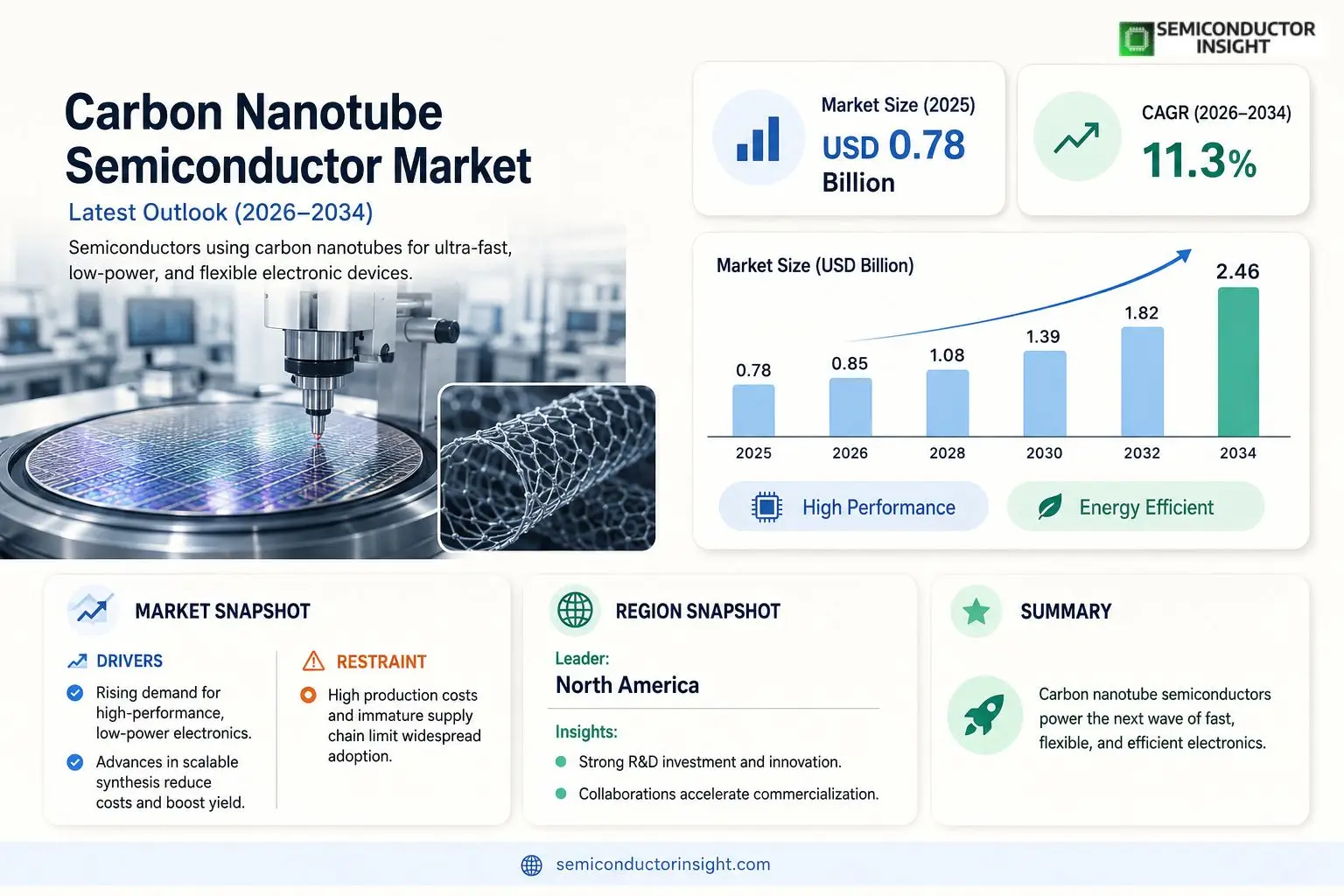
Global Carbon Nanotube Semiconductor market size was valued at USD 0.78 billion in 2025. The market is projected to grow from USD 0.85 billion in 2026 to USD 2.46 billion by 2034, exhibiting a CAGR of 11.3% during the forecast period.
Carbon nanotube semiconductors are ultra‑thin electronic components that leverage the exceptional electrical conductivity, high carrier mobility, and mechanical flexibility of single‑walled or multi‑walled carbon nanotubes. These materials enable next‑generation transistors, flexible displays, and high‑frequency RF devices while offering lower power consumption compared with traditional silicon counterparts.The market is experiencing rapid growth because venture capital funding for nanoelectronics has surged, while demand for wearable IoT devices and high‑performance computing continues to rise. Furthermore, advances in scalable synthesis techniques are reducing production costs, encouraging broader adoption across automotive and aerospace sectors. Leading innovators such as IBM Research, Samsung Electronics, and Intel Corporation are accelerating product rollouts, which further fuels expansion of Carbon Nanotube Semiconductor Market.
MARKET DRIVERS
Rising Demand for High‑Performance Electronics
Carbon Nanotube Semiconductor Market is being propelled by an accelerating appetite for devices that require faster data processing and lower power consumption. Emerging 5G infrastructure, advanced wearables, and next‑generation automotive infotainment systems rely on the superior electron mobility of carbon nanotubes, which translates into significant performance gains over traditional silicon.
Advancements in Manufacturing Techniques
Recent breakthroughs in chemical vapor deposition (CVD) and roll‑to‑roll processing have lowered defect rates and improved yield consistency. These manufacturing improvements enable scalability, allowing larger wafer sizes and reducing the cost barrier that previously limited commercial adoption of carbon nanotube transistors.
➤ “Carbon nanotube platforms now achieve sub‑10 nm channel lengths with reliable repeatability, positioning them as viable successors to silicon in high‑frequency applications.”
Combined, the performance advantages and the maturing production ecosystem create a compelling value proposition for semiconductor manufacturers, driving investment and R&D focus across Carbon Nanotube Semiconductor Market.
MARKET CHALLENGES
Technical Integration Hurdles
Integrating carbon nanotube devices into existing silicon‑based fabrication lines requires substantial redesign of lithography and etching steps. The lack of standardized process modules means many foundries must develop custom tooling, which can delay time‑to‑market and increase capital expenditures.
Other Challenges
Cost Competitiveness
While manufacturing yield is improving, the overall cost per wafer for carbon nanotube semiconductors remains higher than mature silicon processes. This price premium restricts adoption to niche high‑value segments until economies of scale are achieved.
MARKET RESTRAINTS
High Production Costs
Current fab facilities dedicated to carbon nanotube technology entail significant capital outlay for specialized equipment and clean‑room environments. The elevated cost structure limits the ability of smaller players to enter Carbon Nanotube Semiconductor Market, concentrating supply among a few large incumbents.
Limited Supply Chain Maturity
Materials sourcing for high‑purity carbon nanotubes remains fragmented, with few certified suppliers capable of delivering consistent batch quality. This supply‑chain fragility can cause lead‑time variations that hinder large‑scale production planning.
MARKET OPPORTUNITIES
Emerging Applications in Quantum Computing
Quantum processors demand materials with minimal decoherence and exceptional electrical uniformity. Carbon nanotube channels exhibit low defect densities and high carrier velocities, making them attractive candidates for qubit interconnects. Early collaborations between research labs and semiconductor firms are establishing proof‑of‑concept devices, signaling a high‑growth niche within Carbon Nanotube Semiconductor Market.
Expansion into Flexible Electronics
The intrinsic flexibility of carbon nanotube films enables the production of bendable sensors and displays for the Internet of Things (IoT). As consumer demand for wearable health monitors and foldable smartphones rises, manufacturers are exploring nanotube‑based thin‑film transistors as a differentiated technology, opening new revenue streams.Overall, the convergence of performance‑driven demand, emerging high‑value applications, and ongoing cost‑reduction initiatives positions Carbon Nanotube Semiconductor Market for sustained expansion over the next decade.
Carbon Nanotube Semiconductor Market Trends
Scaling Production Reduces Costs
Advances in scalable synthesis techniques are lowering the unit cost of carbon‑nanotube based components. Continuous‐flow chemical vapor deposition and catalyst‑optimized growth processes now enable wafer‑scale production with defect densities below industry thresholds. As a result, automotive manufacturers are beginning pilot programs to replace silicon power transistors with nanotube alternatives, citing projected savings of up to 15 % in energy consumption. Aerospace suppliers are also evaluating the material for lightweight RF front‑ends, where the combination of high carrier mobility and mechanical resilience shortens development cycles while meeting stringent weight targets.
Other Trends
Venture Capital Funding Surge
Venture capital investment in nano‑electronics has risen sharply, with more than $120 million funneled into start‑ups focused on nanotube transistor architectures during the last year. This financial momentum aligns with growing demand for wearable IoT devices that require ultra‑thin, low‑power chips. High‑performance computing platforms are also attracting interest because nanotube channels can operate at frequencies exceeding 300 GHz, delivering performance gains unattainable with conventional silicon. The influx of capital accelerates research timelines, enabling rapid prototype validation and fostering collaborations between academia and industry leaders such as IBM Research, Samsung Electronics, and Intel Corporation.
Emerging Applications in Flexible Displays and RF Devices
Integration of carbon nanotube semiconductors into flexible display backplanes is reshaping the consumer electronics landscape. The material’s inherent bendability allows manufacturers to produce roll‑to‑roll OLED panels that maintain consistent electrical characteristics under repeated stress. Simultaneously, the high‑frequency capability of nanotube transistors is driving next‑generation RF modules for 6G communication trials, where low noise figures and reduced power draw are critical. These application fronts demonstrate how the market is moving beyond laboratory prototypes toward commercial products that exploit both the electrical superiority and physical flexibility of the technology.
COMPETITIVE LANDSCAPEKey Industry Players
Carbon Nanotube Semiconductor Market Competitive Overview
Carbon Nanotube Semiconductor Market is largely shaped by a few technology powerhouses that have integrated carbon‑nanotube (CNT) channels into advanced transistor and sensor platforms. IBM Research leads with its CNT‑FET prototypes that demonstrate high carrier mobility and low power consumption, positioning the firm as a benchmark for scalable nano‑electronics. Samsung Electronics follows closely, leveraging its extensive fab capacity to pilot CNT‑based flexible displays and RF components for 5G devices. Intel Corporation accelerates commercialization through collaborations with academic nanomaterials labs, targeting high‑performance computing chips that can replace silicon in select modules. These three firms dominate the market’s top‑tier segment, drawing significant venture capital and shaping industry standards that dictate material quality, synthesis scalability, and integration pathways.Beyond the headline leaders, a broad set of specialized manufacturers and research‑driven startups enrich the ecosystem. Applied Materials supplies precision deposition equipment essential for uniform CNT growth, while Nantero focuses on CNT‑based memory arrays. Graphenea and Nanocyl provide high‑purity single‑walled carbon nanotubes for semiconductor research. Hitachi and Fujitsu develop niche CNT interconnect solutions for automotive and aerospace electronics. LG, Huawei, and Panasonic are advancing CNT‑enabled flexible sensors for wearable IoT. GlobalFoundries and TSMC explore hybrid integration of CNT channels within traditional silicon processes to bridge legacy fabs with emerging nano‑electronics. This diverse group of niche players enhances supply‑chain resilience and contributes incremental innovations that collectively broaden market adoption.
List of Key Carbon Nanotube Semiconductor Companies Profiled
- IBM Research
- Samsung Electronics
- Intel Corporation
- Applied Materials
- Nantero
- Graphenea
- Nanocyl
- Hitachi
- Fujitsu
- LG Electronics
- Huawei Technologies
- Panasonic
- GlobalFoundries
- TSMC
- ASE Technology Holding
Segment Analysis:
| Segment Category | Sub-Segments | Key Insights |
| By Type |
|
SWCNT Dominance
|
| By Application |
|
Wearable IoT Sensors
|
| By End User |
|
Automotive Integration
|
| By Technology |
|
Bottom‑Up Synthesis Leadership
|
| By Material Form |
|
Printed Ink Form Factor
|
Regional Analysis: North America
North America
North America is driving innovation in carbon nanotube semiconductor technology through dedicated research programs and private sector investments. Focus areas include improving material synthesis techniques, enhancing device performance, and developing scalable manufacturing processes.
Major application areas in North America include flexible electronics, sensors, high-frequency transistors, and energy storage devices. The demand for these applications is growing rapidly, creating a strong market pull for carbon nanotube semiconductors.
Significant venture capital and corporate investments are flowing into the North American carbon nanotube semiconductor sector, supporting the growth of startups and established companies. This influx of capital is facilitating the development of new technologies and the expansion of production capabilities.
The North American supply chain for carbon nanotube semiconductors is evolving, with a mix of domestic manufacturers and international suppliers. Strengthening domestic production capabilities is a key priority for many companies in the region.
United States
The United States represents the largest market within North America for carbon nanotube semiconductors. Its strong focus on semiconductor manufacturing, coupled with substantial government funding for research and development, positions it as a global leader in this field. The presence of numerous universities and research institutions further enhances the country’s innovation ecosystem. The development of advanced packaging technologies is also a significant trend in the US market.
Canada
Canada’s carbon nanotube semiconductor market is steadily growing, driven by government initiatives to foster innovation and support the development of high-tech industries. The country’s strong research capabilities and collaborative environment are attracting investment from both domestic and international players. Key application areas include advanced materials and energy-efficient technologies.
Mexico
Mexico’s carbon nanotube semiconductor market is emerging, benefiting from its proximity to the US and its growing manufacturing sector. The country’s cost-competitiveness and skilled workforce are attracting investment in electronics manufacturing, which is driving demand for advanced semiconductor materials. The focus is currently on supporting the electronics assembly and manufacturing industries with these materials.
Europe
Europe is witnessing a significant increase in interest and investment in Carbon Nanotube Semiconductor Market. Driven by the need for more efficient and powerful electronics, as well as the growing demand for advanced sensors and energy storage devices, the region is actively fostering innovation in this field. Countries like Germany, the UK, and France are leading the way in research and development. Collaborative projects between European universities and industry are playing a crucial role in accelerating the commercialization of carbon nanotube-based solutions.
Asia-Pacific
Asia-Pacific presents a dynamic and rapidly expanding market for Carbon Nanotube Semiconductors. Countries like Japan, South Korea, and China are investing heavily in R&D and manufacturing infrastructure to gain a competitive edge in this emerging field. Strong government policies and substantial private sector investment are fueling growth. The demand is particularly high in the consumer electronics, automotive, and industrial sectors. The region is focused on developing scalable and cost-effective manufacturing processes to meet the growing demand.
Report Scope
This market research report provides a comprehensive analysis of the Carbon Nanotube Semiconductor Market , covering the forecast period 2026–2034. It offers detailed insights into market dynamics, technological advancements, competitive landscape, and key trends shaping the industry.
Key focus areas of the report include:
- Market Overview: The report begins with an overview outlining its current market scenario, key growth indicators, and industry transformation drivers. It discusses macroeconomic factors, demand–supply balance, regulatory landscape, and the strategic role of semiconductors in powering advancements across industries such as automotive, telecommunications, consumer electronics, and industrial automation.
- Market Size & Forecast: Historical data and future projections for revenue, unit shipments, and market value across major regions and segments.
- Segmentation Analysis: Detailed breakdown by product type, technology, application, and end-user industry to identify high-growth segments and investment opportunities.
- Regional Insights: Insights into market performance across North America, Europe, Asia-Pacific, Latin America, and the Middle East & Africa, including country-level analysis where relevant.
- Competitive Landscape: Profiles of leading market participants, including their product offerings, R&D focus, manufacturing capacity, pricing strategies, and recent developments such as mergers, acquisitions, and partnerships.
- Technology Trends & Innovation: Assessment of emerging technologies, integration of AI/IoT, semiconductor design trends, fabrication techniques, and evolving industry standards.
- Market Drivers & Restraints: Evaluation of factors driving market growth along with challenges, supply chain constraints, regulatory issues, and market-entry barriers.
- Stakeholder Insights: Insights for component suppliers, OEMs, system integrators, investors, and policymakers regarding the evolving ecosystem and strategic opportunities.
Primary and secondary research methods are employed, including interviews with industry experts, data from verified sources, and real-time market intelligence to ensure the accuracy and reliability of the insights presented.
FREQUENTLY ASKED QUESTIONS:
What is the current market size of Carbon Nanotube Semiconductor Market?
-> Carbon Nanotube Semiconductor Market was valued at USD 0.78 billion in 2025 and is expected to reach USD 2.46 billion by 2034.
Which key companies operate in Carbon Nanotube Semiconductor Market?
-> Key players include IBM Research, Samsung Electronics, and Intel Corporation, among others.
What are the key growth drivers?
-> Key growth drivers include venture capital funding for nanoelectronics, rising demand for wearable IoT devices and high‑performance computing, and advances in scalable synthesis techniques reducing production costs.
Which region dominates the market?
-> The reference does not specify a dominant regional market.
What are the emerging trends?
-> Emerging trends include scalable synthesis techniques, integration into flexible displays, high‑frequency RF devices, and expanding applications in automotive and aerospace sectors.

Get Sample Report PDF for Exclusive Insights
Report Sample Includes
- Table of Contents
- List of Tables & Figures
- Charts, Research Methodology, and more...
 Download Sample Report PDF