Carbon Film Resistors Market Insights
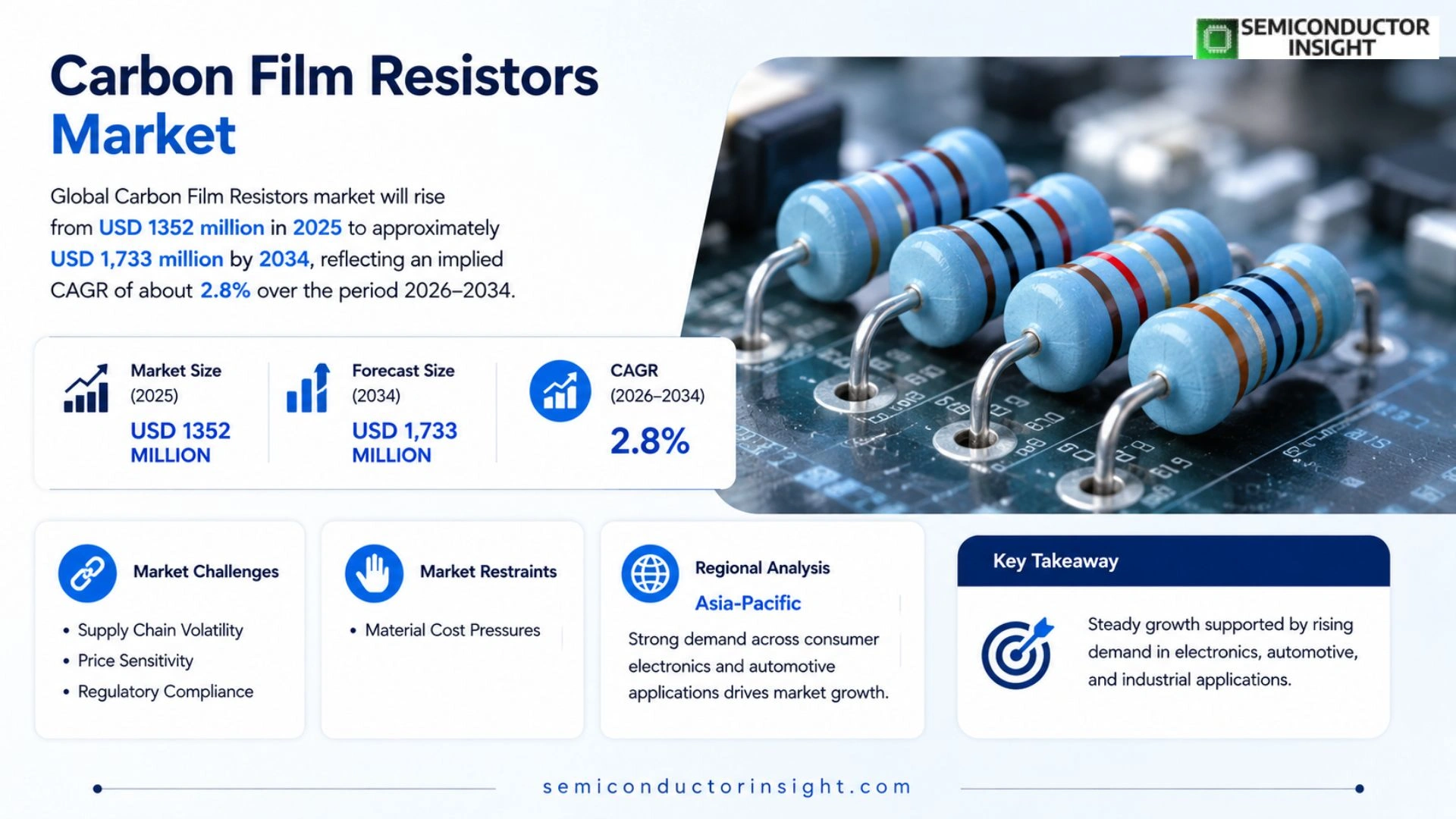
Global Carbon Film Resistors market size was valued at USD 1,352 million in 2025. It will rise from this level in USD 1352 million in 2025 to approximately USD 1,733 million by 2034, reflecting an implied CAGR of about 2.8 % over the period.
Carbon film resistors are fixed resistive components made by depositing a carbon film onto a ceramic substrate and then adjusting the resistance value through a helical cutting process. Their simple construction, low unit cost and wide resistance range keep them prevalent in consumer electronics, industrial control systems, power‑supply units and basic circuitry.
The upstream supply chain comprises raw materials such as ceramic substrates, carbon powders, metal leads and trimming machinery; mid‑stream activities cover film deposition, precision trimming, surface coating and electrical testing; downstream users include consumer‑electronics manufacturers, home‑appliance producers, telecommunications equipment makers and industrial electronics firms.
MARKET DRIVERS
Rising Demand in Automotive Electronics
The shift toward electric‑propulsion and advanced driver‑assistance systems forces automotive OEMs to source components that combine stability with cost‑efficiency. Carbon film resistors, with their tight tolerance and temperature‑coefficient characteristics, match the reliability profile required for power‑train control modules, leading manufacturers to increase their procurement volumes within Carbon Film Resistors Market.
Expansion of Consumer IoT Devices
Smart home hubs, wearable health monitors, and edge‑AI sensors rely on dense printed‑circuit‑board architectures where space and power budgets are limited. The modest footprint and low cost of carbon film technology make it the preferred passive element for these devices, prompting a steady uptick in unit shipments across the market.
➤ Analysts estimate that the adoption of carbon film resistors in automotive and IoT sectors could lift overall market volume by roughly 22 % over the next three years.
Beyond the two headline segments, the broader push for miniaturization in medical diagnostics and industrial instrumentation reinforces the relevance of Carbon Film Resistors Market, as design engineers prioritize components that deliver consistent performance without inflating bill‑of‑materials.
MARKET CHALLENGES
Supply Chain Volatility
Fluctuations in graphite powder availability, coupled with geopolitical tensions affecting logistics routes, have introduced lead‑time unpredictability. End users report that delayed deliveries force buffer inventory creation, which erodes the cost advantage traditionally associated with carbon film devices.
Price Sensitivity in Industrial Applications
Heavy‑duty automation equipment often targets price points below $0.10 per unit. When raw‑material costs rise, manufacturers are compelled to negotiate lower margins or switch to alternative resistor technologies, thereby constraining market expansion.
Other Challenges
Regulatory Compliance
Stringent RoHS and REACH standards require careful screening of additives used in the carbon film formulation. Non‑compliant batches risk costly recalls, prompting tighter quality‑control expenditures that squeeze profitability.
MARKET RESTRAINTS
Material Cost Pressures
The price trajectory of high‑purity carbon and specialty ceramic substrates has shown an upward trend, driven by competing demand from battery manufacturers and semiconductor fabs. As these input costs climb, the margin cushion for carbon film resistors narrows, limiting the ability of producers to invest in capacity upgrades or innovative product variants within Carbon Film Resistors Market.
MARKET OPPORTUNITIES
Emerging High‑Frequency Applications
Next‑generation radio‑frequency front‑ends and small‑cell 5G infrastructure demand passive components with low parasitic inductance. Recent advances in carbon film coating techniques have reduced equivalent series resistance, positioning these resistors as viable candidates for high‑frequency signal paths. Companies that can certify performance at GHz frequencies stand to capture a growing niche that is presently underserved.
Carbon Film Resistors Market Trends
Maturing Market and Volume Expansion
Carbon Film Resistors Market has entered a phase where output levels outpace price movement. In 2025 global production reached roughly 24,667 million units while average unit pricing settled near $0.06, yielding gross margins that sit between 20 % and 32 % for leading manufacturers. Capacity figures,about 32,889 million units,exceed current shipments, indicating that firms retain spare capability to meet occasional spikes in demand. This surplus of manufacturing slack, coupled with thin pricing, signals a transition from rapid expansion to cost‑controlled stability. Companies that can harness the excess capacity to serve niche, higher‑margin segments stand to improve profitability without relying on volume growth alone.
Other Trends
Supply Concentration and Competitive Positioning
Geographic analysis reveals that the supply chain is heavily anchored in Mainland China, Taiwan, Japan, and the United States. Chinese producers dominate the low‑to‑mid resistance range, leveraging scale to keep costs minimal. In contrast, manufacturers in Japan, Europe, and North America concentrate on high‑reliability and industrial‑grade parts, where tolerance specifications and long‑term stability carry premium pricing. This bifurcation forces downstream engineers to weigh cost against performance, and it encourages suppliers in the higher‑end segment to differentiate through stricter quality certifications and extended service agreements.
Application Mix and Margin Landscape
Demand composition has settled into three clear tiers. Consumer electronics continue to generate the largest shipment volumes, but price pressure keeps margins modest. Industrial control and power‑supply circuits provide a steadier demand base, with margins that reflect the balance between reliability needs and cost sensitivity. Medical equipment and high‑end test instrumentation, while representing a smaller share of total units, command the highest profitability due to stringent regulatory standards and the willingness of OEMs to pay for certified performance. For market participants, the strategic implication is to allocate R&D and marketing resources toward applications where margin potential outweighs volume, especially as substitution from metal‑film and thick‑film technologies accelerates in precision‑critical designs.
COMPETITIVE LANDSCAPE
Key Industry Players
Carbon Film Resistors: Competitive Overview
The market is anchored by a handful of large manufacturers that command the bulk of global capacity. Yageo Corporation and Vishay Intertechnology together account for roughly one‑third of total production, leveraging vertically integrated supply chains that span ceramic substrate procurement to final testing. Their scale enables pricing that stays below $0.07 per unit while preserving gross margins in the low‑30 % range. Geographic concentration remains pronounced: Mainland China hosts the majority of low‑to‑mid‑range output, while facilities in Taiwan, Japan and the United States specialize in high‑reliability grades required by aerospace and medical equipment. This bifurcated structure forces midsized entrants to carve out niches either through cost leadership in consumer‑electronics volumes or through precision‑grade offerings that command premium pricing.
Beyond the two titans, a diverse set of specialists sustains the market’s breadth. KOA Corporation and Panasonic Holdings focus on automotive‑grade resistors, emphasizing temperature stability and long‑term durability. TT Electronics and Ohmite Manufacturing excel in power‑supply applications, where tighter tolerance and higher wattage ratings are valued. Stackpole Electronics, Kamaya Electric and Fenghua Advanced Technology serve the telecommunication segment, providing compact form factors for densely packed PCBs. Smaller firms such as Caddock Electronics, MIBA Resistors, UniOhm, Royal Ohm and Taiyo Yuden differentiate through niche product lines,sulfur‑resistant films, miniature resistors for wearable devices, or ultra‑low noise variants for precision instrumentation. Their agility allows rapid response to emerging standards and localized demand spikes, preserving a competitive ecosystem despite the market’s overall maturity.
List of Key Carbon Film Resistors Companies Profiled
- Yageo Corporation
- Vishay Intertechnology
- KOA Corporation
- Panasonic Holdings
- TT Electronics
- Ohmite Manufacturing
- Stackpole Electronics
- Kamaya Electric
- Fenghua Advanced Technology
- Caddock Electronics
- MIBA Resistors
- UniOhm
- Royal Ohm
- Taiyo Yuden
- Murata Manufacturing
Segment Analysis:
| Segment Category | Sub-Segments | Key Insights |
| By Type |
|
Normal Resistor
|
| By Application |
|
Consumer Electronics
|
| By End User |
|
Industrial Control System Providers
|
| By Structure Type |
|
Standard Type
|
| By Power Rating |
|
Low Power (2 W)
|
Regional Analysis: Carbon Film Resistors Market
Asia‑Pacific
The majority of capacity resides in tier‑one foundries in China and Korea, where economies of scale lower per‑unit costs. End‑users benefit from short lead times, while suppliers leverage shared logistics networks to serve adjacent markets efficiently.
R&D labs in Japan and Taiwan prioritize temperature‑coefficient refinement, delivering parts that meet tighter automotive reliability standards without price penalties.
Harmonized safety directives across ASEAN and the Pacific simplify certification, allowing manufacturers to scale offerings across multiple jurisdictions with minimal redesign.
OEMs in consumer electronics emphasize low inductance and consistent tolerance, prompting suppliers to adjust product mixes toward thinner film technologies that preserve performance under high‑frequency operation.
North America
The United States leverages its extensive design talent pool to drive specification upgrades, yet domestic production remains limited. Companies rely on Asian imports, creating a price‑sensitive market where distributors add value through precise inventory management. Growth is anchored in automotive electrification projects that demand reliable, cost‑effective resistors for power‑train control modules. Meanwhile, defense procurement standards impose strict reliability testing, nudging niche suppliers toward higher‑grade carbon film variants. These forces together shape a competitive environment where differentiation hinges on supply reliability and value‑added services rather than raw manufacturing capacity.
Europe
European OEMs prioritize sustainability and traceability, prompting a gradual shift toward suppliers with documented environmental credentials. The market is fragmented, with several mid‑size manufacturers catering to aerospace and industrial automation sectors that require stringent performance envelopes. Regulatory frameworks such as RoHS drive designers to favor carbon film resistors over lead‑based alternatives, reinforcing demand for compliant products. Despite modest volume growth, the region’s emphasis on precision engineering sustains a premium segment where quality assurance outweighs cost considerations.
South America
Brazil and Argentina anchor the South American landscape, where emerging automotive assembly lines and renewable‑energy projects create modest but steady demand. Local distributors often act as intermediaries, consolidating imports from Asia to serve dispersed end‑users. The region faces currency volatility, which squeezes margins for both importers and OEMs. Consequently, buyers gravitate toward standardized resistor families that guarantee consistency across price fluctuations, fostering a market that values reliability and predictability above rapid product evolution.
Middle East & Africa
Infrastructure expansion and data‑center roll‑outs in the Gulf states generate niche opportunities for carbon film resistors in power‑distribution hardware. However, limited in‑region manufacturing means most supply chains are anchored to Asian exporters. In Africa, telecom upgrades and modest automotive growth spur demand, yet procurement processes remain price‑driven. Stakeholders focus on securing uninterrupted supply streams, prompting larger distributors to establish regional warehousing hubs that buffer against global shipping disruptions.
Report Scope
This market research report provides a comprehensive analysis of the Carbon Film Resistors Market , covering the forecast period 2026–2034. It offers detailed insights into market dynamics, technological advancements, competitive landscape, and key trends shaping the industry.
Key focus areas of the report include:
- Market Overview: The report begins with an overview outlining its current market scenario, key growth indicators, and industry transformation drivers. It discusses macroeconomic factors, demand–supply balance, regulatory landscape, and the strategic role of semiconductors in powering advancements across industries such as automotive, telecommunications, consumer electronics, and industrial automation.
- Market Size & Forecast: Historical data and future projections for revenue, unit shipments, and market value across major regions and segments.
- Segmentation Analysis: Detailed breakdown by product type, technology, application, and end-user industry to identify high-growth segments and investment opportunities.
- Regional Insights: Insights into market performance across North America, Europe, Asia-Pacific, Latin America, and the Middle East & Africa, including country-level analysis where relevant.
- Competitive Landscape: Profiles of leading market participants, including their product offerings, R&D focus, manufacturing capacity, pricing strategies, and recent developments such as mergers, acquisitions, and partnerships.
- Technology Trends & Innovation: Assessment of emerging technologies, integration of AI/IoT, semiconductor design trends, fabrication techniques, and evolving industry standards.
- Market Drivers & Restraints: Evaluation of factors driving market growth along with challenges, supply chain constraints, regulatory issues, and market-entry barriers.
- Stakeholder Insights: Insights for component suppliers, OEMs, system integrators, investors, and policymakers regarding the evolving ecosystem and strategic opportunities.
Primary and secondary research methods are employed, including interviews with industry experts, data from verified sources, and real-time market intelligence to ensure the accuracy and reliability of the insights presented.
FREQUENTLY ASKED QUESTIONS:
What is the current market size of Carbon Film Resistors Market?
-> Carbon Film Resistors market size was valued at USD 1,733 million by 2034, reflecting an implied CAGR of about 2.8 %
Which key companies operate in Carbon Film Resistors Market?
-> Key players include Yageo Corporation, Vishay Intertechnology, KOA Corporation, Panasonic Holdings, TT Electronics, Ohmite Manufacturing, Stackpole Electronics, Kamaya Electric, Fenghua Advanced Technology, Caddock Electronics, MIBA Resistors, UniOhm, Royal Ohm.
What are the key growth drivers?
-> Key growth drivers include steady demand from consumer electronics, industrial control systems, and power supply units, alongside cost‑effective production and a wide resistance range of carbon film technology.
Which region dominates the market?
-> Asia dominates the market, with Mainland China leading in low‑to‑mid‑range segments and Japan, Taiwan, and the United States focusing on high‑reliability applications.
What are the emerging trends?
-> Emerging trends include the gradual substitution of carbon film resistors by metal film and thick‑film technologies, while maintaining a niche in low‑cost circuitry and basic electronic products.

Get Sample Report PDF for Exclusive Insights
Report Sample Includes
- Table of Contents
- List of Tables & Figures
- Charts, Research Methodology, and more...
 Download Sample Report PDF