MARKET INSIGHTS
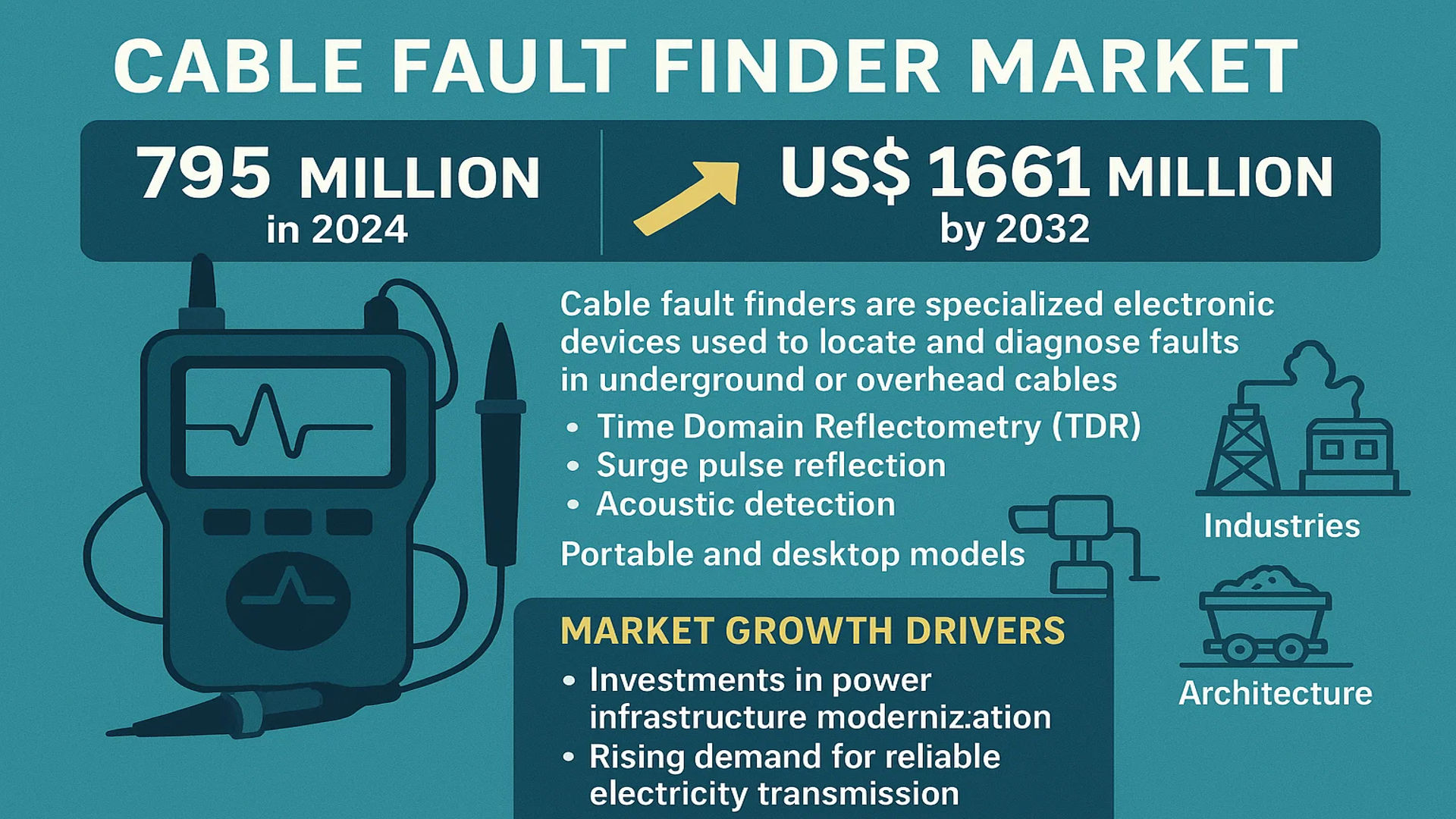
The global Cable Fault Finder Market was valued at 795 million in 2024 and is projected to reach US$ 1661 million by 2032, at a CAGR of 11.4% during the forecast period.
Cable fault finders are specialized electronic devices used to locate and diagnose faults in underground or overhead cables. These instruments employ various technologies such as Time Domain Reflectometry (TDR), surge pulse reflection, and acoustic detection to identify issues like short circuits, open circuits, and insulation breakdowns. The market primarily consists of portable and desktop models, catering to industries like electric power, architecture, and mining.
The market growth is driven by increasing investments in power infrastructure modernization and rising demand for reliable electricity transmission. However, the adoption of wireless monitoring systems presents both a challenge and an opportunity for innovation. Key players including Fluke Corporation, Megger, and 3M are expanding their product portfolios with advanced features like cloud connectivity and AI-powered diagnostics. For instance, in 2023, Fluke introduced the 1625-2 GEO Earth Ground Tester with enhanced fault location accuracy, reflecting the industry’s technological progression.
MARKET DYNAMICS
MARKET DRIVERS
Rising Infrastructure Investments and Grid Modernization to Fuel Market Expansion
Global investments in power infrastructure development and grid modernization projects are driving substantial demand for cable fault finders. With aging electrical networks in developed economies and rapid urbanization in emerging markets, utility companies are prioritizing efficient fault detection solutions to minimize downtime. The global transmission and distribution infrastructure investment is projected to exceed $300 billion annually by 2030, creating significant opportunities for cable diagnostic equipment providers. These tools help maintenance teams quickly locate faults in underground and overhead cables, reducing service interruptions that can cost utilities millions per hour in lost revenue.
Adoption of Smart Grid Technologies Accelerating Market Growth
The integration of smart grid technologies across global power networks is creating robust demand for advanced cable fault detection systems. Modern fault finders with integrated IoT capabilities allow remote monitoring and predictive maintenance, aligning with the operational requirements of next-generation power grids. Utilities adopting these intelligent solutions can achieve up to 40% reduction in cable failure-related outages while improving workforce productivity through data-driven decision making. This technological shift is particularly prominent in regions with ambitious smart city initiatives, where reliability and efficiency are paramount for sustainable urban development.
Stringent Safety Regulations Driving Equipment Upgrades
Increasing regulatory pressure on electrical safety standards is compelling organizations across industries to invest in sophisticated cable fault detection equipment. Recent updates to international electrical codes mandate more frequent testing and documentation of cable insulation integrity, especially in hazardous environments like mining and oil & gas facilities. These requirements are spurring replacement of older test equipment with modern digital fault finders that offer enhanced accuracy and reporting capabilities. The industrial sector currently accounts for over 35% of global cable fault finder sales, with growth expected to accelerate as compliance deadlines approach.
MARKET RESTRAINTS
High Equipment Costs Limiting Adoption Among Small Enterprises
While advanced cable fault finders deliver significant operational benefits, their premium pricing creates adoption barriers for small contractors and developing market utilities. Entry-level portable units typically start above $5,000, while comprehensive diagnostic systems can exceed $50,000—placing them beyond the reach of many budget-constrained organizations. This cost sensitivity is particularly acute in price-driven markets where customers often opt for less sophisticated alternatives despite their limitations. Manufacturers face the challenge of balancing technology development costs with market accessibility to maximize penetration across customer segments.
Other Restraints
Technical Complexity of Modern Cable Networks
The increasing complexity of composite underground cable systems presents diagnostic challenges that strain conventional fault location methods. Modern power networks often incorporate mixed dielectric materials, jointing technologies, and concentric neutrals that require specialized testing approaches. Many existing fault finder models lack the advanced signal processing algorithms needed to accurately interpret these complex cable signatures, potentially leading to undetected faults or false positives that delay repairs.
Skill Gap in Advanced Diagnostic Techniques
Effective utilization of modern cable fault detection equipment requires operators with specialized training in electromagnetic wave propagation and signal analysis. The industry faces a growing shortage of qualified technicians capable of interpreting complex reflectometry results and distinguishing between actual faults and impedance variations. This skills gap is particularly pronounced in developing regions, where the rapid expansion of electrical infrastructure has outpaced workforce training programs.
MARKET OPPORTUNITIES
Integration of AI and Machine Learning Technologies Creating New Prospects
The incorporation of artificial intelligence into cable fault detection systems represents a transformative opportunity for market players. Next-generation analyzers equipped with machine learning algorithms can automatically classify fault types, estimate repair priorities, and predict potential failure points before they occur. These intelligent systems leverage historical test data to continuously improve diagnostic accuracy while reducing interpretation time by up to 70%. Early adopters in utility and industrial sectors are reporting significant improvements in maintenance efficiency and asset lifecycle management through these cognitive capabilities.
Renewable Energy Expansion Driving Specialized Testing Needs
The global transition toward renewable energy infrastructure is creating demand for cable fault finders optimized for solar and wind applications. These environments present unique challenges including longer cable runs, variable loading conditions, and exposure to harsh weather elements that accelerate insulation degradation. Specialized testing solutions capable of evaluating DC collector systems in solar farms or subsea cables for offshore wind installations represent a high-growth niche. Market leaders are developing ruggedized portable units with enhanced moisture detection and partial discharge measurement features to address these emerging requirements.
MARKET CHALLENGES
Standardization Issues Complicate Equipment Selection
The lack of universal standards for cable fault detection methodologies creates confusion in the marketplace, with competing technologies offering different measurement approaches and performance claims. Time Domain Reflectometry (TDR), Arc Reflection, and Impulse Current methods each have specific advantages depending on cable type and fault characteristics, making it difficult for purchasers to evaluate comparative effectiveness. This fragmentation slows procurement decisions and necessitates extensive product demonstrations, particularly among risk-averse public utility operators.
Other Challenges
Data Integration with Asset Management Systems
While modern cable fault finders generate extensive diagnostic data, many organizations struggle to effectively integrate this information with existing asset management platforms. Incompatible file formats, proprietary data structures, and limited API connectivity create silos that prevent comprehensive condition monitoring. This integration challenge is most acute for utilities managing legacy IT infrastructure that lacks the flexibility to incorporate modern diagnostic outputs.
After-Sales Support Requirements
The technical complexity of advanced fault location systems creates substantial aftermarket service demands that strain manufacturer resources. Customers increasingly expect comprehensive training programs, regular software updates, and rapid technical support—requirements that many vendors struggle to meet profitably across global markets. These service expectations are particularly challenging in remote locations where onsite support availability is limited.
CABLE FAULT FINDER MARKET TRENDS
Advancements in Portable and Smart Cable Fault Detection Technologies Drive Market Growth
The global Cable Fault Finder market is witnessing substantial growth, driven primarily by the evolution of portable and smart diagnostic solutions for underground and overhead cable systems. Modern cable fault finders now integrate IoT-enabled sensors, AI-based predictive analytics, and cloud connectivity, significantly reducing downtime in power distribution networks. The rising demand for real-time fault detection in industries such as electric power, mining, and telecommunications has fueled investments in high-precision devices. Manufacturers are focusing on developing compact, battery-operated devices with TDR (Time Domain Reflectometry) and arc reflection technologies, enhancing accuracy in pinpointing cable faults. In 2024, the global market was valued at $795 million, with projections indicating a rise to $1.66 billion by 2032 at a CAGR of 11.4%, reflecting sustained technological adoption.
Other Trends
Growing Infrastructure Modernization in Emerging Economies
Rapid urbanization and expansion of smart grid infrastructure in regions like Asia-Pacific and Latin America are accelerating the deployment of cable fault detectors. Governments are prioritizing power grid reliability through investments in smart city projects, pushing utilities to adopt automated fault location tools. Countries such as China and India are leading the charge, driven by large-scale renewable energy integrations that require robust cable monitoring solutions. Furthermore, the increasing use of underground cabling in metropolitan regions necessitates precision fault detection, reinforcing market growth. Industry reports indicate that China alone accounted for over 30% of total market demand in 2024, with projected spending on infrastructure modernization set to rise by 8% annually through 2030.
Expansion of Energy and Utility Sectors
The global energy transition towards renewable power sources is reshaping the cable fault finder market. Wind and solar farms require extensive underground cabling, increasing the risk of insulation failures and short circuits. As a result, utility companies are investing in advanced diagnostic tools, particularly high-voltage cable testers and portable fault locators. Additionally, aging power infrastructure in North America and Europe is leading to higher replacement cycles, further stimulating demand. In the U.S., for example, an estimated 60% of transmission lines are over 25 years old, necessitating preventative maintenance solutions from industry leaders such as Fluke Corporation and Megger. Meanwhile, the European Commission’s Green Deal is accelerating investments in smart energy infrastructure, fostering innovation in fault detection technologies.
COMPETITIVE LANDSCAPE
Key Industry Players
Technological Advancements and Strategic Expansions Drive Market Competition
The global Cable Fault Finder Market features a competitive yet fragmented landscape, with established multinational corporations and regional players vying for market share. Fluke Corporation maintains a dominant position, commanding significant revenue share due to its comprehensive product portfolio and strong foothold across North America, Europe, and Asia-Pacific. The company’s recent launch of advanced cable fault locators with AI-powered diagnostics has further solidified its market leadership.
Megger and Baur GmbH follow closely, leveraging their decades of expertise in electrical testing solutions. These companies have been investing heavily in R&D to introduce portable cable fault finders with enhanced accuracy and faster response times. Both players have expanded their service networks in emerging markets to capitalize on growing infrastructure development.
Meanwhile, 3M and HV Technologies are making strategic moves through product innovation and mergers & acquisitions. 3M’s recent integration of IoT capabilities into its cable fault detection systems has been particularly well-received in industrial applications. Their emphasis on developing rugged, field-ready equipment has positioned them strongly in the utilities sector.
Emerging players like SCOPE T&M Pvt Ltd and Techno Instrumentation (India) Private Limited are gaining traction with cost-effective solutions tailored for developing economies. These companies are engaging in strategic collaborations with local distributors to expand their geographical footprint while maintaining competitive pricing.
List of Key Cable Fault Finder Companies Profiled
- Fluke Corporation (U.S.)
- Baur GmbH (Austria)
- Megger (U.K.)
- 3M (U.S.)
- SCOPE T&M Pvt Ltd (India)
- Nunes Instruments (U.S.)
- Clinton Instrument (U.S.)
- Alfa Engineering Solutions (Greece)
- Hubbell (U.S.)
- Techno Instrumentation (India) Private Limited (India)
- Fortive (U.S.)
- High Voltage Inc (U.S.)
- HV Technologies (U.S.)
- Transcat (U.S.)
- AMETEK (U.S.)
- Kehui (China)
Segment Analysis:
By Type
Portable Segment Leads the Market Due to High Demand for On-Site Fault Detection
The market is segmented based on type into:
- Portable
- Subtypes: Handheld, Benchtop, and others
- Desktop
By Application
Electric Power Sector Dominates Due to Critical Need for Infrastructure Reliability
The market is segmented based on application into:
- Electric Power
- Architecture
- Mining
- Others
By Technology
Time Domain Reflectometry Gains Prominence for Accurate Fault Location Identification
The market is segmented based on technology into:
- Time Domain Reflectometry (TDR)
- Impulse Current Method
- Armature Burn-off Method
- Others
By End-User
Utility Companies Drive Adoption for Preventive Maintenance Programs
The market is segmented based on end-user into:
- Utility Companies
- Industrial Facilities
- Contractors
- Research Institutes
Regional Analysis: Cable Fault Finder Market
Asia-Pacific
The Asia-Pacific region dominates the global cable fault finder market, driven by rapid urbanization, infrastructure expansion, and government investments in power distribution networks. Countries like China and India are leading the demand, with China accounting for over 35% of the region’s market share due to its extensive power grid modernization initiatives. The focus remains on portable fault detection devices, particularly for utility and industrial applications, as aging underground cable networks require frequent maintenance. Furthermore, Japan and South Korea emphasize advanced fault detection technologies, leveraging AI and IoT integration for predictive maintenance in smart grid projects.
North America
North America holds a significant position in the cable fault finder market, supported by stringent regulatory frameworks and high demand from the energy sector. The U.S. leads the region, with a strong emphasis on non-destructive testing (NDT) technologies and portable cable fault locators, particularly for high-voltage transmission lines. Utility companies prioritize real-time fault detection to minimize downtime, while Canada focuses on upgrading its power infrastructure in remote areas. Major players like Fluke Corporation and Hubbell maintain a strong presence, offering advanced testing solutions tailored to renewable energy integration.
Europe
Europe showcases robust growth in the cable fault finder market, fueled by renewable energy projects and grid digitization. The EU’s Green Deal and initiatives like the ETIP SNET (European Technology & Innovation Platform for Smart Networks) accelerate investments in smart grids, increasing demand for precision fault detection tools. Germany and the U.K. are key adopters, leveraging time-domain reflectometry (TDR)-based devices for underground cable fault localization. Challenges include regulatory compliance with IEC and CENELEC standards, which drive innovation among manufacturers like Megger and Baur GmbH.
South America
South America exhibits steady growth in the cable fault finder market, driven by energy infrastructure projects in Brazil and Argentina. However, economic volatility and limited access to advanced technologies hinder widespread adoption. Portable fault finders dominate the market due to cost-effectiveness, particularly in mining and industrial sectors. Brazil’s power distribution networks increasingly deploy localized fault detection solutions, though reliance on imported equipment remains high.
Middle East & Africa
The Middle East & Africa market is emerging, with countries like Saudi Arabia and the UAE prioritizing grid stability through investments in HV cable testing solutions. The region’s harsh climatic conditions necessitate durable, portable fault finders for outdoor applications. However, growth is constrained by budgetary limitations in African nations and uneven regulatory enforcement. Long-term opportunities lie in urban electrification projects, particularly in GCC countries, where public-private partnerships are driving demand.
Report Scope
This market research report provides a comprehensive analysis of the global Cable Fault Finder market, covering the forecast period 2024–2032. It offers detailed insights into market dynamics, technological advancements, competitive landscape, and key trends shaping the industry.
Key focus areas of the report include:
- Market Size & Forecast: Historical data and future projections for revenue, unit shipments, and market value across major regions and segments. The global Cable Fault Finder market was valued at USD 795 million in 2024 and is projected to reach USD 1661 million by 2032, growing at a CAGR of 11.4%.
- Segmentation Analysis: Detailed breakdown by product type (Portable, Desktop), application (Electric Power, Architecture, Mining, Others), and end-user industry to identify high-growth segments and investment opportunities.
- Regional Outlook: Insights into market performance across North America, Europe, Asia-Pacific, Latin America, and the Middle East & Africa, including country-level analysis where relevant. The U.S. and China are key growth markets.
- Competitive Landscape: Profiles of leading market participants including Fluke Corporation, Baur Gmbh, Megger, 3M, SCOPE T&M Pvt Ltd, among others, with analysis of their product offerings, market share, and recent developments.
- Technology Trends & Innovation: Assessment of emerging technologies in cable fault detection, including advanced diagnostic tools and integration of IoT for predictive maintenance.
- Market Drivers & Restraints: Evaluation of factors driving market growth such as increasing power infrastructure investments, along with challenges like high equipment costs and technical complexities.
- Stakeholder Analysis: Insights for utility providers, industrial operators, equipment manufacturers, and investors regarding the evolving market ecosystem and strategic opportunities.
Primary and secondary research methods are employed, including interviews with industry experts, data from verified sources, and real-time market intelligence to ensure the accuracy and reliability of the insights presented.
FREQUENTLY ASKED QUESTIONS:
What is the current market size of Global Cable Fault Finder Market?
-> Cable Fault Finder Market was valued at 795 million in 2024 and is projected to reach US$ 1661 million by 2032, at a CAGR of 11.4% during the forecast period..
Which key companies operate in Global Cable Fault Finder Market?
-> Key players include Fluke Corporation, Baur Gmbh, Megger, 3M, SCOPE T&M Pvt Ltd, Nunes Instruments, and Hubbell, among others.
What are the key growth drivers?
-> Key growth drivers include rising power infrastructure investments, increasing demand for reliable power supply, and growing adoption of advanced fault detection technologies.
Which region dominates the market?
-> Asia-Pacific is the fastest-growing region, driven by infrastructure development, while North America remains a technologically advanced market.
What are the emerging trends?
-> Emerging trends include integration of AI in fault detection, portable device innovation, and smart grid compatible solutions.

Get Sample Report PDF for Exclusive Insights
Report Sample Includes
- Table of Contents
- List of Tables & Figures
- Charts, Research Methodology, and more...
 Download Sample Report PDF