MARKET INSIGHTS
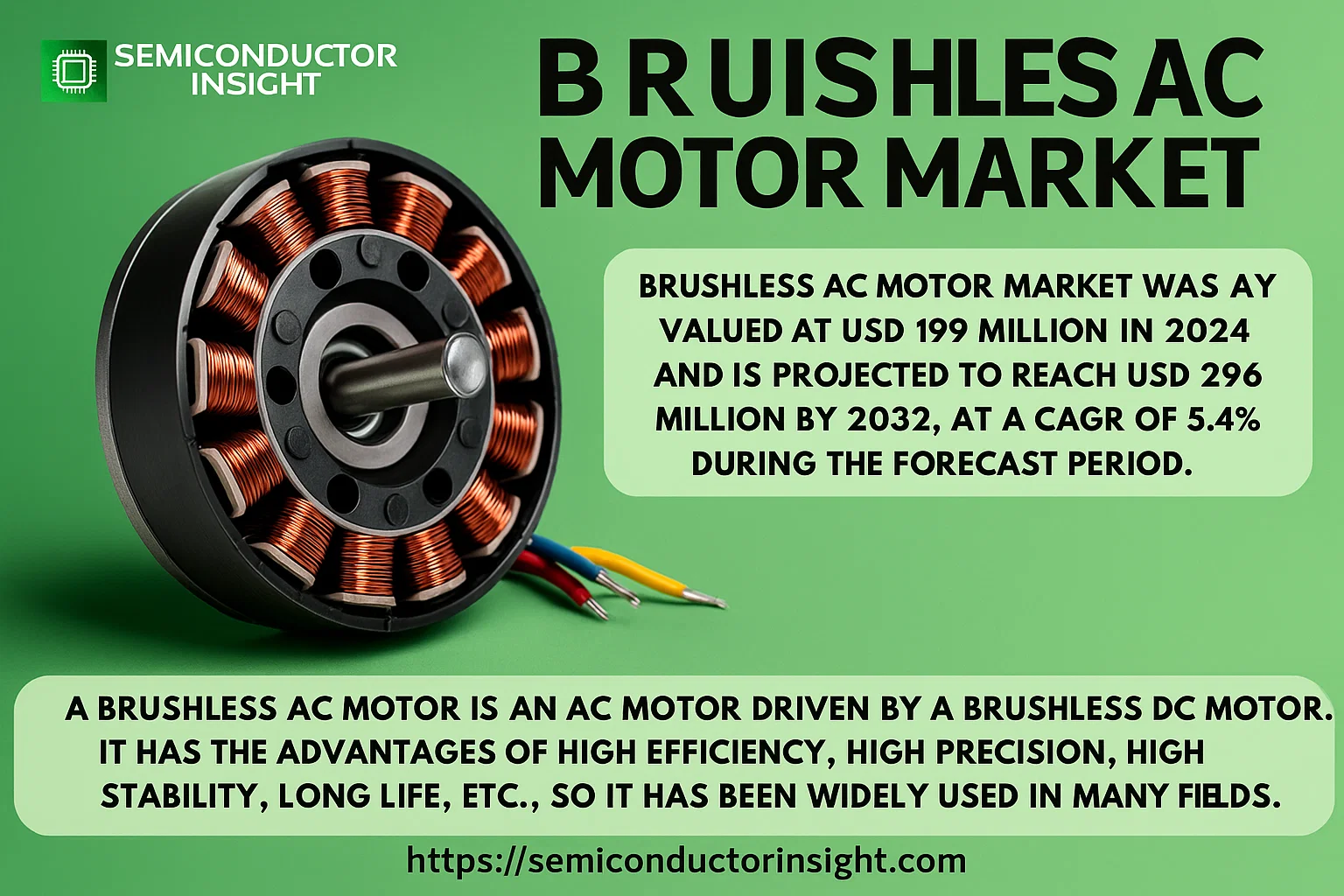
Global Brushless AC Motor Market was valued at USD 199 million in 2024 and is projected to reach USD 296 million by 2032, at a CAGR of 5.4% during the forecast period.
A brushless AC motor is an AC motor driven by a brushless DC motor. It has the advantages of high efficiency, high precision, high stability, long life, etc., so it has been widely used in many fields. The working principle of the brushless AC motor is to use electronic commutation instead of traditional mechanical commutation, thereby avoiding mechanical friction and wear and improving efficiency and stability.
The market is experiencing rapid growth due to several factors, including the increasing demand for energy-efficient motors, the growth of industrial automation, and the expansion of electric vehicle production. Additionally, the rising demand for consumer electronics and medical devices that require precise motion control is contributing to market expansion. Initiatives by the key players in the market are also expected to fuel the market growth. For instance, the continuous investment in research and development by major players like ABB and Nidec is leading to more advanced and cost-effective motor solutions.
MARKET DRIVERS
Rising Demand for Energy-Efficient Motors
The global push for energy conservation is a primary driver for brushless AC motors. Industries are increasingly replacing traditional motors with brushless AC variants, which can improve energy efficiency by up to 30% in applications like HVAC systems, industrial pumps, and fans. This shift is fueled by stringent government regulations and rising electricity costs, compelling companies to adopt more sustainable technologies.
Growth in Industrial Automation and Robotics
The expansion of automation across manufacturing, logistics, and other sectors significantly boosts demand for brushless AC motors. These motors are essential for precision control, high torque, and reliability in robotic arms, CNC machines, and automated guided vehicles. The industrial automation market is projected to grow at a compound annual growth rate of nearly 9%, directly propelling the brushless AC motor market.
➤ The proliferation of electric vehicles (EVs) represents a major catalyst. Brushless AC motors are the preferred technology for EV traction systems due to their high power density, efficiency, and longevity.
Furthermore, advancements in motor control technologies, such as sophisticated variable frequency drives (VFDs), enhance the performance and application range of brushless AC motors, making them suitable for more demanding and precise industrial tasks.
MARKET CHALLENGES
High Initial Cost and System Complexity
A significant challenge facing the brushless AC motor market is the higher initial investment compared to brushed alternatives. The cost includes not only the motor itself but also the essential electronic controllers and drives required for operation. This complexity can deter small and medium-sized enterprises from adopting the technology, despite long-term operational savings.
Other Challenges
Technical Expertise and Maintenance
The sophisticated nature of brushless AC motor systems demands specialized knowledge for installation, programming, and maintenance. A shortage of skilled technicians can lead to increased downtime and higher service costs, posing a barrier to widespread adoption in certain regions.
Supply Chain Vulnerabilities
The market is susceptible to disruptions in the supply of critical raw materials like rare-earth magnets (e.g., neodymium) and semiconductors used in controllers. Geopolitical tensions and trade policies can create price volatility and availability issues, impacting manufacturing consistency and costs.
MARKET RESTRAINTS
Competition from Alternative Motor Technologies
Despite their advantages, brushless AC motors face strong competition from other efficient motor technologies, such as advanced brushed DC motors and switched reluctance motors. In cost-sensitive applications where premium performance is not critical, these alternatives can be more attractive due to their lower upfront cost and simpler control requirements, restraining market growth.
Economic Volatility and Capital Expenditure Cycles
Capital investment in new motor systems is closely tied to overall economic health. During periods of economic uncertainty or recession, industrial companies often delay or cancel capital expenditure projects, including the upgrading of motor systems. This cyclicality in industrial investment acts as a significant restraint on the market’s growth trajectory.
MARKET OPPORTUNITIES
Expansion in Renewable Energy Systems
The rapid growth of the renewable energy sector presents a substantial opportunity. Brushless AC motors are critical components in wind turbine pitch and yaw control systems, as well as in solar tracking systems. The global commitment to increasing renewable energy capacity ensures sustained demand for these high-reliability motors.
IoT Integration and Smart Motors
The integration of Internet of Things (IoT) capabilities into brushless AC motors is creating new opportunities. Smart motors equipped with sensors can provide real-time data on performance, health, and energy consumption, enabling predictive maintenance and optimized operations. This connectivity is highly valued in smart factories and building automation systems, opening up new revenue streams.
Emerging Applications in Medical Devices
The medical device industry offers a growing market for compact, precise, and reliable brushless AC motors. They are increasingly used in applications such as surgical robots, ventilators, infusion pumps, and dental handpieces. The demand for advanced medical equipment, especially in aging populations, provides a strong growth avenue for specialized motor manufacturers.
Brushless AC Motor Market Trends
Sustained Market Expansion and Regional Dominance
The global brushless AC motor market is on a trajectory of solid growth, with a valuation of $199 million in 2024 that is projected to reach $296 million by 2032, representing a compound annual growth rate of 5.4%. This expansion is fundamentally driven by the motor’s superior advantages, including high efficiency, precision, stability, and a long operational life. The technology’s core principle of using electronic commutation instead of mechanical brushes eliminates friction and wear, making it a preferred solution across numerous industries. Japan currently stands as the largest regional market, commanding approximately 36% of the global share, underscoring its role as a key manufacturing and technological hub for advanced motor systems.
Other Trends
Product Type and Application Segmentation
The market’s segmentation reveals clear dominant forces. In terms of product voltage, motors rated below 200V are the largest segment, holding a share of about 37%. This is largely due to their extensive use in smaller-scale automation and precision devices. When examining applications, the Automatic Instruments sector is the most significant, accounting for nearly half (49%) of the market. The adoption of brushless AC motors in this segment is critical for ensuring the reliability and accuracy required in automated systems, from industrial machinery to laboratory equipment.
Competitive Landscape and Industrial Applications
The competitive environment is characterized by the presence of established global players, with the top three companies—ABB, Nidec, and AMETEK—collectively holding a market share of approximately 45%. This concentration indicates a mature market where technological expertise and extensive distribution networks are key competitive advantages. Beyond automatic instruments, significant growth potential exists in other application areas such as medical devices, consumer electronics, and automobile manufacturing. The inherent benefits of brushless AC motors align perfectly with the increasing demand for energy efficiency, quiet operation, and precise control in these high-growth industries, signaling ongoing diversification and opportunity within the market.
COMPETITIVE LANDSCAPE
Key Industry Players
A Concentrated Market Led by Global Electromechanical Giants
The global Brushless AC Motor market is characterized by a high degree of consolidation, with the top three players—ABB, Nidec, and AMETEK—collectively holding approximately 45% of the market share. This dominance is attributed to their extensive product portfolios, significant investment in research and development, and strong global distribution networks. The competitive landscape is largely defined by technological innovation aimed at enhancing motor efficiency, precision, and reliability for demanding applications ranging from industrial automation to consumer electronics. The market’s concentration necessitates that smaller players compete through specialization in niche applications, customized solutions, or by offering competitive pricing.
Beyond the dominant leaders, a number of significant players compete effectively by focusing on specific segments and applications. Companies like Allied Motion Technologies and Kollmorgen (a Altra Industrial Motion company) have established strong positions in high-performance motion control systems, catering to sectors such as medical devices and robotics. Similarly, established industrial automation suppliers like Omron, Mitsubishi Electric, and Rockwell Automation leverage their broad industrial customer base to integrate brushless AC motors into larger automation solutions. Other noteworthy manufacturers, including AMKmotion, Curtiss-Wright, Koki Holdings, and Panasonic, supply critical components to the automobile manufacturing, power tool, and consumer electronics industries, demonstrating the diverse and specialized nature of the broader competitive field.
List of Key Brushless AC Motor Companies Profiled
- ABB
- Nidec Corporation
- AMETEK, Inc.
- Allied Motion Technologies Inc.
- Kollmorgen
- Omron Corporation
- Mitsubishi Electric Corporation
- AMKmotion GmbH
- Curtiss-Wright Corporation
- Koki Holdings Co., Ltd. (formerly Hitachi Koki)
- Panasonic Holdings Corporation
- Rockwell Automation, Inc.
- Johnson Electric Holdings Limited
- maxon
- Regal Rexnord Corporation
Segment Analysis:
| Segment Category | Sub-Segments | Key Insights |
| By Type |
|
Below 200V motors are the predominant force in the market, largely driven by their extensive integration into a wide array of small to medium-sized applications. Their versatility makes them a preferred choice for manufacturers designing products that require a balance of compact size, energy efficiency, and reliable performance. The demand for these motors is particularly robust in industries where precise control and low operational noise are critical factors, solidifying their leading position across numerous end-use sectors. |
| By Application |
|
Automatic Instruments represent the most significant application segment for brushless AC motors, as these devices rely heavily on the motors’ hallmark attributes of high precision, operational stability, and longevity. The integration of these motors is crucial for the functionality of sophisticated equipment in laboratory, industrial automation, and measurement settings, where consistent and accurate performance is non-negotiable. This segment’s growth is further propelled by the ongoing global trend towards automation and the need for highly reliable components in critical instrumentation systems. |
| By End User |
|
Industrial Manufacturing stands as the leading end-user segment, extensively utilizing brushless AC motors to power a vast spectrum of machinery, from conveyor systems and robotic arms to precision tools. The sector’s strong adoption is fueled by the relentless pursuit of increased production efficiency, enhanced process automation, and the need for motors that offer minimal maintenance requirements and long service life, which directly contribute to reduced operational downtime and lower total cost of ownership. |
| By Power Density |
|
Medium Power Density motors are currently the most sought-after category, striking an optimal balance between performance, size, and cost-effectiveness. These motors deliver sufficient torque and speed for a majority of mainstream industrial and commercial applications without the significant size or cost penalties associated with high-power-density alternatives. This versatility makes them the backbone for applications ranging from pumps and fans to general automation equipment, where reliable and efficient power is required within a compact form factor. |
| By Technology |
|
Inner Rotor technology maintains a dominant position in the brushless AC motor landscape due to its superior performance characteristics, including high torque-to-inertia ratios and excellent heat dissipation capabilities. This design is particularly advantageous for applications demanding rapid acceleration, precise speed control, and sustained high-performance operation. The widespread use of inner rotor motors in demanding sectors such as industrial automation, robotics, and high-end consumer electronics underscores their technical superiority and reliability for critical motion control tasks. |
Regional Analysis: Brushless AC Motor Market
The region is the world’s primary hub for industrial automation, with widespread adoption of brushless AC motors in robotics, CNC machinery, and conveyor systems. This dense concentration of manufacturing activity ensures consistent, high-volume demand for high-performance, reliable motors.
As the largest market for electric vehicles, the Asia-Pacific region drives immense demand for brushless AC motors used in traction applications. Leading automotive manufacturers and a burgeoning ecosystem of EV startups are key consumers, pushing technological advancements.
The dominance in global consumer electronics and appliance manufacturing translates into massive demand for compact, efficient brushless AC motors. Applications range from drones and power tools to air conditioners and washing machines, supported by vast production scales.
A highly integrated and cost-effective supply chain for rare-earth magnets, copper windings, and electronic controllers provides a significant competitive advantage. This localized ecosystem allows for rapid prototyping, customization, and volume production at competitive costs.
North America
The North American market for brushless AC motors is characterized by strong demand from the aerospace, defense, and medical equipment sectors, where precision and reliability are paramount. The region benefits from significant investments in factory automation and a growing emphasis on energy-efficient industrial systems. The push for electrification in the automotive sector, including both passenger and commercial vehicles, is creating new avenues for growth. A mature technological landscape fosters innovation in high-performance motor designs tailored for specialized applications. Stringent energy efficiency regulations also drive the replacement of older motor systems with modern brushless alternatives across various industries.
Europe
Europe exhibits a robust market for brushless AC motors, heavily influenced by stringent environmental regulations and a strong focus on sustainable technologies. The automotive industry, particularly in Germany and France, is a major driver, with a sharp pivot towards electric mobility. There is also significant demand from industrial machinery, renewable energy systems like wind turbines, and high-end home appliances. The presence of leading motor manufacturers and a strong research and development ecosystem supports the creation of advanced, energy-efficient motor solutions. The market is mature, with growth driven by the modernization of industrial infrastructure and the adoption of Industry 4.0 principles.
South America
The South American market for brushless AC motors is emerging, with growth primarily driven by the mining, oil & gas, and agriculture sectors, where motors are used in heavy machinery and pumping systems. Industrialization efforts in countries like Brazil and Argentina are gradually increasing adoption. However, the market faces challenges such as economic volatility and less developed industrial automation infrastructure compared to other regions. The focus is often on cost-effective solutions, and demand is growing slowly but steadily as awareness of the energy-saving benefits of brushless technology increases among industrial users.
Middle East & Africa
The Middle East & Africa region represents a developing market, with growth potential linked to infrastructure development, oil & gas extraction, and HVAC systems in the construction sector. The GCC countries show higher adoption rates due to investments in smart cities and industrial diversification projects. In Africa, the market is nascent, with demand concentrated in mining applications and a slowly growing manufacturing base. The region’s growth is tempered by reliance on imports and a less mature industrial base, but increasing urbanization and industrialization present long-term opportunities for brushless AC motor adoption.
Report Scope
This market research report provides a comprehensive analysis of the Brushless AC Motor Market, covering the forecast period 2025–2032. It offers detailed insights into market dynamics, technological advancements, competitive landscape, and key trends shaping the industry.
Key focus areas of the report include:
- Market Overview: The report begins with an overview outlining its current market scenario, key growth indicators, and industry transformation drivers. It discusses macroeconomic factors, demand–supply balance, regulatory landscape, and the strategic role of semiconductors in powering advancements across industries such as automotive, telecommunications, consumer electronics, and industrial automation.
- Market Size & Forecast: Historical data and future projections for revenue, unit shipments, and market value across major regions and segments.
- Segmentation Analysis: Detailed breakdown by product type, technology, application, and end-user industry to identify high-growth segments and investment opportunities.
- Regional Insights: Insights into market performance across North America, Europe, Asia-Pacific, Latin America, and the Middle East & Africa, including country-level analysis where relevant.
- Competitive Landscape: Profiles of leading market participants, including their product offerings, R&D focus, manufacturing capacity, pricing strategies, and recent developments such as mergers, acquisitions, and partnerships.
- Technology Trends & Innovation: Assessment of emerging technologies, integration of AI/IoT, semiconductor design trends, fabrication techniques, and evolving industry standards.
- Market Drivers & Restraints: Evaluation of factors driving market growth along with challenges, supply chain constraints, regulatory issues, and market-entry barriers.
- Stakeholder Insights: Insights for component suppliers, OEMs, system integrators, investors, and policymakers regarding the evolving ecosystem and strategic opportunities.
Primary and secondary research methods are employed, including interviews with industry experts, data from verified sources, and real-time market intelligence to ensure the accuracy and reliability of the insights presented.
FREQUENTLY ASKED QUESTIONS:
What is the current market size and growth rate of the Brushless AC Motor Market?
-> Global Brushless AC Motor Market was valued at USD 199 million in 2024 and is projected to reach USD 296 million by 2032, growing at a CAGR of 5.4% during the forecast period.
Which key companies operate in the Brushless AC Motor Market?
-> Key players include ABB, Nidec, AMETEK, Allied Motion Technologies, Kollmorgens, Omron, Mitsubishi, AMKmotion, Curtiss-Wright, Koki Holdings, Panasonic, and Rockwell, among others. The top three players hold a share of about 45%.
What are the key growth drivers?
-> Key growth drivers include the motor’s advantages of high efficiency, high precision, high stability, and long life, leading to widespread adoption in various fields. The use of electronic commutation eliminates mechanical friction and wear, further enhancing market appeal.
Which region dominates the market?
-> Japan is the largest market, holding a share of about 36%.
What are the emerging application segments?
-> Automatic Instruments is the largest application segment, accounting for a share of about 49%. Other key segments include Medical Devices, Consumer Electronics, and Automobile Manufacturing.

Get Sample Report PDF for Exclusive Insights
Report Sample Includes
- Table of Contents
- List of Tables & Figures
- Charts, Research Methodology, and more...
 Download Sample Report PDF