Brain-Computer Interface Semiconductor Market Insights
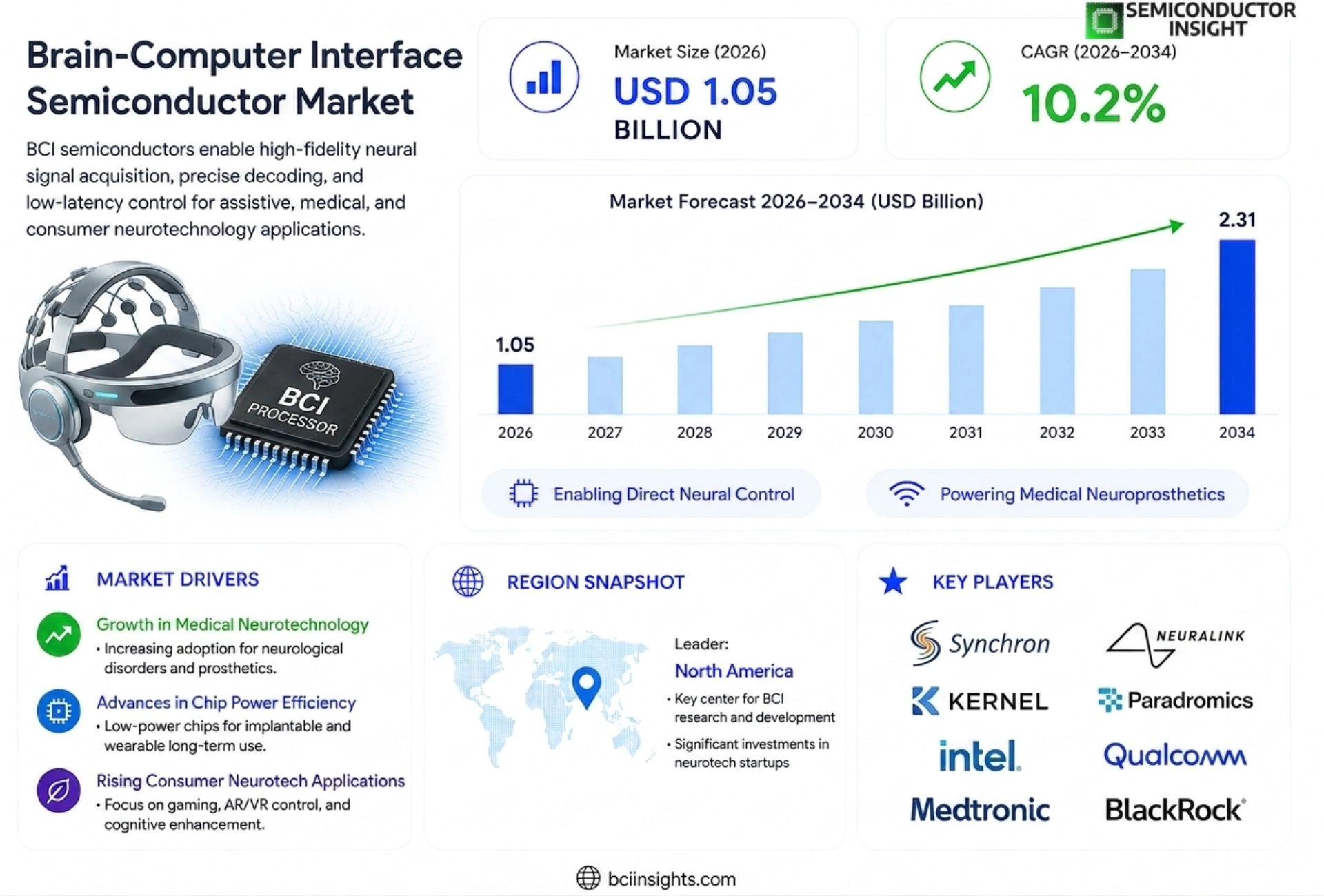
Brain-Computer Interface Semiconductor Market size was valued at USD 0.92 billion in 2025. The market is projected to grow from USD 1.05 billion in 2026 to USD 2.31 billion by 2034, exhibiting a CAGR of 10.2% during the forecast period.
Brain-Computer Interface semiconductors are specialized integrated circuits designed to acquire, process, and transmit neural signals between the brain and external devices. These chips incorporate analog front‑ends, high‑resolution analog‑to‑digital converters, low‑power digital signal processors, and wireless communication modules that enable real‑time decoding of electrophysiological activity for applications ranging from neuroprosthetics to cognitive enhancement.
The market is experiencing rapid growth due to several factors, including increased investment in neurotechnology startups, rising demand for assistive medical devices, and advancements in miniaturized low‑power silicon processes. Furthermore, government initiatives supporting brain health research and the expanding ecosystem of wearable neuro‑sensing platforms are contributing to market expansion. Initiatives by key players such as Neuralink Corp., Blackrock Microsystems, Texas Instruments Inc., and Qualcomm Technologies are expected to fuel further growth as they introduce next‑generation BCI chips with higher channel counts and AI‑enabled signal processing capabilities.
MARKET DRIVERS
Growing Clinical Adoption of Neuroprosthetics
Brain-Computer Interface Semiconductor Market is being propelled by a surge in clinical trials for neuroprosthetic devices that restore motor function in patients with spinal cord injuries. Hospitals are allocating larger budgets to integrate semiconductor‑based signal acquisition modules, leading to a projected annual growth rate of 12 percent over the next five years.
Advancements in Low‑Power Semiconductor Designs
Recent breakthroughs in sub‑nanometer process nodes enable ultra‑low power consumption, extending battery life of implantable Brain‑Computer Interface (BCI) systems. This technical edge reduces patient discomfort and accelerates market penetration across both therapeutic and consumer‑grade applications.
➤ Industry analysts estimate that low‑power ASICs will account for more than 45 percent of new BCI deployments by 2028.
In parallel, strategic partnerships between semiconductor manufacturers and neurotechnology startups are fostering rapid prototyping, further solidifying Brain-Computer Interface Semiconductor Market as a high‑growth segment.
MARKET CHALLENGES
Regulatory Hurdles and Safety Validation
Regulatory pathways for invasive BCI devices remain fragmented across major jurisdictions, causing delays in product approvals. Safety validation protocols require extensive long‑term biocompatibility testing, which inflates development costs and extends time‑to‑market.
Other Challenges
Manufacturing Scalability
Scaling fab processes from prototype to volume production is constrained by the need for ultra‑clean environments and specialized packaging, limiting the ability to meet rising demand.
MARKET RESTRAINTS
High Capital Expenditure Requirements
The initial capital outlay for designing and qualifying semiconductor components for BCI applications exceeds $150 million, deterring entry by smaller firms and consolidating market power among a few large players.
Furthermore, the need for specialized testing equipment and skilled personnel adds recurring operational costs, which can erode profit margins in the early stages of market entry.
These financial barriers act as a restraint on the overall expansion rate of Brain-Computer Interface Semiconductor Market, especially in emerging economies where funding for advanced neurotechnology is limited.
MARKET OPPORTUNITIES
Expansion into Consumer Wellness Devices
Beyond clinical settings, there is a growing opportunity to integrate BCI semiconductor solutions into consumer wellness products such as focus‑enhancing headsets and gaming accessories. This diversification broadens the addressable market and introduces new revenue streams.
Additionally, the convergence of artificial intelligence with BCI hardware creates prospects for adaptive signal processing, enabling more intuitive user experiences and opening doors for personalized neurofeedback services.
Brain-Computer Interface Semiconductor Market Trends
AI‑Enabled Signal Processing Gains Momentum
The integration of artificial‑intelligence algorithms directly into BCI semiconductor chips is reshaping data handling capabilities. By embedding neural network inference engines, manufacturers can perform real‑time artifact rejection and pattern recognition on the device itself, reducing latency for prosthetic control and cognitive‑enhancement applications. This shift is driven by advances in low‑power AI accelerators that maintain battery life while delivering higher channel counts. Companies such as Neuralink and Qualcomm are launching prototypes that combine AI cores with high‑resolution analog‑to‑digital converters, allowing seamless decoding of complex electrophysiological patterns. Analysts observe that this trend shortens the feedback loop between brain activity detection and actuation, which is critical for closed‑loop therapeutic systems.
Other Trends
Miniaturization and Low‑Power Design
Continuous scaling of silicon processes enables BCI chips to occupy sub‑square‑millimeter footprints while consuming less than a milliwatt per channel. The adoption of FinFET and emerging FD‑SOI technologies has facilitated the integration of wireless transceivers alongside analog front‑ends, supporting fully implantable solutions. Investment from venture capital into neurotechnology startups is accelerating the development of power‑gating techniques and energy‑harvesting modules that extend operational lifetimes without external recharging. As a result, designers are delivering platforms that can be mounted on flexible substrates, expanding the range of wearable neuro‑sensing devices and reducing patient discomfort.
Expansion of Wearable Neuro‑Sensing Platforms
The consumer‑grade wearables market is converging with clinical BCI applications, creating a hybrid segment where semiconductor solutions must balance precision and comfort. Leading firms are launching headsets that incorporate multi‑modal sensors,electroencephalography, electromyography, and near‑infrared spectroscopy,managed by a single SoC. This integration simplifies system architecture and lowers overall bill of materials, encouraging broader adoption in fields such as mental‑state monitoring and neuro‑feedback training. Government programs that fund brain‑health research further reinforce this momentum by providing grants for prototype validation and regulatory pathways. Consequently, the ecosystem around wearable neuro‑sensing platforms is maturing, with standardized communication protocols and secure data pipelines becoming common practice.
COMPETITIVE LANDSCAPE
Key Industry Players
Brain-Computer Interface Semiconductor Market is characterized by a dynamic mix of established semiconductor giants, specialized neurotechnology firms, and well-funded startups competing across chip design, neural signal acquisition, and AI-enabled signal processing capabilities.
Brain-Computer Interface Semiconductor Market is led by a combination of pioneering neurotechnology companies and established semiconductor manufacturers driving innovation across analog front-end design, low-power digital signal processing, and wireless neural data transmission. Neuralink Corp. has emerged as a high-profile leader with its custom N1 implantable BCI chip, demonstrating ultra-high channel-count neural recording in human trials, while Blackrock Microsystems continues to hold a strong position in the clinical and research-grade BCI semiconductor segment with its well-validated Utah Array and supporting integrated circuits. Texas Instruments Inc. and Qualcomm Technologies bring decades of semiconductor expertise to the market, offering low-power analog and mixed-signal components alongside wireless communication chipsets that are increasingly integrated into wearable and implantable BCI platforms. Intan Technologies has established itself as a specialized player supplying high-channel-count neural recording chips widely adopted across academic and commercial neuroscience applications. The competitive intensity of the market is further amplified by significant venture capital inflows and strategic collaborations between neurotechnology startups and leading semiconductor foundries, driving a rapid cadence of next-generation chip introductions with higher electrode counts, improved signal-to-noise ratios, and embedded AI inference engines.
Beyond the market leaders, a robust ecosystem of niche and emerging players is reshaping the Brain-Computer Interface Semiconductor competitive landscape. Paradromics Inc. is developing high-bandwidth data-acquisition ASICs targeting large-scale cortical recording, while Synchron Inc. is advancing its Stentrode-based endovascular BCI approach supported by custom signal-processing semiconductor solutions. Precision Neuroscience is another notable entrant offering minimally invasive cortical arrays paired with specialized readout integrated circuits. On the broader semiconductor side, Analog Devices Inc. and NVIDIA Corporation are contributing precision analog front-ends and GPU-accelerated neural decoding platforms, respectively, that serve as critical enabling components within BCI system architectures. Medtronic plc, leveraging its deep implantable neurostimulation heritage, continues to develop adaptive closed-loop BCI chips for therapeutic applications. Additionally, Emotiv Inc. and Neurosity are addressing the consumer and developer wearable EEG semiconductor segment, while research-oriented entities such as IMEC are advancing next-generation low-power neural recording silicon processes that are expected to underpin future commercial BCI semiconductor offerings across both invasive and non-invasive application domains.
List of Key Brain-Computer Interface Semiconductor Companies Profiled
- Neuralink Corp.
- Blackrock Microsystems
- Texas Instruments Inc.
- Qualcomm Technologies
- Intan Technologies
- Paradromics Inc.
- Synchron Inc.
- Precision Neuroscience
- Analog Devices Inc.
- NVIDIA Corporation
- Medtronic plc
- Emotiv Inc.
- Neurosity
- IMEC
Segment Analysis:
| Segment Category | Sub-Segments | Key Insights |
| By Type |
|
Analog Front‑End ICs drive the market by providing ultra‑low‑noise acquisition of neural potentials, enabling reliable signal capture even in wearable form factors. • Engineers prioritize low power consumption to extend battery life of implantable devices. • Integration of high‑resolution converters supports fine‑grained decoding of brain activity, fostering breakthroughs in neuroprosthetic control. • Vendors focus on miniaturization, allowing seamless embedding within head‑mounted displays and compact research rigs. |
| By Application |
|
Neuroprosthetics remain the flagship application, where precise, real‑time decoding translates intent into motion for limb‑replacement systems. • Researchers value the ability of semiconductors to handle multi‑channel inputs with deterministic latency. • Close collaboration with medical device firms drives co‑development of safety‑critical firmware. • Emerging closed‑loop stimulation capabilities are expanding therapeutic possibilities beyond motor restoration. |
| By End User |
|
Medical Device Manufacturers are the primary end‑user segment, integrating BCI semiconductors into implantable and external therapeutic platforms. • Their design cycles prioritize regulatory compliance and long‑term reliability. • Partnerships with semiconductor innovators accelerate the adoption of AI‑enhanced decoding pipelines. • Feedback loops from clinical trials shape next‑generation chip architectures that balance performance with patient safety. |
| By Technology |
|
Neuromorphic Architectures are gaining traction as they emulate neural firing patterns directly within hardware, reducing the computational burden on external processors. • Designers highlight the promise of on‑chip learning for adaptive BCI systems. • Early prototypes demonstrate lower latency in closed‑loop stimulation scenarios. • Industry consortia are fostering standards that will simplify integration across diverse neuro‑sensing devices. |
| By Deployment Platform |
|
Implantable Devices dominate strategic planning as they require rigorous power management, biocompatibility, and long‑term stability. • Semiconductor partners invest heavily in hermetic packaging technologies. • The push for higher channel counts drives innovation in 3‑D integration. • Collaboration with neurosurgeons ensures that chip form‑factor aligns with surgical implantation workflows. |
Regional Analysis: North America
The medical sector represents the largest application segment within the US BCI semiconductor market. Its focus on prosthetic control, neural restoration, and disease management is proving to be a major growth driver. Increased prevalence of neurological disorders and a growing need for advanced therapeutic interventions are further propelling demand for sophisticated BCI semiconductor devices.
Significant investment in academic and industrial research drives innovation in the US BCI semiconductor market. Universities and research institutions are at the forefront of developing novel algorithms, hardware platforms, and biocompatible materials. This strong R&D base fosters a continuous pipeline of new technologies and applications.
While still in its nascent stages, the integration of BCI semiconductors into consumer electronics, such as gaming devices and wearables, is gaining traction. This application caters to the growing interest in cognitive enhancement and personalized experiences, presenting a future growth opportunity for the US market.
Federal agencies like the NIH and NSF are actively funding BCI research and development projects, providing crucial support for innovation in the US. These initiatives are instrumental in accelerating the translation of research findings into commercially viable BCI semiconductor solutions.
Europe
Europe is witnessing a steady expansion in its Brain-Computer Interface Semiconductor Market. Driven by strong healthcare infrastructure and increasing investments in biomedical research, the region presents a promising landscape for growth. Germany, the UK, and France are key markets within Europe, exhibiting significant adoption rates for BCI technologies in medical applications. Emphasis on patient-centric care and a growing awareness of neurodegenerative diseases are contributing to the demand. Regulatory frameworks, like the EU Medical Device Regulation (MDR), are shaping the market dynamics, emphasizing safety and efficacy standards. The focus remains particularly strong on therapeutic applications and neurorehabilitation solutions.
Asia-Pacific
The Asia-Pacific region, particularly China and Japan, is emerging as a dynamic player Brain-Computer Interface Semiconductor Market. Rapid advancements in robotics, artificial intelligence, and healthcare technologies are fueling adoption. China’s substantial investments in R&D and its large patient population create a significant market opportunity. Japan’s strong focus on advanced medical devices and robotics further enhances the region’s potential. However, regulatory complexities and competition from established players pose challenges. The market is expected to witness substantial growth in the coming years, driven by increasing healthcare expenditure and technological advancements.
South America
South America represents a relatively nascent market for Brain-Computer Interface Semiconductor solutions. While awareness of BCI technologies is growing, adoption is currently limited. Brazil and Argentina are the key markets with potential for future expansion, driven by increasing healthcare investments and a growing interest in neurotechnologies. The market is expected to experience moderate growth in the coming years, contingent on advancements in affordability and accessibility.
Middle East & Africa
The Middle East & Africa region presents a relatively small but potentially high-growth market for Brain-Computer Interface Semiconductor solutions. Increasing healthcare spending, particularly in countries like Saudi Arabia and South Africa, is driving demand for advanced medical technologies. The region’s aging population and rising prevalence of neurological disorders contribute to the market’s potential. However, the market is characterized by limited infrastructure and a relatively low awareness of BCI technologies, requiring significant investment in education and infrastructure development.
Report Scope
This market research report provides a comprehensive analysis of the Brain-Computer Interface Semiconductor Market , covering the forecast period 2026–2034. It offers detailed insights into market dynamics, technological advancements, competitive landscape, and key trends shaping the industry.
Key focus areas of the report include:
- Market Overview: The report begins with an overview outlining its current market scenario, key growth indicators, and industry transformation drivers. It discusses macroeconomic factors, demand–supply balance, regulatory landscape, and the strategic role of semiconductors in powering advancements across industries such as automotive, telecommunications, consumer electronics, and industrial automation.
- Market Size & Forecast: Historical data and future projections for revenue, unit shipments, and market value across major regions and segments.
- Segmentation Analysis: Detailed breakdown by product type, technology, application, and end-user industry to identify high-growth segments and investment opportunities.
- Regional Insights: Insights into market performance across North America, Europe, Asia-Pacific, Latin America, and the Middle East & Africa, including country-level analysis where relevant.
- Competitive Landscape: Profiles of leading market participants, including their product offerings, R&D focus, manufacturing capacity, pricing strategies, and recent developments such as mergers, acquisitions, and partnerships.
- Technology Trends & Innovation: Assessment of emerging technologies, integration of AI/IoT, semiconductor design trends, fabrication techniques, and evolving industry standards.
- Market Drivers & Restraints: Evaluation of factors driving market growth along with challenges, supply chain constraints, regulatory issues, and market-entry barriers.
- Stakeholder Insights: Insights for component suppliers, OEMs, system integrators, investors, and policymakers regarding the evolving ecosystem and strategic opportunities.
Primary and secondary research methods are employed, including interviews with industry experts, data from verified sources, and real-time market intelligence to ensure the accuracy and reliability of the insights presented.
FREQUENTLY ASKED QUESTIONS:
What is the current market size of Brain-Computer Interface Semiconductor Market?
-> Brain-Computer Interface Semiconductor Market size was valued at USD 0.92 billion in 2025. The market is projected to grow from USD 1.05 billion in 2026 to USD 2.31 billion by 2034, exhibiting a CAGR of 10.2%
Which key companies operate Brain-Computer Interface Semiconductor Market?
-> Key players include Neuralink Corp., Blackrock Microsystems, Texas Instruments Inc., Qualcomm Technologies, among others.
What are the key growth drivers?
-> Key growth drivers include increased investment in neurotechnology startups, rising demand for assistive medical devices, advancements in miniaturized low‑power silicon processes, and supportive government initiatives for brain health research.
Which region dominates the market?
-> The reference does not specify a single dominant region; market participation is global with significant activity in North America and Asia‑Pacific.
What are the emerging trends?
-> Emerging trends include AI‑enabled signal processing in BCI chips, wearable neuro‑sensing platforms, and next‑generation high‑channel‑count semiconductor designs.

Get Sample Report PDF for Exclusive Insights
Report Sample Includes
- Table of Contents
- List of Tables & Figures
- Charts, Research Methodology, and more...
 Download Sample Report PDF