Bottom Anti-Reflective Coatings (BARC) Market Insights
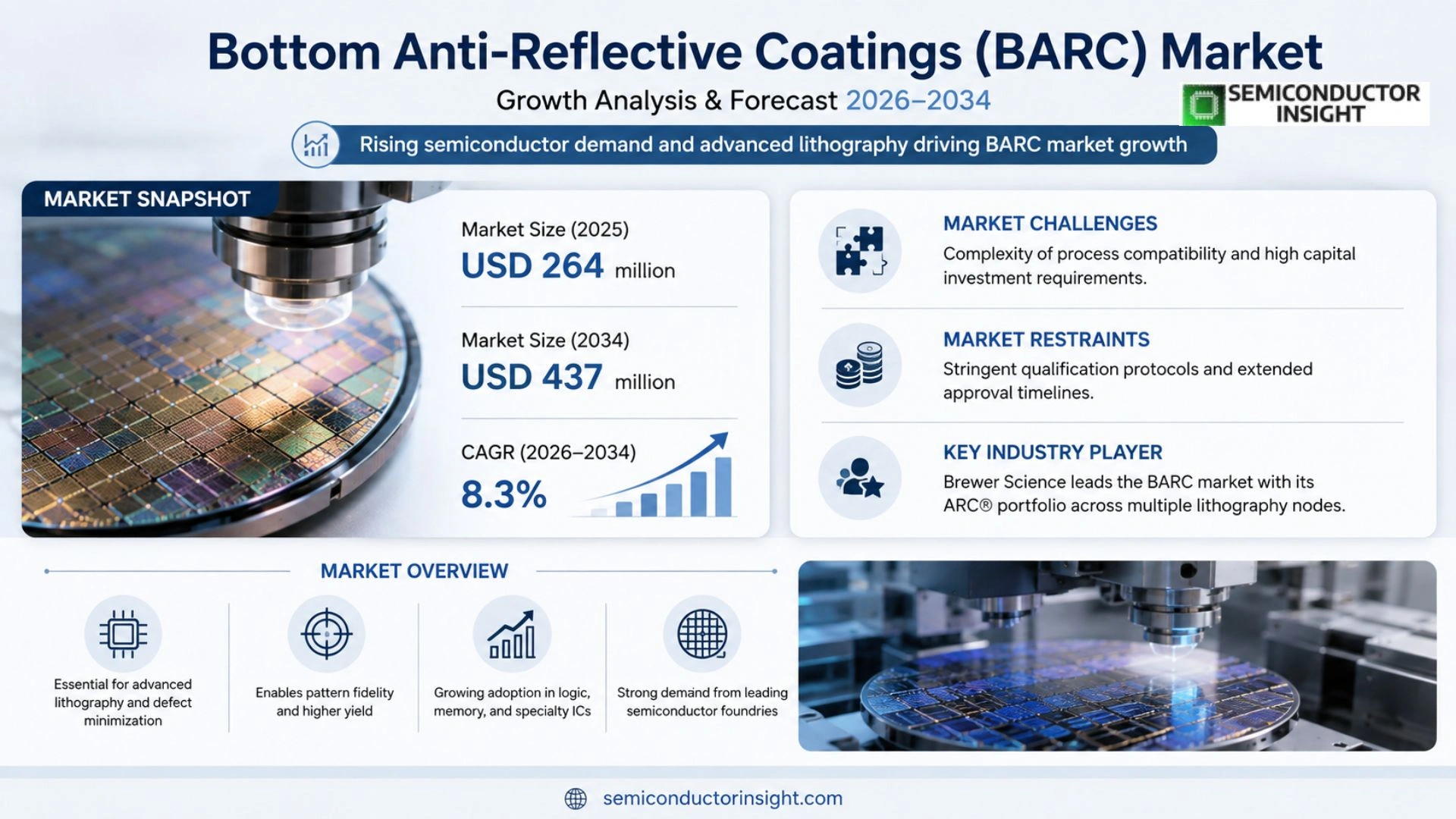
Bottom Anti-Reflective Coatings (BARC) market size was valued at USD 264 million in 2025 and is projected to reach USD 437 million by 2034, exhibiting a CAGR of 8.3% during the forecast period.
Bottom Anti-Reflective Coatings (BARC) are lithography materials applied between the substrate/film stack and the photoresist. They are engineered to control reflectivity through optical constants, thickness, and absorption, suppressing standing waves and swing‑curve effects, thereby improving critical dimension control and pattern fidelity. In practice, spin‑on organic BARCs dominate the market, while inorganic silicon‑containing variants address more complex integration needs.
MARKET DRIVERS
Demand from Advanced Lithography Platforms
The adoption of extreme ultraviolet (EUV) and deep‑ultraviolet (DUV) lithography systems has intensified the need for high‑performance Bottom Anti‑Reflective Coatings. These coatings improve pattern fidelity, allowing chip manufacturers to push critical dimensions below 10 nm. Because pattern distortion directly impacts yield, fabs are allocating a larger portion of their material budgets to BARC solutions.
Regulatory Pressure for Reduced Chemical Footprint
Environmental legislation across North America and Europe now mandates lower volatile organic compound (VOC) emissions during wafer processing. Bottom Anti‑Reflective Coatings formulated with water‑based chemistries meet these standards while maintaining optical performance, prompting fabs to replace legacy solvents with compliant BARC products. The shift not only avoids penalties but also enhances corporate sustainability credentials.
➤ Integration of BARC into multi‑patterning workflows has become a decisive cost‑control lever for leading semiconductor producers.
Another catalyst is the rise of heterogeneous integration, where silicon, photonics, and MEMS components coexist on a single substrate. Each material stack demands a tailored anti‑reflective layer, and suppliers capable of rapid customization are securing long‑term contracts. Such diversification broadens the Bottom Anti‑Reflective Coatings (BARC) Market beyond traditional logic chips into sensors and power‑device domains.
MARKET CHALLENGES
Complexity of Process Compatibility
BARC formulations must coexist with a myriad of photoresists, etchants, and post‑exposure bake temperatures. Even minor incompatibilities can trigger line‑edge roughness or adhesion failures, forcing manufacturers to conduct extensive qualification cycles. The time‑intensive nature of these trials slows the introduction of new coating chemistries.
Other Challenges
Capital Intensity
Deploying state‑of‑the‑art coating equipment demands multi‑million‑dollar investments. Facilities that cannot justify the expense may defer upgrades, limiting market penetration for premium BARC products.
MARKET RESTRAINTS
Stringent Qualification Protocols
Semiconductor fabs operate under tight defect‑density thresholds,often fewer than one defect per hundred wafers. Each new Bottom Anti‑Reflective Coating must undergo rigorous reliability testing, including thermal cycling and plasma exposure. The prolonged approval timeline discourages smaller suppliers from entering the market.
Raw‑Material Scarcity
Key precursors for high‑purity BARC polymers, such as fluorinated monomers, face supply constraints due to limited production capacity and geopolitical factors. When shortages arise, pricing volatility erodes margins for downstream manufacturers.
Alternative Anti‑Reflective Technologies
Emerging approaches like plasma‑etched nano‑structures provide comparable reflectivity suppression without the need for a coating layer. While still in early adoption, these alternatives siphon a fraction of the potential clientele away from conventional BARC offerings.
MARKET OPPORTUNITIES
Expansion into Flexible Electronics
Flexible display manufacturers are seeking anti‑reflective layers that can endure bending stresses without cracking. Customized polymer blends designed for low‑temperature curing present a clear opening for BARC providers to diversify beyond rigid silicon wafers.
AI‑Enabled Formulation Optimization
Machine‑learning platforms now predict coating performance based on molecular descriptors, cutting development cycles by up to 30 %. Companies that integrate such tools can accelerate time‑to‑market and offer highly tuned BARC solutions for niche applications, such as quantum‑dot LEDs.
Geographic Growth in Emerging Fab Zones
Regions like Southeast Asia and Eastern Europe are attracting new semiconductor fabs due to favorable tax regimes. These greenfield facilities typically adopt the latest process stacks, creating a demand surge for next‑generation Bottom Anti‑Reflective Coatings (BARC) Market participants willing to supply at scale.
Bottom Anti-Reflective Coatings (BARC) Market Trends
Increasing Demand for High‑Resolution Lithography
The adoption of sub‑10 nm nodes has forced wafer fabs to tighten critical‑dimension (CD) control, and BARC materials have become a decisive lever for achieving that precision. By moderating reflectivity at the substrate interface, Bottom Anti-Reflective Coatings (BARC) blunt standing‑wave effects that would otherwise distort pattern fidelity. As logic and memory manufacturers migrate from KrF to ArF immersion and begin limited EUV pilot lines, the optical constants of BARC formulations are being engineered to suit each wavelength, delivering the extra latitude needed for multi‑patterning cycles. This technical shift is reflected in the market’s expansion from $264 million in 2025 to an estimated $437 million by 2034, underscoring the material’s strategic importance in the process flow.
Other Trends
Sustainability‑Driven Reformulation
Regulatory pressure on per‑ and poly‑fluoroalkyl substances (PFAS) has prompted the leading suppliers,Brewer Science, Merck KGaA, TOK, and Qnity,to replace traditional PFOS/PFOA backbones with fluorine‑free chemistries. The new formulations retain low outgassing and high thermal stability while delivering comparable absorption, a balance that satisfies both compliance audits and yield targets. Customers are increasingly demanding “green” BARC options, and vendors are differentiating on metrics such as carbon‑footprint per kilogram and recyclability of spin‑on solvents. These moves open a niche for specialty chemical firms that can provide customized solvent systems, potentially reshaping the supplier landscape beyond the incumbent few.
Integration of BARC with Advanced Packaging
Beyond classic logic and memory, the surge in heterogeneous integration and 3D‑IC stacking has amplified the role of Bottom Anti-Reflective Coatings (BARC) in advanced packaging. When multiple layers of redistribution lines are built atop a wafer, the topography becomes increasingly irregular, and BARC‑enabled planarization helps maintain uniform exposure across depths. Some vendors now bundle BARC with gap‑fill polymers, allowing a single spin‑on step to address both reflectivity suppression and surface planarization. This convergence reduces cycle time and equipment cost, offering a compelling value proposition for high‑volume manufacturers seeking to scale chiplet‑based architectures. The trend signals a broadening of the BARC addressable market, tying its fortunes not only to transistor scaling but also to the growth of next‑generation packaging solutions.
COMPETITIVE LANDSCAPE
Key Industry Players
Competitive dynamics in the BARC sector, 2025‑2034
Brewer Science remains the de‑facto benchmark provider, leveraging its ARC® line that spans i‑line through 193 nm immersion to lock in a sizable share of high‑volume logic and memory fabs. Merck KGaA follows closely, offering a portfolio that blends organic and inorganic chemistries to meet the strict outgassing and removability constraints of advanced nodes. TOK differentiates itself with PFOS‑free formulations, appealing to customers under tightening environmental regulations, while Qnity’s cross‑linkable KrF‑grade BARCs have gained traction for their excellent film‑planarity attributes. Collectively, these four firms anchor a market that is highly qualification‑intensive; their products are typically bundled with complementary resist and TARC solutions, creating a barrier to entry for newcomers and reinforcing concentration at the top of the value chain.
Beyond the tier‑one incumbents, a cohort of specialist suppliers enriches the competitive tapestry. Dongjin Semichem supplies inorganic BARCs that integrate seamlessly with EUV processes, whereas Nissan Chemical focuses on high‑absorption organic blends for 3D‑NAND stacks. Allresist GmbH leverages its German engineering base to deliver low‑outgassing materials for automotive‑grade logic. YCCHEM Co., Ltd and SK Materials Performance (SKMP) target niche applications in advanced packaging, emphasizing gap‑fill capability. Red Avenue, Xiamen Hengkun New Material Technology, and PhiChem round out the list with region‑specific offerings that cater to emerging Asian fabs seeking cost‑effective alternatives without compromising performance. The presence of these diverse players sustains a modest yet vibrant ecosystem, where niche expertise and regional relationships can translate into incremental market share, especially as fabs diversify their material sources to mitigate supply‑chain risk.
List of Key Bottom Anti-Reflective Coatings (BARC) Companies Profiled
- Brewer Science
- Merck KGaA
- TOK
- Qnity
- Honeywell
- Dongjin Semichem
- Nissan Chemical
- Allresist GmbH
- YCCHEM Co., Ltd
- SK Materials Performance (SKMP)
- Red Avenue
- Xiamen Hengkun New Material Technology
- PhiChem
Segment Analysis:
| Segment Category | Sub-Segments | Key Insights |
| By Type |
|
Organic BARC continues to dominate due to its process flexibility and ease of integration. – Provides excellent spin‑on uniformity, enabling fine thickness control for diverse lithography wavelengths. – Supports rapid removal through plasma or developable chemistries, reducing downstream etch steps. – Aligns well with existing photoresist formulations, minimizing intermixing risks and improving overall pattern fidelity. Inorganic BARC, while niche, is valued for superior thermal stability and compatibility with aggressive etch environments, positioning it for advanced node and multi‑patterning scenarios. |
| By Application |
|
Logic IC BARC is the primary growth driver across the lithography ecosystem. – Addresses stringent critical dimension (CD) control needs as device geometries shrink. – Enhances vertical profile control, mitigating topography‑induced pattern distortions in multi‑layer stacks. – Facilitates multi‑patterning and EUV integration by suppressing standing‑wave effects, thereby improving yield and defectivity. Memory and advanced packaging applications are emerging, leveraging BARC’s gap‑fill capabilities for high‑density interconnects. |
| By End User |
|
Semiconductor fabs drive adoption through extensive qualification programs and high‑volume integration. – Demand for low‑outgassing, high‑purity formulations to meet stringent fab cleanliness standards. – Preference for BARC solutions that enable process latitude, allowing tighter focus windows and reduced cycle times. – Growing emphasis on sustainability, prompting migration toward PFOS/PFOA‑free chemistries and greener solvent systems. Packaging houses and research labs follow fab trends but place additional emphasis on rapid prototyping and customizable material properties. |
Regional Analysis: Bottom Anti-Reflective Coatings (BARC) Market
Asia-Pacific
Local fabs collaborate closely with chemical firms, enabling rapid feedback loops that shorten formulation cycles. This proximity reduces lead times and allows iterative optimisation of coating thickness and adhesion, directly feeding into production schedules.
Joint ventures between equipment OEMs and specialty coating providers accelerate the introduction of next‑generation BARC chemistries, aligning material performance with the aggressive node shrink ambitions of regional chip makers.
Harmonised environmental standards across key economies simplify compliance for suppliers, while still encouraging the development of low‑volatile‑organic‑compound formulations that meet local sustainability targets.
A concentration of universities specialising in surface chemistry fuels a steady pipeline of expertise, allowing firms to recruit analysts who can translate laboratory breakthroughs into manufacturable coating solutions.
North America
In North America, Bottom Anti-Reflective Coatings (BARC) Market is anchored by a mature photolithography supply base and a strong focus on intellectual property protection. Companies leverage extensive patent portfolios to command premium pricing for proprietary chemistries. Customer demand is shaped by a cautious adoption pace; firms prefer proven processes that align with existing equipment generations. Consequently, suppliers invest heavily in service agreements and technical support to mitigate integration risk, positioning themselves as long‑term partners rather than mere material vendors.
Europe
European participants in the BARC arena emphasise sustainability and regulatory compliance. The market reacts to stringent EU chemical directives, prompting developers to formulate coatings with reduced ecological footprints. This regulatory pressure fosters collaboration between research institutes and industry players, resulting in niche solutions that target high‑precision applications such as advanced logic devices. The emphasis on circular‑economy principles also encourages recycling initiatives for spent coating materials, adding a layer of differentiation for European manufacturers.
South America
South America remains early in its adoption curve for bottom anti‑reflective technologies. Growth is spurred by governmental programmes that aim to attract semiconductor assembly operations. While the region lacks a dense supplier network, multinational firms are establishing local distribution hubs to serve emerging fabrication plants. The market narrative here focuses on capacity building, training, and the gradual transition from legacy coating approaches to modern BARC formulations that improve yield consistency.
Middle East & Africa
In the Middle East & Africa, market activity is driven by diversification strategies that seek to move beyond oil‑centric economies. Emerging electronics manufacturing zones are exploring BARC solutions to support niche consumer‑device production. Partnerships with Asian technology exporters provide access to established formulations, while regional investment funds finance pilot lines that test coating performance under local environmental conditions. The overall outlook stresses capability development and gradual integration into the global supply chain.
Report Scope
This market research report provides a comprehensive analysis of the Bottom Anti-Reflective Coatings (BARC) Market , covering the forecast period 2026–2034. It offers detailed insights into market dynamics, technological advancements, competitive landscape, and key trends shaping the industry.
Key focus areas of the report include:
- Market Overview: The report begins with an overview outlining its current market scenario, key growth indicators, and industry transformation drivers. It discusses macroeconomic factors, demand–supply balance, regulatory landscape, and the strategic role of semiconductors in powering advancements across industries such as automotive, telecommunications, consumer electronics, and industrial automation.
- Market Size & Forecast: Historical data and future projections for revenue, unit shipments, and market value across major regions and segments.
- Segmentation Analysis: Detailed breakdown by product type, technology, application, and end-user industry to identify high-growth segments and investment opportunities.
- Regional Insights: Insights into market performance across North America, Europe, Asia-Pacific, Latin America, and the Middle East & Africa, including country-level analysis where relevant.
- Competitive Landscape: Profiles of leading market participants, including their product offerings, R&D focus, manufacturing capacity, pricing strategies, and recent developments such as mergers, acquisitions, and partnerships.
- Technology Trends & Innovation: Assessment of emerging technologies, integration of AI/IoT, semiconductor design trends, fabrication techniques, and evolving industry standards.
- Market Drivers & Restraints: Evaluation of factors driving market growth along with challenges, supply chain constraints, regulatory issues, and market-entry barriers.
- Stakeholder Insights: Insights for component suppliers, OEMs, system integrators, investors, and policymakers regarding the evolving ecosystem and strategic opportunities.
Primary and secondary research methods are employed, including interviews with industry experts, data from verified sources, and real-time market intelligence to ensure the accuracy and reliability of the insights presented.
FREQUENTLY ASKED QUESTIONS:
What is the current market size of Bottom Anti-Reflective Coatings (BARC) Market?
-> Bottom Anti-Reflective Coatings (BARC) Market is expected to reach USD 437 million by 2034, representing a CAGR of 8.3% during the forecast period.
Which key companies operate in Bottom Anti-Reflective Coatings (BARC) Market?
-> Key players include Brewer Science, Merck KGaA, TOK, Qnity, and Honeywell, among others.
What are the key growth drivers?
-> Key growth drivers include tighter CD/defect requirements, multi‑patterning complexity, sustainability and PFOS/PFOA compliance pressures, and increasing stack complexity that demand advanced reflectivity control.
Which region dominates the market?
-> Asia‑Pacific holds a substantial share owing to intensive semiconductor fabrication activities, while detailed regional breakdowns are provided for North America, Europe, and other regions.
What are the emerging trends?
-> Emerging trends include PFOS/PFOA‑free formulations, inorganic BARC development for enhanced etch/hardmask synergies, integration with multi‑patterning workflows, and sustainability‑driven material innovation.
Get Sample Report PDF for Exclusive Insights
Report Sample Includes
- Table of Contents
- List of Tables & Figures
- Charts, Research Methodology, and more...