Black and White Polarizer Market Insights
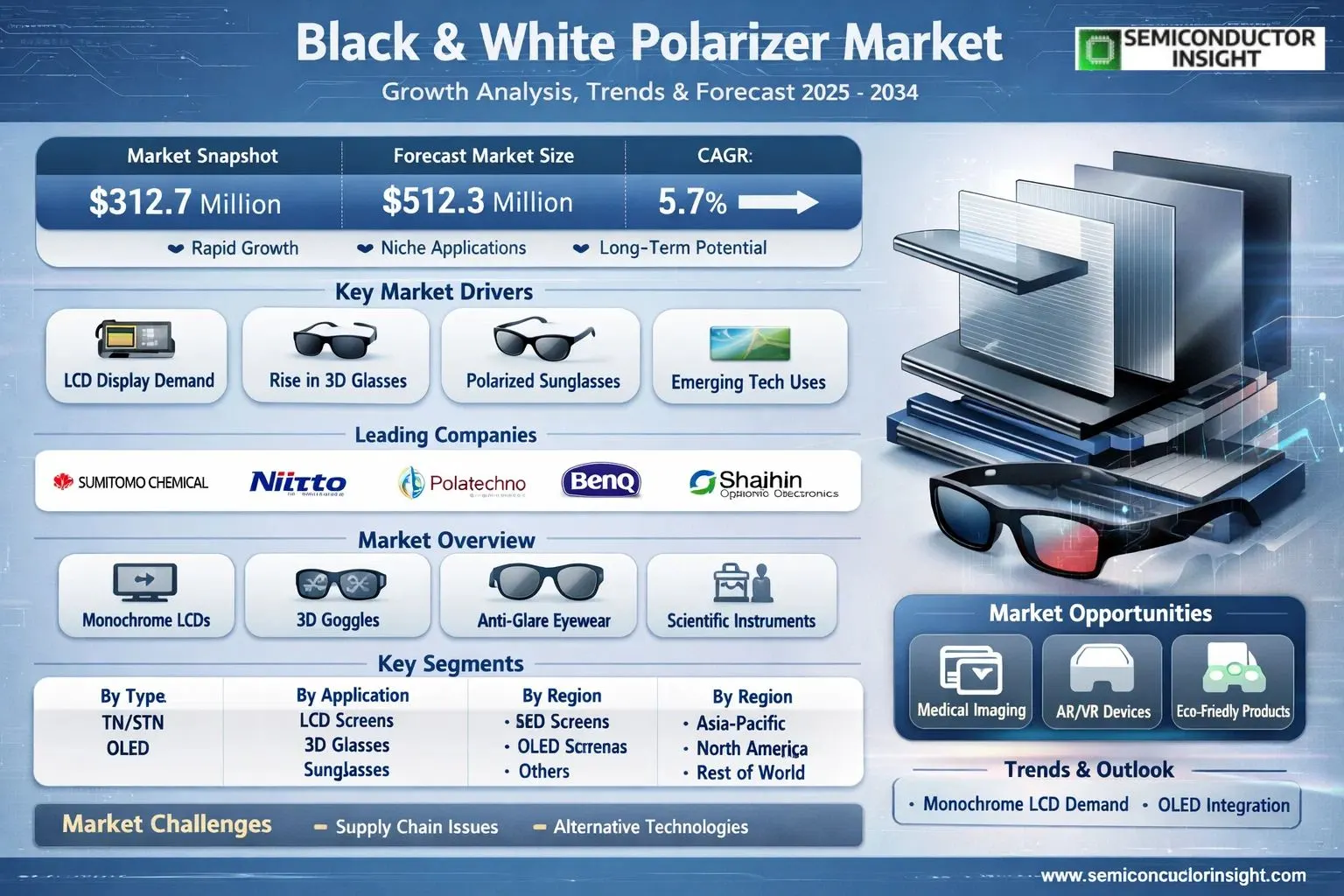
Global Black and White Polarizer market size was valued at USD 312.7 million in 2025. The market is projected to grow from USD 328.5 million in 2026 to USD 512.3 million by 2034, exhibiting a CAGR of 5.7% during the forecast period.
Black and White Polarizers are specialized polarizing films essential for monochrome and false color LCD displays, 3D goggles, and polarized sunglasses. These films polarize light critical for liquid crystal display imaging, with two layers typically attached to the liquid crystal glass to form a roughly 1mm thick assembly. Absent these polarizers, LCD panels fail to produce images. Distinguished by application, they serve TN/STN and certain OLED types, contrasting with high-performance TFT-LCD films for color displays, primarily due to differing optical and durability requirements.
The market sustains moderate growth fueled by ongoing demand in cost-sensitive sectors like calculators, instrumentation panels, automotive displays, and anti-glare eyewear. While overshadowed by advanced color technologies, niche persistence and emerging uses in smart wearables support expansion. Furthermore, production in regions like China maintains supply for these applications. Leading players including Sumitomo Chemical, Nitto Denko, BenQ Materials (BQM), Shanjin Optoelectronics, and Hengmei Optoelectronics command the landscape with tailored portfolios.
MARKET DRIVERS
Growing Demand in Photography and Optics
Black and White Polarizer Market is propelled by increasing adoption in professional photography and cinematography, where these specialized filters enhance contrast and reduce glare for superior monochrome imaging. With the resurgence of analog and fine-art black-and-white photography, demand has surged, contributing to a market expansion at approximately 6.2% CAGR from 2023 to 2030.
Advancements in Material Science
Innovations in thin-film coatings and polymer substrates have improved the efficiency and durability of black and white polarizers, making them essential in high-end camera lenses and optical instruments. These developments address traditional limitations in light transmission, boosting their integration in precision optics for scientific applications.
➤ The integration of nanotechnology has enhanced polarization efficiency by up to 25%, driving adoption in drone and aerial imaging sectors.
Furthermore, the expanding use in consumer electronics displays underscores sustained growth in Black and White Polarizer Market, supported by global trends toward high-contrast visual technologies.
MARKET CHALLENGES
Intense Competition from Alternatives
Black and White Polarizer Market faces hurdles from digital post-processing tools that mimic polarization effects, reducing the need for physical filters among amateur photographers. This shift has slowed hardware sales, with traditional polarizers capturing only 35% of the enhancement filter segment in recent years.
Other Challenges
Supply Chain Disruptions
Geopolitical tensions and raw material shortages for optical polymers have increased production costs by 15-20%, challenging manufacturers to maintain competitive pricing in Black and White Polarizer Market.Additionally, rapid technological obsolescence requires continuous R&D investment, straining smaller players while larger firms dominate through economies of scale.
MARKET RESTRAINTS
Regulatory and Environmental Compliance
Stringent environmental regulations on chemical coatings used in polarizer manufacturing pose significant restraints to Black and White Polarizer Market. Compliance with RoHS and REACH standards has raised operational costs, limiting scalability for producers in developing regions.High precision requirements in fabrication processes further constrain output, as defect rates above 2% render batches unusable, impacting overall market supply.Moreover, dependency on rare earth elements for advanced polarizers exposes the market to price volatility, hindering consistent growth projections through 2030.
MARKET OPPORTUNITIES
Expansion into Emerging Applications
Black and White Polarizer Market holds promise in emerging fields like medical imaging and AR/VR devices, where high-contrast monochrome polarization is critical. Projected growth in these sectors could add $150 million in revenue by 2028.Strategic partnerships with camera manufacturers offer avenues for customized solutions, capitalizing on the premium segment for professional-grade equipment.Rising interest in sustainable optics also presents opportunities, with eco-friendly polarizer variants gaining traction in Europe and North America markets.
Black and White Polarizer Market Trends
Persistent Demand in Monochrome LCD and Specialized Optics
Black and White Polarizer Market continues to serve critical niches within the broader polarizing film industry, where these components are indispensable for monochrome and false color LCD displays. Polarizing films, tightly attached to liquid crystal glass, enable imaging through polarized light, with black and white variants primarily supporting TN and STN types. Despite the dominance of color TFT-LCD panels, Black and White Polarizer Market maintains steady relevance in applications requiring low-cost, low-power solutions, such as industrial instruments and segment displays.
Other Trends
Expansion in 3D Glasses and Polarized Sunglasses
Black and white polarizers find growing adoption in 3D goggles and anti-glare polarized sunglasses, leveraging their ability to reduce reflections and block UV rays. These applications capitalize on the films’ frosted surfaces that scatter light and widen viewing angles, aligning with consumer demand for enhanced visual comfort in outdoor and entertainment settings. This segment bolsters Black and White Polarizer Market by diversifying beyond traditional displays.
OLED Penetration and Competitive Dynamics
Although LCD remains predominant, OLED panels are gradually influencing Black and White Polarizer Market through integration in flexible and high-contrast devices. Leading manufacturers like Sumitomo Chemical, Nitto Denko, and Polatechno dominate, with Asian producers such as Shanjin Optoelectronics and Hengmei Optoelectronics focusing on TN/STN and emerging OLED types. China’s modest production capacity underscores limited but stable demand, while regional shifts emphasize Asia-Pacific leadership, including Japan and South Korea, in supply chain innovations. The market’s trajectory reflects a balance between legacy monochrome needs and adaptive optical enhancements, positioning black and white polarizers as enduring enablers in specialized electronics.
COMPETITIVE LANDSCAPE
Key Industry Players
Leading Manufacturers in Black and White Polarizer Market
Black and White Polarizer Market is dominated by a few established Japanese and Taiwanese giants, with Sumitomo Chemical and Nitto Denko leading the pack due to their advanced technological capabilities and extensive production capacities. These top players collectively hold a significant revenue share, approximately 50-60% of the global market in 2025, as per industry surveys. The market structure is moderately concentrated, characterized by high barriers to entry stemming from proprietary PVA-iodine lamination processes and stringent quality requirements for TN/STN and OLED applications in monochrome LCDs, 3D glasses, and polarized sunglasses. Sumitomo Chemical excels in high-transmittance films for STN displays, while Nitto Denko dominates with integrated supply chains supporting automotive and consumer electronics sectors.
Beyond the leaders, niche players from China and other regions contribute through specialized production for cost-sensitive segments like small-sized monochrome displays. Companies such as BenQ Materials (BQM), Shanjin Optoelectronics (affiliated with LG), and Hengmei Optoelectronics (Samsung-backed) focus on regional demands in Asia, particularly for TN/STN types amid declining but persistent volumes. Emerging Chinese firms like CMMT, Optimax, Shenzhen Sunnypol Optoelectronics, Shenzhen SAPO Photoelectric, and WINDA Optoelectronics are gaining traction with localized manufacturing, addressing smaller-scale applications and aftermarket needs. This tier provides competitive pricing pressures while the overall landscape sees limited mergers, with top firms investing in OLED transitions to counter LCD decline.
List of Key Black and White Polarizer Companies Profiled
- Sumitomo Chemical
- Nitto Denko
- Polatechno
- BenQ Materials (BQM)
- Shanjin Optoelectronics (LG)
- Hengmei Optoelectronics (Samsung)
- CMMT
- Optimax
- Shenzhen Sunnypol Optoelectronics
- Shenzhen SAPO Photoelectric
- WINDA Optoelectronics
Segment Analysis:
| Segment Category | Sub-Segments | Key Insights |
| By Type |
|
Leading Segment: TN/STN Type
|
| By Application |
|
Leading Segment: LCD Display Screen
|
| By End User |
|
Leading Segment: Industrial Instruments
|
| By Polarizer Position |
|
Leading Segment: Viewer-Side Polarizer
|
| By Display Size |
|
Leading Segment: Small Displays
|
Regional Analysis: Black and White Polarizer Market
Asia-Pacific
Asia-Pacific’s vast production facilities produce superior Black and White Polarizers, benefiting from skilled labor and proximity to raw material sources. This enables precise control over polarization efficiency, catering to high-end applications in monochrome imaging.
Booming consumer electronics in the region drives Black and White Polarizer Market expansion, with displays and cameras requiring enhanced contrast for vivid black-and-white visuals, supported by local R&D investments.
Tech hubs like Tokyo and Shenzhen pioneer next-gen polarizers, integrating nanomaterials for better light management, keeping Asia-Pacific ahead in Black and White Polarizer Market dynamics.
Streamlined logistics and supplier networks minimize delays, ensuring reliable Black and White Polarizer availability for global exports and domestic use, enhancing regional market resilience.
North America
North America exhibits steady growth in Black and White Polarizer Market, fueled by professional photography and film industries centered in the United States and Canada. Demand stems from high-end studios seeking superior contrast filters for artistic black-and-white shots. Innovations in digital cinema polarizers strengthen market presence, with collaborations between optics firms and content creators driving adoption. Regulatory focus on energy-efficient optics aligns with regional sustainability goals, promoting advanced materials. Challenges include import dependencies, yet local customization services bolster competitiveness, positioning North America as a premium segment player.
Europe
Europe’s Black and White Polarizer Market thrives on heritage in precision engineering, particularly in Germany, France, and the UK. Art photography and automotive displays spur demand for high-fidelity polarizers that enhance monochrome clarity. Stringent quality standards ensure reliable performance, while EU-funded research into sustainable polarization tech accelerates progress. Market dynamics reflect a balance of traditional craftsmanship and modern applications in heritage restoration imaging, fostering steady expansion amid collaborative industry consortia.
South America
South America shows emerging potential in Black and White Polarizer Market, led by Brazil and growing creative sectors in Argentina. Rising interest in documentary filmmaking and wildlife photography boosts need for durable outdoor polarizers. Local adaptation to tropical conditions enhances appeal, though infrastructure limitations pose hurdles. Partnerships with Asian suppliers facilitate technology transfer, nurturing a nascent ecosystem focused on affordable, robust solutions for regional visual arts.
Middle East & Africa
The Middle East & Africa region is witnessing gradual uptake in Black and White Polarizer Market, driven by media hubs in the UAE and South Africa. Luxury cinematography and architectural photography demand premium filters for dramatic contrasts. Investments in media infrastructure support growth, with adaptations for harsh climates improving durability. Cultural emphasis on visual storytelling encourages market penetration, though fragmented distribution networks challenge scalability.
Report Scope
This market research report provides a comprehensive analysis of Black and White Polarizer Market, covering the forecast period 2025–2032. It offers detailed insights into market dynamics, technological advancements, competitive landscape, and key trends shaping the industry.
Key focus areas of the report include:
- Market Overview: The report begins with an overview outlining its current market scenario, key growth indicators, and industry transformation drivers. It discusses macroeconomic factors, demand–supply balance, regulatory landscape, and the strategic role of polarizing films in powering advancements across industries such as consumer electronics, LCD displays, 3D glasses, and polarized sunglasses.
- Market Size & Forecast: Historical data and future projections for revenue, unit shipments, and market value across major regions and segments.
- Segmentation Analysis: Detailed breakdown by product type, technology, application, and end-user industry to identify high-growth segments and investment opportunities.
- Regional Insights: Insights into market performance across North America, Europe, Asia-Pacific, Latin America, and the Middle East & Africa, including country-level analysis where relevant.
- Competitive Landscape: Profiles of leading market participants, including their product offerings, R&D focus, manufacturing capacity, pricing strategies, and recent developments such as mergers, acquisitions, and partnerships.
- Technology Trends & Innovation: Assessment of emerging technologies, integration of AI/IoT, semiconductor design trends, fabrication techniques, and evolving industry standards.
- Market Drivers & Restraints: Evaluation of factors driving market growth along with challenges, supply chain constraints, regulatory issues, and market-entry barriers.
- Stakeholder Insights: Insights for component suppliers, OEMs, system integrators, investors, and policymakers regarding the evolving ecosystem and strategic opportunities.
Primary and secondary research methods are employed, including interviews with industry experts, data from verified sources, and real-time market intelligence to ensure the accuracy and reliability of the insights presented.
FREQUENTLY ASKED QUESTIONS:
What is the current market size of Black and White Polarizer Market?
-> Global Black and White Polarizer market size was valued at USD 328.5 million in 2026 to USD 512.3 million by 2034, exhibiting a CAGR of 5.7% during the forecast period.
Which key companies operate in Black and White Polarizer Market?
-> Key players include Sumitomo Chemical, Nitto Denko, Polatechno, BenQ Materials(BQM), Shanjin Optoelectronics (LG), Hengmei Optoelectronics (Samsung), CMMT, Optimax, Shenzhen Sunnypol Optoelectronics, Shenzhen SAPO Photoelectric, among others.
What are the key growth drivers?
-> Key growth drivers include demand from monochrome and false color LCD displays, 3D goggles, polarized sunglasses, and niche production capacity.
Which region dominates the market?
-> Asia is the fastest-growing region, while North America remains a key market.
What are the emerging trends?
-> Emerging trends include OLED panel penetration into large-sized products, continued small-scale production of TN/STN black and white polarizers.

Get Sample Report PDF for Exclusive Insights
Report Sample Includes
- Table of Contents
- List of Tables & Figures
- Charts, Research Methodology, and more...
 Download Sample Report PDF