Key Statistics
Key Takeaways
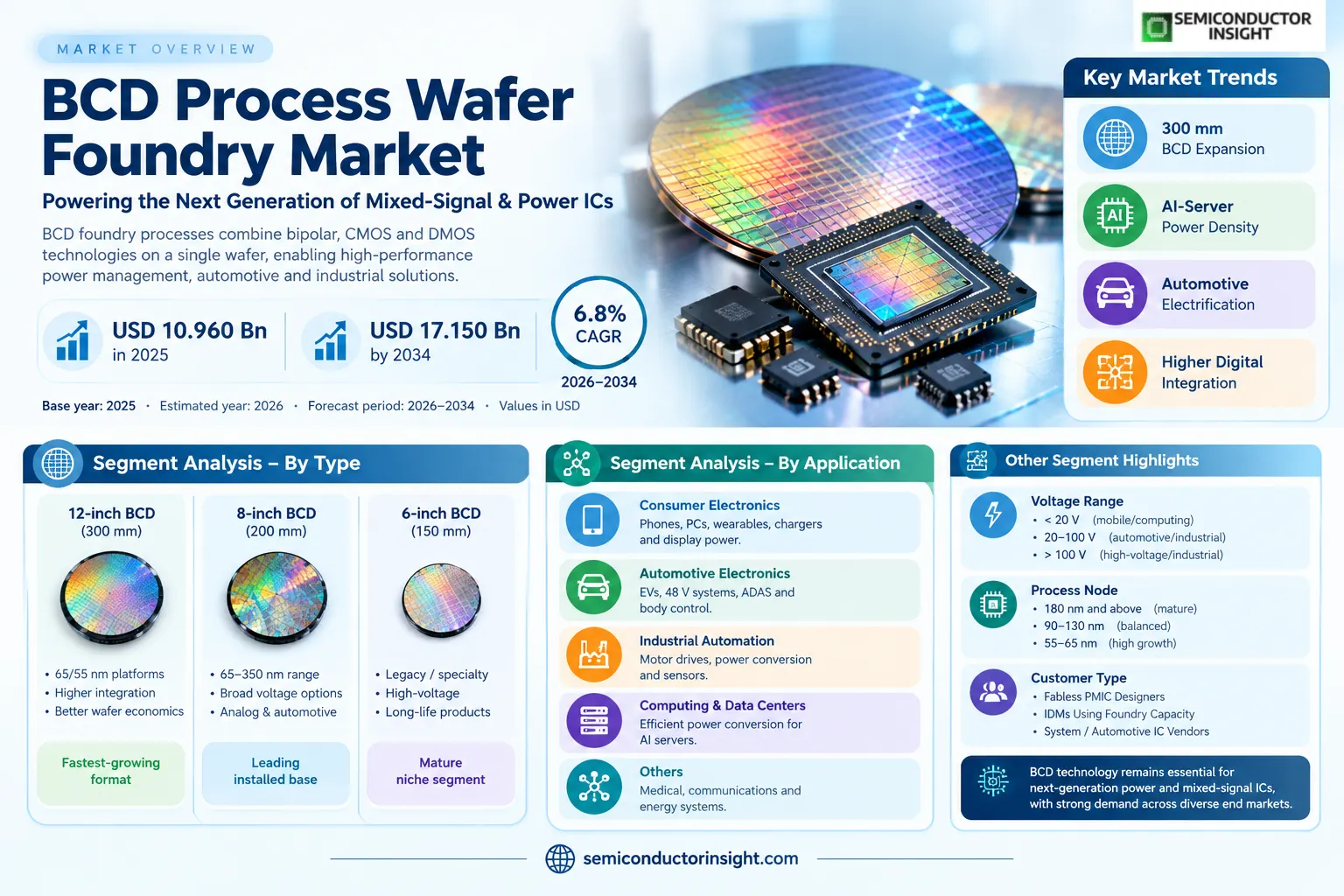
- Market size and growth: the market is valued at USD 10.960 billion in 2025 and is projected to reach USD 17.150 billion by 2034, with a 6.8% CAGR over 2026–2034.
- 8-inch BCD leads by type because 200 mm fabs remain the broadest installed manufacturing base for mature analog and power-management processes across consumer, industrial and automotive devices.
- Consumer Electronics is the leading application because smartphones, PCs, wearables and connected devices consume large volumes of PMICs, chargers, load switches and display or LED power-control ICs.
- Asia Pacific leads regionally, while Asia Pacific offers the strongest incremental growth.
- Primary driver: electrification, AI-server power delivery and consumer electronics are increasing demand for highly integrated PMIC and driver processes
- Principal restraint: specialty fab investment, automotive qualification and mature-node capacity constraints can limit rapid supply expansion
Market Overview
The BCD process wafer foundry market was valued at USD 10.960 billion in 2025 and is projected to reach USD 17.150 billion by 2034, expanding at a 6.8% CAGR over 2026–2034. Asia Pacific leads in 2025, while the market is being reshaped by 300 mm BCD expansion, AI-server power density, automotive electrification and higher digital integration within power-management ICs..
BCD foundry processes integrate bipolar devices, CMOS logic and DMOS power transistors on one wafer platform so designers can combine analog control, digital logic and power switching in a single IC. The technology is central to PMICs, motor drivers, battery-management ICs, load switches, LED drivers and DC-DC converters. Foundries compete on on-resistance, breakdown voltage, embedded memory, isolation, digital density and the ability to manufacture economically on 200 mm or 300 mm wafers.
UMC currently offers BCD nodes from 0.35 micrometer to 55 nm with multiple voltage ratings and embedded OTP, MTP, ROM, eFuse and nonvolatile-memory options. TSMC describes BCD as part of its specialty technology portfolio for mobile, automotive, medical, wearable and IoT applications. These broad platforms illustrate why BCD remains strategically important even as leading-edge logic migrates to much smaller nodes.
Tower Semiconductor is pushing BCD toward higher digital integration and AI power systems. Its 65 nm 300 mm platform supports low-voltage PMICs, while a 2024 expansion added a 3.3 V-based platform for mobile, AI and data-center power management. Tower also offers 180 nm BCD and SOI options extending to high-voltage operation, showing how the market spans both dense low-voltage converters and rugged automotive or industrial drivers.
Segment Analysis: By Type
By type, the market is segmented into 12-inch BCD, 8-inch BCD, 6-inch BCD. 8-inch BCD holds the leading position based on current performance requirements and deployment economics.
| Type | Function / role | Market position |
|---|---|---|
| 12-inch BCD | 300 mm manufacturing for newer 65/55 nm power-management platforms. | Fastest-growing format as digital integration and wafer economics improve. |
| 8-inch BCD | 200 mm BCD across 65–350 nm with broad voltage and device options. | Leading installed base for analog, automotive and industrial PMICs. |
| 6-inch BCD | Legacy or specialty high-voltage processes. | Smaller mature segment serving long-life niche products. |
Commercial implications by type
Wafer diameter is tied to both technology node and fab economics. 200 mm remains highly competitive for many analog and high-voltage products, while 300 mm becomes attractive when die size, digital content and very high volume justify more advanced infrastructure. Customers increasingly value dual-site or geographic redundancy because PMIC supply can constrain entire electronics systems.
Segment Analysis: By Application
By application, demand is segmented into Consumer Electronics, Automotive Electronics, Industrial Automation, Computing & Data Centers, Others. Consumer Electronics is the leading application because it directly links the technology to measurable bandwidth, positioning, power, disinfection or system-efficiency benefits.
| Application | Demand characteristics |
|---|---|
| Consumer Electronics | Largest application across phones, PCs, wearables, chargers and display power. |
| Automotive Electronics | EVs, 48 V systems, body control and ADAS require qualified PMIC and driver technologies. |
| Industrial Automation | Motor drives, power conversion and sensors use rugged analog and high-voltage BCD. |
| Computing & Data Centers | AI servers require efficient multiphase power conversion and high-current control. |
| Others | Medical, communications and energy systems broaden demand. |
By Voltage Range
| Voltage Range | Commercial relevance |
|---|---|
| Below 20 V | Mobile, computing and low-voltage PMICs emphasize low Rdson and dense logic. |
| 20–100 V | Automotive, industrial and battery systems require robust power devices. |
| Above 100 V | High-voltage drivers and SOI BCD serve industrial and specialized power conversion. |
By Process Node
| Process Node | Commercial relevance |
|---|---|
| 180 nm and Above | Mature high-voltage and automotive flows dominate long-lifecycle devices. |
| 90–130 nm | Mid-node platforms balance analog flexibility and digital integration. |
| 55–65 nm | Fast-growing low-voltage platforms target compact PMICs, AI and mobile power. |
By Customer Type
| Customer Type | Commercial relevance |
|---|---|
| Fabless PMIC Designers | Outsource wafer production and rely on foundry PDKs and device libraries. |
| IDMs Using Foundry Capacity | Supplement internal fabs or diversify supply. |
| System / Automotive IC Vendors | Use BCD for highly integrated power-control platforms. |
Regional Analysis
Asia Pacific leads the market because the market analysis identifies Asia as the dominant market because Taiwan, China, South Korea and Japan host major foundries and electronics manufacturing ecosystems. Asia Pacific has the strongest growth profile as demand expands through 300 mm capacity, automotive electrification, consumer electronics scale and domestic power-semiconductor investment.
How does regional demand differ across this market?
Asia Pacific dominates foundry capacity and customer demand, with Taiwan and China especially important in specialty analog manufacturing. North America and Europe contribute high-value automotive, computing and industrial demand, while Middle East foundry activity is concentrated in Israel. Regional strategy increasingly includes multi-site resilience because power-management IC shortages can disrupt complete end systems.
| Region | Position | Growth outlook | Demand profile | Supplier selection |
|---|---|---|---|---|
| Asia Pacific | Largest | Fastest | Foundry and electronics scale | Process breadth, capacity, cost |
| North America | Second | Strong | AI power and automotive | Efficiency, supply resilience |
| Europe | Third | Strong | Automotive and industrial | Voltage range, qualification, lifecycle |
| Middle East | Specialized | Strong | Analog foundry technology | Differentiation and export reach |
| South America | Smaller | Selective | Downstream electronics | Cost and availability |
Competitive Landscape
Competition is led by pure-play foundries with broad specialty-process portfolios, large installed capacity and proven automotive or high-volume manufacturing capability.
TSMC, UMC, GlobalFoundries, Samsung, Tower, SMIC and Hua Hong compete across voltage ranges and wafer sizes. The strongest platforms combine optimized LDMOS, embedded NVM, digital libraries and application-specific isolation options.
UMC’s current BCD offering spans 0.35 micrometer to 55 nm and includes EPI and non-EPI substrates plus OTP, MTP, ROM and eFuse. Tower’s 65 nm platform targets lower-voltage high-integration PMICs while its 180 nm options extend toward 200 V and beyond using bulk and SOI.
The competitive focus is moving toward energy efficiency and manufacturing scale. Tower’s 300 mm 65 nm 3.3 V platform targets AI and data-center power systems, showing that BCD is evolving alongside higher-current computing rather than remaining confined to mature consumer PMICs.
| Competitive tier | Representative participants | Competitive focus |
|---|---|---|
| Global pure-play leaders | TSMC, UMC, GlobalFoundries, Samsung | Scale, process breadth and global customer base |
| Specialty analog foundries | Tower Semiconductor, X-FAB, Vanguard | Differentiated BCD, SOI and automotive process depth |
| Regional challengers | SMIC, Hua Hong, Nexchip and others | Domestic capacity expansion and cost competition |
Companies Profiled
TSMC, UMC, GlobalFoundries, Samsung Foundry, Tower Semiconductor, X-FAB, SMIC, Hua Hong Semiconductor, Vanguard International Semiconductor
Production Capacity Analysis
BCD foundry capacity depends on specialty analog wafer fabs, high-voltage device modules, embedded-memory options, reticle and PDK support, and qualified 200 mm or 300 mm manufacturing lines.
Unlike leading-edge logic, BCD uses a wide span of mature and mid-node technologies. Expanding capacity can involve debottlenecking existing 200 mm fabs or introducing newer 300 mm flows. The process mix matters because one fab may support several voltage and isolation options that are not easily interchangeable.
Automotive and industrial customers add qualification constraints. A capacity increase does not immediately become qualified supply; process changes, equipment moves and second-source sites may need extended reliability validation. This makes stable multi-site manufacturing and PDK compatibility strategically valuable.
Market Dynamics
The market is evolving from mature 200 mm PMIC production toward a two-track model that retains high-voltage specialty flows while adding denser 300 mm BCD for computing and mobile power.
AI servers, electric vehicles and advanced consumer devices all need more efficient power conversion, but they require different voltage and integration profiles. Foundries that can span low-voltage 65/55 nm, mainstream 180 nm and high-voltage SOI can capture more customer roadmaps and reduce the need for customers to qualify multiple vendors.
Market Drivers
Drivers Impact Analysis
| Driver | Impact | Commercial mechanism |
|---|---|---|
| AI and data-center power | High | Higher current and power density increase demand for efficient PMIC and multiphase controllers. |
| Automotive electrification | High | Battery, motor and 48 V systems require rugged BCD power devices. |
| Consumer electronics | High | Phones and PCs use large volumes of PMICs and chargers. |
| Industrial automation | Medium | Motor drivers and power converters sustain mature high-voltage demand. |
AI and data-center power
Higher current and power density increase demand for efficient PMIC and multiphase controllers.
Automotive electrification
Battery, motor and 48 V systems require rugged BCD power devices.
Consumer electronics
Phones and PCs use large volumes of PMICs and chargers.
Industrial automation
Motor drivers and power converters sustain mature high-voltage demand.
Market Restraints
Restraints Impact Analysis
| Restraint | Impact | Commercial mechanism |
|---|---|---|
| Specialty fab capital | High | BCD process modules and 300 mm expansion require large investment. |
| Qualification cycles | High | Automotive customers require long reliability validation. |
| Process fragmentation | Medium | Different voltage and isolation requirements increase platform complexity. |
| Mature-node bottlenecks | Medium | PMIC demand can exceed available analog capacity during electronics upcycles. |
Specialty fab capital
BCD process modules and 300 mm expansion require large investment.
Qualification cycles
Automotive customers require long reliability validation.
Process fragmentation
Different voltage and isolation requirements increase platform complexity.
Mature-node bottlenecks
PMIC demand can exceed available analog capacity during electronics upcycles.
Market Opportunities
300 mm 65 nm BCD
Larger wafers and dense digital integration improve economics for high-volume PMICs.
AI power-management ICs
Server power rails need faster switching and lower conversion loss.
Automotive 48 V
Mild-hybrid and zonal power systems create new voltage requirements.
High-voltage SOI BCD
Isolation and temperature performance create differentiated industrial and automotive value.
Supply Chain Analysis
200 mm and 300 mm analog fabs
Bipolar, CMOS, LDMOS, isolation, eNVM
PDKs, models, standard cells, ESD
PMIC, automotive, industrial and computing IC vendors
Wafer fabs
Specialty equipment and recipes support multiple voltage classes rather than one standardized node.
Process modules
LDMOS on-resistance, isolation and breakdown voltage determine the power-performance envelope.
Design ecosystem
Accurate models and reusable IP shorten customer tape-out cycles.
Customer qualification
Automotive and industrial buyers require long-term process control and traceability.
Recent Developments
2024 — Tower releases 300 mm 65 nm 3.3 V BCD platform
The platform targets high-efficiency power for mobile, AI and data-center applications. Source
Current — UMC supports BCD from 0.35 micrometer to 55 nm
UMC’s platform spans DC-DC, LED drivers, battery management and motor drivers with multiple embedded-memory options. Source
Current — TSMC maintains broad specialty BCD portfolio
TSMC positions BCD across mobile, automotive, medical, wearable and IoT applications. Source
Report Scope & Segmentation
| Attribute | Coverage |
|---|---|
| Market | BCD Process Wafer Foundry |
| Base Year | 2025 |
| Estimated Year | 2026 |
| Forecast Period | 2026–2034 |
| 2025 Market Size | USD 10.960 billion |
| 2026 Estimated Size | USD 11.720 billion |
| 2034 Forecast Size | USD 17.150 billion |
| CAGR | 6.8% (2026–2034) |
| By Type | 12-inch BCD, 8-inch BCD, 6-inch BCD |
| By Application | Consumer Electronics, Automotive Electronics, Industrial Automation, Computing & Data Centers, Others |
| By Voltage Range | Below 20 V, 20–100 V, Above 100 V |
| By Process Node | 180 nm and Above, 90–130 nm, 55–65 nm |
| By Customer Type | Fabless PMIC Designers, IDMs Using Foundry Capacity, System / Automotive IC Vendors |
| Regions | Asia Pacific, North America, Europe, Middle East, South America |
| Companies Profiled | TSMC, UMC, GlobalFoundries, Samsung Foundry, Tower Semiconductor, X-FAB, SMIC, Hua Hong Semiconductor, Vanguard International Semiconductor |
Frequently Asked Questions
What is the BCD process wafer foundry market size in 2025?
The market is valued at USD 10.960 billion in 2025.
What is the projected market size by 2034?
The market is projected to reach USD 17.150 billion by 2034.
What is the CAGR from 2026 to 2034?
The market is expected to expand at a 6.8% CAGR.
Which region leads the market?
Asia Pacific is the largest regional market in 2025.
Which type leads the market?
8-inch BCD is the leading type.
Which application leads demand?
Consumer Electronics is the leading application.
What is the main growth driver?
electrification, AI-server power delivery and consumer electronics are increasing demand for highly integrated PMIC and driver processes.
What is the principal restraint?
specialty fab investment, automotive qualification and mature-node capacity constraints can limit rapid supply expansion.
Where are the strongest opportunities?
300 mm 65/55 nm BCD, AI power converters, 48 V automotive and high-voltage SOI processes.
Which companies are active in the market?
TSMC, UMC, GlobalFoundries, Samsung Foundry, Tower Semiconductor, X-FAB, SMIC, Hua Hong Semiconductor.
Research Sources & Evidence Base
View primary and official evidence used in this overview
- TSMC: Bipolar-CMOS-DMOS Technology — Foundry BCD specialty-process positioning and applications.
- UMC: BCD Technology — 0.35 micrometer to 55 nm BCD, voltage and embedded-memory options.
- Tower Semiconductor: Power Management — 65 nm and 180 nm BCD platform coverage and voltage ranges.
- Tower Semiconductor: 65 nm BCD Power Management — 300 mm low-voltage BCD characteristics.
- Tower Semiconductor: 180 nm BCD Power Management — High-voltage bulk and SOI BCD capability.
- Tower Semiconductor: 300 mm 65 nm 3.3 V BCD Platform — AI/data-center and mobile power-management expansion.

Get Sample Report PDF for Exclusive Insights
Report Sample Includes
- Table of Contents
- List of Tables & Figures
- Charts, Research Methodology, and more...
 Download Sample Report PDF