Market Insights
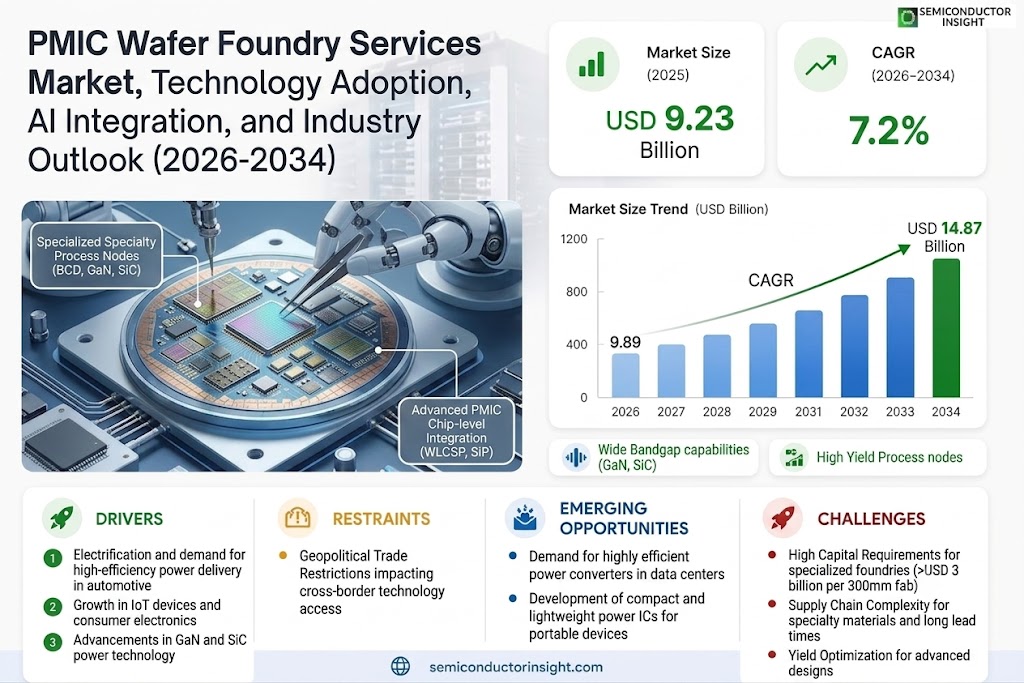
Global PMIC Wafer Foundry Services Market size was valued at USD 9.23 billion in 2025. The market is projected to grow from USD 9.89 billion in 2026 to USD 14.87 billion by 2034, exhibiting a CAGR of 7.2% during the forecast period.
Power Management IC (PMIC) wafer foundry services specialize in manufacturing semiconductor wafers that integrate voltage regulation, power conversion, and energy management functions for electronic devices. These services enable efficient power delivery across applications such as smartphones, automotive electronics, and industrial systems by leveraging advanced fabrication processes like 12-inch and 8-inch wafer technologies.
The market growth is driven by rising demand for energy-efficient electronics, expansion of IoT and 5G networks, and increasing adoption of electric vehicles. Leading foundries such as TSMC and Samsung Foundry are investing in capacity expansions to meet demand, while innovations in gallium nitride (GaN) and silicon carbide (SiC) technologies further enhance power efficiency. However, supply chain constraints and geopolitical factors pose challenges to sustained growth.
MARKET DRIVERS
Growing Demand for Advanced Power Management ICs
PMIC Wafer Foundry Services Market is witnessing strong growth driven by increasing demand for energy-efficient power management solutions across consumer electronics, automotive, and industrial applications. The rise of 5G, IoT, and AI technologies has significantly boosted the need for specialized PMICs, with Global market projected to grow at a CAGR of 8.2% from 2023 to 2030.
Shift Toward Specialty Process Nodes
Foundries are experiencing increased demand for PMIC wafer services at 40nm and finer process nodes, as these enable higher integration and better power efficiency. Leading semiconductor companies are outsourcing PMIC production to focus on design innovation, creating a USD 2.4 billion opportunity for foundry services.
Recent supply chain disruptions have also accelerated the trend of dual-sourcing strategies, with many fabless companies expanding their foundry partnerships for PMIC production.
MARKET CHALLENGES
High Capital Requirements for PMIC Production
Establishing PMIC wafer foundry capabilities requires significant investment in specialized equipment and process technologies. The average cost to equip a 300mm wafer fab for PMIC production exceeds USD 3 billion, creating substantial barriers to entry.
Other Challenges
Supply Chain Complexity
PMIC wafer production involves complex supply chains for specialty materials like silicon carbide and gallium nitride, with lead times often exceeding 6 months for certain substrates.
Yield Optimization
Achieving high yields for advanced PMIC designs remains challenging, with initial yields typically below 60% for new product introductions at leading-edge nodes.
MARKET RESTRAINTS
Geopolitical Trade Restrictions
Export controls and trade restrictions are impacting Global PMIC Wafer Foundry Services Market, particularly in the US-China technology sector. Recent regulations have reduced Chinese access to advanced PMIC manufacturing technologies by approximately 35%, according to industry estimates.
MARKET OPPORTUNITIES
Emerging Wide Bandgap Semiconductor Demand
PMIC Wafer Foundry Services Market is poised for growth in gallium nitride (GaN) and silicon carbide (SiC) power IC production, with these technologies expected to capture 25% of the power semiconductor market by 2027. Foundries investing in wide bandgap capabilities are gaining first-mover advantages.
Automotive Electrification Expansion
Electric vehicle proliferation is creating new opportunities for PMIC wafer foundries, with automotive PMIC content per vehicle expected to triple by 2025 due to increasing ADAS and infotainment system requirements.
PMIC Wafer Foundry Services Market Trends
Growing Demand for Energy-Efficient Semiconductor Solutions
PMIC Wafer Foundry Services Market industry is experiencing significant growth driven by increasing demand for power-efficient semiconductor solutions. Power Management ICs play a critical role in optimizing energy consumption across various electronic devices, from smartphones to automotive systems. Major foundries are expanding their PMIC production capabilities to meet this rising demand while maintaining high yield rates.
Other Trends
Transition to Larger Wafer Sizes
Foundries are increasingly focusing on 12-inch wafer production for PMIC manufacturing, as it offers better cost efficiency and higher throughput compared to 8-inch and 6-inch alternatives. This transition is particularly evident among leading foundry service providers, though some specialized applications continue to utilize smaller wafer sizes for legacy products.
Expansion of Automotive and Industrial Applications
The automotive sector represents one of the fastest-growing segments for PMIC wafer foundry services, driven by increasing vehicle electrification and advanced driver assistance systems. Industrial applications are also contributing to market growth, particularly in power management for IoT devices and smart infrastructure solutions. Foundries are adapting their processes to meet the stringent quality requirements of these sectors.
Geographical Market Shifts
Asia continues to dominate PMIC wafer foundry services, with Taiwan, China, and South Korea maintaining strong positions. However, there’s growing investment in North America and Europe as part of broader semiconductor supply chain diversification efforts. This geographical expansion is creating new opportunities for foundry service providers worldwide.
Technological Advancements in PMIC Manufacturing
Leading foundries are investing in advanced process technologies to improve PMIC performance and power efficiency. These developments include finer process nodes, specialized packaging solutions, and improved power delivery architectures. The competitive landscape is intensifying as major players continuously enhance their manufacturing capabilities to serve the evolving needs of PMIC designers.
COMPETITIVE LANDSCAPE
Key Industry Players
TSMC and Samsung Dominate with 45% Combined Market Share in PMIC Wafer Foundry Services
Taiwan Semiconductor Manufacturing Company (TSMC) and Samsung Foundry lead Global PMIC Wafer Foundry Services Market, commanding significant technological and production capacities. The market exhibits a moderately concentrated structure, with the top five players accounting for approximately 65% of total revenue. These leaders benefit from advanced process nodes (12-inch and 8-inch wafer capabilities), strong R&D investments, and established client relationships with major fabless semiconductor companies.
Several regional foundries have carved out specialized positions in the PMIC market. Chinese players like SMIC and Hua Hong Semiconductor are gaining traction with government support and localized supply chains. Pure-play foundries such as GlobalFoundries and UMC maintain strong positions in automotive-grade PMIC production, while specialty foundries like X-FAB and Tower Semiconductor focus on niche applications requiring high-reliability PMICs.
List of Key PMIC Wafer Foundry Companies Profiled
- Taiwan Semiconductor Manufacturing Company (TSMC)
- Samsung Foundry
- GlobalFoundries
- United Microelectronics Corporation (UMC)
- Semiconductor Manufacturing International Corporation (SMIC)
- Tower Semiconductor
- Powerchip Semiconductor Manufacturing Corp (PSMC)
- Vanguard International Semiconductor (VIS)
- Hua Hong Semiconductor
- HLMC (Huahong Grace Semiconductor)
- X-FAB Silicon Foundries
- DB HiTek
- Nexchip Semiconductor
- Intel Foundry Services (IFS)
- GTA Semiconductor Co., Ltd.
Segment Analysis:
| Segment Category | Sub-Segments | Key Insights |
| By Type |
|
12-inch PMIC Wafer Foundry dominates due to superior economies of scale and higher production efficiency in large-scale semiconductor manufacturing, while 8-inch remains preferred for legacy nodes and specialized applications. The market sees:
|
| By Application |
|
Smart Phone leads as the most demanding application for advanced PMIC solutions, creating sustained demand for foundry services. Key trends include:
|
| By End User |
|
Fabless Semiconductor Companies are the primary consumers of wafer foundry services, driving innovation and volume demand. Notable observations:
|
| By Technology Node |
|
Mature Nodes (40nm-90nm) represent the sweet spot for PMIC production with optimal performance and cost. Market characteristics:
|
| By Geographic Demand |
|
Asia Pacific serves as both the production hub and largest consumption region for PMIC wafer foundry services. Regional dynamics:
|
Regional Analysis: Global PMIC Wafer Foundry Services Market
Asia-Pacific
Asia-Pacific foundries lead in advanced PMIC manufacturing technologies, including BCD (Bipolar-CMOS-DMOS) processes and specialized power packaging solutions. The region is pioneering AI-based predictive maintenance for PMIC wafer production lines.
Concentrated semiconductor ecosystem enables efficient PMIC wafer production, with mature substrate suppliers, packaging houses, and testing facilities located within close proximity. This vertical integration reduces lead times for PMIC solutions.
Regional foundries are developing specialized PMIC processes for electric vehicles, including high-voltage battery management ICs. Collaborations with Asian automakers drive customized PMIC wafer service offerings.
Increasing deployment of 5G base stations across Asia is creating strong demand for power-efficient PMIC solutions. Foundries are offering dedicated RF power management wafer services for telecom applications.
North America
The North American PMIC Wafer Foundry Services Market is characterized by specialized analog/mixed-signal capabilities and strong R&D focus. While lacking large-scale pure-play foundries, the region excels in high-value PMIC solutions for aerospace and defense applications. Fabless semiconductor companies drive demand for specialized PMIC wafer services, with increasing requirements for AI-optimized power management in data centers. Emerging collaborations between university research labs and foundries are advancing next-generation PMIC technologies.
Europe
European PMIC wafer foundries focus on automotive and industrial applications, with strong capabilities in high-reliability power management solutions. The region benefits from stringent energy efficiency regulations driving innovation in PMIC architectures. Specialty foundries are developing low-power PMIC processes for IoT devices and smart energy applications. Strategic partnerships between equipment manufacturers and foundries are enhancing PMIC manufacturing capabilities.
South America
South America’s emerging PMIC Wafer Foundry Services Market primarily serves regional consumer electronics and automotive needs. The market is characterized by technology transfers from global foundries and increasing investments in power management solutions for renewable energy systems. Local governments are supporting semiconductor infrastructure development to reduce dependence on imported PMIC components.
Middle East & Africa
The PMIC Wafer Foundry Services Market in this region is in early development stages, focusing on establishing basic semiconductor manufacturing capabilities. Strategic investments in power management solutions for oil/gas equipment and telecom infrastructure are creating niche opportunities. Partnerships with Asian foundries are helping build foundational PMIC wafer processing expertise.
Report Scope
This market research report provides a comprehensive analysis of the PMIC Wafer Foundry Services Market, covering the forecast period 2025–2034. It offers detailed insights into market dynamics, technological advancements, competitive landscape, and key trends shaping the industry.
Key focus areas of the report include:
- Market Overview: The report begins with an overview outlining its current market scenario, key growth indicators, and industry transformation drivers. It discusses macroeconomic factors, demand-supply balance, regulatory landscape, and the strategic role of semiconductors in powering advancements across industries such as automotive, telecommunications, consumer electronics, and industrial automation.
- Market Size & Forecast: Historical data and future projections for revenue, unit shipments, and market value across major regions and segments.
- Segmentation Analysis: Detailed breakdown by product type, technology, application, and end-user industry to identify high-growth segments and investment opportunities.
- Regional Insights: Insights into market performance across North America, Europe, Asia-Pacific, Latin America, and the Middle East & Africa, including country-level analysis where relevant.
- Competitive Landscape: Profiles of leading market participants, including their product offerings, R&D focus, manufacturing capacity, pricing strategies, and recent developments such as mergers, acquisitions, and partnerships.
- Technology Trends & Innovation: Assessment of emerging technologies, integration of AI/IoT, semiconductor design trends, fabrication techniques, and evolving industry standards.
- Market Drivers & Restraints: Evaluation of factors driving market growth along with challenges, supply chain constraints, regulatory issues, and market-entry barriers.
- Stakeholder Insights: Insights for component suppliers, OEMs, system integrators, investors, and policymakers regarding the evolving ecosystem and strategic opportunities.
Primary and secondary research methods are employed, including interviews with industry experts, data from verified sources, and real-time market intelligence to ensure the accuracy and reliability of the insights presented.
FREQUENTLY ASKED QUESTIONS:
What is the current market size of PMIC Wafer Foundry Services Market?
-> PMIC Wafer Foundry Services Market size was valued at USD 9.23 billion in 2025. The market is projected to grow from USD 9.89 billion in 2026 to USD 14.87 billion by 2034, exhibiting a CAGR of 7.2% during the forecast period.
Which key companies operate in PMIC Wafer Foundry Services Market?
-> Key players include TSMC, Samsung Foundry, GlobalFoundries, United Microelectronics Corporation (UMC), SMIC, Tower Semiconductor, PSMC, VIS (Vanguard International Semiconductor), Hua Hong Semiconductor, HLMC, X-FAB, DB HiTek, Nexchip, Intel Foundry Services (IFS), GTA Semiconductor Co., Ltd., CanSemi, Polar Semiconductor, LLC, Silterra, SK keyfoundry Inc.
What are the key growth drivers?
-> Key growth drivers include rising demand for power-efficient electronic devices, environmental protection trends, and advancements in semiconductor fabrication technologies.
Which region dominates the market?
-> Asia-Pacific dominates the market with significant contributions from China, Japan, and South Korea, driven by strong semiconductor manufacturing capabilities and growing electronics industries.
What are the emerging trends?
-> Emerging trends include increasing adoption of 12-inch wafers, integration of AI/IoT in power management solutions, and sustainable semiconductor manufacturing practices.
Get Sample Report PDF for Exclusive Insights
Report Sample Includes
- Table of Contents
- List of Tables & Figures
- Charts, Research Methodology, and more...
 Download Sample Report PDF