Battery Temperature Sensor Market Insights
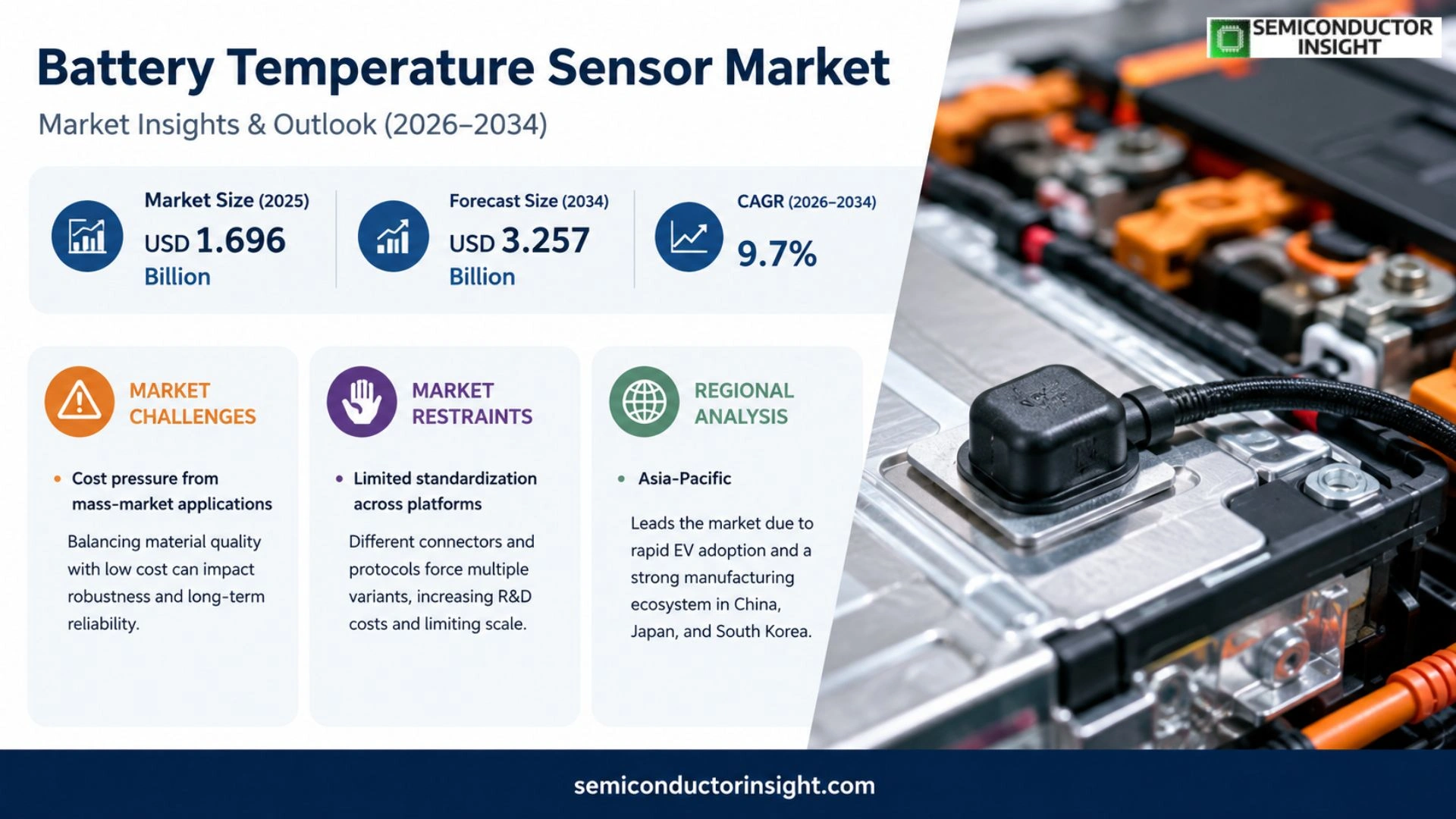
Battery Temperature Sensor market was valued at USD 1.696 billion in 2025 and will climb to approximately USD 3.257 billion by 2034, reflecting a compound annual growth rate of about 9.7% over that span.
A battery temperature sensor is an electronic component that continuously monitors the surface or internal temperature of individual battery cells or modules. Typically based on NTC thermistors, PTC elements, or digital temperature‑chip technology, these sensors deliver high accuracy, rapid response times, and resistance to chemical corrosion. Integration into battery management systems of electric vehicles, stationary energy‑storage installations, and consumer electronics helps prevent overheating, ensures safe charge‑discharge cycles, and supports optimized thermal‑management strategies.
MARKET DRIVERS
Stringent safety regulations in electric mobility
Battery Temperature Sensor Market is gaining momentum as automotive safety standards tighten. Regulators now require real‑time thermal monitoring to prevent thermal runaway, prompting OEMs to embed more precise sensors within battery packs. This shift translates into higher component orders and a scramble among suppliers to certify their products against the new benchmarks.
Demand for higher energy density cells
Manufacturers pursuing greater energy density are forced to confront tighter thermal margins. As cell chemistry evolves, the heat generated during fast charging escalates, making accurate temperature sensing indispensable. Companies that can deliver sensors with millisecond response times are positioned to capture a larger share of the emerging high‑performance segment.
➤ “Without reliable thermal feedback, the cost of warranty claims and recall risk outweighs the upside of higher capacity cells.”
Consequently, system integrators are prioritizing sensor‑fusion architectures that combine temperature data with state‑of‑charge analytics. This integrative approach not only improves safety but also unlocks smarter battery‑management strategies, reinforcing the growth trajectory of Battery Temperature Sensor Market.
MARKET CHALLENGES
Cost pressure from mass‑market applications
While premium EVs can absorb higher sensor costs, the broader automotive fleet demands aggressive price points. Tier‑1 suppliers are forced to balance material quality against unit cost, often leading to compromises in robustness that can affect long‑term reliability. This tension hampers widespread adoption beyond high‑end models.
Other Challenges
Supply‑chain volatility
The reliance on rare‑earth alloys for high‑precision thermocouples creates exposure to geopolitical fluctuations. When export restrictions tighten, lead times extend, and manufacturers may face inventory shortages that ripple through production schedules.
MARKET RESTRAINTS
Limited standardization across vehicle platforms
Automotive manufacturers continue to employ disparate connector types and communication protocols, preventing economies of scale for sensor makers. The lack of a unified interface forces vendors to develop multiple variants, inflating R&D expenses and diluting focus.
MARKET OPPORTUNITIES
Growth of stationary energy‑storage installations
Utility‑scale battery farms are scaling rapidly, and each megawatt‑hour of capacity requires dozens of temperature monitoring points. This creates a parallel revenue stream for sensor providers that can adapt automotive‑grade technology to stationary contexts, where durability and remote diagnostics are paramount.
Furthermore, the rise of predictive‑maintenance platforms invites partnerships between sensor manufacturers and data‑analytics firms. By bundling sensor hardware with cloud‑based monitoring services, vendors can capture recurring revenue while delivering actionable insights that reduce downtime for grid operators.
Battery Temperature Sensor Market Trends
Shift Toward Integrated MEMS Sensors
The latest production data show that in 2024 roughly 155 million units were shipped, yielding an average price of US$12 each. Manufacturers are converting legacy NTC thermistors into MEMS‑based chips that combine temperature, voltage and pressure sensing within a millimetre‑scale package. This miniaturization trims wiring complexity and cuts board‑space requirements, directly addressing the packaging constraints of electric‑vehicle battery packs. The transition also improves measurement accuracy to within ±0.5 °C and shortens response time, which translates into tighter thermal control loops for high‑energy‑density cells. Companies that succeed in scaling MEMS fabrication are able to command gross margins near the upper end of the 25‑45 % range, because the added functionality justifies premium pricing while volume efficiencies drive unit cost down. The strategic move toward integrated sensors is therefore reshaping the value chain: upstream silicon‑process suppliers become critical partners, and downstream system integrators gain leverage by embedding richer data streams into their BMS architectures.
Other Trends
Multi‑Point Distributed Monitoring
Automakers and energy‑storage operators are moving from single‑sensor schemes to cell‑level, multi‑point networks. Deploying a sensor on each cell enables real‑time thermal mapping across the entire pack, exposing hot‑spots that would otherwise remain hidden until a failure escalates. This granular visibility supports more aggressive charging protocols, which in turn improves vehicle range and reduces turnaround time for stationary storage facilities. The trade‑off is higher component count, but advances in low‑cost packaging and batch calibration are keeping per‑sensor expenditures in check. As a result, the adoption curve for distributed monitoring is steepening, prompting OEMs to revise their design specifications to include sensor density as a key performance metric.
AI‑Enabled Thermal Runaway Prediction
With BMS architectures converging on domain‑control platforms, temperature data is increasingly fed into machine‑learning models that forecast thermal runaway several seconds before it manifests. These predictive algorithms ingest high‑frequency readings from the MEMS array, correlate them with voltage, current and impedance signatures, and output an early‑warning flag that triggers protective actions such as load shedding or forced cooling. The practical upside is a measurable reduction in warranty claims and a stronger safety narrative for end‑users, which can be leveraged in marketing campaigns and regulatory filings. Vendors that bundle AI analytics with their sensor offerings are positioning themselves as turnkey solution providers, blurring the line between hardware and software revenue streams. This evolution underscores a broader industry shift: Battery Temperature Sensor Market is no longer defined solely by physical component specs, but by the intelligence that can be derived from those measurements.
COMPETITIVE LANDSCAPE
Key Industry Players
Battery temperature sensor market – competitive overview
Among the manufacturers, NXP Semiconductors, TDK and Murata dominate the upper tier, leveraging vertically integrated semiconductor fabs and extensive BMS partnerships with major EV OEMs. NXP’s portfolio blends digital temperature ICs with integrated voltage monitoring, enabling tighter package footprints that accommodate the aggressive miniaturization trends in high‑energy‑density cells. TDK’s thermistor‑based solutions retain cost advantages in mass‑produced passenger‑car batteries, while simultaneously expanding into solid‑state battery modules where its multilayer ceramic sensors deliver ±0.3 °C accuracy. Murata’s adoption of MEMS‑type temperature chips, combined with its global footprint in automotive electronics, positions it as a primary supplier for both automotive and stationary‑storage applications. The concentration of these three firms accounts for roughly 45 % of global shipments, forcing mid‑size players to specialize in niche segments such as wireless passive sensors or fiber‑optic temperature monitoring to capture differentiated demand.
The remainder of the landscape is populated by a mix of specialist and regionally focused manufacturers. AKCP and JR Sensors have carved out footholds in industrial power‑supply and railway electrification, where ruggedized packages and long‑term reliability outweigh pure cost considerations. Proponent Battery Services GmbH and ATC Semitec concentrate on European EV‑battery pack integrators, offering calibrated sensor kits that include firmware‑level thermal‑runaway analytics. Infineon Technologies and TE Connectivity bring broader semiconductor and connectivity expertise, allowing them to embed temperature sensing directly into BMS ASICs and high‑density wiring harnesses, respectively. Companies such as IEE, Morningstar and Focusens are active in emerging markets, supplying low‑price NTC thermistor arrays for consumer electronics and low‑speed electric scooters. The strategic move toward distributed, cell‑level sensing is prompting many of these firms to invest in MEMS and wireless modules, a shift that could reorder market share if scalability hurdles are overcome.
List of Key Battery Temperature Sensor Companies Profiled
- NXP Semiconductors
- TDK
- Murata Manufacturing
- AKCP
- JR Sensors
- Amphenol Advanced Sensors
- Infineon Technologies
- Proponent Battery Services GmbH
- ATC Semitec
- IEE
- Morningstar
- Focusens
- Limitor
- TE Connectivity
- ams OSRAM
Segment Analysis:
| Segment Category | Sub-Segments | Key Insights |
| By Type |
|
NTC Thermistor Sensor dominates early‑stage deployments because it offers a reliable balance of cost, durability and temperature accuracy. – Proven performance in harsh automotive environments. – Simple integration with existing BMS architectures. – Enables widespread adoption across entry‑level electric vehicles and battery packs. |
| By Application |
|
Energy Storage Batteries are the primary growth engine as large‑scale installations demand precise thermal control to ensure safety and longevity. – Supports grid‑level reliability through distributed temperature monitoring. – Enables advanced thermal management strategies that extend cycle life. – Aligns with regulatory focus on safety for stationary storage systems. |
| By End User |
|
Automotive OEMs prioritize sensor solutions that integrate tightly with vehicle BMS and support emerging domain‑control architectures. – Demand for multi‑point cell‑level monitoring to prevent thermal runaway. – Preference for sensors that can feed AI‑driven predictive safety algorithms. – Require rugged designs that withstand vibration and wide temperature ranges. |
| By Technology |
|
Integrated Multi‑parameter Sensors are gaining traction as they combine temperature, voltage and pressure sensing in a single chip, simplifying system design. – Reduces wiring complexity and improves reliability. – Facilitates real‑time data fusion for advanced BMS analytics. – Supports the shift toward compact battery modules in electric vehicles. |
| By Output Signal |
|
Digital Output Sensors are preferred for next‑generation BMS because they provide precise, noise‑immune data streams directly to control units. – Enable seamless integration with automotive Ethernet and CAN‑FD networks. – Support firmware upgrades that add intelligence over the product life. – Align with industry moves toward centralized computing and over‑the‑air updates. |
Regional Analysis: Battery Temperature Sensor Market
Asia‑Pacific
Governments across the region are tightening safety standards for high‑energy batteries, mandating real‑time temperature monitoring. Compliance requirements are prompting manufacturers to certify sensors against rigorous test protocols, boosting demand for validated solutions.
Proximity of semiconductor fabs to battery pack assemblers shortens lead times. However, periodic raw‑material shortages push suppliers to diversify sources and adopt flexible production schedules to meet OEM timelines.
Local R&D hubs are experimenting with flexible printed sensors and AI‑driven thermal prognostics. These advances aim to shrink form factor while delivering predictive alerts that can pre‑empt overheating events.
End‑users are moving beyond simple threshold alarms toward integrated solutions that couple temperature data with battery management systems, seeking holistic insights that extend cycle life.
North America
The United States and Canada are leveraging mature automotive supply chains to embed Battery Temperature Sensors in a growing portfolio of electric trucks and utility vehicles. Safety‑first regulation from agencies such as NHTSA encourages manufacturers to adopt redundant thermal monitoring, while commercial customers prioritize sensor durability for harsh climate operation. With a strong emphasis on data integration, North American firms are aligning sensor outputs with cloud‑based analytics platforms, creating opportunities for service‑based revenue models.
Europe
European automakers are driven by strict CO₂ emission targets that accelerate electric vehicle rollouts across Germany, France, and the Nordics. The regulatory environment, exemplified by the EU’s type‑approval framework, insists on continuous temperature logging, compelling suppliers to certify products for cross‑border compatibility. Simultaneously, the region’s emphasis on circular economy principles pushes manufacturers to select sensors that are recyclable and supported by extended warranty schemes.
South America
In Brazil and Argentina, nascent electric bus programs are sparking interest in reliable thermal management. Limited charging infrastructure places a premium on battery safety, and local fleets are opting for sensors that can operate under high ambient temperatures. The market is still fragmented, but partnerships between global sensor makers and regional distributors are beginning to standardize performance criteria.
Middle East & Africa
Rapid urbanization and government incentives for clean transport in the Gulf states are fostering early adoption of Battery Temperature Sensors in taxis and delivery fleets. Harsh desert conditions demand sensors with enhanced temperature tolerance and robust sealing. In Africa, pilot projects for solar‑charged micro‑grids are exploring sensor integration to protect stationary storage assets from thermal excursions.
Report Scope
This market research report provides a comprehensive analysis of the Battery Temperature Sensor Market , covering the forecast period 2026–2034. It offers detailed insights into market dynamics, technological advancements, competitive landscape, and key trends shaping the industry.
Key focus areas of the report include:
- Market Overview: The report begins with an overview outlining its current market scenario, key growth indicators, and industry transformation drivers. It discusses macroeconomic factors, demand–supply balance, regulatory landscape, and the strategic role of semiconductors in powering advancements across industries such as automotive, telecommunications, consumer electronics, and industrial automation.
- Market Size & Forecast: Historical data and future projections for revenue, unit shipments, and market value across major regions and segments.
- Segmentation Analysis: Detailed breakdown by product type, technology, application, and end-user industry to identify high-growth segments and investment opportunities.
- Regional Insights: Insights into market performance across North America, Europe, Asia-Pacific, Latin America, and the Middle East & Africa, including country-level analysis where relevant.
- Competitive Landscape: Profiles of leading market participants, including their product offerings, R&D focus, manufacturing capacity, pricing strategies, and recent developments such as mergers, acquisitions, and partnerships.
- Technology Trends & Innovation: Assessment of emerging technologies, integration of AI/IoT, semiconductor design trends, fabrication techniques, and evolving industry standards.
- Market Drivers & Restraints: Evaluation of factors driving market growth along with challenges, supply chain constraints, regulatory issues, and market-entry barriers.
- Stakeholder Insights: Insights for component suppliers, OEMs, system integrators, investors, and policymakers regarding the evolving ecosystem and strategic opportunities.
Primary and secondary research methods are employed, including interviews with industry experts, data from verified sources, and real-time market intelligence to ensure the accuracy and reliability of the insights presented.
FREQUENTLY ASKED QUESTIONS:
What is the current market size of Battery Temperature Sensor Market?
-> Battery Temperature Sensor market will climb to approximately USD 3.257 billion by 2034, reflecting a compound annual growth rate of about 9.7%
Which key companies operate in Battery Temperature Sensor Market?
-> Key players include NXP Semiconductors, TDK, Murata, AKCP, JR Sensors, Amphenol Advanced Sensors, Infineon Technologies, Proponent Battery Services GmbH, ATC Semitec, IEE, Morningstar, Focusens, Limitor, XJ BMS, Bosch Mobility, Tosida, TE Connectivity, TOPOS, ams OSRAM.
What are the key growth drivers?
-> Key growth drivers include enhanced safety requirements for electric vehicles and energy‑storage systems, increasing adoption of multi‑point temperature monitoring, and the integration of sensor data into AI‑based thermal‑runaway early‑warning models.
Which region dominates the market?
-> Asia leads the market, driven by rapid electric‑vehicle adoption, large‑scale battery manufacturing hubs, and extensive energy‑storage deployments, while North America and Europe follow as significant contributors.
What are the emerging trends?
-> Emerging trends include miniaturized MEMS‑based multi‑function sensors, fiber‑optic and wireless passive temperature sensing solutions, and the convergence of temperature, voltage, and pressure sensing on a single chip to support AI‑enabled battery management.

Get Sample Report PDF for Exclusive Insights
Report Sample Includes
- Table of Contents
- List of Tables & Figures
- Charts, Research Methodology, and more...
 Download Sample Report PDF