Battery Supervisor and Monitor ICs Market Insights
Battery Supervisor and Monitor ICs market size was valued at USD 1099 million in 2025. The market is projected to grow from USD 1099 million in 2025 to USD 2120 million by 2034, exhibiting a CAGR of 10.0% during the forecast period.
Battery Supervisor and Monitor ICs are analog‑mixed‑signal devices placed at cell, module or pack level that continuously measure voltage, current, temperature and open‑wire status, detect over‑charge, over‑discharge, over‑current, short‑circuit or over‑temperature events, and then execute balancing, fault reporting, shutdown or coordinated control with an upper‑level controller. Their functionality has expanded from simple single‑cell protection to multicell monitoring, active/passive balancing, stack current sensing and isolated daisy‑chain communication, serving electric vehicles, stationary storage, UPS systems and power tools.
According to the International Energy Agency, battery demand in the energy sector reached 1 TWh in 2024 while EV battery shipments exceeded 950 GWh; electric‑car sales reached 21 million units in 2025approximately one out of four new cars sold. This acceleration raises safety‑critical monitoring requirements and pushes suppliers toward higher accuracy chips equipped with functional‑safety certification and integrated system designs.
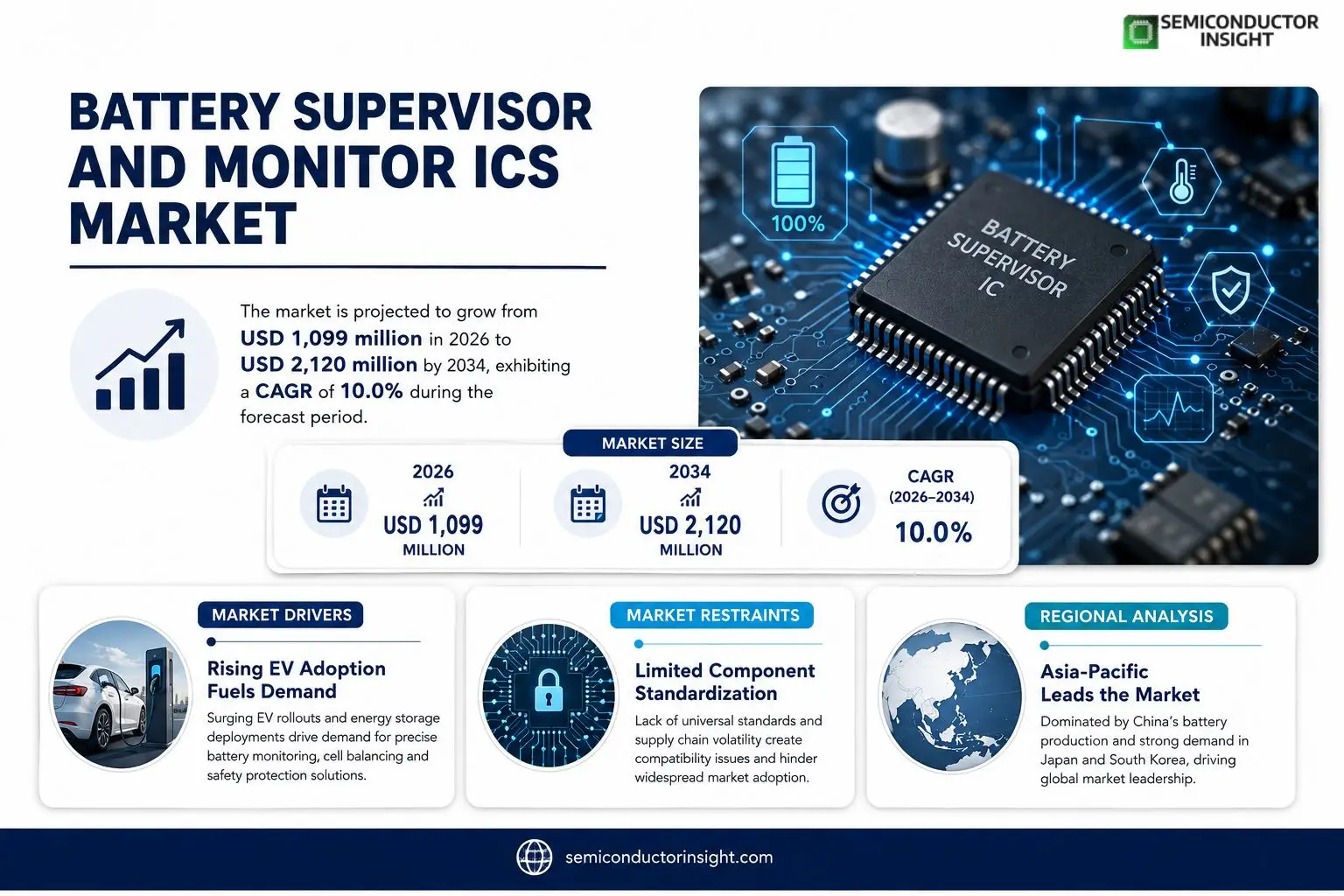
MARKET DRIVERS
Rising EV Adoption Fuels Demand
The acceleration of electric‑vehicle roll‑outs has compelled OEMs to prioritize battery reliability. Battery Supervisor and Monitor ICs Market participants are seeing heightened interest because manufacturers need precise cell‑balancing and over‑voltage protection to safeguard high‑capacity packs. This pressure translates into faster specification cycles and larger procurement orders.
Stringent Safety Regulations Shape Design
safety directives now mandate real‑time monitoring of temperature, state‑of‑charge and fault conditions. Companies that embed robust supervisory functions into their silicon gain a compliance advantage, allowing them to enter regulated markets more swiftly. The regulatory tide is therefore a catalyst that pushes silicon vendors to embed richer diagnostics.
➤ Industry analysts note that a 10‑percentage‑point uplift in safety‑related specifications over the next two years will directly expand the addressable market for supervisory ICs.
These forces converge to reshape the procurement landscape, prompting design teams to replace legacy discrete components with integrated monitoring solutions that promise lower board count and improved manufacturability.
MARKET CHALLENGES
Design Integration Hurdles
Embedding supervisory functionality into increasingly compact power architectures introduces layout constraints and signal‑integrity concerns. Engineers must reconcile low‑noise analog front‑ends with high‑frequency digital control loops, a balance that often extends development timelines.
Other Challenges
Cost Pressure
End‑users demand higher performance at tighter unit prices, forcing IC vendors to optimise silicon real estate while maintaining accuracy and reliability.
MARKET RESTRAINTS
Limited Component Standardization
Absent a universally accepted pin‑out or communication protocol, system designers frequently encounter compatibility friction when swapping suppliers. This fragmentation discourages broader adoption, especially among OEMs seeking a single‑source solution.
Supply-chain volatility for silicon wafers and passive components adds another layer of uncertainty. Sudden shortages can delay production ramps, prompting manufacturers to keep larger safety stocks and eroding the cost advantage of newer supervisory ICs.
High qualification costs for automotive and aerospace certifications further restrain market entry. Even proven designs must undergo rigorous testing, a process that can consume months and substantial engineering resources.
MARKET OPPORTUNITIES
Emerging Portable Power Segments
Wearable electronics and low‑power IoT devices are embracing rechargeable chemistries that operate within narrow voltage windows. Supervisory ICs offering ultra‑low quiescent current and compact packages present a clear value proposition for these markets.
Smart‑grid storage installations require granular monitoring across large battery banks. Solutions that combine cell‑level telemetry with cloud‑ready interfaces enable operators to optimise charge cycles and extend asset lifespan.
Customizable firmware platforms are becoming a differentiator, allowing OEMs to tailor alarm thresholds and reporting cadence without redesigning silicon. This flexibility opens a revenue stream for vendors that can deliver configurable, software‑driven supervision.
Battery Supervisor and Monitor ICs Market Trends
Integration of Safety, Balancing and Communication Functions
Battery Supervisor and Monitor ICs Market is undergoing a decisive move from discrete protection blocks to highly integrated silicon solutions. Vendors now embed voltage, temperature, current sensing, fault detection, passive‑balancing networks and ISO‑qualified communication channels inside a single die. This consolidation trims bill‑of‑materials, cuts board‑level wiring, and satisfies automotive functional‑safety audits with fewer external components. As electric‑vehicle packs expand to 14‑cell and 25‑cell configurations, the demand for accurate stack‑level monitoring outpaces the capacity of legacy single‑cell protectors. Integrated devices therefore capture a larger share of the value chain, prompting manufacturers to position these chips as the primary safety node rather than an after‑thought add‑on.
Other Trends
Technology Consolidation Across Cell Counts
Three product families now dominate Battery Supervisor and Monitor ICs Market: single‑cell protectors, multicell monitors with active or passive balancing, and high‑voltage stack controllers that support isolated daisy‑chain networks. The multicell segment is gaining traction because it meets the emerging requirement for open‑wire diagnostics and precise coulomb counting in traction batteries. Simultaneously, high‑voltage stack controllers address the need for redundant communication pathways, improving fault tolerance in megawatt‑scale storage installations. This stratification reflects a market response to tighter safety regulations such as the EU Batteries Regulation and UNECE R100, which penalize designs that rely on multiple discrete components.
Regional Supply‑Demand Divergence
While China produces roughly 80 % of the world’s battery cells, the supply of Battery Supervisor and Monitor ICs remains geographically diversified. European and U.S. firms focus on automotive‑grade, high‑reliability parts, leveraging long‑term qualification programs to lock in OEM contracts. Japanese suppliers retain deep expertise in precise lithium‑ion monitoring, whereas Taiwanese and mainland Chinese companies compete on cost‑effective single‑cell protectors for consumer and power‑tool applications. This split creates a layered ecosystem: high‑volume battery assemblers source safety‑critical ICs from the West for premium EV platforms, while cost‑sensitive market segments source from East Asian players. The resulting dynamic suggests that profit opportunities will cluster around devices that combine high accuracy, robust safety features, and reusable platforms across multiple vehicle architectures.
COMPETITIVE LANDSCAPEKey Industry Players
Battery Supervisor and Monitor ICs – Competitive Overview
Texas Instruments remains the market anchor, leveraging its broad analog portfolio and deep automotive‑grade qualification to dominate high‑voltage, multi‑cell segments. The company’s recent introduction of a 25‑cell monitoring ASIC has reinforced its foothold among OEMs seeking integrated safety and balancing functions. Its extensive design‑in ecosystem, reinforced by long‑term supply assurances, forces many system integrators to align their reference architectures with TI’s devices, creating a de‑facto standard in the EV traction space. Parallel to TI, Analog Devices and Infineon have carved out sizable niches by emphasizing precision current sensing and functional safety compliance, respectively, allowing them to capture premium contracts where certification depth outweighs pure cost considerations.
Beyond the tier‑one giants, a diverse set of specialists is reshaping the value chain. Monolithic Power Systems, onsemi, and Diodes Incorporated focus on compact, single‑cell protection modules suited for power‑tools and e‑bike applications, where volume and price sensitivity dominate. European and Japanese firms such as NXP Semiconductors, STMicroelectronics, Renesas Electronics, ROHM, and Nisshinbo Micro Devices excel in multicell monitoring and integrated communication stacks, often supplying OEMs with region‑specific safety certifications. Taiwanese and Chinese playersincluding ABLIC, TOREX SEMICONDUCTOR, Nuvoton Technology, SG Micro Corp, Southchip Semiconductor, Guangdong CellWise, Sino Wealth Electronic, and Fortune Semiconductorare rapidly expanding their product breadth, targeting mid‑range segments and offering aggressive price points backed by localized manufacturing footprints. This fragmentation produces a competitive environment where differentiation hinges on accuracy, integration level, and the ability to meet stringent automotive or energy‑storage standards.
List of Key Battery Supervisor and Monitor ICs Companies Profiled
- Texas Instruments
- Analog Devices
- Monolithic Power Systems
- onsemi
- Diodes Incorporated
- Infineon Technologies
- NXP Semiconductors
- STMicroelectronics
- Renesas Electronics
- ROHM
- ABLIC
- Nisshinbo Micro Devices
- TOREX SEMICONDUCTOR
- Nuvoton Technology
- SG Micro Corp
- Southchip Semiconductor Technology (Shanghai) Co., Ltd.
- Guangdong CellWise Microelectronics Co., Ltd.
- Sino Wealth Electronic Ltd.
- Fortune Semiconductor Corporation
Segment Analysis:
| Segment Category | Sub-Segments | Key Insights |
| By Type |
|
Multi‑Cell Monitoring – The market is converging on multicell solutions that combine protection, monitoring and balancing. – Integrated functionality reduces external components and wiring complexity. – Higher voltage/cell‑count designs are driving demand for stack‑level diagnostics. – Customers prioritize accuracy and safety certifications for automotive and large‑scale storage. |
| By Application |
|
Automotive – Battery supervisor ICs are becoming core safety nodes in electric vehicle platforms. – Functional‑safety compliance (ISO‑26262) drives adoption of fault‑tolerant architectures. – Integration of temperature, current and state‑of‑charge sensing supports advanced vehicle control strategies. – OEMs demand long‑term supply stability and automotive‑grade qualification. |
| By End User |
|
Vehicle OEMs – OEMs require chips that can be tightly coupled with vehicle control units. – Preference for devices offering isolated daisy‑chain communication for redundancy. – Emphasis on documentation for safety audits and traceability across product generations. – Strategic partnerships with chip suppliers to co‑develop reference designs. |
| By Technology |
|
Integrated Monitoring & Balancing – Consolidation of multiple functions onto a single die is reshaping product value. – Reduces PCB footprint and component count, lowering system cost. – Enables more precise state‑of‑charge estimation and active balancing strategies. – Aligns with OEM demands for modular, upgradable battery management blocks. |
| By Integration Level |
|
System‑Level Monitoring Modules – OEMs increasingly prefer ready‑made modules that embed monitoring, communication and safety logic. – Accelerates time‑to‑market for new battery platforms. – Facilitates certification by providing pre‑validated safety features. – Supports modular upgrades as battery chemistries evolve. |
Regional Analysis: Battery Supervisor and Monitor ICs Market
North America
Federal safety standards now prescribe minimum isolation thresholds for monitoring ICs, forcing designers to prioritize fault‑proof architectures. State‑level incentives for low‑emission vehicles further tighten the design envelope, nudging suppliers toward integrated supervision modules that satisfy both automotive and consumer‑electronics criteria.
Recent disruptions have motivated OEMs to source from domestic fabs, reducing lead times for critical supervisory chips. Strategic stockpiling of key silicon wafers and partnerships with foundries in the Midwest provide a buffer against future material shortages.
Integration of AI‑driven diagnostics within supervision ICs is gaining traction, allowing real‑time health assessments of battery packs. Early adopters report modest extensions of cycle life, which could become a differentiator in premium EV segments.
Established players capitalize on legacy IP while new entrants focus on ultra‑low‑power designs for wearables. The tug‑of‑war between cost leadership and performance leadership defines the pricing dynamics across the segment.
Europe
European manufacturers are responding to stringent type‑approval processes that embed battery monitoring requirements into the core certification dossier. This regulatory rigor drives a preference for highly integrated supervisory solutions that can be verified across multiple vehicle platforms. Concurrently, the continent’s push toward carbon‑neutral mobility fuels collaborations between semiconductor firms and automotive clusters in Germany and France, accelerating prototype validation cycles. Market participants note that the emphasis on sustainability is reshaping procurement policies, with buyers demanding traceable silicon sources and demonstrable reliability metrics. Consequently, the European segment is characterized by a balance of rigorous compliance and collaborative innovation, positioning it as a crucible for next‑generation monitoring technologies.
Asia‑Pacific
In the Asia‑Pacific arena, rapid rollout of electric two‑wheelers and mass‑market EVs creates a distinctive demand profile for cost‑effective monitoring ICs. Manufacturers in China and India prioritize high‑volume, low‑cost designs that still meet basic safety thresholds, prompting a wave of simplified supervisory architectures. However, the region’s burgeoning advanced‑pack production facilities in South Korea and Japan are incubators for more sophisticated solutions, especially those targeting premium automotive segments. The dichotomy between high‑volume, low‑cost and high‑performance, premium offerings leads to a fragmented supply landscape, where local foundries compete on both price and technological nuance.
South America
South American markets are witnessing a gradual shift as national EV incentives emerge, particularly in Brazil and Chile. The nascent demand encourages local assemblers to adopt supervisory ICs that can be sourced from regional distributors, reducing import dependencies. Yet, the overall market size remains modest, prompting OEMs to leverage multi‑regional platforms that share supervision IP across vehicle families. This approach mitigates development costs while allowing adaptation to localized regulatory nuances, creating a pragmatic pathway for market penetration.
Middle East & Africa
The Middle East and Africa region presents a mixed outlook, with luxury EV adoption concentrated in the Gulf states and limited penetration elsewhere. High‑temperature operating environments compel chip designers to emphasize robust thermal management within supervision ICs, prompting a niche demand for ruggedized solutions. Meanwhile, emerging renewable‑energy storage projects in South Africa and Kenya create ancillary opportunities for battery monitoring in stationary applications, extending the relevance of supervisory technologies beyond automotive use cases.
Report Scope
This market research report provides a comprehensive analysis of the Battery Supervisor and Monitor ICs Market , covering the forecast period 2026–2034. It offers detailed insights into market dynamics, technological advancements, competitive landscape, and key trends shaping the industry.
Key focus areas of the report include:
- Market Overview: The report begins with an overview outlining its current market scenario, key growth indicators, and industry transformation drivers. It discusses macroeconomic factors, demand–supply balance, regulatory landscape, and the strategic role of semiconductors in powering advancements across industries such as automotive, telecommunications, consumer electronics, and industrial automation.
- Market Size & Forecast: Historical data and future projections for revenue, unit shipments, and market value across major regions and segments.
- Segmentation Analysis: Detailed breakdown by product type, technology, application, and end-user industry to identify high-growth segments and investment opportunities.
- Regional Insights: Insights into market performance across North America, Europe, Asia-Pacific, Latin America, and the Middle East & Africa, including country-level analysis where relevant.
- Competitive Landscape: Profiles of leading market participants, including their product offerings, R&D focus, manufacturing capacity, pricing strategies, and recent developments such as mergers, acquisitions, and partnerships.
- Technology Trends & Innovation: Assessment of emerging technologies, integration of AI/IoT, semiconductor design trends, fabrication techniques, and evolving industry standards.
- Market Drivers & Restraints: Evaluation of factors driving market growth along with challenges, supply chain constraints, regulatory issues, and market-entry barriers.
- Stakeholder Insights: Insights for component suppliers, OEMs, system integrators, investors, and policymakers regarding the evolving ecosystem and strategic opportunities.
Primary and secondary research methods are employed, including interviews with industry experts, data from verified sources, and real-time market intelligence to ensure the accuracy and reliability of the insights presented.
FREQUENTLY ASKED QUESTIONS:
What is the current market size of Battery Supervisor and Monitor ICs Market?
-> Battery Supervisor and Monitor ICs Market was valued at USD 1099 million in 2025 and is expected to reach USD 2120 million by 2034, growing at a CAGR of 10.0% over the forecast period.
Which key companies operate in Battery Supervisor and Monitor ICs Market?
-> Key players include Texas Instruments Incorporated, Analog Devices, Inc., Monolithic Power Systems, Inc., onsemi, Diodes Incorporated, Infineon Technologies AG, NXP Semiconductors N.V., STMicroelectronics N.V., Renesas Electronics Corporation, ROHM Co., Ltd., ABLIC Inc., Nisshinbo Micro Devices Inc., TOREX SEMICONDUCTOR LTD., Nuvoton Technology Corporation, SG Micro Corp, Southchip Semiconductor Technology (Shanghai) Co., Ltd., Guangdong CellWise Microelectronics Co., Ltd., Sino Wealth Electronic Ltd., Fortune Semiconductor Corporation.
What are the key growth drivers?
-> Growth is driven by the rapid expansion of electric‑vehicle and energy‑storage deployments, increasing safety and functional‑safety requirements, higher‑voltage and higher‑cell‑count battery architectures, and the need for integrated monitoring, balancing and communication solutions.
Which region dominates the market?
-> Asia-Pacific holds the largest market share, supported by dominant battery‑cell manufacturing in China and strong demand in Japan and South Korea, while Europe and the United States remain mature, high‑value markets.
What are the emerging trends?
-> Emerging trends include migration toward higher‑voltage, multi‑cell stackable ICs, functional integration of monitoring, balancing and communication in single silicon platforms, and the adoption of isolated daisy‑chain and redundant communication architectures for enhanced safety and fault tolerance.

Get Sample Report PDF for Exclusive Insights
Report Sample Includes
- Table of Contents
- List of Tables & Figures
- Charts, Research Methodology, and more...