Autonomous Farming Electronics Market Insights
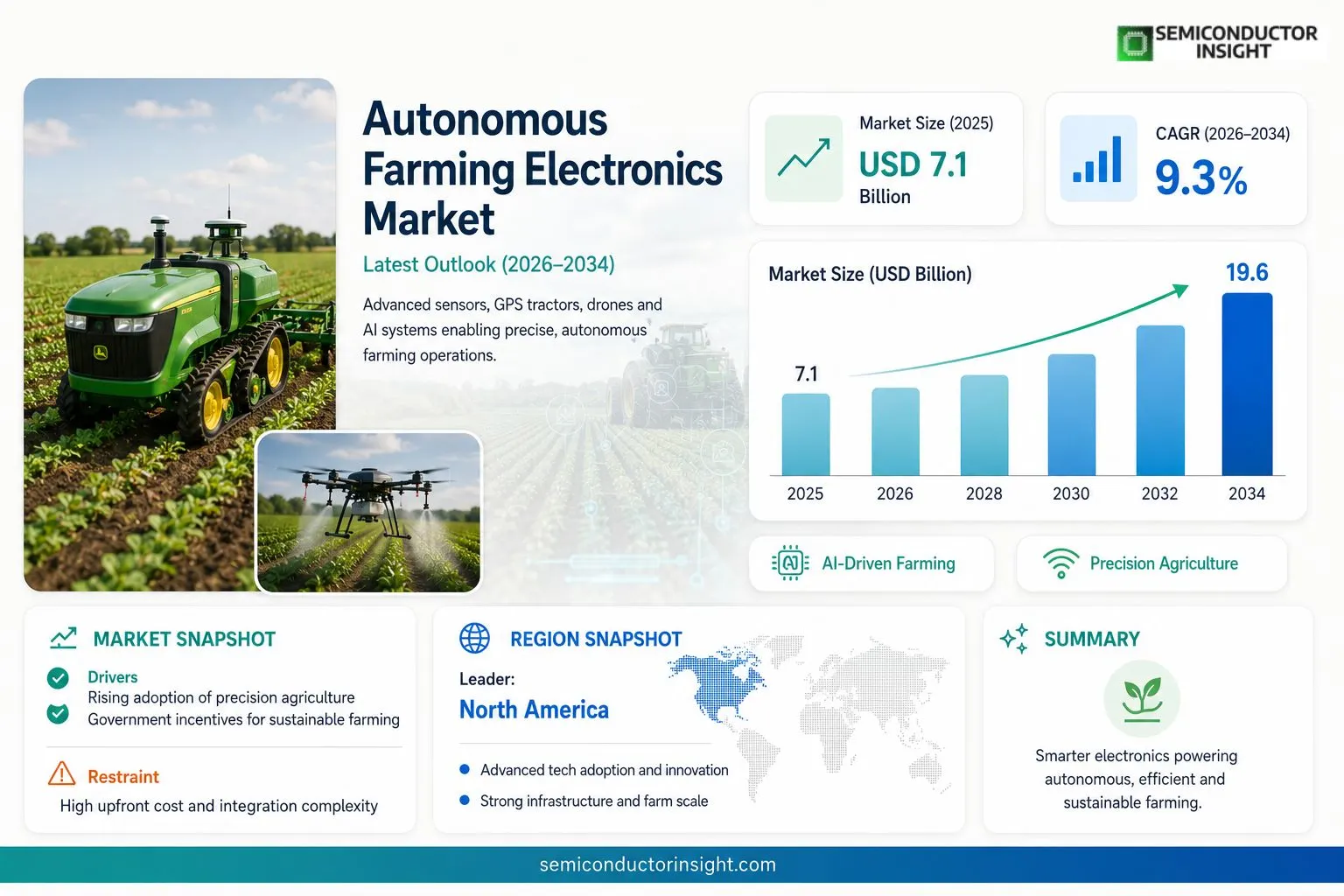
Global autonomous farming electronics market size was valued at USD 7.1 billion in 2025. The market is projected to grow from USD 7.8 billion in 2026 to USD 19.6 billion by 2034, exhibiting a CAGR of 9.3% during the forecast period.
Autonomous farming electronics comprise advanced sensors, GPS‑guided tractors, aerial drones, robotic weeders, and AI‑driven control systems that enable precise sowing, fertilizing, monitoring and harvesting without direct human intervention. These technologies integrate IoT connectivity, machine‑learning algorithms and real‑time data analytics to optimize field operations and resource use.The market is experiencing rapid growth due to several factors, including rising adoption of precision agriculture practices, increasing government incentives for sustainable farming, and accelerating advances in artificial‑intelligence hardware. Furthermore, expanding broadband coverage in rural areas facilitates seamless data transmission for autonomous platforms. Initiatives by key players such as John Deere, AGCO Corporation, Trimble Inc., and CNH Industrial are also expected to fuel expansion; for example, in March 2024 John Deere announced a partnership with a leading semiconductor firm to embed next‑generation vision processors into its autonomous tractors.
MARKET DRIVERS
Technology Adoption Accelerates Productivity
The rapid integration of sensor‑based navigation and AI‑driven decision platforms is boosting field efficiency by up to 25% in major grain‑producing regions. Farm operators are adopting autonomous electronics to reduce labor constraints and improve input utilization, which directly fuels growth of Autonomous Farming Electronics Market.
Cost Reductions Through Scale
Manufacturers are achieving economies of scale through modular hardware designs, driving unit costs down by roughly 15% year‑over‑year. Lower price points make advanced guidance and sprayer systems accessible to mid‑size farms, expanding the total addressable market.
➤ Deployments of autonomous tractors in the Midwest have demonstrated a 30% increase in acreage coverage per season without additional labor.
Policy incentives, such as precision‑agriculture tax credits, further reinforce adoption trends, ensuring sustained demand for high‑performance electronic controllers, connectivity modules, and edge‑computing units.
MARKET CHALLENGES
Integration with Existing Farm Systems
Legacy machinery often lacks standardized communication protocols, forcing farmers to invest in retrofit kits that can be complex to configure. This interoperability hurdle slows the overall rollout speed of new autonomous solutions.
Other Challenges
High Capital Expenditure
The upfront cost of fully autonomous fleets remains a barrier for smallholder producers, who typically operate on thin margins. Financing models are still maturing, and many farms delay purchases until clear ROI evidence is available.
Data Security Concerns
Connected farm equipment generates large volumes of operational data, raising questions about cyber‑threat exposure and proprietary information protection. Without robust security frameworks, some adopters remain hesitant.
MARKET RESTRAINTS
Regulatory and Data Privacy Concerns
Regulatory authorities in several regions have yet to publish clear guidelines for autonomous field equipment, creating uncertainty around certification timelines and compliance costs.Data‑privacy legislation, particularly in the European Union, imposes strict rules on how farm data can be collected, stored, and shared. Companies must invest in compliant data‑handling infrastructure, which adds to product development expenses.Additionally, liability frameworks for incidents involving autonomous machinery are still evolving, potentially exposing manufacturers to legal risks that can deter aggressive market expansion.
MARKET OPPORTUNITIES
Emerging Services in Precision Agronomy
Beyond hardware sales, service‑based revenue streams,including remote monitoring, predictive maintenance, and pay‑per‑use analytics,are gaining traction. These models lower the entry barrier for farms and create recurring income for suppliers.Integration of satellite‑grade imaging with on‑board AI enables real‑time crop health assessments, opening opportunities for bundled solutions that combine electronics, software, and agronomic advisory.Geographically, adoption is accelerating in Latin America and Sub‑Saharan Africa, where labor shortages and expanding export markets drive demand for autonomous field equipment.
Autonomous Farming Electronics Market Trends
AI‑Enhanced Sensor Networks Drive Operational Precision
Autonomous Farming Electronics Market is increasingly defined by the deployment of AI‑enhanced sensor networks that deliver real‑time agronomic insights. Advanced multispectral cameras, soil moisture probes, and lidar units now feed machine‑learning models that predict optimal sowing windows, nutrient applications, and pest interventions. By continuously calibrating equipment based on micro‑climatic data, growers achieve higher yields while reducing input waste. This shift toward data‑centric operation is supported by open‑source analytics platforms that allow equipment manufacturers to integrate proprietary algorithms without extensive redesign, fostering faster innovation cycles across the ecosystem.
Other Trends
Rural Broadband Expansion Enables Seamless Connectivity
Reliable high‑speed internet has become a prerequisite for autonomous platforms, and recent infrastructure initiatives in major agricultural regions have markedly expanded coverage. The enhanced connectivity permits uninterrupted telemetry from field‑deployed devices to cloud‑based control centers, where large‑scale pattern recognition can be performed. This seamless data flow reduces latency in autonomous decision‑making and supports coordinated fleet management, allowing multiple autonomous tractors and drones to operate synergistically on large plots.
Strategic Partnerships Accelerate Hardware Innovation
Collaborations between equipment manufacturers and semiconductor specialists are reshaping the hardware landscape of Autonomous Farming Electronics Market. Recent joint ventures focus on embedding next‑generation vision processors and edge‑AI chips directly into autonomous tractors and aerial drones. These alliances shorten development timelines and lower the cost barrier for smaller farms to adopt sophisticated autonomous solutions. As a result, the market is witnessing a broader diffusion of high‑precision tools that were previously limited to large‑scale producers, driving overall sector resilience and competitiveness.
COMPETITIVE LANDSCAPEKey Industry Players
Competitive Landscape Overview of Autonomous Farming Electronics
John Deere, AGCO Corporation, Trimble Inc., and CNH Industrial form the core of the autonomous farming electronics ecosystem, commanding the majority of revenue through vertically integrated tractor platforms, precision guidance modules, and proprietary AI controllers. These incumbents leverage deep dealer networks and extensive field‑service capabilities to bundle advanced sensors, GPS‑guided drivetrains, and vision‑based perception systems into single‑tractor solutions. Recent strategic moves,such as John Deere’s March 2024 partnership with a leading semiconductor supplier to embed next‑generation vision processors,underscore a consolidation trend where hardware manufacturers acquire or closely collaborate with niche software firms to accelerate time‑to‑market. Consequently, the market structure is characterized by a few dominant OEMs steering overall growth while establishing ecosystem standards that shape downstream component sourcing.Beyond the majors, a vibrant set of niche innovators expands functionality and drives specialization across the autonomous farming electronics domain. Raven Industries and Bosch Global contribute rugged sensor suites and connectivity modules tailored for harsh field environments. Drone manufacturers like DJI and AgEagle Aerial Systems enable high‑resolution aerial scouting and variable‑rate application, while vision‑AI startups such as Blue River Technology and PrecisionHawk deliver weed‑identification algorithms that integrate with tractor controllers. Data‑analytics firms including Taranis and Climate Corporation focus on cloud‑based decision platforms that translate raw telemetry into actionable agronomic insights. These players, often operating with agile development cycles, address specific crop‑type challenges and regional requirements, enriching the competitive landscape and providing alternatives to the OEM‑centric offerings of the larger manufacturers.
List of Key Autonomous Farming Electronics Companies Profiled
- John Deere
- AGCO Corporation
- Trimble Inc.
- CNH Industrial
- Raven Industries
- Bosch Global
- DJI
- AgEagle Aerial Systems
- Sentera
- Blue River Technology
- PrecisionHawk
- Taranis
- Climate Corporation
Segment Analysis:
| Segment Category | Sub-Segments | Key Insights |
| By Type |
|
Advanced Sensors
|
| By Application |
|
Precision Planting
|
| By End User |
|
Large Commercial Farms
|
| By [Segment Category 3]] |
|
Leading Segment description with qualitative insights only [Pointers preferred in bullets atleast 2-3]. |
| By [Segment Category 4]] |
|
Leading Segment description with qualitative insights only [Pointers preferred in bullets atleast 2-3]. |
Regional Analysis: North America
United States
The integration of sensors, GPS, and data analytics for optimized farming practices is a major growth driver.
Drones are increasingly used for aerial imaging, crop health assessment, and yield prediction.
Autonomous robots are being deployed for tasks such as weeding, harvesting, and planting.
Advanced data analytics and artificial intelligence are transforming farm management through predictive modeling.
Europe
Europe exhibits steady growth in Autonomous Farming Electronics Market, with a focus on sustainable and environmentally conscious agricultural practices. Stringent regulations regarding pesticide use and water conservation are driving the adoption of precision farming technologies. Key markets include Germany, France, and the United Kingdom. The region emphasizes the development of smart farming solutions that minimize environmental impact while maximizing crop yields. Business strategies in Europe often center on collaborations between agricultural technology firms and research institutions. The emphasis on data security and privacy is a significant consideration for companies operating in the European market. There’s a strong push towards circular economy principles in agriculture, influencing the development of electronics designed for longevity and recyclability. The adoption rate is slightly lower than in the US, but the long-term outlook is positive, driven by increasing awareness of the benefits of digital agriculture.
Asia-Pacific
The Asia-Pacific region presents a high-potential market for Autonomous Farming Electronics Market, driven by its large agricultural sector and increasing adoption of technology. Countries like China, India, and Australia are experiencing rapid growth in the deployment of smart farming solutions. The demand for autonomous machinery, precision irrigation systems, and crop monitoring tools is rising significantly to address the challenges of feeding a growing population. The region is witnessing a proliferation of local and international companies offering affordable and innovative electronic solutions for farmers. Government support for agricultural modernization is a key factor contributing to market expansion. However, fragmentation of the farming sector and varying levels of technological adoption across different countries pose challenges. Business strategies in Asia-Pacific often involve partnerships with local distributors and the development of customized solutions tailored to regional needs.
South America
South America is an emerging market for Autonomous Farming Electronics Market, particularly in Brazil and Argentina. The region’s vast agricultural land and focus on commodity crops drive demand for technology that improves efficiency and reduces input costs. The adoption of drone technology for crop monitoring and precision spraying is gaining traction. While the market is relatively nascent compared to North America and Europe, the potential for growth is substantial. Challenges include limited access to financing for smallholder farmers and infrastructure constraints in some areas. Business strategies in South America often focus on providing cost-effective solutions and building strong relationships with agricultural cooperatives. The rise of precision agriculture is directly linked to the need to optimize resource utilization in large-scale farming operations.
Middle East & Africa
The Middle East and Africa represent a relatively underdeveloped market for Autonomous Farming Electronics Market, but with considerable growth potential. Increasing concerns about water scarcity and food security are driving interest in smart farming technologies. Countries like the UAE, Saudi Arabia, and South Africa are beginning to invest in precision agriculture solutions. The adoption of sensors for soil monitoring and irrigation management is a key trend. Challenges include limited infrastructure, high upfront costs, and a lack of skilled labor. Business strategies in this region often involve partnerships with international technology providers and government initiatives promoting agricultural development. The focus is on developing solutions that are adapted to the specific climatic conditions and agricultural practices of the region.
Report Scope
This market research report provides a comprehensive analysis of the Autonomous Farming Electronics Market , covering the forecast period 2026–2034. It offers detailed insights into market dynamics, technological advancements, competitive landscape, and key trends shaping the industry.
Key focus areas of the report include:
- Market Overview: The report begins with an overview outlining its current market scenario, key growth indicators, and industry transformation drivers. It discusses macroeconomic factors, demand–supply balance, regulatory landscape, and the strategic role of semiconductors in powering advancements across industries such as automotive, telecommunications, consumer electronics, and industrial automation.
- Market Size & Forecast: Historical data and future projections for revenue, unit shipments, and market value across major regions and segments.
- Segmentation Analysis: Detailed breakdown by product type, technology, application, and end-user industry to identify high-growth segments and investment opportunities.
- Regional Insights: Insights into market performance across North America, Europe, Asia-Pacific, Latin America, and the Middle East & Africa, including country-level analysis where relevant.
- Competitive Landscape: Profiles of leading market participants, including their product offerings, R&D focus, manufacturing capacity, pricing strategies, and recent developments such as mergers, acquisitions, and partnerships.
- Technology Trends & Innovation: Assessment of emerging technologies, integration of AI/IoT, semiconductor design trends, fabrication techniques, and evolving industry standards.
- Market Drivers & Restraints: Evaluation of factors driving market growth along with challenges, supply chain constraints, regulatory issues, and market-entry barriers.
- Stakeholder Insights: Insights for component suppliers, OEMs, system integrators, investors, and policymakers regarding the evolving ecosystem and strategic opportunities.
Primary and secondary research methods are employed, including interviews with industry experts, data from verified sources, and real-time market intelligence to ensure the accuracy and reliability of the insights presented.
FREQUENTLY ASKED QUESTIONS:
What is the current market size of Autonomous Farming Electronics Market?
-> Autonomous Farming Electronics Market was valued at USD 7.1 billion in 2025 and is expected to reach USD 19.6 billion by 2034.
Which key companies operate in Autonomous Farming Electronics Market?
-> Key players include John Deere, AGCO Corporation, Trimble Inc., CNH Industrial, among others.
What are the key growth drivers?
-> Key growth drivers include adoption of precision agriculture, government incentives for sustainable farming, advances in AI hardware, and expanding broadband coverage in rural areas.
Which region dominates the market?
-> The reference does not specify a dominant region for Autonomous Farming Electronics Market.
What are the emerging trends?
-> Emerging trends include advanced sensors, GPS‑guided tractors, aerial drones, robotic weeders, and AI‑driven control systems integrated with IoT and real‑time analytics.

Get Sample Report PDF for Exclusive Insights
Report Sample Includes
- Table of Contents
- List of Tables & Figures
- Charts, Research Methodology, and more...
 Download Sample Report PDF