
Autonomous Checkout Semiconductor Market Insights
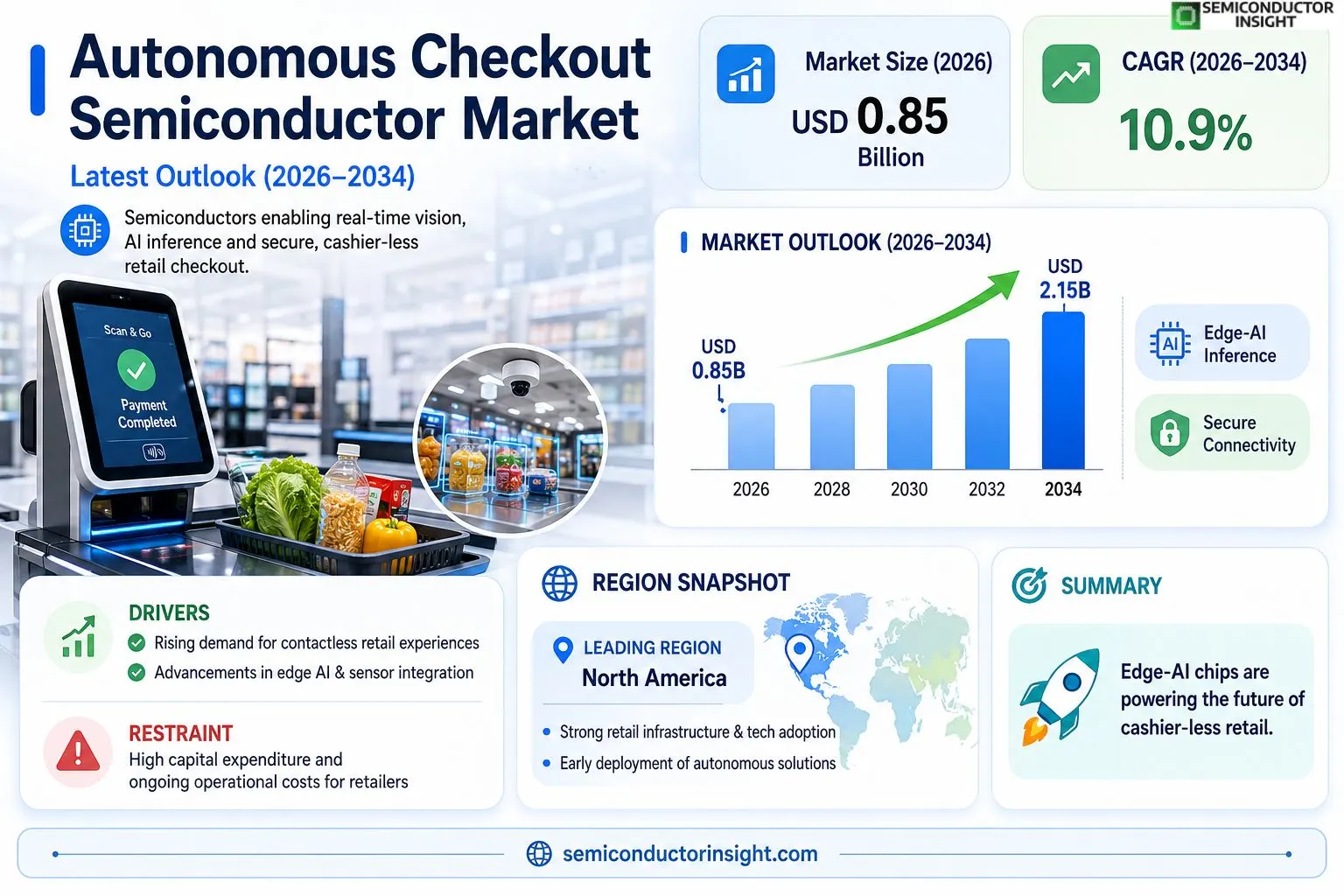
Global Autonomous Checkout Semiconductor market size was valued at USD 0.85 billion in 2026. The market is projected to grow from USD 0.85 billion in 2026 to USD 2.15 billion by 2034, exhibiting a CAGR of 10.9% during the forecast period.
Autonomous checkout semiconductors are specialized integrated circuits that enable real‑time image processing, sensor fusion, and edge‑AI inference for cashier‑less retail environments. These chips combine high‑performance vision processors, low‑power neural accelerators, and secure connectivity modules to support computer‑vision algorithms that identify products, track shopper movements, and manage transaction security without human intervention.The market is experiencing rapid growth because retailers are accelerating digital transformation initiatives while consumers demand frictionless shopping experiences. Furthermore, advancements in AI accelerator architectures and reductions in silicon cost are driving wider adoption across grocery chains and convenience stores worldwide. Leading semiconductor firms such as NVIDIA, Qualcomm, and MediaTek have announced dedicated platforms for autonomous checkout solutions in 2023‑2024, further fueling expansion.
MARKET DRIVERS
Rise of Contactless Retail Solutions
The growing consumer preference for touch‑free experiences is accelerating adoption of autonomous checkout systems. Retailers are investing heavily in integrated semiconductor solutions that enable real‑time video analytics and rapid barcode‑free item recognition, directly boosting demand for Autonomous Checkout Semiconductor Market.
Advancements in Edge AI and Sensor Integration
Recent breakthroughs in low‑power AI accelerators and multimodal sensor arrays allow on‑device processing of visual and weight data, reducing latency and reliance on cloud infrastructure. These technical gains make autonomous checkout stations more reliable and cost‑effective, driving further market expansion.
➤ Edge‑optimized chips that combine vision, inference and secure encryption are becoming the cornerstone of next‑generation checkout kiosks.
Additionally, strategic partnerships between semiconductor manufacturers and major retail technology providers are creating ecosystem‑wide standards that streamline integration, ensuring sustained growth for Autonomous Checkout Semiconductor Market.
MARKET CHALLENGES
Technical Complexity and Integration
Designing a seamless autonomous checkout solution requires tight coupling of vision processors, RF modules and power‑management ICs. Variations in store layout, lighting conditions and product packaging increase engineering difficulty, leading to longer development cycles and higher R&D costs.
Other Challenges
Data Security & Privacy
Regulatory scrutiny around facial recognition and transaction data mandates robust encryption and on‑device processing, which adds to silicon complexity and may limit adoption in privacy‑sensitive regions.
MARKET RESTRAINTS
High Capital Expenditure for Retailers
Upfront investment in hardware, installation and staff training can be prohibitive for mid‑size retailers. The cost of specialized semiconductor modules, while decreasing, remains a significant barrier to widespread rollout.Furthermore, the need for continuous firmware updates to address new product SKUs and evolving security standards imposes ongoing operational expenses that can deter early adopters.These financial considerations constrain market penetration until economies of scale and modular designs lower total cost of ownership.
MARKET OPPORTUNITIES
Emerging Markets and Modular Designs
Rapid urbanization and increasing e‑commerce penetration in Asia‑Pacific and Latin America create fertile ground for autonomous checkout pilots. Modular semiconductor platforms that can be customized for different store formats present a clear growth avenue.In addition, the convergence of 5G connectivity with edge AI chips enables real‑time inventory management and dynamic pricing, unlocking new revenue streams for both retailers and semiconductor suppliers.Strategic focus on low‑power, high‑efficiency designs will further reduce installation costs, making autonomous checkout solutions attractive to a broader range of retail operators.
Autonomous Checkout Semiconductor Market Trends
AI‑Driven Vision Processors Powering Frictionless Retail
Retail operators are accelerating the rollout of cashier‑less stores, and the semiconductor components that enable real‑time image analysis have become a decisive factor. Modern vision processors now integrate high‑resolution image pipelines with dedicated neural‑accelerator blocks, allowing product identification and shopper behavior tracking to occur entirely at the edge. This reduces latency, preserves privacy, and eliminates the need for costly cloud bandwidth. The convergence of low‑power design techniques with advanced AI inference engines is expanding deployment beyond flagship grocery chains to convenience stores and specialty retailers, creating a broader ecosystem of vendors that rely on these chips for seamless transaction flows.
Other Trends
Edge‑AI Security Enhancements
Security concerns have driven semiconductor firms to embed cryptographic modules and secure boot capabilities directly into autonomous checkout chips. These built‑in protections guard against tampering of vision algorithms and ensure the integrity of payment data transmitted over wireless links. Recent platform releases from leading players incorporate hardware‑rooted attestation that authenticates firmware before execution, thereby reducing the attack surface for counterfeit sensor data. Retailers benefit from a unified security posture that aligns with GDPR‑style data‑privacy expectations while maintaining the high throughput required for uninterrupted shopper experiences.
Consolidated Platform Ecosystems
Another notable trend is the emergence of comprehensive development kits that bundle vision processors, neural accelerators, and connectivity solutions into a single reference design. This approach shortens time‑to‑market for hardware manufacturers and allows system integrators to focus on application‑specific tuning rather than low‑level hardware integration. By providing standardized APIs and pre‑validated software stacks, these ecosystems accelerate innovation in areas such as dynamic pricing displays and real‑time inventory analytics, further reinforcing the strategic role of Autonomous Checkout Semiconductor Market in the broader digital‑retail transformation.
COMPETITIVE LANDSCAPEKey Industry Players
Autonomous Checkout Semiconductor Market Competitive Overview
Autonomous Checkout Semiconductor Market is currently anchored by a handful of global powerhouses that have leveraged deep AI‑accelerator expertise and vision‑processing IP to create end‑to‑end solutions for cashier‑less retail. NVIDIA leads the segment with its Jetson family, delivering high‑performance GPU‑based inference that scales from boutique stores to large‑format supermarkets. Qualcomm’s Snapdragon Compute Platform and MediaTek’s Dimensity Vision series provide integrated sensor fusion, low‑power neural engines, and secure connectivity, enabling fast edge deployment while keeping bill of materials modest. Intel’s Xeon‑based edge modules complement the ecosystem by offering robust CPU‑GPU hybrids for legacy integration and heavy‑duty workloads. Collectively, these firms shape market structure around modular, programmable silicon that can be bundled with software stacks, creating a de‑facto standard that smaller vendors must align with to gain ecosystem compatibility.Beyond the dominant tier, a diverse set of niche players contributes specialized capabilities that address particular segments of the autonomous checkout value chain. AMD’s Radeon Instinct accelerators attract retailers seeking alternative GPU ecosystems, while Ambarella’s low‑power video processors excel in high‑frame‑rate imaging for shelf‑level analytics. Texas Instruments supplies ultra‑low‑power analog front‑ends and power‑management ICs that reduce overall system draw. STMicroelectronics and Infineon Technologies focus on secure element integration and robust automotive‑grade reliability, supporting harsh retail environments. Renesas and NXP Semiconductors bring expertise in connectivity and sensor interfacing, while Sony’s image‑sensor leadership enhances product‑recognition accuracy. This breadth of specialized suppliers enriches the competitive landscape, fostering innovation and price competition across the value chain.
List of Key Autonomous Checkout Semiconductor Companies Profiled
- NVIDIA
- Qualcomm
- MediaTek
- Intel
- AMD
- Ambarella
- Texas Instruments
- STMicroelectronics
- Infineon Technologies
- Renesas Electronics
- NXP Semiconductors
- Sony Semiconductor
Segment Analysis:
| Segment Category | Sub-Segments | Key Insights |
| By Type |
|
Vision Processors
|
| By Application |
|
Grocery Stores
|
| By End User |
|
Large Retail Chains
|
| By Technology |
|
Edge AI Chips
|
| By Retail Format |
|
Overhead Imaging Systems
|
Regional Analysis: North America
United States
The market is characterized by a competitive landscape with both established players and emerging startups vying for dominance. Partnerships between semiconductor manufacturers and retail giants are becoming increasingly common, facilitating the integration of hardware and software solutions. The development of specialized chips optimized for edge computing and real-time data processing is a key trend shaping the future of autonomous checkout semiconductor solutions in the United States.
The North American retail sector is witnessing a gradual but steady shift towards autonomous checkout solutions. Large national chains are pioneering pilot programs, while smaller independent retailers are also exploring the benefits of these technologies. The pace of adoption is influenced by factors such as store size, customer demographics, and investment capacity.
Key trends include the integration of computer vision for inventory management and loss prevention, and the use of advanced sensor technology for accurate transaction processing.
Advancements in sensor technology are playing a pivotal role in the development of effective autonomous checkout systems. This includes improvements in image recognition, depth sensing, and infrared technology. The miniaturization of sensors and the increasing integration of AI capabilities within these devices are further enhancing the performance and reliability of these systems.
The focus is shifting towards creating sensor fusion systems that combine data from multiple sources to improve accuracy and reduce false positives.
Security and data privacy are paramount concerns within the North American autonomous checkout market. Retailers are implementing robust measures to protect customer data and prevent fraud. This includes the use of encryption technology, biometric authentication, and advanced analytics to detect suspicious activity.
Compliance with data privacy regulations such as GDPR and CCPA is also a key consideration for companies operating in this space.
Innovative business models are emerging to facilitate the adoption of autonomous checkout solutions. This includes leasing models, subscription services, and partnerships with technology providers. Retailers are also exploring opportunities to monetize the data collected by these systems, such as through targeted advertising and personalized offers.
The development of open platforms and standardized interfaces is expected to further accelerate innovation and reduce barriers to entry.
Europe
The European autonomous checkout semiconductor market is exhibiting steady growth, driven by increasing consumer demand for efficient and contactless shopping experiences. While adoption rates may lag slightly behind North America, the region possesses a strong commitment to technological advancement and a sophisticated retail landscape. Key trends include the integration of AI-powered computer vision systems for accurate product identification and the use of advanced sensor fusion techniques for enhanced reliability. Regulatory frameworks such as GDPR are significantly influencing the development and deployment of these technologies, emphasizing data privacy and security. The European market is also characterized by a diverse range of retail formats, from large hypermarkets to smaller convenience stores, each presenting unique opportunities and challenges for autonomous checkout solutions.
A significant focus is on interoperability and the development of open standards to ensure seamless integration with existing retail infrastructure. The increasing adoption of mobile payment systems and the growing popularity of e-commerce are also contributing to the growth of the autonomous checkout market in Europe.
Asia-Pacific
Asia-Pacific represents a high-growth potential market for autonomous checkout semiconductors, fueled by rapid urbanization, increasing disposable incomes, and a burgeoning e-commerce sector. The region’s retail landscape is highly diverse, ranging from traditional markets to modern shopping malls, creating a wide array of opportunities for innovation. Government initiatives promoting technological advancement and the growing investment in smart retail are further accelerating market growth. Key trends include the adoption of facial recognition technology for customer identification and the integration of AI-powered analytics for optimizing store layouts and inventory management.
However, challenges such as data privacy concerns and the need for robust infrastructure are also present. The market is witnessing increased competition from both domestic and international players, driving innovation and cost efficiencies. The emphasis on localized solutions and the development of culturally relevant applications are also shaping the trajectory of the autonomous checkout market in Asia-Pacific.
South America
The South American autonomous checkout semiconductor market is in its early stages of development, but it holds significant long-term potential. Increasing smartphone penetration, rising internet access, and a growing adoption of digital payment methods are creating a favorable environment for the deployment of these technologies. The region’s retail sector is undergoing a transformation, with a shift towards modern shopping formats and an increasing focus on customer experience. Key trends include the adoption of basic computer vision systems for product identification and the use of mobile apps for self-checkout transactions.
Challenges such as infrastructure limitations, regulatory hurdles, and economic uncertainties present obstacles to market growth. However, the increasing investment in technology and the growing consumer demand for convenient shopping experiences are expected to drive future expansion. The focus is on developing cost-effective solutions that are tailored to the specific needs of the South American market.
Middle East & Africa
The Middle East and Africa represent a dynamic and evolving market for autonomous checkout semiconductors. Rapid urbanization, increasing disposable incomes, and a growing consumer base are creating significant opportunities for growth. The retail sector in the region is undergoing modernization, with a shift towards modern shopping malls and hypermarkets. Key trends include the adoption of contactless payment systems and the use of AI-powered analytics for optimizing store operations.
Challenges such as infrastructure limitations and regulatory complexities can hinder market development. However, increasing government investments in technology and the growing focus on smart city initiatives are expected to drive future adoption. The market is witnessing increasing interest from international technology providers, leading to a diverse range of solutions being offered to retailers in the region.
Report Scope
This market research report provides a comprehensive analysis of the Autonomous Checkout Semiconductor Market , covering the forecast period 2026–2034. It offers detailed insights into market dynamics, technological advancements, competitive landscape, and key trends shaping the industry.
Key focus areas of the report include:
- Market Overview: The report begins with an overview outlining its current market scenario, key growth indicators, and industry transformation drivers. It discusses macroeconomic factors, demand–supply balance, regulatory landscape, and the strategic role of semiconductors in powering advancements across industries such as automotive, telecommunications, consumer electronics, and industrial automation.
- Market Size & Forecast: Historical data and future projections for revenue, unit shipments, and market value across major regions and segments.
- Segmentation Analysis: Detailed breakdown by product type, technology, application, and end-user industry to identify high-growth segments and investment opportunities.
- Regional Insights: Insights into market performance across North America, Europe, Asia-Pacific, Latin America, and the Middle East & Africa, including country-level analysis where relevant.
- Competitive Landscape: Profiles of leading market participants, including their product offerings, R&D focus, manufacturing capacity, pricing strategies, and recent developments such as mergers, acquisitions, and partnerships.
- Technology Trends & Innovation: Assessment of emerging technologies, integration of AI/IoT, semiconductor design trends, fabrication techniques, and evolving industry standards.
- Market Drivers & Restraints: Evaluation of factors driving market growth along with challenges, supply chain constraints, regulatory issues, and market-entry barriers.
- Stakeholder Insights: Insights for component suppliers, OEMs, system integrators, investors, and policymakers regarding the evolving ecosystem and strategic opportunities.
Primary and secondary research methods are employed, including interviews with industry experts, data from verified sources, and real-time market intelligence to ensure the accuracy and reliability of the insights presented.
FREQUENTLY ASKED QUESTIONS:
What is the current market size of Autonomous Checkout Semiconductor Market?
-> Autonomous Checkout Semiconductor Market was valued at USD 0.85 billion in 2026 and is expected to reach USD 2.15 billion by 2034, reflecting a robust growth trajectory.
Which key companies operate in Autonomous Checkout Semiconductor Market?
-> Key players include NVIDIA, Qualcomm, MediaTek, among others.
What are the key growth drivers?
-> Key growth drivers include retail digital transformation, consumer demand for frictionless shopping, AI accelerator advancements, and reductions in silicon cost.
Which region dominates the market?
-> Asia-Pacific is the fastest‑growing region, while North America remains a dominant market.
What are the emerging trends?
-> Emerging trends include edge‑AI inference, sensor‑fusion architectures, and secure connectivity modules for autonomous checkout solutions.
Get Sample Report PDF for Exclusive Insights
Report Sample Includes
- Table of Contents
- List of Tables & Figures
- Charts, Research Methodology, and more...
 Download Sample Report PDF





