Automotive Sensors Market Insights
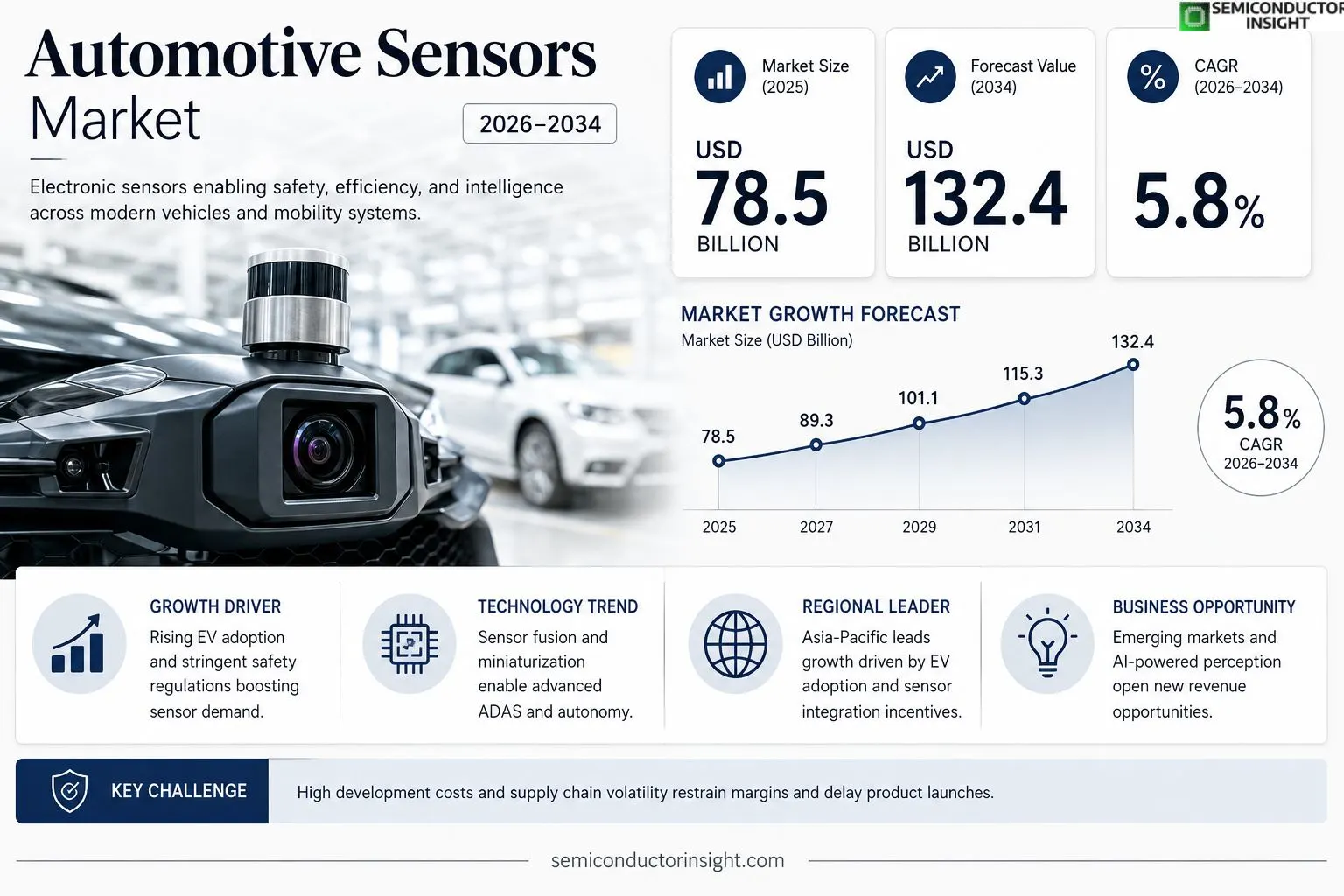
Global automotive sensors market size was valued at USD 78.5 billion in 2025. The market is projected to grow from USD 80.2 billion in 2025 to USD 132.4 billion by 2034, exhibiting a CAGR of 5.8% during the forecast period.
Automotive sensors are electronic devices that detect physical parameters such as temperature, pressure, speed, proximity, and light, converting them into electrical signals for vehicle control systems. They enable functions ranging from engine management and safety‑critical braking systems to advanced driver‑assistance (ADAS) and autonomous driving capabilities.The market is accelerating because of rising demand for electric vehicles, stricter safety regulations, and rapid adoption of ADAS technologies. Furthermore, ongoing miniaturization and cost‑reduction trends are expanding sensor integration across vehicle platforms. Key players,including Bosch Group, Denso Corp., Continental AG, Valeo SA, and Texas Instruments,are investing heavily in R&D and strategic partnerships to broaden their sensor portfolios.
MARKET DRIVERS
Electrification and Advanced Driver‑Assistance Systems (ADAS)
The rapid shift toward electric vehicles and the integration of ADAS have created a surge in demand for high‑precision sensors such as LiDAR, radar, and ultrasonic units. Automotive Sensors Market growth is propelled by manufacturers seeking to meet safety regulations and consumer expectations for autonomous features.
Regulatory Standards and Emissions Goals
Stringent emissions standards worldwide require real‑time monitoring of engine performance and exhaust treatment, driving adoption of oxygen, nitrogen‑oxide, and particulate sensors. Automotive Sensors Market benefits from these mandates, as OEMs embed more sensor networks to ensure compliance.
➤ “Sensor density per vehicle is expected to double by 2030, underpinning a robust growth trajectory for the sector.”
Additionally, the proliferation of connected car services expands data collection needs, encouraging investment in temperature, pressure, and vibration sensors. These trends collectively strengthen market fundamentals.
MARKET CHALLENGES
Cost Management and Supply Chain Volatility
While demand rises, the high cost of semiconductor‑based sensors poses a barrier for price‑sensitive manufacturers. Fluctuating raw‑material prices and geopolitical tensions have intensified supply‑chain risks, limiting Automotive Sensors Market expansions in low‑margin segments.
Other Challenges
Technology Standardization
The lack of unified communication protocols across sensor types hampers seamless integration, slowing adoption rates and increasing engineering complexity.
MARKET RESTRAINTS
High Development Costs and Certification Hurdles
Developing sensors that meet automotive durability standards requires extensive testing and certification, inflating R&D expenditures. These financial and regulatory restraints can delay product launches, tempering the overall growth momentum of Automotive Sensors Market.
MARKET OPPORTUNITIES
Emerging Markets and Sensor Fusion Technologies
Rapid urbanization in emerging economies fuels demand for safety‑enhanced vehicles, opening new avenues for sensor manufacturers. Advances in sensor fusion,combining data from radar, LiDAR, and camera systems,present significant opportunities to deliver richer perception capabilities, positioning Automotive Sensors Market for accelerated adoption in next‑generation mobility solutions.
Automotive Sensors Market Trends
Electrification and Safety Regulations Driving Sensor Adoption
The shift toward electric propulsion and tighter safety standards is reshaping Automotive Sensors Market. OEMs are integrating temperature, pressure, and proximity sensors to meet regulatory requirements for emission control and advanced braking systems. At the same time, ADAS features such as lane‑keeping assist and adaptive cruise control rely on high‑resolution radar and lidar sensors, accelerating sensor density per vehicle. This convergence of electrification and safety compliance creates a clear upward trajectory for sensor deployment across all vehicle classes. Regulatory bodies in Europe and North America have introduced mandatory electronic stability control and crash‑avoidance standards, which directly increase the quantity of accelerometers and gyroscopes embedded in vehicle chassis. Moreover, the rising consumer expectation for over‑the‑air updates drives manufacturers to embed modular sensor arrays that can be calibrated remotely, further boosting sensor counts.
Other Trends
Miniaturization and Cost Reduction
Miniaturization and cost reduction continue to influence the sensor supply chain. Advances in MEMS fabrication enable sensors that are a fraction of previous size while delivering higher accuracy, which supports integration into compact electric drivetrains. Lower component cost encourages OEMs to replace legacy mechanical switches with solid‑state alternatives, expanding sensor coverage in areas such as cabin climate control and tire‑pressure monitoring. The combined effect is a broader footprint for sensor networks without a proportional increase in vehicle bill of materials. Supply chain localization trends also contribute to cost efficiency, as regional fabs reduce logistics expenses and lead times. The shift toward standardized communication protocols, such as CAN‑FD and Ethernet, simplifies integration across different vehicle architectures, allowing manufacturers to deploy a common sensor suite across multiple models.
Strategic R&D and Partnerships Among Leading Suppliers
Key suppliers such as Bosch Group, Denso Corp., Continental AG, Valeo SA, and Texas Instruments are deepening R&D investments and forming strategic alliances to broaden sensor portfolios. Collaborative programs focus on integrating artificial‑intelligence algorithms with sensor data streams, enabling predictive maintenance and enhanced driver assistance. Joint development with EV manufacturers accelerates the rollout of high‑temperature and high‑voltage sensors required for battery management systems. These coordinated efforts reinforce Automotive Sensors Market’s capacity to meet emerging performance benchmarks while maintaining a competitive cost structure. In addition, joint ventures focused on silicon‑photonic lidar development aim to lower unit costs below $50, a threshold identified as critical for mass‑market autonomous features. These initiatives also address the need for robust sensor performance under adverse weather conditions, a key factor for regulatory acceptance of higher‑level automation. Overall, the convergence of technology, policy, and collaborative business models positions the sensor ecosystem for sustained growth through the next decade.
COMPETITIVE LANDSCAPEKey Industry Players
Automotive Sensors Market – Competitive Dynamics and Growth Drivers
Automotive Sensors Market remains heavily anchored by a few global technology leaders that command the majority of revenue and R&D spend. Bosch Group continues to dominate the segment, leveraging its extensive OEM relationships, deep sensor‑fusion expertise, and aggressive investment in MEMS and radar technologies for ADAS and autonomous driving. Continental AG and Valeo SA occupy the next tier, each expanding their portfolio through strategic acquisitions and joint ventures that integrate sensor hardware with software analytics. Texas Instruments, while traditionally a semiconductor supplier, has risen as a critical enabler of low‑power sensor interfaces, positioning itself as a preferred partner for electric‑vehicle platforms. This concentration creates a competitive landscape where scale, cross‑functional integration, and intellectual‑property depth dictate market leadership, while smaller innovators must differentiate through niche applications or ultra‑cost‑effective designs.Beyond the dominant quartet, a broader cohort of specialized firms adds depth and diversity to the ecosystem. Denso Corp. focuses on high‑precision temperature and pressure sensors for power‑train efficiency, whereas Aptiv emphasizes connectivity‑centric perception sensors. Infineon Technologies and NXP Semiconductors supply robust automotive‑grade micro‑controllers and signal‑processing ASICs that underpin sensor performance. Sensata Technologies, Magna International, and Murata Manufacturing contribute niche solutions ranging from vibration monitoring to high‑frequency radar modules. Alpine Alps, Hella, and ZF Friedrichshafen round out the field with automotive lighting, lighting‑sensor integration, and chassis‑control sensor suites. Collectively, these companies drive innovation in miniaturization, cost reduction, and functional safety, ensuring a competitive pressure that supports the market’s projected CAGR of 5.8 % through 2034.
List of Key Automotive Sensors Companies Profiled
- Bosch Group
- Denso Corp.
- Continental AG
- Valeo SA
- Texas Instruments
- Aptiv
- Infineon Technologies
- NXP Semiconductors
- Sensata Technologies
- Magna International
- Murata Manufacturing
- Alps Alpine
- Hella
- ZF Friedrichshafen
Segment Analysis:
| Segment Category | Sub-Segments | Key Insights |
| By Type |
|
Temperature Sensors are pivotal for engine thermal management and battery pack regulation. They enable precise control of operating temperatures, which directly influences efficiency, emissions, and component longevity. Ongoing miniaturization and robust packaging allow seamless integration with electronic control units, supporting predictive maintenance strategies. The focus on material innovation helps these sensors endure harsh automotive environments while delivering reliable data for system optimization. |
| By Application |
|
Advanced Driver‑Assistance Systems (ADAS) rely heavily on high‑resolution proximity and speed sensors to enable features such as automated emergency braking, lane‑keep assist and adaptive cruise control. The growing sophistication of ADAS pushes sensor manufacturers toward tighter tolerances and faster response times. Integrated sensor‑fusion architectures are emerging, allowing multiple sensor inputs to be processed collectively, which improves decision‑making reliability and paves the way for higher levels of vehicle autonomy. |
| By End User |
|
Original Equipment Manufacturers (OEMs) drive the strategic direction of sensor adoption by defining vehicle architectures and safety standards. OEM specifications increasingly emphasize sensor redundancy, reliability and integration with vehicle networks. As electrification accelerates, OEMs prioritize sensors that support battery management and powertrain efficiency, encouraging suppliers to innovate around cost‑effective, high‑performance solutions that meet stringent automotive qualifying criteria. |
| By Powertrain |
|
Electric Vehicles are reshaping sensor priorities by demanding highly accurate temperature, pressure and current sensors for battery packs and power electronics. The need for real‑time thermal monitoring drives innovation in sensor reliability and integration density. Moreover, EV platforms encourage the consolidation of multiple sensor functions into single modules, reducing wiring complexity and supporting lightweight vehicle designs. |
| By Technology Trend |
|
Integrated Sensor Systems combine multiple sensing modalities into a single package, delivering richer data streams while reducing component count. This trend enables tighter packaging within constrained vehicle spaces and supports the rollout of sophisticated driver‑assist features. The move toward wireless communication further simplifies system integration, allowing flexible placement of sensors and facilitating over‑the‑air updates that enhance functionality throughout the vehicle’s lifecycle. |
Regional Analysis: North America
North America
The demand for sensors supporting ADAS features like lane departure warning, adaptive cruise control, and automatic emergency braking is a major driver. This segment is experiencing rapid growth as automakers prioritize safety and driver assistance technologies.
EVs have unique sensor requirements, including those for battery management, thermal control, and charging systems. The increasing adoption of EVs is creating new market opportunities for specialized automotive sensors.
With the rise of connected vehicles, sensors are increasingly integrated with communication systems, requiring robust cybersecurity measures. This trend is driving demand for sensors with built-in security features and secure data transmission capabilities.
Radar sensors are becoming more sophisticated, offering improved range, resolution, and field of view. This is particularly important for autonomous driving applications and for enhancing safety in adverse weather conditions.
North America
The North American automotive sensors market is shaped by a complex interplay of technological advancements, regulatory pressures, and consumer preferences. The region’s automotive industry is undergoing a profound transformation, driven by the shift towards electric vehicles, autonomous driving, and connected car technologies. This evolution is creating both challenges and opportunities for sensor manufacturers. The focus on safety regulations and the increasing demand for ADAS features are key factors influencing market growth. Furthermore, the region’s strong automotive manufacturing base and the presence of leading technology companies provide a fertile ground for innovation in the automotive sensors space. The integration of artificial intelligence (AI) and machine learning (ML) with sensor data is expected to further enhance the capabilities of automotive sensors, enabling more intelligent and responsive vehicle systems. The competitive landscape is characterized by a mix of established players and emerging startups, all vying for market share in this rapidly evolving sector. The emphasis on data security and privacy is also gaining prominence, as connected vehicles generate vast amounts of data that need to be protected from cyber threats.
Europe
Europe is another significant market for automotive sensors, with a strong emphasis on safety, environmental regulations, and fuel efficiency. The region’s automotive industry is highly innovative, with a growing focus on electric vehicles and autonomous driving. Stringent emission standards and government incentives are driving the adoption of advanced sensor technologies to improve vehicle performance and reduce environmental impact. Key trends include the development of sensors for battery management systems, electric motor control, and autonomous driving. The European market is characterized by a diverse range of automotive manufacturers, each with its own technological priorities. Collaboration between automotive companies, sensor suppliers, and research institutions is fostering innovation and accelerating the development of new sensor solutions. The increasing importance of data analytics and cloud computing is also creating new opportunities for sensor-based services.
Asia-Pacific
Asia-Pacific is the largest and fastest-growing market for automotive sensors globally. The region’s rapid economic growth, increasing vehicle production, and rising disposable incomes are driving strong demand for sensor systems. China is the dominant market in this region, with a large and rapidly expanding automotive industry. The region is witnessing a surge in investment in electric vehicles and autonomous driving, creating significant opportunities for sensor manufacturers. Key trends include the adoption of sensors for driver assistance systems, powertrain control, and vehicle connectivity. The Asia-Pacific market is characterized by a highly competitive landscape, with a mix of local and international players vying for market share. Government support for the automotive industry and the development of advanced manufacturing capabilities are further fueling market growth. The increasing focus on cybersecurity is also a key concern in this region, as connected vehicles become more prevalent.
South America
South America represents a smaller but growing market for automotive sensors. The region’s automotive industry is experiencing steady growth, driven by increasing vehicle sales and rising disposable incomes. The demand for sensors is primarily focused on safety features and fuel efficiency improvements. The increasing adoption of electric vehicles and the development of autonomous driving technologies are creating new opportunities for sensor manufacturers in this region. The South American market is characterized by a relatively concentrated automotive industry, with a few major players dominating the market. Government regulations and economic conditions can significantly impact market growth. The focus on cost-effective sensor solutions is also a key consideration in this market.
Middle East & Africa
The Middle East and Africa represent a nascent but promising market for automotive sensors. The region’s automotive industry is experiencing growth, driven by increasing vehicle sales and government initiatives to promote automotive manufacturing. The demand for sensors is primarily focused on safety features and fuel efficiency improvements. The increasing adoption of electric vehicles and the development of autonomous driving technologies are expected to drive future growth in this region. The Middle East and Africa market is characterized by diverse economic conditions and varying levels of automotive development. Government regulations and infrastructure investments play a crucial role in shaping market growth. The focus on robust and reliable sensor solutions is essential in the region’s challenging environmental conditions.
Report Scope
This market research report provides a comprehensive analysis of the Automotive Sensors Market , covering the forecast period 2026–2034. It offers detailed insights into market dynamics, technological advancements, competitive landscape, and key trends shaping the industry.
Key focus areas of the report include:
- Market Overview: The report begins with an overview outlining its current market scenario, key growth indicators, and industry transformation drivers. It discusses macroeconomic factors, demand–supply balance, regulatory landscape, and the strategic role of semiconductors in powering advancements across industries such as automotive, telecommunications, consumer electronics, and industrial automation.
- Market Size & Forecast: Historical data and future projections for revenue, unit shipments, and market value across major regions and segments.
- Segmentation Analysis: Detailed breakdown by product type, technology, application, and end-user industry to identify high-growth segments and investment opportunities.
- Regional Insights: Insights into market performance across North America, Europe, Asia-Pacific, Latin America, and the Middle East & Africa, including country-level analysis where relevant.
- Competitive Landscape: Profiles of leading market participants, including their product offerings, R&D focus, manufacturing capacity, pricing strategies, and recent developments such as mergers, acquisitions, and partnerships.
- Technology Trends & Innovation: Assessment of emerging technologies, integration of AI/IoT, semiconductor design trends, fabrication techniques, and evolving industry standards.
- Market Drivers & Restraints: Evaluation of factors driving market growth along with challenges, supply chain constraints, regulatory issues, and market-entry barriers.
- Stakeholder Insights: Insights for component suppliers, OEMs, system integrators, investors, and policymakers regarding the evolving ecosystem and strategic opportunities.
Primary and secondary research methods are employed, including interviews with industry experts, data from verified sources, and real-time market intelligence to ensure the accuracy and reliability of the insights presented.
FREQUENTLY ASKED QUESTIONS:
What is the current market size of Automotive Sensors Market?
-> Automotive Sensors Market was valued at USD 78.5 billion in 2025 and is expected to reach USD 132.4 billion by 2034, representing a CAGR of 5.8% over the forecast period.
Which key companies operate in Automotive Sensors Market?
-> Key players include Bosch Group, Denso Corp., Continental AG, Valeo SA, and Texas Instruments, among others.
What are the key growth drivers?
-> Key growth drivers include rising demand for electric vehicles, stricter safety regulations, rapid adoption of advanced driver‑assistance systems (ADAS), ongoing miniaturization of sensor components, and cost‑reduction trends.
Which region dominates the market?
-> Asia‑Pacific is the fastest‑growing region due to strong EV adoption and sensor integration incentives, while Europe remains a major market with stringent safety standards.
What are the emerging trends?
-> Emerging trends include integration of sensors for autonomous driving, AI‑enhanced perception algorithms, increased miniaturization, and the convergence of sensor data with IoT platforms for predictive vehicle analytics.

Get Sample Report PDF for Exclusive Insights
Report Sample Includes
- Table of Contents
- List of Tables & Figures
- Charts, Research Methodology, and more...