MARKET INSIGHTS
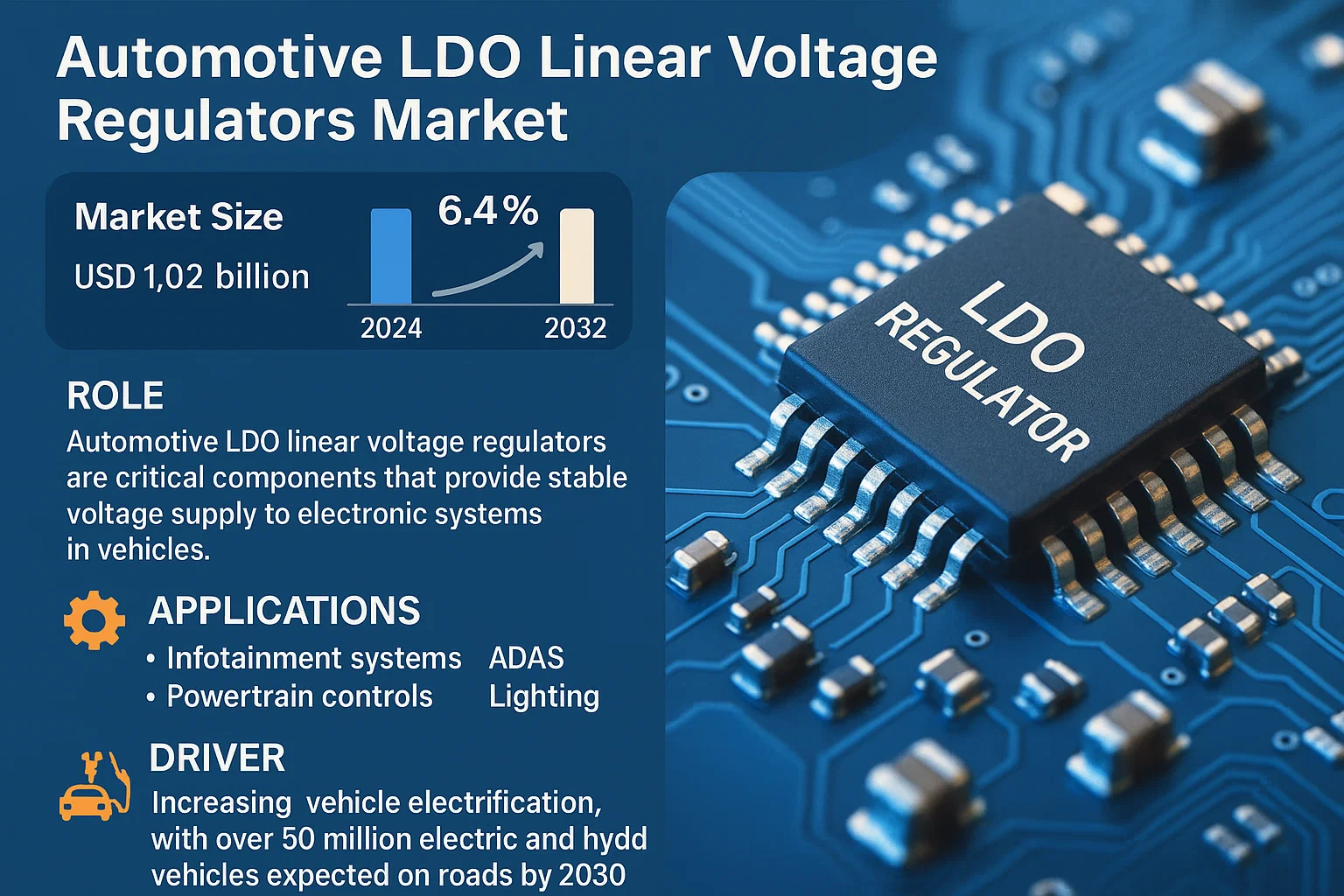
The global Automotive LDO Linear Voltage Regulators Market size was valued at USD 1.02 billion in 2024 to USD 1.85 billion by 2032, exhibiting a CAGR of 6.4% during the forecast period.
Automotive LDO (Low Dropout) linear voltage regulators are critical components that provide stable voltage supply to electronic systems in vehicles. These regulators ensure reliable operation of automotive electronics by minimizing voltage fluctuations, even with small differences between input and output voltages. They are widely used in infotainment systems, ADAS (Advanced Driver Assistance Systems), powertrain controls, and lighting modules.
The market growth is driven by increasing vehicle electrification, with over 50 million electric and hybrid vehicles expected on roads by 2030. However, the 2022 global automotive production decline to 81.6 million units (OICA data) temporarily affected demand. Key players like Texas Instruments, Infineon, and STMicroelectronics are investing in advanced regulator technologies to meet stringent automotive safety standards such as AEC-Q100, while addressing challenges like thermal management in compact designs.
MARKET DYNAMICS
MARKET DRIVERS
Rising Automotive Electronics Integration to Drive Demand for LDO Regulators
The automotive industry is undergoing a profound transformation with the increasing integration of advanced electronic systems, which is significantly driving the demand for LDO linear voltage regulators. Modern vehicles now incorporate an average of over 100 electronic control units (ECUs) that require stable power supply, ranging from infotainment systems and advanced driver assistance systems (ADAS) to engine management and safety features. LDO regulators provide critical voltage regulation for these sensitive electronic components, ensuring reliable operation despite voltage fluctuations from the vehicle’s electrical system. The global shift toward electric and hybrid vehicles further amplifies this demand, as these vehicles contain approximately 40% more electronic content compared to traditional internal combustion engine vehicles. This substantial increase in electronic systems per vehicle directly correlates with higher LDO regulator adoption rates across all vehicle segments.
Stringent Automotive Safety and Emission Regulations Fueling Market Growth
Global automotive safety and emission regulations are becoming increasingly stringent, compelling manufacturers to integrate more sophisticated electronic control systems that rely on precise voltage regulation. Regulatory mandates such as Euro 7 emissions standards and NCAP safety requirements necessitate the implementation of advanced electronic systems that monitor and control various vehicle functions in real-time. These systems require stable power supplies with minimal noise and ripple, which LDO regulators excel at providing. The automotive industry’s compliance with these regulations has led to approximately 25% annual growth in electronic content per vehicle, creating a corresponding increase in LDO regulator demand. Furthermore, the push toward autonomous driving capabilities requires redundant power systems with multiple LDO regulators to ensure fail-safe operation, adding another layer of demand growth.
Growth in Electric Vehicle Production Creating New Application Areas
The rapid expansion of the electric vehicle market represents a significant driver for automotive LDO regulators. Electric vehicles contain sophisticated battery management systems, power conversion units, and numerous sensor networks that all require precise voltage regulation. The global electric vehicle market has demonstrated remarkable growth, with production increasing from approximately 2.2 million units in 2019 to over 10 million units in 2022. This represents a compound annual growth rate of nearly 65% during this period. Each electric vehicle typically utilizes 30-50% more LDO regulators compared to conventional vehicles due to their complex power architecture and numerous low-voltage electronic systems. The transition to 48-volt electrical systems in modern vehicles also creates additional demand for LDO regulators that can efficiently step down voltages for various electronic components.
➤ Major automotive semiconductor manufacturers have reported that LDO regulator content per vehicle has increased by approximately 200% since 2015, reflecting the industry’s growing reliance on stable power management solutions.
Furthermore, the increasing consumer demand for connected car features and advanced infotainment systems is driving additional growth in the LDO regulator market. These systems require multiple voltage domains and noise-sensitive analog circuits that benefit from the clean power delivery provided by LDO regulators.
MARKET CHALLENGES
Thermal Management and Efficiency Constraints in High-Current Applications
The automotive LDO regulator market faces significant challenges related to thermal management and power efficiency, particularly in high-current applications. LDO regulators inherently dissipate excess power as heat, which becomes problematic in automotive environments where ambient temperatures can reach 125°C and space constraints limit cooling options. This thermal challenge is exacerbated by the increasing power requirements of modern automotive electronics, with some systems now demanding currents exceeding 5A. The power dissipation issue becomes particularly critical in electric vehicles where energy efficiency directly impacts driving range. Automotive manufacturers report that thermal management accounts for approximately 15-20% of the total system cost in power-dense electronic modules, making efficient thermal design a critical factor in LDO regulator selection and implementation.
Other Challenges
Electromagnetic Compatibility Requirements
Stringent electromagnetic compatibility (EMC) requirements in automotive applications present substantial challenges for LDO regulator design and implementation. Automotive systems must operate reliably in electrically noisy environments while not generating interference that affects other systems. The automotive industry’s EMC standards require components to withstand electromagnetic fields of up to 200 V/m while maintaining proper operation. Meeting these requirements often necessitates additional filtering components and shielding, increasing system complexity and cost. Furthermore, the trend toward higher switching frequencies in surrounding systems creates additional noise challenges that LDO regulators must overcome while maintaining their low-noise output characteristics.
Cost Pressure and Component Miniaturization
Intense cost pressure in the automotive industry combined with the need for component miniaturization creates significant design challenges for LDO regulators. Automotive manufacturers typically require annual price reductions of 3-5% while demanding improved performance and reliability. This cost pressure forces semiconductor manufacturers to develop more integrated solutions that reduce external component count while maintaining or improving performance characteristics. The space constraints in modern vehicle designs often limit the available board area for power management components to less than 25 mm² per regulator, driving the need for higher levels of integration and more advanced packaging technologies.
MARKET RESTRAINTS
Competition from Switching Regulators Limiting Market Penetration
The automotive LDO regulator market faces significant restraint from the growing competition posed by switching regulators, particularly in applications where efficiency is paramount. Switching regulators typically offer efficiency levels of 85-95%, compared to LDO regulators which often operate at 40-60% efficiency in high dropout voltage scenarios. This efficiency gap becomes critically important in electric vehicles where every percentage point of efficiency loss can translate to reduced driving range. The automotive industry’s push toward higher system efficiency has led many designers to replace LDO regulators with switching alternatives in applications where the noise performance of switching regulators can be adequately managed through filtering and layout techniques. This trend is particularly evident in power-hungry systems such as infotainment displays and ADAS processing units, where power consumption often exceeds 10W.
Supply Chain Constraints and Semiconductor Shortages Impacting Market Growth
Persistent supply chain constraints and semiconductor shortages continue to restrain the growth of the automotive LDO regulator market. The automotive industry experienced production losses exceeding 11 million vehicles in 2021-2022 due to semiconductor shortages, with power management components being among the most affected categories. The specialized manufacturing processes required for automotive-grade semiconductors, including extended temperature range operation and enhanced reliability features, create production bottlenecks that limit market growth. Additionally, the automotive industry’s qualification processes typically require 12-18 months for new components, slowing the adoption of newer, more advanced LDO regulator designs. These supply chain challenges are compounded by the increasing demand for automotive semiconductors across all vehicle categories, creating a supply-demand imbalance that restrains market expansion.
Increasing Complexity of Automotive Power Architectures
The increasing complexity of automotive power architectures presents a significant restraint for traditional LDO regulator solutions. Modern vehicles employ multiple voltage domains, power sequencing requirements, and complex start-up/shut-down protocols that often exceed the capabilities of basic LDO regulators. This architectural complexity drives the need for more sophisticated power management integrated circuits (PMICs) that combine multiple LDO regulators with other power management functions. However, the development and qualification of these complex PMICs requires substantial investment and extended development cycles, temporarily restraining market growth while these advanced solutions are being developed and qualified. The transition to zonal architecture in vehicle electrical systems also changes the requirements for power delivery, potentially reducing the number of individual LDO regulators needed in future vehicle designs.
MARKET OPPORTUNITIES
Advanced Driver Assistance Systems Creating New Application Frontiers
The rapid development and deployment of advanced driver assistance systems (ADAS) present substantial growth opportunities for automotive LDO regulators. ADAS systems require numerous sensors, processors, and communication interfaces that all need clean, stable power supplies. Current ADAS platforms typically incorporate 15-20 LDO regulators per system to power various sub-systems including radar, lidar, camera modules, and processing units. The adoption rate of ADAS features has increased dramatically, with approximately 45% of new vehicles now equipped with Level 2 autonomy features. This represents a market expansion opportunity of nearly 400% compared to five years ago. The continued progression toward higher levels of autonomy will further increase the complexity and number of power domains requiring regulation, creating additional opportunities for LDO regulator manufacturers.
Electric Vehicle Power Management Systems Driving Innovation
The electric vehicle revolution creates unprecedented opportunities for advanced LDO regulator solutions specifically designed for high-voltage automotive applications. Electric vehicles employ sophisticated battery management systems that require precise voltage regulation for monitoring circuitry, communication interfaces, and safety systems. These applications often require LDO regulators capable of operating from the high voltages present in traction battery systems while providing isolated low-voltage outputs for sensitive electronics. The growing adoption of 800-volt electrical architectures in premium electric vehicles creates additional opportunities for high-voltage LDO regulators that can interface between these high-voltage systems and conventional low-voltage electronics. The electric vehicle power management market is projected to require approximately 35% more voltage regulation components per vehicle compared to conventional vehicles, representing a significant growth opportunity.
Integration of Smart Features and Diagnostics
The increasing demand for smart power management features with integrated diagnostics presents significant opportunities for value-added LDO regulator solutions. Modern automotive systems require power management components that can provide real-time status information, fault detection, and prognostic capabilities. Smart LDO regulators with integrated current monitoring, temperature sensing, and fault reporting capabilities command premium prices and higher profit margins. The automotive industry’s focus on functional safety standards such as ISO 26262 drives the adoption of these intelligent power management solutions. Components with ASIL compliance typically achieve 20-30% higher average selling prices compared to standard components, creating attractive opportunities for manufacturers who can develop these enhanced solutions. The integration of communication interfaces such as SENT or PSI5 into LDO regulators also creates new application possibilities in safety-critical systems.
➤ Industry analysis indicates that the market for automotive LDO regulators with integrated diagnostic features is growing at approximately 28% annually, significantly outpacing the growth of conventional LDO regulators.
Furthermore, the development of application-specific LDO regulators optimized for particular automotive systems such as radar, camera modules, or infotainment systems creates additional specialization opportunities that can command premium pricing and improve customer retention.
AUTOMOTIVE LDO LINEAR VOLTAGE REGULATORS MARKET TRENDS
Electrification and Advanced Driver-Assistance Systems (ADAS) Propel Market Demand
The global shift towards vehicle electrification and the rapid integration of Advanced Driver-Assistance Systems (ADAS) are fundamentally reshaping the demand landscape for LDO (Low-Dropout) linear voltage regulators. These components are critical for providing stable, low-noise power to sensitive electronic control units (ECUs), sensors, and infotainment systems, which are proliferating in modern vehicles. A single premium vehicle can now contain over 150 ECUs, each potentially requiring its own localized, clean power supply. This massive increase in electronic content directly translates to heightened demand for robust voltage regulation solutions. Furthermore, the stringent electromagnetic compatibility (EMC) and functional safety requirements (up to ASIL-D) mandated for automotive applications necessitate LDOs with exceptional performance characteristics, including ultra-low noise figures often below 30µV and high power supply rejection ratios (PSRR) exceeding 60dB at frequencies relevant to switching power supplies. This trend is not confined to luxury segments; it is permeating the entire automotive market as these features become standard, ensuring sustained growth for high-reliability automotive-grade LDO regulators.
Other Trends
Miniaturization and Integration for Space-Constrained Applications
The relentless push for miniaturization within automotive electronics is driving the development of highly integrated and compact LDO solutions. As manufacturers strive to pack more functionality into smaller spaces, particularly with the advent of domain controllers and zonal architectures, there is a growing preference for LDOs in small-outline packages like DFN, WLCSP, and even chip-scale packages. This allows for placement directly on the same PCB as the load they are powering, minimizing parasitic inductance and improving transient response. Concurrently, integration is a key trend, with manufacturers combining multiple LDOs into a single package or offering programmable multi-output regulators. This approach simplifies board design, reduces the overall component count, and enhances system reliability. The market has seen a significant rise in the adoption of these integrated power management units (PMUs), which are essential for powering complex system-on-chips (SoCs) used in ADAS and digital cockpits, contributing to a more streamlined and efficient electronic architecture.
Increasing Focus on Quiescent Current for Enhanced Energy Efficiency
With the automotive industry’s intensified focus on reducing energy consumption to extend electric vehicle (EV) range and minimize parasitic load on internal combustion engine (ICE) vehicles, ultra-low quiescent current (Iq) has emerged as a paramount specification for LDO regulators. Traditional LDOs can draw significant current even when in a standby or sleep mode, which is detrimental to a vehicle’s 12V battery life, especially during extended periods of inactivity. In response, semiconductor companies are innovating LDOs with quiescent currents dropping into the single-digit microamp range, some as low as 1µA, while still maintaining full regulation capability. This is critically important for ‘always-on’ systems like keyless entry, security, and telematics modules, which must operate for weeks or months without draining the battery. The development of these high-efficiency LDOs is a direct enabler of sophisticated power state management in modern vehicles, allowing different electronic domains to enter deep sleep modes without losing their ability to wake up instantly upon receiving a signal, thereby striking a crucial balance between functionality and energy conservation.
COMPETITIVE LANDSCAPE
Key Industry Players
Semiconductor Giants Leverage Automotive Expertise to Dominate Voltage Regulation
The global competitive landscape for Automotive LDO Linear Voltage Regulators is highly consolidated, dominated by established semiconductor powerhouses with deep roots in automotive electronics. These players command significant market share due to their extensive product portfolios, robust supply chains, and longstanding relationships with major automotive OEMs and Tier 1 suppliers. The market’s trajectory is heavily influenced by the relentless drive towards vehicle electrification, advanced driver-assistance systems (ADAS), and in-vehicle infotainment, all of which require highly reliable power management solutions.
Texas Instruments (TI) is a preeminent force in this market, leveraging its broad analog semiconductor portfolio and its AEC-Q100 qualified products. Its leadership is reinforced by significant manufacturing capacity and a strong focus on research and development for automotive-grade components. Similarly, Infineon Technologies AG and STMicroelectronics hold substantial market shares, capitalizing on their strong presence in European and Asian automotive markets and their expertise in providing integrated solutions for powertrain and safety applications.
These leading companies are continuously strengthening their positions through strategic initiatives. For instance, recent developments have seen a surge in product launches specifically designed for 48V systems and high-temperature applications exceeding 150°C, catering to the stringent requirements of electric and hybrid vehicles. Furthermore, expansion of manufacturing facilities, particularly in regions like Southeast Asia, is a common strategy to ensure supply chain resilience and meet growing global demand.
Meanwhile, other key players like ON Semiconductor, NXP Semiconductors, and ROHM Semiconductor are aggressively competing through technological innovation. They are focusing on developing ultra-low-noise LDOs for sensitive analog and RF circuits in ADAS sensors and introducing products with exceptionally low quiescent current to support always-on systems in modern vehicles without draining the battery. Their growth is fueled by targeted investments and partnerships aimed at capturing specific application segments within the broader automotive ecosystem.
List of Key Automotive LDO Linear Voltage Regulator Companies Profiled
- Texas Instruments Inc. (TI) (U.S.)
- Infineon Technologies AG (Germany)
- NXP Semiconductors N.V. (Netherlands)
- STMicroelectronics N.V. (Switzerland)
- ON Semiconductor (U.S.)
- Analog Devices, Inc. (U.S.)
- Renesas Electronics Corporation (Japan)
- Microchip Technology Inc. (U.S.)
- ROHM Semiconductor (Japan)
- Maxim Integrated (Part of Analog Devices) (U.S.)
Segment Analysis:
By Type
Single-Output LDO Regulators Segment Dominates the Market Due to Widespread Use in Individual Electronic Control Units
The market is segmented based on type into:
- Single-Output LDO Regulators
- Multi-Output LDO Regulators
By Application
Passenger Cars Segment Leads Due to High Vehicle Production Volumes and Increasing Electronic Content Per Vehicle
The market is segmented based on application into:
- Passenger Cars
- Commercial Vehicles
By Output Current
Low-Current LDOs Hold Significant Share Owing to Proliferation of Low-Power Sensors and Infotainment Systems
The market is segmented based on output current into:
- Low-Current LDOs (Less than 100mA)
- Medium-Current LDOs (100mA to 500mA)
- High-Current LDOs (Above 500mA)
By Vehicle Electrification Level
Conventional ICE Vehicles Remain the Largest Segment While Electric Vehicles Show Highest Growth Potential
The market is segmented based on vehicle electrification level into:
- Conventional Internal Combustion Engine (ICE) Vehicles
- Hybrid Electric Vehicles (HEVs)
- Battery Electric Vehicles (BEVs)
Regional Analysis: Automotive LDO Linear Voltage Regulators Market
Asia-Pacific
The Asia-Pacific region dominates the global Automotive LDO Linear Voltage Regulators market, accounting for over 50% of total demand, primarily driven by China’s expansive automotive manufacturing sector. As the world’s largest vehicle producer, China’s push toward electric vehicles and advanced driver-assistance systems (ADAS) is accelerating adoption of precision voltage regulation components. Japan and South Korea follow closely, with their strong presence of automotive electronics suppliers and semiconductor manufacturers. While cost competitiveness remains crucial, regional players are increasingly focusing on low-quiescent-current LDOs to meet stringent energy efficiency requirements in modern vehicles. The proliferation of in-vehicle infotainment systems and telematics in India’s growing automotive market further contributes to market expansion.
North America
Characterized by technological innovation and premium vehicle production, North America maintains a strong position in automotive LDO regulator adoption. The region’s focus centers on high-reliability components for electric and autonomous vehicles, with U.S. automakers specifying increasingly sophisticated power management solutions. Stringent automotive electronics standards (AEC-Q100) govern component quality, favoring established semiconductor suppliers with automotive-grade product portfolios. Canada’s growing EV manufacturing base and Mexico’s role as an auto export hub create additional demand drivers, though supply chain localization remains a challenge for some market participants.
Europe
European automakers’ emphasis on electrification and energy efficiency shapes the LDO regulator market, with Germany at the forefront of demand. The region’s strict emissions regulations (Euro 7) and rapid EV adoption push component manufacturers to develop ultra-low-power solutions with minimal voltage dropout. Automotive Tier 1 suppliers often prefer multi-output LDO regulators to streamline power distribution in advanced vehicle architectures. While the market demonstrates steady growth, competitive pressures from Asian semiconductor firms and the complex regulatory environment present ongoing challenges for suppliers.
South America
The South American market shows moderate but steady growth, primarily serving the region’s automotive manufacturing clusters in Brazil and Argentina. Cost sensitivity leads to continued use of established single-output LDO regulators, though increasing electronic content in vehicles drives gradual adoption of more advanced solutions. Economic volatility and import dependency create supply chain uncertainties, though regional trade agreements help maintain component availability. Local assemblers focus on meeting basic electronic stability control and safety system requirements, limiting demand for high-end voltage regulation products.
Middle East & Africa
This emerging market remains the smallest in terms of Automotive LDO regulator consumption but shows potential for long-term growth. The presence of vehicle assembly plants in countries like South Africa and Morocco drives foundational demand, while luxury vehicle imports create niche opportunities for premium components. Infrastructure limitations and aftermarket focus shape product requirements, with durability and wide input voltage ranges being key purchase criteria. Regional development plans for localized automotive production could stimulate future market expansion, though progress remains incremental.
Report Scope
This market research report provides a comprehensive analysis of the global Automotive LDO Linear Voltage Regulators market, covering the forecast period 2025–2032. It offers detailed insights into market dynamics, technological advancements, competitive landscape, and key trends shaping the industry.
Key focus areas of the report include:
- Market Size & Forecast: Historical data and future projections for revenue, unit shipments, and market value across major regions and segments. The global Automotive LDO Linear Voltage Regulators market was valued at USD 1.2 billion in 2024 and is projected to reach USD 1.8 billion by 2032, growing at a CAGR of 5.3% during the forecast period.
- Segmentation Analysis: Detailed breakdown by product type (Single-Output and Multi-Output LDO Regulators), application (Passenger Cars and Commercial Vehicles), and end-user industry to identify high-growth segments.
- Regional Outlook: Insights into market performance across North America, Europe, Asia-Pacific, Latin America, and the Middle East & Africa. Asia-Pacific dominates with 56% market share due to high automotive production in China, Japan, and South Korea.
- Competitive Landscape: Profiles of leading market participants including TI, Infineon Technologies, NXP Semiconductors, STMicroelectronics, and ON Semiconductor, covering their product portfolios and strategic initiatives.
- Technology Trends: Assessment of emerging innovations in low-dropout regulator design, integration with automotive electronics, and power efficiency improvements.
- Market Drivers & Restraints: Analysis of factors including increasing vehicle electrification, ADAS adoption, and semiconductor shortages impacting supply chains.
- Stakeholder Analysis: Strategic insights for automotive OEMs, tier-1 suppliers, and component manufacturers navigating the evolving automotive electronics ecosystem.
The research methodology combines primary interviews with industry experts and analysis of verified market data from regulatory bodies, trade associations, and company financial reports to ensure accuracy and reliability.
FREQUENTLY ASKED QUESTIONS:
What is the current market size of Global Automotive LDO Linear Voltage Regulators Market?
-> Automotive LDO Linear Voltage Regulators Market size was valued at USD 1.02 billion in 2024 to USD 1.85 billion by 2032, exhibiting a CAGR of 6.4% during the forecast period.
Which key companies operate in this market?
-> Key players include TI, Infineon Technologies, NXP Semiconductors, STMicroelectronics, ON Semiconductor, Analog Devices, and ROHM Semiconductor.
What are the key growth drivers?
-> Growth is driven by increasing vehicle electrification, rising ADAS adoption (projected in 40% of new cars by 2025), and demand for power-efficient automotive electronics.
Which region dominates the market?
-> Asia-Pacific leads with 56% market share, followed by Europe (24%) and North America (16%), reflecting regional automotive production volumes.
What are the emerging trends?
-> Emerging trends include integration with vehicle ECUs, ultra-low power consumption designs, and compatibility with 48V automotive electrical systems.

Get Sample Report PDF for Exclusive Insights
Report Sample Includes
- Table of Contents
- List of Tables & Figures
- Charts, Research Methodology, and more...
 Download Sample Report PDF