Automotive Haptic Driver IC Market Trends, Business Strategies 2026-2036

Automotive Haptic Driver IC market will reach USD 223 million by 2034, reflecting a CAGR of 27.1% during the forecast period.

PDF Icon Download Sample Report PDF
  • Quick Dispatch

    All Orders

  • Secure Payment

    100% Secure Payment

Price range: $1,500.00 through $4,250.00

Clear

Automotive Haptic Driver IC Market Insights

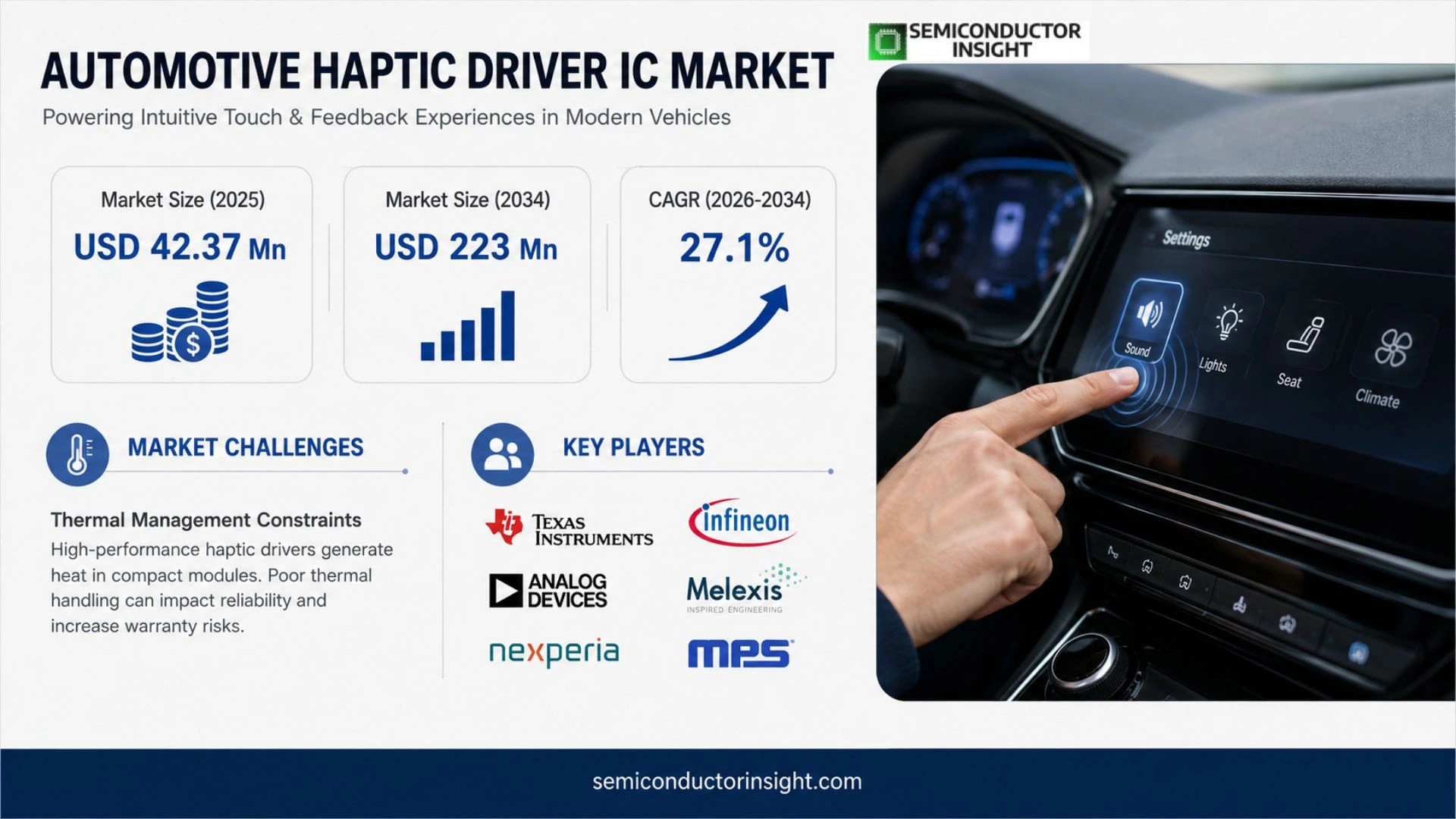
Automotive Haptic Driver IC market was valued at USD 42.37 million in 2025 and will reach USD 223 million by 2034, reflecting a CAGR of 27.1% during the forecast period.

Automotive haptic driver ICs are control chips that translate electronic commands into tactile sensations for human‑machine interaction inside intelligent cockpits. They power actuators such as linear‑resonance (LRA), eccentric‑rotating‑mass (ERM), voice‑coil (VCM) or solenoid devices, delivering clicks, pulses or damping feedback through closed‑loop control, automatic resonance tracking and low‑latency triggering while meeting AEC‑Q100 automotive reliability standards.

The market expands because vehicle manufacturers seek to replace mechanical switches with touch‑based interfaces that still provide clear confirmation without diverting driver attention. Regulations in Europe and the United States increasingly require eyes‑free operation cues, turning haptic feedback into a safety‑related feature rather than an optional luxury. Leading suppliers,including Texas Instruments, Renesas Electronics, Cirrus Logic, Awinic, Dongwoon Anatech and FourSemi,are broadening portfolios with integrated touch‑plus‑haptics solutions from Microchip and Infineon, accelerating adoption across center‑stack displays, steering wheels and smart‑surface panels.
Automotive Haptic Driver IC Market Growth

MARKET DRIVERS

Electrification of Vehicle Interfaces

The shift toward electric and hybrid powertrains has prompted automakers to re‑engineer interior control systems. With fewer mechanical linkages, designers rely on electronic actuation, creating a fertile ground for sophisticated haptic feedback solutions. Automotive Haptic Driver IC Market participants that can deliver low‑latency, low‑power drivers are gaining strategic relevance as manufacturers seek to preserve driver confidence while reducing wiring complexity.

Advances in Tactile Feedback Technology

Recent breakthroughs in piezoelectric and electro‑static actuation enable finer vibration patterns that mimic real‑world textures. These capabilities allow OEMs to differentiate infotainment consoles, steering wheels, and pedal assemblies, turning haptic cues into a brand asset. Companies that integrate adaptive algorithms into their driver ICs are positioning themselves at the forefront of this functional‑aesthetic convergence.

➤ “Vibration‑based alerts reduce visual distraction by up to 30 % in high‑speed driving scenarios, according to in‑vehicle trials.”

Regulatory emphasis on driver attention and safety reinforces the business case for reliable haptic signaling. As safety standards evolve, suppliers that can certify their driver ICs against automotive‑grade environmental tests will find a growing runway for contractual engagement.

MARKET CHALLENGES

Thermal Management Constraints

High‑performance haptic drivers generate heat that must be dissipated within cramped cockpit modules. Designers often battle competing thermal budgets, and excessive temperature spikes can jeopardize long‑term reliability. Manufacturers that overlook robust thermal pathways risk costly warranty claims and brand erosion.

Other Challenges

Supply‑Chain Volatility

The semiconductor ecosystem still feels the after‑effects of recent capacity shortages. Lead‑times for specialized process nodes used in automotive‑grade ICs have lengthened, pressuring project timelines and inflating component costs.

MARKET RESTRAINTS

Stringent Qualification Requirements

Automotive applications demand qualification against rigorous vibration, humidity, and temperature cycles. The extensive testing regimen extends product development cycles and adds upfront expense, discouraging smaller innovators from entering the field without substantial partner support.

MARKET OPPORTUNITIES

Integration with Autonomous Driving Suites

As Level 3+ autonomy matures, the cockpit evolves into a multimodal interaction zone where haptic cues complement visual and auditory alerts. Driver‑assist systems can leverage precise vibration patterns to convey lane‑keeping status, obstacle proximity, or system handover intent, creating a fresh revenue stream for IC providers that embed AI‑ready interfaces.

Automotive Haptic Driver IC Market Trends

Shift Toward Integrated Touch‑Haptic Controllers

Automotive Haptic Driver IC Market is rapidly consolidating around solutions that bundle haptic actuation, resonance tracking and touch‑sensing into a single silicon package. Early‑stage projects still rely on dedicated driver chips from suppliers such as TI or Renesas, but recent vehicle programs for large‑format displays and curved smart surfaces prefer the tighter footprint and reduced BOM of integrated controllers from Microchip and Infineon. This transition is driven by the need to synchronize waveform generation with touch‑force data in real time, eliminating latency mismatches that can confuse the driver. By co‑optimising the analog front‑end and the digital feedback loop, manufacturers can trim validation cycles and meet the tighter schedule of platform‑level design‑wins. Consequently, the proportion of product designs that request a standalone driver is expected to fall below half of new introductions within the next three years.

Other Trends

Safety‑Centric Human‑Machine Interaction

Regulatory pressure in Europe and the United States is reshaping how Automotive Haptic Driver IC Market addresses driver distraction. New evaluation protocols require tactile confirmation for critical functions such as climate control or window operation, turning haptic feedback from an optional convenience into a compliance element. Suppliers that embed diagnostic protection, low‑latency triggering and AEC‑Q100‑grade reliability into their chips gain a decisive edge, because OEM engineering teams can demonstrate measurable reductions in glance time during vehicle testing. The shift also influences software toolchains: waveform libraries now include preset patterns that align with safety‑critical alerts, enabling faster integration and consistent performance across multiple vehicle models.

Supply‑Side Realignment and Competitive Pressures

The competitive landscape of Automotive Haptic Driver IC Market reflects a geographic split between legacy analog powerhouses in the United States and Europe and fast‑moving entrants from Korea and China. Western firms continue to dominate high‑precision actuator driving and automated resonance tracking, while Asian suppliers are aggressively pricing compatible solutions and offering localized support for regional cockpit programs. This duality forces Tier 1 HMI providers to manage two parallel supply chains, balancing performance certainty with cost efficiency. Companies that can deliver extensive evaluation boards, GUI‑based configuration tools and comprehensive field‑application support are increasingly viewed as strategic partners rather than simple component vendors, a dynamic that will likely dictate platform allocation decisions for the next generation of premium and mid‑range vehicles.

COMPETITIVE LANDSCAPE

Key Industry Players

Automotive Haptic Driver IC Market Competitive Overview

The market is anchored by a handful of analog specialists that supply dedicated haptic drivers capable of energizing LRAs, ERMs, VCMs and solenoids with closed‑loop control, resonance tracking and automotive‑grade reliability. Texas Instruments occupies the lead, leveraging its deep analog portfolio and extensive design‑in ecosystem to secure design‑win on most high‑volume platforms. Its reference boards and waveform libraries have become de‑facto standards for OEM engineering teams, allowing rapid validation and low‑latency integration. Renesas Electronics follows closely, differentiating through system‑on‑chip solutions that embed touch‑sensing front‑ends, thereby narrowing the gap between pure drivers and integrated controllers. This tier of suppliers dictates market structure: OEMs first evaluate dedicated drivers for single‑node applications such as steering‑wheel haptics, then move to more complex, multi‑node architectures where integrated solutions become attractive.

Beyond the dominant analog houses, a diverse set of niche and emerging players expands the competitive field. Cirrus Logic and Awinic focus on ultra‑low‑power designs that target battery‑sensitive electric vehicle cabins. Dongwoon Anatech and FourSemi emphasize cost‑effective silicon for mass‑market models, often partnering with local Tier‑1 integrators. Microchip Technology and Infineon Technologies push integrated touch‑plus‑haptic controllers that combine capacitive sensing, force‑touch algorithms and driver circuitry, appealing to large‑format displays and smart‑surface deployments. Asian entrants such as STMicroelectronics, NXP Semiconductors, ROHM Semiconductor, Skyworks Solutions, Silicon Labs, Analog Devices and Qorvo round out the ecosystem, each bringing a mix of mixed‑signal expertise, packaging innovation or regional market reach that pressures incumbents to broaden feature sets and improve time‑to‑market support.

List of Key Automotive Haptic Driver IC Companies Profiled

Segment Analysis:

Segment Category Sub-Segments Key Insights
By Type
  • LRA (Linear Resonance Actuator) Driver IC
  • ERM (Eccentric Rotating Mass) Driver IC
  • Piezo Driver IC
Dedicated Actuator Drivers

  • Provide optimized waveforms for specific actuator families, enhancing tactile fidelity.
  • Offer closed‑loop control and resonance tracking, reducing calibration effort for OEMs.
  • Maintain strict automotive reliability (AEC‑Q100) which is critical for safety‑related functions.
By Application
  • Touch Keys
  • Steering Wheel Controls
  • Door Panel Interfaces
  • Seat Adjusters
  • Others
Smart‑Surface Interaction

  • Enables eyes‑free confirmation, directly supporting driver‑distraction mitigation strategies.
  • Provides tactile feedback for high‑frequency functions (climate, volume, window), reinforcing muscle‑memory operation.
  • Allows OEMs to replace mechanical switches, creating design flexibility while preserving safety compliance.
By End User
  • OEM Vehicle Manufacturers
  • Tier‑1 Cockpit Domain Suppliers
  • HMI Solution Providers
Platform‑Driven Adoption

  • OEMs prioritize chips that integrate seamlessly into vehicle platforms, shortening validation cycles.
  • Tier‑1s value comprehensive toolchains (evaluation boards, waveform libraries) that accelerate design‑in.
  • HMI providers focus on multi‑modal solutions that combine touch sensing and haptic actuation for differentiated user experiences.
By Integration Approach
  • Dedicated Haptic Driver ICs
  • Touch‑Plus‑Haptic Integrated Controllers
  • System‑Level Cockpit ASICs
Shift Toward System‑Level Integration

  • Manufacturers are bundling force‑touch sensing, low‑latency actuation, and diagnostic protection into single silicon blocks.
  • This reduces PCB real‑estate and simplifies software stacks, an advantage for large‑screen cockpit designs.
  • Integrated solutions also enable coordinated multi‑node haptic experiences across the vehicle interior.
By Functional Capability
  • Closed‑Loop Resonance Control
  • Automatic Waveform Storage & Playback
  • Diagnostic & Fault‑Tolerant Operation
Enhanced Reliability & Tuning Flexibility

  • Closed‑loop control ensures consistent tactile intensity despite temperature or actuator variance.
  • On‑chip waveform libraries accelerate design‑win by providing ready‑made feedback patterns.
  • Built‑in diagnostic features align with emerging safety regulations, positioning haptics as a functional safety element.

Regional Analysis: Automotive Haptic Driver IC Market

Europe

Europe retains a decisive edge in Automotive Haptic Driver IC Market thanks to a confluence of mature vehicle electrification programs and a dense network of automotive‑electronics specialists. Original equipment manufacturers (OEMs) across Germany, France and the Nordics have incorporated nuanced tactile feedback systems into premium models, seeking to differentiate the driver experience as autonomous functions become more prevalent. This strategic emphasis pressures local semiconductor firms to accelerate mixed‑signal integration, ensuring that haptic drivers can coexist with advanced driver‑assistance sensors without compromising latency. Meanwhile, the European Union’s stringent safety directives encourage early adoption of haptic alerts, turning compliance into a competitive advantage for suppliers that can certify their ICs across multiple member states. The region’s robust research ecosystem,anchored by universities in the Netherlands and Sweden,feeds a steady pipeline of patents that translate into differentiated product families. Consequently, European tier‑1 suppliers are increasingly partnering with niche fabless designers to secure differentiated IP, a move that deepens the continent’s value chain and creates entry barriers for newcomers. Collectively, these dynamics reinforce Europe’s status as the market’s innovation hub, shaping product roadmaps that reverberate globally.

Design Innovation
European design houses leverage the region’s strong multidisciplinary engineering base to embed multi‑frequency haptic patterns directly into driver‑assist modules, enabling richer tactile cues without expanding hardware footprints. This approach aligns with OEMs’ push for slimmer cockpit architectures.
Supply Chain Resilience
Recent geopolitical shocks prompted European firms to diversify wafer sources, favouring on‑shore fabs and strategic stockpiling. The resulting resilience lowers lead‑times for haptic driver ICs, a critical factor for just‑in‑time vehicle assembly lines.
Regulatory Landscape
EU safety regulations now mandate haptic feedback for critical alerts in Level‑2 automated vehicles. Compliance drives early adoption, compelling suppliers to embed certification criteria into their design cycles from inception.
OEM Partnerships
Tier‑1 suppliers are forging joint development agreements with leading carmakers, co‑creating bespoke haptic driver IC platforms that map directly to brand‑specific user‑experience roadmaps.

North America
North America’s trajectory in Automotive Haptic Driver IC Market is shaped by its aggressive rollout of advanced driver‑assist systems (ADAS). U.S. manufacturers prioritize tactile alerts as a safety fallback for visual overload scenarios, prompting demand for high‑precision driver ICs that can operate under stringent latency constraints. Silicon Valley’s venture capital ecosystem fuels startups that specialize in ultra‑low‑power haptic modules, offering OEMs cost‑effective pathways to integrate feedback into electric vehicle dashboards. At the same time, Canadian research consortia are advancing silicon‑on‑insulator (SOI) processes that improve signal integrity, a development closely watched by Tier‑1 suppliers seeking performance gains. The confluence of regulatory encouragement and technology‑focused financing sustains a vibrant innovation pipeline, positioning North America as a strong secondary hub for market growth.

Asia‑Pacific
Asia‑Pacific’s market dynamism stems from the region’s rapid automotive electrification and burgeoning consumer appetite for premium in‑car experiences. Chinese and Korean OEMs are embedding haptic feedback into infotainment and climate‑control interfaces to differentiate mass‑market models. Local semiconductor manufacturers benefit from economies of scale, but face pressure to meet increasingly sophisticated driver‑IC specifications demanded by global partners. Collaborative programs between Japanese automotive clusters and Taiwanese fabless firms are accelerating the co‑development of mixed‑signal solutions that balance cost with performance. Although supply‑chain volatility remains a concern, the sheer volume of vehicle production ensures Automotive Haptic Driver IC Market will remain a focal point for regional players seeking to capture export opportunities.

South America
South America’s automotive landscape is evolving from volume‑oriented manufacturing toward a modest yet noticeable emphasis on driver‑assist features. Brazilian and Argentine OEMs are piloting tactile feedback in new‑generation compact SUVs, driven by consumer expectations for safety‑enhanced cabins. The region’s limited local fab capacity pushes firms to import haptic driver ICs, yet growing trade agreements facilitate smoother access to European and North American suppliers. As governments introduce stricter safety standards, South American manufacturers will likely align with global design cues, creating incremental demand for adaptable IC platforms that can be tuned for varying market price points.

Middle East & Africa
In the Middle East & Africa, luxury vehicle adoption fuels interest in refined haptic interfaces that complement high‑end interior design. Wealth‑driven demand encourages OEMs to integrate tactile alerts for driver‑attention monitoring, a feature gaining traction in the Gulf’s premium segment. While local semiconductor ecosystems remain nascent, strategic partnerships with European firms enable technology transfer and localized assembly, reducing import reliance. Emerging safety regulations in select African markets also create a niche for cost‑effective haptic driver ICs, prompting regional distributors to position themselves as value‑adding intermediaries between global manufacturers and local dealers.

Report Scope

This market research report provides a comprehensive analysis of the Automotive Haptic Driver IC Market , covering the forecast period 2026–2034. It offers detailed insights into market dynamics, technological advancements, competitive landscape, and key trends shaping the industry.

Key focus areas of the report include:

  • Market Overview: The report begins with an overview outlining its current market scenario, key growth indicators, and industry transformation drivers. It discusses macroeconomic factors, demand–supply balance, regulatory landscape, and the strategic role of semiconductors in powering advancements across industries such as automotive, telecommunications, consumer electronics, and industrial automation.
  • Market Size & Forecast: Historical data and future projections for revenue, unit shipments, and market value across major regions and segments.
  • Segmentation Analysis: Detailed breakdown by product type, technology, application, and end-user industry to identify high-growth segments and investment opportunities.
  • Regional Insights: Insights into market performance across North America, Europe, Asia-Pacific, Latin America, and the Middle East & Africa, including country-level analysis where relevant.
  • Competitive Landscape: Profiles of leading market participants, including their product offerings, R&D focus, manufacturing capacity, pricing strategies, and recent developments such as mergers, acquisitions, and partnerships.
  • Technology Trends & Innovation: Assessment of emerging technologies, integration of AI/IoT, semiconductor design trends, fabrication techniques, and evolving industry standards.
  • Market Drivers & Restraints: Evaluation of factors driving market growth along with challenges, supply chain constraints, regulatory issues, and market-entry barriers.
  • Stakeholder Insights: Insights for component suppliers, OEMs, system integrators, investors, and policymakers regarding the evolving ecosystem and strategic opportunities.

Primary and secondary research methods are employed, including interviews with industry experts, data from verified sources, and real-time market intelligence to ensure the accuracy and reliability of the insights presented.

FREQUENTLY ASKED QUESTIONS:

What is the current market size of Automotive Haptic Driver IC Market?

-> Automotive Haptic Driver IC market will reach USD 223 million by 2034, reflecting a CAGR of 27.1% during the forecast period.

Which key companies operate in Automotive Haptic Driver IC Market?

-> Key players include TI, Renesas Electronics, Cirrus Logic, Awinic, Dongwoon Anatech, FourSemi, Microchip Technology, and Infineon Technologies, among others.

What are the key growth drivers?

-> Key growth drivers include the shift toward smart cockpit interfaces, need to reduce driver distraction, regulatory pressure for eyes‑free operation, and expanding use of haptic feedback in touch keys, steering wheels, and door panels.

Which region dominates the market?

-> North America remains the dominant market due to early adoption of advanced HMI systems, while Asia‑Pacific is the fastest‑growing region driven by large automotive production volumes.

What are the emerging trends?

-> Emerging trends include integration of touch‑plus‑haptic controllers, ultra‑low‑latency feedback, AI‑enabled waveform tuning, and broader deployment of haptic nodes across seats, HVAC zones, and curved displays.
Automotive Haptic Driver IC Market Trends, Business Strategies 2026-2036

Get Sample Report PDF for Exclusive Insights

Report Sample Includes

  • Table of Contents
  • List of Tables & Figures
  • Charts, Research Methodology, and more...

PDF Icon Download Sample Report PDF
SKU: 0f11495912dc
Category:
License Type

Corporate License, Excel License, PDF and Excel Databook License

Download Sample Report

Table of Content

1 Introduction to Research & Analysis Reports
1.1 Automotive Haptic Driver IC Market Definition
1.2 Market Segments
1.2.1 Segment by Type
1.2.2 Segment by Solution Architecture
1.2.3 Segment by Primary Application Scenarios
1.2.4 Segment by Application
1.3 Global Automotive Haptic Driver IC Market Overview
1.4 Features & Benefits of This Report
1.5 Methodology & Sources of Information
1.5.1 Research Methodology
1.5.2 Research Process
1.5.3 Base Year
1.5.4 Report Assumptions & Caveats
2 Global Automotive Haptic Driver IC Overall Market Size
2.1 Global Automotive Haptic Driver IC Market Size: 2025 VS 2034
2.2 Global Automotive Haptic Driver IC Market Size, Prospects & Forecasts: 2021-2034
2.3 Global Automotive Haptic Driver IC Sales: 2021-2034
3 Company Landscape
3.1 Top Automotive Haptic Driver IC Players in Global Market
3.2 Top Global Automotive Haptic Driver IC Companies Ranked by Revenue
3.3 Global Automotive Haptic Driver IC Revenue by Companies
3.4 Global Automotive Haptic Driver IC Sales by Companies
3.5 Global Automotive Haptic Driver IC Price by Manufacturer (2021-2026)
3.6 Top 3 and Top 5 Automotive Haptic Driver IC Companies in Global Market, by Revenue in 2025
3.7 Global Manufacturers Automotive Haptic Driver IC Product Type
3.8 Tier 1, Tier 2, and Tier 3 Automotive Haptic Driver IC Players in Global Market
3.8.1 List of Global Tier 1 Automotive Haptic Driver IC Companies
3.8.2 List of Global Tier 2 and Tier 3 Automotive Haptic Driver IC Companies
4 Sights by Type
4.1 Overview
4.1.1 Segment by Type – Global Automotive Haptic Driver IC Market Size Markets, 2025 & 2034
4.1.2 LRA (Linear Resonance Actuator) Driver IC
4.1.3 ERM (Eccentric Rotating Mass) Driver IC
4.1.4 Piezo Driver IC
4.2 Segment by Type – Global Automotive Haptic Driver IC Revenue & Forecasts
4.2.1 Segment by Type – Global Automotive Haptic Driver IC Revenue, 2021-2026
4.2.2 Segment by Type – Global Automotive Haptic Driver IC Revenue, 2027-2034
4.2.3 Segment by Type – Global Automotive Haptic Driver IC Revenue Market Share, 2021-2034
4.3 Segment by Type – Global Automotive Haptic Driver IC Sales & Forecasts
4.3.1 Segment by Type – Global Automotive Haptic Driver IC Sales, 2021-2026
4.3.2 Segment by Type – Global Automotive Haptic Driver IC Sales, 2027-2034
4.3.3 Segment by Type – Global Automotive Haptic Driver IC Sales Market Share, 2021-2034
4.4 Segment by Type – Global Automotive Haptic Driver IC Price (Manufacturers Selling Prices), 2021-2034
5 Sights by Solution Architecture
5.1 Overview
5.1.1 Segment by Solution Architecture – Global Automotive Haptic Driver IC Market Size Markets, 2025 & 2034
5.1.2 Dedicated Automotive Haptic Driver
5.1.3 Integrated Touch Plus Haptic Controller
5.2 Segment by Solution Architecture – Global Automotive Haptic Driver IC Revenue & Forecasts
5.2.1 Segment by Solution Architecture – Global Automotive Haptic Driver IC Revenue, 2021-2026
5.2.2 Segment by Solution Architecture – Global Automotive Haptic Driver IC Revenue, 2027-2034
5.2.3 Segment by Solution Architecture – Global Automotive Haptic Driver IC Revenue Market Share, 2021-2034
5.3 Segment by Solution Architecture – Global Automotive Haptic Driver IC Sales & Forecasts
5.3.1 Segment by Solution Architecture – Global Automotive Haptic Driver IC Sales, 2021-2026
5.3.2 Segment by Solution Architecture – Global Automotive Haptic Driver IC Sales, 2027-2034
5.3.3 Segment by Solution Architecture – Global Automotive Haptic Driver IC Sales Market Share, 2021-2034
5.4 Segment by Solution Architecture – Global Automotive Haptic Driver IC Price (Manufacturers Selling Prices), 2021-2034
6 Sights by Primary Application Scenarios
6.1 Overview
6.1.1 Segment by Primary Application Scenarios – Global Automotive Haptic Driver IC Market Size Markets, 2025 & 2034
6.1.2 Touch Keys
6.1.3 Steering Wheel
6.1.4 Others
6.2 Segment by Primary Application Scenarios – Global Automotive Haptic Driver IC Revenue & Forecasts
6.2.1 Segment by Primary Application Scenarios – Global Automotive Haptic Driver IC Revenue, 2021-2026
6.2.2 Segment by Primary Application Scenarios – Global Automotive Haptic Driver IC Revenue, 2027-2034
6.2.3 Segment by Primary Application Scenarios – Global Automotive Haptic Driver IC Revenue Market Share, 2021-2034
6.3 Segment by Primary Application Scenarios – Global Automotive Haptic Driver IC Sales & Forecasts
6.3.1 Segment by Primary Application Scenarios – Global Automotive Haptic Driver IC Sales, 2021-2026
6.3.2 Segment by Primary Application Scenarios – Global Automotive Haptic Driver IC Sales, 2027-2034
6.3.3 Segment by Primary Application Scenarios – Global Automotive Haptic Driver IC Sales Market Share, 2021-2034
6.4 Segment by Primary Application Scenarios – Global Automotive Haptic Driver IC Price (Manufacturers Selling Prices), 2021-2034
7 Sights by Application
7.1 Overview
7.1.1 Segment by Application – Global Automotive Haptic Driver IC Market Size, 2025 & 2034
7.1.2 Passenger Car
7.1.3 Commercial Vehicle
7.2 Segment by Application – Global Automotive Haptic Driver IC Revenue & Forecasts
7.2.1 Segment by Application – Global Automotive Haptic Driver IC Revenue, 2021-2026
7.2.2 Segment by Application – Global Automotive Haptic Driver IC Revenue, 2027-2034
7.2.3 Segment by Application – Global Automotive Haptic Driver IC Revenue Market Share, 2021-2034
7.3 Segment by Application – Global Automotive Haptic Driver IC Sales & Forecasts
7.3.1 Segment by Application – Global Automotive Haptic Driver IC Sales, 2021-2026
7.3.2 Segment by Application – Global Automotive Haptic Driver IC Sales, 2027-2034
7.3.3 Segment by Application – Global Automotive Haptic Driver IC Sales Market Share, 2021-2034
7.4 Segment by Application – Global Automotive Haptic Driver IC Price (Manufacturers Selling Prices), 2021-2034
8 Sights Region
8.1 By Region – Global Automotive Haptic Driver IC Market Size, 2025 & 2034
8.2 By Region – Global Automotive Haptic Driver IC Revenue & Forecasts
8.2.1 By Region – Global Automotive Haptic Driver IC Revenue, 2021-2026
8.2.2 By Region – Global Automotive Haptic Driver IC Revenue, 2027-2034
8.2.3 By Region – Global Automotive Haptic Driver IC Revenue Market Share, 2021-2034
8.3 By Region – Global Automotive Haptic Driver IC Sales & Forecasts
8.3.1 By Region – Global Automotive Haptic Driver IC Sales, 2021-2026
8.3.2 By Region – Global Automotive Haptic Driver IC Sales, 2027-2034
8.3.3 By Region – Global Automotive Haptic Driver IC Sales Market Share, 2021-2034
8.4 North America
8.4.1 By Country – North America Automotive Haptic Driver IC Revenue, 2021-2034
8.4.2 By Country – North America Automotive Haptic Driver IC Sales, 2021-2034
8.4.3 United States Automotive Haptic Driver IC Market Size, 2021-2034
8.4.4 Canada Automotive Haptic Driver IC Market Size, 2021-2034
8.4.5 Mexico Automotive Haptic Driver IC Market Size, 2021-2034
8.5 Europe
8.5.1 By Country – Europe Automotive Haptic Driver IC Revenue, 2021-2034
8.5.2 By Country – Europe Automotive Haptic Driver IC Sales, 2021-2034
8.5.3 Germany Automotive Haptic Driver IC Market Size, 2021-2034
8.5.4 France Automotive Haptic Driver IC Market Size, 2021-2034
8.5.5 U.K. Automotive Haptic Driver IC Market Size, 2021-2034
8.5.6 Italy Automotive Haptic Driver IC Market Size, 2021-2034
8.5.7 Russia Automotive Haptic Driver IC Market Size, 2021-2034
8.5.8 Nordic Countries Automotive Haptic Driver IC Market Size, 2021-2034
8.5.9 Benelux Automotive Haptic Driver IC Market Size, 2021-2034
8.6 Asia
8.6.1 By Region – Asia Automotive Haptic Driver IC Revenue, 2021-2034
8.6.2 By Region – Asia Automotive Haptic Driver IC Sales, 2021-2034
8.6.3 China Automotive Haptic Driver IC Market Size, 2021-2034
8.6.4 Japan Automotive Haptic Driver IC Market Size, 2021-2034
8.6.5 South Korea Automotive Haptic Driver IC Market Size, 2021-2034
8.6.6 Southeast Asia Automotive Haptic Driver IC Market Size, 2021-2034
8.6.7 India Automotive Haptic Driver IC Market Size, 2021-2034
8.7 South America
8.7.1 By Country – South America Automotive Haptic Driver IC Revenue, 2021-2034
8.7.2 By Country – South America Automotive Haptic Driver IC Sales, 2021-2034
8.7.3 Brazil Automotive Haptic Driver IC Market Size, 2021-2034
8.7.4 Argentina Automotive Haptic Driver IC Market Size, 2021-2034
8.8 Middle East & Africa
8.8.1 By Country – Middle East & Africa Automotive Haptic Driver IC Revenue, 2021-2034
8.8.2 By Country – Middle East & Africa Automotive Haptic Driver IC Sales, 2021-2034
8.8.3 Turkey Automotive Haptic Driver IC Market Size, 2021-2034
8.8.4 Israel Automotive Haptic Driver IC Market Size, 2021-2034
8.8.5 Saudi Arabia Automotive Haptic Driver IC Market Size, 2021-2034
8.8.6 UAE Automotive Haptic Driver IC Market Size, 2021-2034
9 Manufacturers & Brands Profiles
9.1 TI
9.1.1 TI Company Summary
9.1.2 TI Business Overview
9.1.3 TI Automotive Haptic Driver IC Major Product Offerings
9.1.4 TI Automotive Haptic Driver IC Sales and Revenue in Global (2021-2026)
9.1.5 TI Key News & Latest Developments
9.2 Renesas Electronics
9.2.1 Renesas Electronics Company Summary
9.2.2 Renesas Electronics Business Overview
9.2.3 Renesas Electronics Automotive Haptic Driver IC Major Product Offerings
9.2.4 Renesas Electronics Automotive Haptic Driver IC Sales and Revenue in Global (2021-2026)
9.2.5 Renesas Electronics Key News & Latest Developments
9.3 Cirrus Logic
9.3.1 Cirrus Logic Company Summary
9.3.2 Cirrus Logic Business Overview
9.3.3 Cirrus Logic Automotive Haptic Driver IC Major Product Offerings
9.3.4 Cirrus Logic Automotive Haptic Driver IC Sales and Revenue in Global (2021-2026)
9.3.5 Cirrus Logic Key News & Latest Developments
9.4 Awinic
9.4.1 Awinic Company Summary
9.4.2 Awinic Business Overview
9.4.3 Awinic Automotive Haptic Driver IC Major Product Offerings
9.4.4 Awinic Automotive Haptic Driver IC Sales and Revenue in Global (2021-2026)
9.4.5 Awinic Key News & Latest Developments
9.5 Dongwoon Anatech
9.5.1 Dongwoon Anatech Company Summary
9.5.2 Dongwoon Anatech Business Overview
9.5.3 Dongwoon Anatech Automotive Haptic Driver IC Major Product Offerings
9.5.4 Dongwoon Anatech Automotive Haptic Driver IC Sales and Revenue in Global (2021-2026)
9.5.5 Dongwoon Anatech Key News & Latest Developments
9.6 FourSemi
9.6.1 FourSemi Company Summary
9.6.2 FourSemi Business Overview
9.6.3 FourSemi Automotive Haptic Driver IC Major Product Offerings
9.6.4 FourSemi Automotive Haptic Driver IC Sales and Revenue in Global (2021-2026)
9.6.5 FourSemi Key News & Latest Developments
9.7 Microchip Technology
9.7.1 Microchip Technology Company Summary
9.7.2 Microchip Technology Business Overview
9.7.3 Microchip Technology Automotive Haptic Driver IC Major Product Offerings
9.7.4 Microchip Technology Automotive Haptic Driver IC Sales and Revenue in Global (2021-2026)
9.7.5 Microchip Technology Key News & Latest Developments
9.8 Infineon Technologies
9.8.1 Infineon Technologies Company Summary
9.8.2 Infineon Technologies Business Overview
9.8.3 Infineon Technologies Automotive Haptic Driver IC Major Product Offerings
9.8.4 Infineon Technologies Automotive Haptic Driver IC Sales and Revenue in Global (2021-2026)
9.8.5 Infineon Technologies Key News & Latest Developments
10 Global Automotive Haptic Driver IC Production Capacity, Analysis
10.1 Global Automotive Haptic Driver IC Production Capacity, 2021-2034
10.2 Automotive Haptic Driver IC Production Capacity of Key Manufacturers in Global Market
10.3 Global Automotive Haptic Driver IC Production by Region
11 Key Market Trends, Opportunity, Drivers and Restraints
11.1 Market Opportunities & Trends
11.2 Market Drivers
11.3 Market Restraints
12 Automotive Haptic Driver IC Supply Chain Analysis
12.1 Automotive Haptic Driver IC Industry Value Chain
12.2 Automotive Haptic Driver IC Upstream Market
12.3 Automotive Haptic Driver IC Downstream and Clients
12.4 Marketing Channels Analysis
12.4.1 Marketing Channels
12.4.2 Automotive Haptic Driver IC Distributors and Sales Agents in Global
13 Conclusion
14 Appendix
14.1 Note
14.2 Examples of Clients
14.3 DisclaimerList of Tables
Table 1. Key Players of Automotive Haptic Driver IC in Global Market
Table 2. Top Automotive Haptic Driver IC Players in Global Market, Ranking by Revenue (2025)
Table 3. Global Automotive Haptic Driver IC Revenue by Companies, (US$, Mn), 2021-2026
Table 4. Global Automotive Haptic Driver IC Revenue Share by Companies, 2021-2026
Table 5. Global Automotive Haptic Driver IC Sales by Companies, (Million Units), 2021-2026
Table 6. Global Automotive Haptic Driver IC Sales Share by Companies, 2021-2026
Table 7. Key Manufacturers Automotive Haptic Driver IC Price (2021-2026) & (US$/Unit)
Table 8. Global Manufacturers Automotive Haptic Driver IC Product Type
Table 9. List of Global Tier 1 Automotive Haptic Driver IC Companies, Revenue (US$, Mn) in 2025 and Market Share
Table 10. List of Global Tier 2 and Tier 3 Automotive Haptic Driver IC Companies, Revenue (US$, Mn) in 2025 and Market Share
Table 11. Segment by Type – Global Automotive Haptic Driver IC Revenue, (US$, Mn), 2025 & 2034
Table 12. Segment by Type – Global Automotive Haptic Driver IC Revenue (US$, Mn), 2021-2026
Table 13. Segment by Type – Global Automotive Haptic Driver IC Revenue (US$, Mn), 2027-2034
Table 14. Segment by Type – Global Automotive Haptic Driver IC Sales (Million Units), 2021-2026
Table 15. Segment by Type – Global Automotive Haptic Driver IC Sales (Million Units), 2027-2034
Table 16. Segment by Solution Architecture – Global Automotive Haptic Driver IC Revenue, (US$, Mn), 2025 & 2034
Table 17. Segment by Solution Architecture – Global Automotive Haptic Driver IC Revenue (US$, Mn), 2021-2026
Table 18. Segment by Solution Architecture – Global Automotive Haptic Driver IC Revenue (US$, Mn), 2027-2034
Table 19. Segment by Solution Architecture – Global Automotive Haptic Driver IC Sales (Million Units), 2021-2026
Table 20. Segment by Solution Architecture – Global Automotive Haptic Driver IC Sales (Million Units), 2027-2034
Table 21. Segment by Primary Application Scenarios – Global Automotive Haptic Driver IC Revenue, (US$, Mn), 2025 & 2034
Table 22. Segment by Primary Application Scenarios – Global Automotive Haptic Driver IC Revenue (US$, Mn), 2021-2026
Table 23. Segment by Primary Application Scenarios – Global Automotive Haptic Driver IC Revenue (US$, Mn), 2027-2034
Table 24. Segment by Primary Application Scenarios – Global Automotive Haptic Driver IC Sales (Million Units), 2021-2026
Table 25. Segment by Primary Application Scenarios – Global Automotive Haptic Driver IC Sales (Million Units), 2027-2034
Table 26. Segment by Application – Global Automotive Haptic Driver IC Revenue, (US$, Mn), 2025 & 2034
Table 27. Segment by Application – Global Automotive Haptic Driver IC Revenue, (US$, Mn), 2021-2026
Table 28. Segment by Application – Global Automotive Haptic Driver IC Revenue, (US$, Mn), 2027-2034
Table 29. Segment by Application – Global Automotive Haptic Driver IC Sales, (Million Units), 2021-2026
Table 30. Segment by Application – Global Automotive Haptic Driver IC Sales, (Million Units), 2027-2034
Table 31. By Region – Global Automotive Haptic Driver IC Revenue, (US$, Mn), 2025 & 2034
Table 32. By Region – Global Automotive Haptic Driver IC Revenue, (US$, Mn), 2021-2026
Table 33. By Region – Global Automotive Haptic Driver IC Revenue, (US$, Mn), 2027-2034
Table 34. By Region – Global Automotive Haptic Driver IC Sales, (Million Units), 2021-2026
Table 35. By Region – Global Automotive Haptic Driver IC Sales, (Million Units), 2027-2034
Table 36. By Country – North America Automotive Haptic Driver IC Revenue, (US$, Mn), 2021-2026
Table 37. By Country – North America Automotive Haptic Driver IC Revenue, (US$, Mn), 2027-2034
Table 38. By Country – North America Automotive Haptic Driver IC Sales, (Million Units), 2021-2026
Table 39. By Country – North America Automotive Haptic Driver IC Sales, (Million Units), 2027-2034
Table 40. By Country – Europe Automotive Haptic Driver IC Revenue, (US$, Mn), 2021-2026
Table 41. By Country – Europe Automotive Haptic Driver IC Revenue, (US$, Mn), 2027-2034
Table 42. By Country – Europe Automotive Haptic Driver IC Sales, (Million Units), 2021-2026
Table 43. By Country – Europe Automotive Haptic Driver IC Sales, (Million Units), 2027-2034
Table 44. By Region – Asia Automotive Haptic Driver IC Revenue, (US$, Mn), 2021-2026
Table 45. By Region – Asia Automotive Haptic Driver IC Revenue, (US$, Mn), 2027-2034
Table 46. By Region – Asia Automotive Haptic Driver IC Sales, (Million Units), 2021-2026
Table 47. By Region – Asia Automotive Haptic Driver IC Sales, (Million Units), 2027-2034
Table 48. By Country – South America Automotive Haptic Driver IC Revenue, (US$, Mn), 2021-2026
Table 49. By Country – South America Automotive Haptic Driver IC Revenue, (US$, Mn), 2027-2034
Table 50. By Country – South America Automotive Haptic Driver IC Sales, (Million Units), 2021-2026
Table 51. By Country – South America Automotive Haptic Driver IC Sales, (Million Units), 2027-2034
Table 52. By Country – Middle East & Africa Automotive Haptic Driver IC Revenue, (US$, Mn), 2021-2026
Table 53. By Country – Middle East & Africa Automotive Haptic Driver IC Revenue, (US$, Mn), 2027-2034
Table 54. By Country – Middle East & Africa Automotive Haptic Driver IC Sales, (Million Units), 2021-2026
Table 55. By Country – Middle East & Africa Automotive Haptic Driver IC Sales, (Million Units), 2027-2034
Table 56. TI Company Summary
Table 57. TI Automotive Haptic Driver IC Product Offerings
Table 58. TI Automotive Haptic Driver IC Sales (Million Units), Revenue (US$, Mn) and Average Price (US$/Unit) & (2021-2026)
Table 59. TI Key News & Latest Developments
Table 60. Renesas Electronics Company Summary
Table 61. Renesas Electronics Automotive Haptic Driver IC Product Offerings
Table 62. Renesas Electronics Automotive Haptic Driver IC Sales (Million Units), Revenue (US$, Mn) and Average Price (US$/Unit) & (2021-2026)
Table 63. Renesas Electronics Key News & Latest Developments
Table 64. Cirrus Logic Company Summary
Table 65. Cirrus Logic Automotive Haptic Driver IC Product Offerings
Table 66. Cirrus Logic Automotive Haptic Driver IC Sales (Million Units), Revenue (US$, Mn) and Average Price (US$/Unit) & (2021-2026)
Table 67. Cirrus Logic Key News & Latest Developments
Table 68. Awinic Company Summary
Table 69. Awinic Automotive Haptic Driver IC Product Offerings
Table 70. Awinic Automotive Haptic Driver IC Sales (Million Units), Revenue (US$, Mn) and Average Price (US$/Unit) & (2021-2026)
Table 71. Awinic Key News & Latest Developments
Table 72. Dongwoon Anatech Company Summary
Table 73. Dongwoon Anatech Automotive Haptic Driver IC Product Offerings
Table 74. Dongwoon Anatech Automotive Haptic Driver IC Sales (Million Units), Revenue (US$, Mn) and Average Price (US$/Unit) & (2021-2026)
Table 75. Dongwoon Anatech Key News & Latest Developments
Table 76. FourSemi Company Summary
Table 77. FourSemi Automotive Haptic Driver IC Product Offerings
Table 78. FourSemi Automotive Haptic Driver IC Sales (Million Units), Revenue (US$, Mn) and Average Price (US$/Unit) & (2021-2026)
Table 79. FourSemi Key News & Latest Developments
Table 80. Microchip Technology Company Summary
Table 81. Microchip Technology Automotive Haptic Driver IC Product Offerings
Table 82. Microchip Technology Automotive Haptic Driver IC Sales (Million Units), Revenue (US$, Mn) and Average Price (US$/Unit) & (2021-2026)
Table 83. Microchip Technology Key News & Latest Developments
Table 84. Infineon Technologies Company Summary
Table 85. Infineon Technologies Automotive Haptic Driver IC Product Offerings
Table 86. Infineon Technologies Automotive Haptic Driver IC Sales (Million Units), Revenue (US$, Mn) and Average Price (US$/Unit) & (2021-2026)
Table 87. Infineon Technologies Key News & Latest Developments
Table 88. Automotive Haptic Driver IC Capacity of Key Manufacturers in Global Market, 2024-2026 (Million Units)
Table 89. Global Automotive Haptic Driver IC Capacity Market Share of Key Manufacturers, 2024-2026
Table 90. Global Automotive Haptic Driver IC Production by Region, 2021-2026 (Million Units)
Table 91. Global Automotive Haptic Driver IC Production by Region, 2027-2034 (Million Units)
Table 92. Automotive Haptic Driver IC Market Opportunities & Trends in Global Market
Table 93. Automotive Haptic Driver IC Market Drivers in Global Market
Table 94. Automotive Haptic Driver IC Market Restraints in Global Market
Table 95. Automotive Haptic Driver IC Raw Materials
Table 96. Automotive Haptic Driver IC Raw Materials Suppliers in Global Market
Table 97. Typical Automotive Haptic Driver IC Downstream
Table 98. Automotive Haptic Driver IC Downstream Clients in Global Market
Table 99. Automotive Haptic Driver IC Distributors and Sales Agents in Global Market

List of Figures
Figure 1. Automotive Haptic Driver IC Product Picture
Figure 2. Automotive Haptic Driver IC Segment by Type in 2025
Figure 3. Automotive Haptic Driver IC Segment by Solution Architecture in 2025
Figure 4. Automotive Haptic Driver IC Segment by Primary Application Scenarios in 2025
Figure 5. Automotive Haptic Driver IC Segment by Application in 2025
Figure 6. Global Automotive Haptic Driver IC Market Overview: 2025
Figure 7. Key Caveats
Figure 8. Global Automotive Haptic Driver IC Market Size: 2025 VS 2034 (US$, Mn)
Figure 9. Global Automotive Haptic Driver IC Revenue: 2021-2034 (US$, Mn)
Figure 10. Automotive Haptic Driver IC Sales in Global Market: 2021-2034 (Million Units)
Figure 11. The Top 3 and 5 Players Market Share by Automotive Haptic Driver IC Revenue in 2025
Figure 12. Segment by Type – Global Automotive Haptic Driver IC Revenue, (US$, Mn), 2025 & 2034
Figure 13. Segment by Type – Global Automotive Haptic Driver IC Revenue Market Share, 2021-2034
Figure 14. Segment by Type – Global Automotive Haptic Driver IC Sales Market Share, 2021-2034
Figure 15. Segment by Type – Global Automotive Haptic Driver IC Price (US$/Unit), 2021-2034
Figure 16. Segment by Solution Architecture – Global Automotive Haptic Driver IC Revenue, (US$, Mn), 2025 & 2034
Figure 17. Segment by Solution Architecture – Global Automotive Haptic Driver IC Revenue Market Share, 2021-2034
Figure 18. Segment by Solution Architecture – Global Automotive Haptic Driver IC Sales Market Share, 2021-2034
Figure 19. Segment by Solution Architecture – Global Automotive Haptic Driver IC Price (US$/Unit), 2021-2034
Figure 20. Segment by Primary Application Scenarios – Global Automotive Haptic Driver IC Revenue, (US$, Mn), 2025 & 2034
Figure 21. Segment by Primary Application Scenarios – Global Automotive Haptic Driver IC Revenue Market Share, 2021-2034
Figure 22. Segment by Primary Application Scenarios – Global Automotive Haptic Driver IC Sales Market Share, 2021-2034
Figure 23. Segment by Primary Application Scenarios – Global Automotive Haptic Driver IC Price (US$/Unit), 2021-2034
Figure 24. Segment by Application – Global Automotive Haptic Driver IC Revenue, (US$, Mn), 2025 & 2034
Figure 25. Segment by Application – Global Automotive Haptic Driver IC Revenue Market Share, 2021-2034
Figure 26. Segment by Application – Global Automotive Haptic Driver IC Sales Market Share, 2021-2034
Figure 27. Segment by Application -Global Automotive Haptic Driver IC Price (US$/Unit), 2021-2034
Figure 28. By Region – Global Automotive Haptic Driver IC Revenue, (US$, Mn), 2025 & 2034
Figure 29. By Region – Global Automotive Haptic Driver IC Revenue Market Share, 2021 VS 2025 VS 2034
Figure 30. By Region – Global Automotive Haptic Driver IC Revenue Market Share, 2021-2034
Figure 31. By Region – Global Automotive Haptic Driver IC Sales Market Share, 2021-2034
Figure 32. By Country – North America Automotive Haptic Driver IC Revenue Market Share, 2021-2034
Figure 33. By Country – North America Automotive Haptic Driver IC Sales Market Share, 2021-2034
Figure 34. United States Automotive Haptic Driver IC Revenue, (US$, Mn), 2021-2034
Figure 35. Canada Automotive Haptic Driver IC Revenue, (US$, Mn), 2021-2034
Figure 36. Mexico Automotive Haptic Driver IC Revenue, (US$, Mn), 2021-2034
Figure 37. By Country – Europe Automotive Haptic Driver IC Revenue Market Share, 2021-2034
Figure 38. By Country – Europe Automotive Haptic Driver IC Sales Market Share, 2021-2034
Figure 39. Germany Automotive Haptic Driver IC Revenue, (US$, Mn), 2021-2034
Figure 40. France Automotive Haptic Driver IC Revenue, (US$, Mn), 2021-2034
Figure 41. U.K. Automotive Haptic Driver IC Revenue, (US$, Mn), 2021-2034
Figure 42. Italy Automotive Haptic Driver IC Revenue, (US$, Mn), 2021-2034
Figure 43. Russia Automotive Haptic Driver IC Revenue, (US$, Mn), 2021-2034
Figure 44. Nordic Countries Automotive Haptic Driver IC Revenue, (US$, Mn), 2021-2034
Figure 45. Benelux Automotive Haptic Driver IC Revenue, (US$, Mn), 2021-2034
Figure 46. By Region – Asia Automotive Haptic Driver IC Revenue Market Share, 2021-2034
Figure 47. By Region – Asia Automotive Haptic Driver IC Sales Market Share, 2021-2034
Figure 48. China Automotive Haptic Driver IC Revenue, (US$, Mn), 2021-2034
Figure 49. Japan Automotive Haptic Driver IC Revenue, (US$, Mn), 2021-2034
Figure 50. South Korea Automotive Haptic Driver IC Revenue, (US$, Mn), 2021-2034
Figure 51. Southeast Asia Automotive Haptic Driver IC Revenue, (US$, Mn), 2021-2034
Figure 52. India Automotive Haptic Driver IC Revenue, (US$, Mn), 2021-2034
Figure 53. By Country – South America Automotive Haptic Driver IC Revenue Market Share, 2021-2034
Figure 54. By Country – South America Automotive Haptic Driver IC Sales, Market Share, 2021-2034
Figure 55. Brazil Automotive Haptic Driver IC Revenue, (US$, Mn), 2021-2034
Figure 56. Argentina Automotive Haptic Driver IC Revenue, (US$, Mn), 2021-2034
Figure 57. By Country – Middle East & Africa Automotive Haptic Driver IC Revenue, Market Share, 2021-2034
Figure 58. By Country – Middle East & Africa Automotive Haptic Driver IC Sales, Market Share, 2021-2034
Figure 59. Turkey Automotive Haptic Driver IC Revenue, (US$, Mn), 2021-2034
Figure 60. Israel Automotive Haptic Driver IC Revenue, (US$, Mn), 2021-2034
Figure 61. Saudi Arabia Automotive Haptic Driver IC Revenue, (US$, Mn), 2021-2034
Figure 62. UAE Automotive Haptic Driver IC Revenue, (US$, Mn), 2021-2034
Figure 63. Global Automotive Haptic Driver IC Production Capacity (Million Units), 2021-2034
Figure 64. The Percentage of Production Automotive Haptic Driver IC by Region, 2025 VS 2034
Figure 65. Automotive Haptic Driver IC Industry Value Chain
Figure 66. Marketing Channels