
Market Insights
Global Automotive-Grade MEMS Mics Market size was valued at USD 473 million in 2025. The market is projected to grow from USD 520 million in 2026 to USD 907 million by 2032, exhibiting a CAGR of 9.9% during the forecast period.
Automotive-Grade MEMS Mics are specialized microelectromechanical acoustic sensors designed for in-cabin voice capture and acoustic perception. These components maintain stable performance under extreme automotive conditions, including wide temperature ranges (-40°C to +105°C), strong vibration (up to 20G), and complex electromagnetic environments. They meet stringent AEC-Q100 qualification standards for automotive reliability, enabling critical applications like voice assistants, active noise cancellation, and occupant monitoring systems.
The market growth is driven by increasing adoption of smart cockpit technologies, with average microphone installations per vehicle rising from 2-3 units in entry-level models to 6-8 units in premium vehicles featuring advanced driver assistance systems (ADAS). Key manufacturers are developing beamforming-capable digital MEMS microphone arrays that integrate with vehicle ECUs through I²S or PDM interfaces, supporting emerging use cases like emergency call detection and in-cabin biometric authentication.
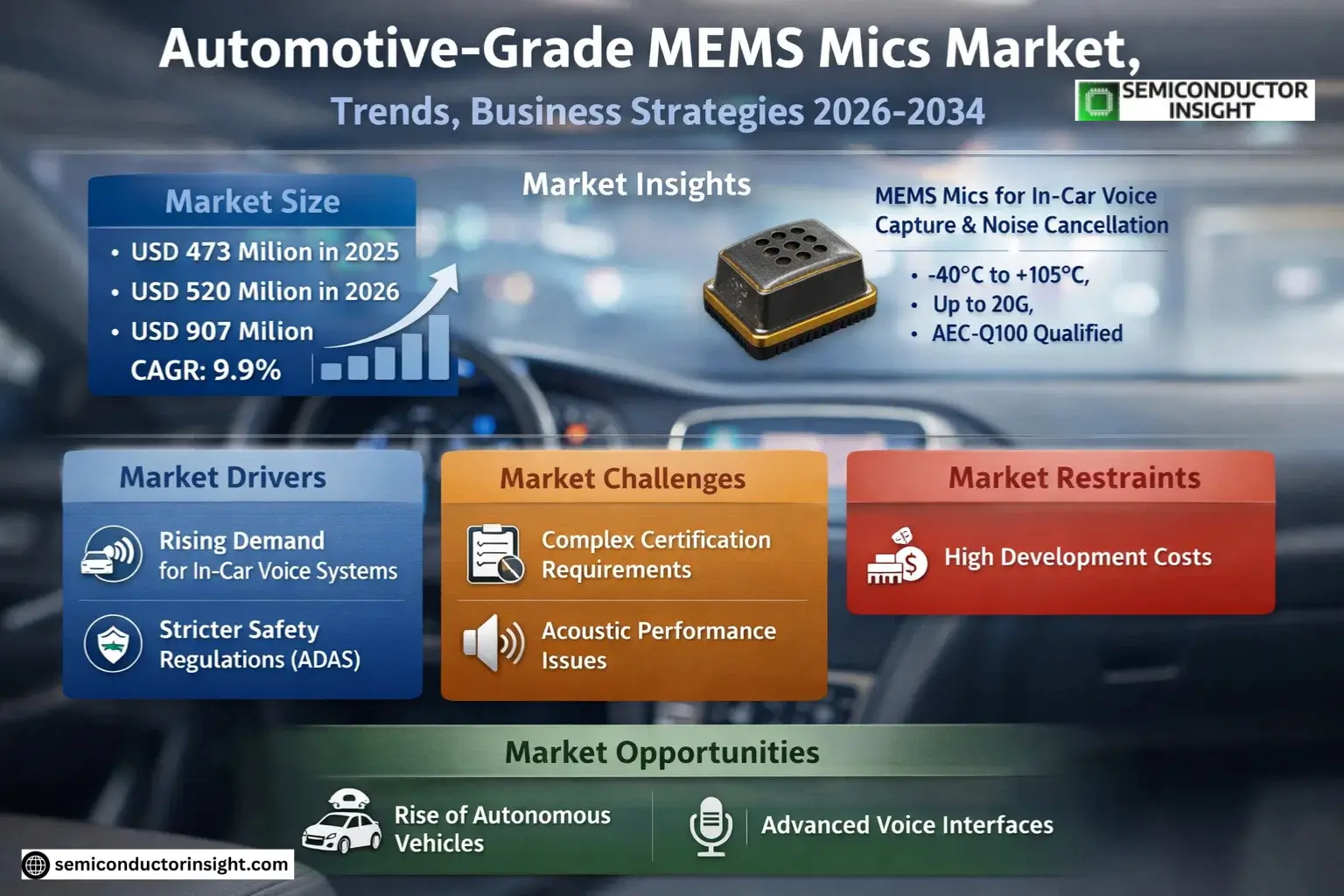
MARKET DRIVERS
Growing Demand for In-Car Voice Recognition Systems
Automotive-Grade MEMS Mics Market is experiencing robust growth driven by the increasing adoption of voice-activated systems in modern vehicles. With over 65% of new vehicles now featuring voice control interfaces, the demand for high-performance microphones that can operate reliably in automotive environments has surged. These MEMS mics enable noise cancellation and far-field voice pickup, critical for safety and convenience features.
Stringent Safety Regulations Driving Adoption
Governments worldwide are mandating advanced driver assistance systems (ADAS) that often incorporate voice control functionality. Automotive-Grade MEMS microphones meet the strict AEC-Q100 qualification standards required for vehicle components, making them the preferred choice over conventional microphones in safety-critical applications.
OEMs are increasingly standardizing MEMS microphone arrays in premium models, with trickle-down adoption expected in mid-range vehicles as costs continue to decrease.
MARKET CHALLENGES
Complex Automotive Certification Requirements
Developing Automotive-Grade MEMS Mics that meet the rigorous temperature (-40°C to 105°C), vibration, and EMI standards adds significant development costs and time to market. The AEC-Q100 qualification process alone can take 12-18 months, challenging smaller manufacturers.
Other Challenges
Acoustic Performance in Noisy Environments
While MEMS technology has advanced substantially, achieving consistent voice pickup quality across diverse vehicle interior configurations and road noise conditions remains an ongoing engineering challenge for microphone suppliers.
MARKET RESTRAINTS
High Development Costs Limiting Market Entry
The specialized manufacturing processes and testing requirements for Automotive-Grade MEMS Mics create substantial barriers to entry. New players face initial investments exceeding USD 20 million for production facilities capable of meeting automotive quality standards, restricting market competition.
MARKET OPPORTUNITIES
Emerging Applications in Autonomous Vehicles
The development of Level 4 and 5 autonomous vehicles presents significant growth potential for the Automotive-Grade MEMS Mics Market. These advanced systems require multiple microphone arrays for both voice interfaces and interior monitoring, with some concepts incorporating 8-12 microphones per vehicle. The shift toward software-defined vehicle architectures also enables new audio processing capabilities that enhance microphone functionality.
Automotive-Grade MEMS Mics Market Trends
Growing Demand for Voice-Centric Vehicle Interfaces
Automotive-Grade MEMS Mics Market is experiencing robust growth due to increasing integration of voice assistants in modern vehicles. Automakers are deploying multiple microphones per vehicle to enable advanced features like hands-free calling, voice commands, and noise cancellation. These sensors must maintain precise acoustic performance across temperature extremes (-40°C to 105°C) and vehicle vibrations, driving demand for specialized automotive-grade solutions.
Other Trends
Transition Toward Digital MEMS Microphone Arrays
Automotive OEMs are shifting from analog to digital MEMS microphone solutions to support high-channel-count beamforming applications. This enables superior speech recognition accuracy in noisy environments while reducing system-level power consumption. Digital interfaces also simplify integration with AI processors used for voice biometrics and natural language processing.
Safety-Critical Applications Driving Quality Standards
Stringent automotive functional safety requirements (ISO 26262 ASIL-B) are becoming mandatory for MEMS microphones used in driver monitoring and emergency call systems. Manufacturers are implementing enhanced failure detection circuitry and redundancy features to meet these standards, particularly for Level 3+ autonomous vehicles where microphone reliability directly impacts safety.
Consolidation in the Supply Chain
The market is seeing vertical integration as MEMS suppliers acquire packaging and testing capabilities to deliver fully qualified automotive-grade solutions. Leading players are investing in wafer-level packaging technologies to improve yield rates while meeting AEC-Q100 qualification requirements.
Regional Production Shifts
While China remains the dominant production hub for Automotive-Grade MEMS Mics, suppliers are establishing secondary manufacturing sites in Southeast Asia and Eastern Europe to mitigate geopolitical risks and serve regional automotive markets more effectively.
COMPETITIVE LANDSCAPE
Key Industry Players
Strategic Positioning in the Automotive-Grade MEMS Mics Market
Automotive-Grade MEMS Mics Market is dominated by established semiconductor and acoustic component manufacturers with strong automotive qualification expertise. Knowles Corporation leads the market with approximately 28% revenue share in 2025, leveraging its specialized MEMS technology and deep relationships with Tier 1 automotive suppliers. STMicroelectronics follows closely with 19% share, capitalizing on its integrated semiconductor solutions for automotive infotainment systems. The competitive landscape features tight technical specifications where suppliers must meet AEC-Q100 reliability standards while delivering superior signal-to-noise ratios for voice recognition applications.
Niche players are gaining traction through specialized offerings: Gorertek and AAC Technologies focus on cost-optimized solutions for Chinese automakers, while Analog Devices and Bosch emphasize high-performance microphones for premium vehicles with advanced noise cancellation. Emerging Chinese suppliers like Memsensing Microsystems are challenging incumbents through aggressive pricing and localization strategies. Recent capacity expansions by TDK InvenSense and Hosiden indicate growing competition in the ASIL-B compliant microphone segment for autonomous vehicle applications.
List of Key Automotive-Grade MEMS Mics Companies Profiled
- Knowles Corporation
- STMicroelectronics
- Gorertek
- AAC Technologies
- BSE
- TDK InvenSense
- Hosiden Corporation
- Analog Devices
- Bosch Sensortec
- Memsensing Microsystems
- Microchip Technology
- Goer Microelectronics
- NXP Semiconductors
- Infineon Technologies
- Vesper Technologies
Segment Analysis:
| Segment Category | Sub-Segments | Key Insights |
| By Type |
|
Digital Type is gaining prominence due to:
|
| By Application |
|
Voice Interaction Systems dominate due to:
|
| By End User |
|
Luxury Vehicle OEMs lead adoption due to:
|
| By Safety Grade |
|
ISO 26262 ASIL-B is preferred because:
|
| By Vehicle Architecture |
|
Centralized Audio Processing remains dominant due to:
|
Regional Analysis: Automotive-Grade MEMS Mics Market
Asia-Pacific’s integrated semiconductor ecosystem enables cost-effective production of Automotive-Grade MEMS Mics. Proximity to raw material suppliers and packaging facilities reduces lead times significantly compared to other regions.
The region’s aggressive transition to electric vehicles creates new opportunities for MEMS microphone integration in voice-activated controls and cabin monitoring systems, with China accounting for over half of global EV sales.
Japan and South Korea lead in developing MEMS solutions with superior signal-to-noise ratios for challenging automotive environments, setting new industry standards for acoustic performance in vehicles.
Global MEMS manufacturers are establishing dedicated automotive R&D facilities in the region to co-develop solutions with automakers, accelerating time-to-market for customized microphone arrays.
North America
North America represents a high-value market for Automotive-Grade MEMS Mics, driven by premium vehicle adoption and stringent safety regulations. The region shows strong demand for beamforming microphone arrays in hands-free calling systems and voice recognition interfaces. U.S. automakers prioritize MEMS solutions that meet AEC-Q100 reliability standards for extreme temperature operation. The presence of leading technology companies developing in-car voice assistants creates additional growth opportunities requiring advanced microphone technologies with low power consumption and high acoustic sensitivity.
Europe
Europe’s Automotive-Grade MEMS Mics Market benefits from luxury vehicle production in Germany and France, where premium audio systems require multiple microphone placements. Strict EU noise regulations drive innovation in active noise cancellation technologies using MEMS microphone arrays. The region shows growing interest in MEMS-based in-cabin monitoring systems for child presence detection and occupant identification applications. European automakers collaborate with MEMS suppliers to develop automotive-qualified microphones optimized for hybrid and electric vehicle architectures.
South America
South America’s market focuses on cost-effective solutions for entry-level vehicles, with Brazilian automakers incorporating basic MEMS microphone configurations for hands-free calling. The region shows gradual adoption of higher-performance microphones as local production of mid-range vehicles increases. Market growth is constrained by economic volatility but benefits from regional trade agreements that facilitate technology transfer from global automotive suppliers.
Middle East & Africa
This emerging market shows potential for Automotive-Grade MEMS Mics in premium vehicle segments, particularly in GCC countries. The harsh climatic conditions drive demand for ruggedized microphone solutions with extended temperature range capabilities. Regional automakers are beginning to integrate MEMS microphones in luxury models, though adoption remains limited by lower vehicle connectivity penetration compared to other regions.
Report Scope
This market research report provides a comprehensive analysis of the Automotive-Grade MEMS Mics Market , covering the forecast period 2025–2032. It offers detailed insights into market dynamics, technological advancements, competitive landscape, and key trends shaping the industry.
Key focus areas of the report include:
- Market Overview: The report begins with an overview outlining its current market scenario, key growth indicators, and industry transformation drivers. It discusses macroeconomic factors, demand–supply balance, regulatory landscape, and the strategic role of semiconductors in powering advancements across industries such as automotive, telecommunications, consumer electronics, and industrial automation.
- Market Size & Forecast: Historical data and future projections for revenue, unit shipments, and market value across major regions and segments.
- Segmentation Analysis: Detailed breakdown by product type, technology, application, and end-user industry to identify high-growth segments and investment opportunities.
- Regional Insights: Insights into market performance across North America, Europe, Asia-Pacific, Latin America, and the Middle East & Africa, including country-level analysis where relevant.
- Competitive Landscape: Profiles of leading market participants, including their product offerings, R&D focus, manufacturing capacity, pricing strategies, and recent developments such as mergers, acquisitions, and partnerships.
- Technology Trends & Innovation: Assessment of emerging technologies, integration of AI/IoT, semiconductor design trends, fabrication techniques, and evolving industry standards.
- Market Drivers & Restraints: Evaluation of factors driving market growth along with challenges, supply chain constraints, regulatory issues, and market-entry barriers.
- Stakeholder Insights: Insights for component suppliers, OEMs, system integrators, investors, and policymakers regarding the evolving ecosystem and strategic opportunities.
Primary and secondary research methods are employed, including interviews with industry experts, data from verified sources, and real-time market intelligence to ensure the accuracy and reliability of the insights presented.
FREQUENTLY ASKED QUESTIONS:
What is the current market size of Automotive-Grade MEMS Mics Market?
-> Automotive-Grade MEMS Mics Market size was valued at USD 473 million in 2025. The market is projected to grow from USD 520 million in 2026 to USD 907 million by 2032, exhibiting a CAGR of 9.9% during the forecast period.
Which key companies operate in Automotive-Grade MEMS Mics Market?
-> Key players include Knowles, Gorertek, AAC, BSE, STMicroelectronics, TDK, Hosiden, Analog Devices, Bosch, and Memsensing Microsystems, among others.
What are the key growth drivers?
-> Key growth drivers include increasing penetration of voice assistants, demand for hands-free communication, in-cabin monitoring systems, and active noise control solutions in vehicles.
Which region dominates the market?
-> Asia is the largest market, with significant production and adoption in China, Japan, and South Korea.
What are the emerging trends?
-> Emerging trends include multi-microphone arrays for spatial audio processing, smart cockpit solutions, and integration with autonomous driving systems.
Get Sample Report PDF for Exclusive Insights
Report Sample Includes
- Table of Contents
- List of Tables & Figures
- Charts, Research Methodology, and more...
 Download Sample Report PDF





