Key Statistics
Key Takeaways
- 256 GB BGA SSDs remain the mainstream capacity class for established infotainment, telematics and central-compute storage workloads, while 500 GB, 1 TB and above gain importance as vehicles store more maps, software, camera data and local AI assets.
- Passenger cars represent the largest application because digital cockpits, connected services, ADAS and software-defined vehicle architectures are introduced at higher volumes than in commercial vehicles.
- Asia Pacific is the largest 2025 market because it combines the world’s largest vehicle-production base with major NAND, controller, embedded-storage and automotive-electronics supply chains.
- Automotive qualification and product longevity are stronger competitive barriers than raw NAND cost; suppliers must support wide temperature ranges, data integrity, functional safety processes and long platform lifecycles.
- Storage is becoming an architectural component of the software-defined vehicle, supporting operating systems, OTA updates, event logging, AI models and high-definition maps rather than serving only infotainment content.
Automotive BGA SSD Market Overview
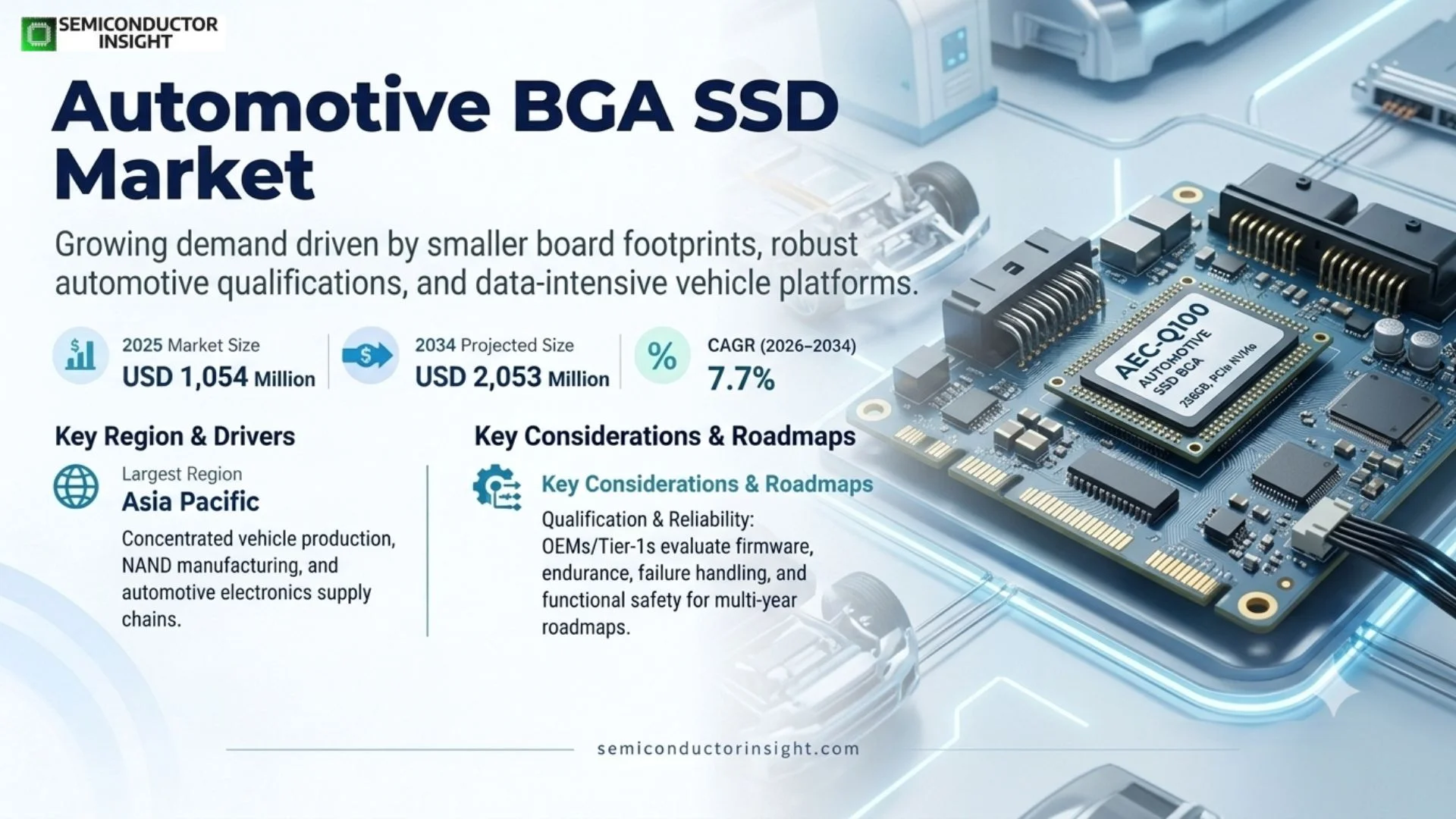
Automotive BGA SSD Market was valued at USD 1,054 million in 2025 and is projected to reach USD 2,053 million by 2034. The two market-size anchors imply a CAGR of 7.7% across the 2026–2034 forecast presentation, with a consistent 2026 market level of USD 1,135 million. Asia Pacific held the largest 2025 market position, reflecting its concentration of vehicle production, NAND flash manufacturing and automotive electronics supply chains.
An automotive BGA SSD is a managed NAND storage device packaged in a soldered ball-grid-array form factor for embedded use in vehicle electronics. It combines NAND flash, a controller, firmware, error correction, wear management and interface logic in a compact package that can be mounted directly on a printed circuit board. Automotive products are designed for wider temperature ranges, long service life, predictable data retention and robust behavior under vibration and power interruption, making them suitable for digital cockpits, telematics, ADAS, domain controllers and centralized vehicle computers.
The market sits between commodity managed NAND and removable or socketed SSDs. A BGA device reduces board area and connector count, but it also becomes part of the vehicle platform’s long qualification cycle. That changes the supplier relationship: OEMs and Tier-1s evaluate controller firmware, NAND generation, endurance, diagnostics, failure handling, functional-safety processes and long-term availability. The storage vendor therefore needs a roadmap that remains supportable for years even as consumer NAND technology moves rapidly to new generations.
Demand is being reshaped by the software-defined vehicle. Infotainment remains important, but storage increasingly holds operating systems, ADAS data, high-definition maps, diagnostic logs, over-the-air update packages and AI models. UNECE Regulation No. 156 formalizes software-update management requirements across participating markets, reinforcing the shift toward vehicles that must manage software throughout their operational life. More software and richer sensing raise both capacity requirements and the value of reliable local storage.
Segment Analysis: By Type
By type, the report segments the market into 256 GB, 500 GB, 1 TB and above 1 TB capacity classes. The 256 GB class remains the mainstream volume tier because it can support established cockpit, telematics and system-software requirements at a lower bill-of-material cost. Higher capacities are gaining strategic importance as centralized compute platforms consolidate vehicle domains, high-resolution maps grow, camera and sensor data are retained locally, and software-defined vehicles support larger update images and application stacks.
| Type | Typical role | Market position |
|---|---|---|
| 256 GB | Infotainment, telematics, digital cockpit software, navigation data and core embedded storage. | Mainstream volume tier with mature availability and cost profile; suitable where local logging and AI workloads remain moderate. |
| 500 GB | Higher-content digital cockpits, domain controllers, richer maps, larger OTA partitions and expanded diagnostics. | Growth tier as software footprints and local data retention increase across mid- and premium vehicles. |
| 1 TB | Central compute, high-definition maps, ADAS logging, AI models and multi-domain software platforms. | High-value tier benefiting from centralized E/E architectures and more data-intensive vehicle functions. |
| Above 1 TB | Advanced development fleets, intensive sensor logging, high-autonomy platforms and future centralized storage. | Emerging premium tier; adoption depends on cost, endurance, thermal limits and whether the architecture requires large persistent local data sets. |
Additional segmentation: By End User
The market is also segmented by OEMs, Tier-1 suppliers and aftermarket or retrofit providers. OEMs define the vehicle architecture and long-term software strategy, while Tier-1s frequently select and integrate storage inside infotainment, cockpit, telematics, ADAS and domain-control modules. The aftermarket is much smaller for soldered BGA devices because replacement and upgrades generally occur at the module level rather than by changing the embedded memory package. This makes design-win access to OEM and Tier-1 engineering teams commercially decisive.
| End user | Purchasing logic |
|---|---|
| OEMs | Platform-level specifications, software lifecycle, quality targets, cybersecurity, long-term availability and vehicle warranty risk. |
| Tier-1 suppliers | Module performance, qualification evidence, firmware support, package integration, supply continuity and customer-specific validation. |
| Aftermarket / retrofit providers | Limited direct BGA demand; storage is usually embedded in replacement modules, development hardware or specialized upgrades. |
Additional segmentation: By Memory Technology
The report segments memory technology into 3D NAND TLC, 3D NAND QLC and emerging technologies such as PLC. TLC is the prevailing automotive choice where endurance, retention and write performance outweigh the lowest possible cost per bit. QLC can provide higher density for read-intensive workloads, but design teams must account for endurance and operating-condition requirements. Newer high-density cell architectures can expand capacity, yet qualification cycles mean automotive adoption normally follows consumer and data-center technology rather than leading it.
| Memory technology | Automotive relevance |
|---|---|
| 3D NAND TLC | Balanced endurance, retention and performance; widely suited to write-active automotive workloads and long platform lifecycles. |
| 3D NAND QLC | Higher density and lower cost per bit, but better matched to read-dominant use cases unless controller and overprovisioning strategies offset endurance limits. |
| Emerging higher-density NAND | Potential future cost and capacity benefit, with adoption gated by automotive qualification, temperature behavior, retention and long-term availability. |
Segment Analysis: By Application
By application, passenger cars account for the larger demand base because connected infotainment, digital clusters, ADAS and software-defined architectures are being deployed across high-volume vehicle platforms. Commercial vehicles represent a smaller but important segment where telematics, fleet analytics, driver monitoring, mapping and automated-driving features create storage demand. Purchasing priorities differ: passenger-car programs emphasize feature density and cost at scale, while commercial platforms place greater weight on durability, uptime, long service life and predictable data retention under continuous operation.
| Application | Demand characteristics |
|---|---|
| Passenger Car | High-volume demand from infotainment, digital cockpit, connected services, OTA updates and ADAS. Capacity grows with software content and local sensor data, while OEMs maintain strict cost, qualification and warranty requirements. |
| Commercial Vehicle | Telematics, fleet management, route and map data, camera recording and advanced safety systems create demand. Long duty cycles and fleet uptime strengthen the value of endurance, health monitoring and extended product availability. |
Regional Analysis
Asia Pacific is the largest automotive BGA SSD market because automotive production and the semiconductor storage supply chain are concentrated in the same region. OICA reported that global vehicle production rose to 96.4 million units in 2025 and specifically identified growth shifting east, reinforcing the role of Asian vehicle output. North America is a high-value market for software-defined and ADAS-heavy vehicles, while Europe combines premium vehicle architectures with regulatory pressure around cybersecurity and software updates. South America and the Middle East & Africa remain smaller but increasingly connected vehicle markets.
How do regional demand and supply differ in automotive embedded storage?
Regional market position reflects both vehicle output and the location of NAND, controller and embedded-storage suppliers. Asia Pacific benefits from manufacturing scale and supplier proximity. North America contributes vehicle-compute architecture, semiconductor design and early adoption of high-performance systems. Europe is strongly influenced by premium OEM engineering and software-update regulation. South America is more cost-sensitive and import-dependent, while Middle East & Africa demand is concentrated in imported premium vehicles, fleet modernization and connected services. These differences change capacity mix, qualification priorities and channel structure.
| Region | Position | Growth outlook | Demand profile | Market access gate |
|---|---|---|---|---|
| Asia Pacific | Largest | High | Production scale, EVs, local supply chain | OEM/Tier-1 qualification and local support |
| North America | Major high-value market | High | Central compute, ADAS, OTA | Platform design wins and safety/cybersecurity validation |
| Europe | Major premium market | Steady-high | Premium OEMs, SDV, regulatory compliance | Quality systems, software lifecycle and long supply |
| South America | Emerging | Moderate | Connected infotainment and localized production | Landed cost, availability and module integration |
| Middle East & Africa | Emerging | Selective | Premium imports, fleets, connected services | Thermal reliability, distribution and service support |
Competitive Landscape
Competition is led by companies that control NAND technology, managed-flash firmware, SSD controllers or automotive qualification capabilities. Samsung, Western Digital, Micron, Kioxia and SK hynix benefit from memory scale and broad embedded-storage portfolios, while Phison adds deep controller and firmware capability. Longsys, BIWIN, YEESTOR, Exascend, Swissbit, Apacer, Transcend, Kingston and Greenliant compete through specialized embedded products, industrial-grade reliability, regional customer access or custom qualification.
Automotive design wins are sticky because the storage device is validated as part of a module and vehicle platform. Once firmware behavior, thermal limits, endurance, data retention and failure modes are qualified, switching suppliers can require engineering work and renewed testing. This creates a commercial advantage for vendors with stable roadmaps, documented change-control processes and the ability to preserve product support across long vehicle lifecycles.
The market is also converging with automotive UFS and other managed NAND categories. Kioxia, Micron and Western Digital publicly position UFS products for ADAS, infotainment, telematics and central computing, while Phison presents BGA SSD and UFS as parallel automotive storage options. This means competition is not only between BGA SSD brands; it is also between storage interfaces and form factors selected by each electronic/electrical architecture.
| Competitive tier | Representative companies | Primary differentiation |
|---|---|---|
| Integrated memory leaders | Samsung, Western Digital, Micron, Kioxia, SK hynix | NAND scale, controller/firmware integration, automotive qualification, supply continuity and global OEM access. |
| Controller and embedded-storage specialists | Phison, Longsys, BIWIN, YEESTOR, Exascend | Firmware customization, BGA/NVMe/UFS product breadth, regional engineering and specialized endurance. |
| Industrial and niche embedded suppliers | Swissbit, Apacer, Transcend, Kingston, Greenliant | Long lifecycle, industrial temperature, managed BOMs and specialized embedded-market support. |
Key companies profiled
Samsung, Western Digital, Micron Technology, Exascend, Phison Electronics, Longsys, YEESTOR Microelectronics, BIWIN Storage Technology, Kioxia, SK hynix, Swissbit, Apacer Technology, Transcend Information, Kingston Technology and Greenliant Systems are profiled within the report scope. Competitive relevance should be evaluated by automotive-qualified product availability and platform support rather than by total corporate storage revenue.
Production Capacity Analysis
Automotive BGA SSD capacity is linked to NAND wafer output, controller availability, package assembly, firmware loading and automotive-grade test rather than a standalone BGA-SSD factory category. Integrated NAND manufacturers have an upstream capacity advantage, while fabless controller and embedded-storage vendors rely on foundry, NAND and outsourced semiconductor assembly-and-test partners. Effective automotive capacity can be lower than nominal electronics capacity because every component revision, NAND change or firmware release must be managed within qualification and customer change-control requirements.
Asia dominates physical production because NAND fabrication, controller ecosystems, semiconductor packaging and electronics manufacturing are concentrated in South Korea, Japan, China, Taiwan and Southeast Asia. However, supply resilience increasingly requires geographic diversification, multi-sourcing and long-term product commitments. Automotive customers cannot freely substitute a newer consumer NAND generation if it changes endurance, retention or controller behavior, so suppliers often reserve qualified die, maintain controlled firmware branches or provide product-longevity programs that effectively convert capacity planning into a lifecycle-management function.
Market Dynamics
The market grows as vehicle software and sensor data expand faster than the capacity requirements of legacy infotainment storage. Centralized computing, OTA updates, ADAS logging and AI models increase local storage needs, while automotive qualification raises the value per device. The main restraints are long validation cycles, technology obsolescence and the difficulty of guaranteeing supply across vehicle lifecycles. Opportunities favor suppliers that combine high-density NAND with firmware, diagnostics, security, functional-safety processes and long-term roadmap control.
Market Drivers
| Driver | Impact | Time horizon | Evidence basis |
|---|---|---|---|
| Software-defined vehicle architectures | High | Near to long term | Larger software stacks, OTA packages and centralized compute increase local persistent storage. |
| ADAS and sensor-data growth | High | Near to medium term | Camera, radar, map and logging workloads raise capacity and sustained-write requirements. |
| Higher embedded-storage interface performance | Medium-High | Near term | Automotive UFS 4.0/4.1 products show the industry’s move toward faster managed NAND for vehicle computers. |
| Global vehicle-production growth | Medium | Cyclical | OICA reported 96.4 million vehicles produced in 2025, supporting the installed base for automotive electronics. |
Software-defined vehicles expand storage from a component into a platform resource
Modern vehicles increasingly retain multiple operating systems, application packages, maps, calibration data and update images. Storage must support secure OTA installation, rollback partitions and lifecycle logging as well as normal read and write traffic. This raises both required capacity and the cost of storage failure, supporting demand for managed BGA devices with diagnostics, power-loss handling and predictable firmware behavior.
ADAS creates sustained write and data-retention requirements
ADAS systems ingest high-rate camera and sensor data, while development and higher-autonomy functions require local logging, map storage and AI models. The resulting workload is more demanding than conventional infotainment because sustained writes and data integrity matter. Higher-capacity 500 GB, 1 TB and above devices therefore gain relevance as central-compute platforms consolidate multiple vehicle domains.
Faster managed NAND interfaces support central vehicle computers
Kioxia and Micron are moving automotive UFS toward 4.0 and 4.1, demonstrating the performance requirements of next-generation vehicle computers. Even when a platform selects BGA SSD rather than UFS, the same architectural trend applies: storage must boot quickly, sustain higher throughput and integrate advanced health monitoring. Interface competition pushes vendors to improve controllers, firmware and package efficiency.
Vehicle production provides the volume base for content growth
OICA reported global vehicle production of 96.4 million units in 2025. The storage market does not need vehicle unit growth alone to expand because memory content per vehicle can rise, but a growing production base amplifies that content effect. Asia’s production scale also strengthens the regional advantage of suppliers located near automakers, Tier-1 electronics factories and memory manufacturing.
Market Restraints
| Restraint | Impact | Commercial consequence |
|---|---|---|
| Long automotive qualification cycles | High | Design wins require years of validation and cannot be changed quickly when NAND generations move. |
| Technology obsolescence versus vehicle lifecycles | High | Suppliers must support qualified devices longer than typical consumer-storage product cycles. |
| NAND price and supply cyclicality | Medium-High | Flash-market swings affect cost, allocation and the economics of long-term supply commitments. |
| Thermal, endurance and retention requirements | Medium-High | Automotive specifications can limit use of the lowest-cost NAND configurations and require stronger controller management. |
Qualification slows substitution even when a new device is technically better
Automotive electronics require disciplined validation because a storage fault can affect boot, navigation, ADAS logs or software updates. Changing a NAND die, controller revision or firmware can trigger requalification and customer approval. This makes rapid cost optimization harder than in consumer electronics and raises the value of stable bill-of-material management. The same barrier protects incumbent design wins but lengthens time-to-revenue for new entrants.
NAND innovation moves faster than vehicle programs
Consumer storage can transition quickly to newer NAND generations, while a vehicle platform may remain in production and service for a decade or more. Suppliers therefore face the challenge of preserving qualified components after the mainstream semiconductor market has moved on. Product-longevity programs, controlled firmware and planned migrations are commercial necessities, not optional support features.
Flash-memory cycles complicate long-term pricing
NAND is a cyclical semiconductor market in which supply additions, inventory corrections and demand shocks can move pricing materially. Automotive customers prefer predictable long-term economics, but suppliers still depend on the broader memory supply chain. Contracts, reserved capacity, qualified alternative die and strategic inventory can reduce risk, yet each adds cost that must be balanced against vehicle-platform volume.
Automotive environments restrict the cheapest density options
High temperature, long retention, repeated write cycles and power interruptions can stress NAND more severely than many consumer workloads. QLC and future higher-density architectures can reduce cost per bit, but controller design, overprovisioning and qualification must ensure adequate endurance and retention. This slows the shift to the most aggressive density nodes and preserves a meaningful role for TLC in demanding automotive applications.
Market Opportunities
Centralized vehicle computers
The transition from distributed ECUs toward domain and central computers creates larger shared storage pools and stronger requirements for boot performance, diagnostics and availability. BGA SSD suppliers can move up the value chain by supporting reference designs, virtualization, health monitoring and functional-safety processes around these central platforms. The opportunity grows as OEMs consolidate software and data functions that were previously distributed across many separate electronic control units.
High-capacity ADAS and autonomous-development storage
Vehicles and development fleets generate large sensor data sets for validation, event recording and AI improvement. One-terabyte and larger embedded storage becomes commercially attractive where local logging cannot depend on continuous cloud connectivity. Vendors that combine high sustained-write endurance with compact packages can address these high-value workloads. Commercial value is highest where the storage device can sustain continuous writes, preserve data integrity and remain qualified across the full vehicle program.
Lifecycle and managed-supply services
Long vehicle lifecycles create an opportunity beyond the device itself. Vendors can differentiate through controlled bill-of-materials, change notifications, firmware maintenance, data-retention validation and guaranteed product availability. These services reduce requalification risk for OEMs and Tier-1s and can improve margins relative to purely commodity storage supply. For OEMs and Tier-1s, this lifecycle support can lower the engineering cost and schedule risk associated with requalifying a replacement device.
Automotive-grade security and diagnostics
As vehicles receive software throughout their life, storage security and health visibility become more important. Secure boot support, encryption, authenticated firmware, telemetry and predictive wear information can turn an embedded drive into a managed reliability component. Suppliers that align these features with automotive cybersecurity and functional-safety processes can win platform-level design positions.
Supply Chain Analysis
NAND wafers and controllers. Upstream economics are set by 3D NAND supply, controller silicon, firmware IP and DRAM or cache choices where used. Integrated memory suppliers control more of this stack, while independent embedded-storage vendors source NAND and combine it with proprietary or third-party controllers. NAND generation changes can alter endurance, retention and firmware behavior, so automotive customers require tighter change control than consumer channels.
BGA packaging and firmware. Assembly places NAND and controller silicon in a compact soldered package and loads the firmware that manages wear, error correction, bad blocks and diagnostics. Automotive products add wide-temperature testing and stricter quality screening. Firmware is a major differentiation layer because it determines power-fail handling, data integrity, health reporting and workload behavior even when suppliers use similar NAND technology.
Automotive qualification and module integration. Tier-1 suppliers and OEM engineering teams validate storage within infotainment, cockpit, telematics, ADAS or domain-control modules. AEC-Q100, functional-safety processes, cybersecurity requirements and customer-specific tests shape the design cycle. Qualification is expensive but creates durable design wins, making early engineering support and complete documentation critical commercial capabilities.
OEM platforms, OTA and in-vehicle operation. Once deployed, the BGA SSD supports software updates, maps, logs, applications and user data for years. Because field replacement is difficult, health monitoring, data retention and firmware stability have high lifecycle value. UNECE software-update requirements further institutionalize the need to manage vehicle software over time, reinforcing the importance of dependable local storage and controlled update processes.
Recent Developments in the Automotive BGA SSD Market
Developments tracked to September 2026. The selected items focus on automotive embedded-storage performance, capacity, qualification and software lifecycle because these factors directly influence the addressable market for BGA SSDs and competing managed-NAND form factors.
- March 2026
Kioxia detailed automotive UFS 4.1 devices for increasingly intelligent and connected vehicles, reinforcing the shift toward higher-performance managed NAND for ADAS, telematics and vehicle computers. The same system requirements support demand for compact automotive BGA SSDs where PCIe or SSD-style interfaces are selected. Source - 31 July 2025
Kioxia began sampling UFS 4.1 embedded memory for automotive applications in 128 GB, 256 GB, 512 GB and 1 TB capacities. The launch targets infotainment, ADAS, telematics, domain controllers and vehicle computers, demonstrating how automotive storage is scaling in both capacity and interface performance. Source - 2025
Micron introduced automotive UFS 4.1 based on G9 NAND with ASIL-B compliance, ASPICE certification, cybersecurity features and enhanced thermal protection. The product illustrates how storage vendors increasingly compete on automotive system requirements in addition to NAND density and sequential speed. Source - 2025-2026
UNECE continued implementation and amendment work around UN Regulation No. 156 for software updates and software-update-management systems. The regulation reinforces the long-term software lifecycle of connected vehicles, which expands the importance of reliable local storage for update packages, rollback, logs and persistent vehicle software. Source
Report Scope & Segmentation
| Attribute | Scope |
|---|---|
| Report title | Automotive BGA SSD Market Size, Share & Industry Analysis, By Type (256 GB, 500 GB, 1 TB, Above 1 TB), By Application (Passenger Car, Commercial Vehicle), and Regional Forecast, 2026-2034 |
| Base year | 2025 |
| Estimated year | 2026 |
| Forecast period | 2026–2034 |
| 2025 market size | USD 1,054 million |
| 2026 estimated size | USD 1,135 million |
| 2034 projected size | USD 2,053 million |
| CAGR (2026–2034) | 7.7% |
| Largest market in 2025 | Asia Pacific |
| By Type | 256 GB; 500 GB; 1 TB; Above 1 TB |
| By Application | Passenger Car; Commercial Vehicle |
| By End User | OEMs (Original Equipment Manufacturers); Tier-1 Suppliers; Aftermarket / Retrofit Providers |
| By Memory Technology | 3D NAND TLC; 3D NAND QLC; Emerging Technologies (e.g., PLC) |
| By Vehicle Autonomy Level | Level 1-2 (Driver Assistance); Level 3 (Conditional Automation); Level 4-5 (High/Full Automation) |
| Companies profiled | Samsung; Western Digital; Micron Technology; Exascend; Phison Electronics; Longsys; YEESTOR Microelectronics; BIWIN Storage Technology; Kioxia; SK hynix; Swissbit AG; Apacer Technology; Transcend Information; Kingston Technology; Greenliant Systems |
Frequently Asked Questions
What is the automotive BGA SSD market size in 2025?
The global automotive BGA SSD market is valued at USD 1,054 million in 2025. The market covers compact soldered solid-state storage designed for vehicle electronics, including products used in infotainment, telematics, ADAS, domain controllers and centralized vehicle-compute platforms. The scope includes compact managed storage embedded directly in vehicle electronic modules rather than removable consumer drives or aftermarket storage media.
What is the automotive BGA SSD market forecast for 2034?
The market is projected to reach USD 2,053 million by 2034. The 2025 and 2034 market-size anchors imply a consistent compound growth rate of 7.7%, with a 2026 market level of USD 1,135 million. The forecast therefore retains the same automotive embedded-storage scope across the base year, estimated year and 2034 endpoint.
Which region is the largest automotive BGA SSD market?
Asia Pacific is the largest 2025 market because the region combines the world’s largest vehicle-production base with major NAND flash, controller, packaging and automotive-electronics supply chains. China, Japan and South Korea are particularly important for both demand and supply-side capability. Supplier proximity to automakers and Tier-1 electronics manufacturers further strengthens the region’s ability to qualify and ramp new storage platforms.
Which capacity segment is most important?
The 256 GB class remains the mainstream volume tier for established infotainment, telematics and system-software needs. Demand is shifting toward 500 GB, 1 TB and above as central compute, ADAS logging, high-definition maps, larger OTA packages and AI workloads increase local storage requirements. Higher capacities become more attractive as centralized compute, high-definition maps, local logging and over-the-air software packages expand in size.
Why are automotive BGA SSDs used instead of consumer SSDs?
Automotive BGA SSDs are designed for soldered embedded use, wide temperature operation, vibration, long data retention, controlled firmware behavior and long product lifecycles. Automotive customers also require qualification evidence, change control and support that consumer storage products are not designed to provide. The qualification burden and long vehicle lifecycle make firmware stability, change control and extended product support central to supplier selection.
How does the software-defined vehicle affect storage demand?
Software-defined vehicles increase the number and size of operating systems, applications, maps, update images, diagnostic logs and AI models stored locally. They also make storage reliability more important because failed or corrupted storage can interfere with boot, OTA updates and safety-related functions across centralized vehicle computers. As software content rises, storage becomes a platform resource supporting boot, updates, diagnostics, security and persistent application data.
What role does NAND technology play in the market?
TLC 3D NAND remains important because it balances endurance, retention and performance for write-active automotive workloads. QLC offers higher density and lower cost per bit but requires careful controller management and use-case selection. Newer high-density NAND must pass automotive qualification before it can replace established technology. Automotive adoption therefore depends on controller management, overprovisioning, thermal behavior and qualification rather than density alone.
What are the main barriers to automotive BGA SSD adoption?
The main barriers are long qualification cycles, NAND supply and pricing volatility, the mismatch between rapid semiconductor technology changes and long vehicle lifecycles, and demanding requirements for endurance, retention, thermal behavior and product continuity. These barriers favor suppliers with strong lifecycle-management and firmware capabilities. These constraints make long-term supply planning and controlled technology migration as important as nominal capacity or interface performance.
Which companies are profiled in the automotive BGA SSD market?
The report profiles Samsung, Western Digital, Micron Technology, Exascend, Phison Electronics, Longsys, YEESTOR Microelectronics, BIWIN Storage Technology, Kioxia, SK hynix, Swissbit, Apacer, Transcend, Kingston and Greenliant Systems. Their competitive positions differ across integrated NAND supply, controller IP, embedded-storage design and long-lifecycle industrial support. Automotive design wins also depend on validated firmware, traceable component changes and multi-year product availability across the vehicle platform lifecycle.
What will determine market growth through 2034?
Growth will be determined by storage content per vehicle, adoption of centralized compute and ADAS, the size of local software and data sets, higher-capacity managed NAND, and suppliers’ ability to maintain qualified products for long vehicle lifecycles. Regional vehicle production remains important, but rising memory content can grow the market even without matching unit-production growth.
Research Sources & Evidence Base
View research sources used in this market overview
- OICA – Auto industry growth shifted east in 2025 amid global repositioning. Global 2025 vehicle production and regional production context, published 23 April 2026.
- UNECE – UN Regulation No. 156 – Software update and software update management system. Regulatory evidence for vehicle software-update lifecycle and management.
- KIOXIA – Kioxia Sampling UFS Ver. 4.1 Embedded Flash Memory Devices for Automotive Applications. Automotive UFS 4.1 capacities, target applications and product launch, 31 July 2025.
- KIOXIA – UFS for Automotive. Automotive UFS performance, -40°C to +105°C temperature range, AEC-Q100 Grade 2 and capacity information.
- Micron – Universal Flash Storage – Automotive UFS 4.1. Automotive UFS 4.1, G9 NAND, functional-safety and automotive software-process evidence.
- Western Digital – Advanced Flash Storage Solutions for Automotive Applications. Automotive embedded-flash package, UFS/e.MMC interfaces, AEC-Q100/Q104 and ADAS/central-compute use cases.
- Phison – Automotive Storage Solutions. Automotive BGA SSD, UFS and eMMC portfolio, certifications and product-longevity positioning.
- Phison – SSD Solutions. BGA SSD form factor, capacity and wide-temperature product evidence.
Get Sample Report PDF for Exclusive Insights
Report Sample Includes
- Table of Contents
- List of Tables & Figures
- Charts, Research Methodology, and more...