MARKET INSIGHTS
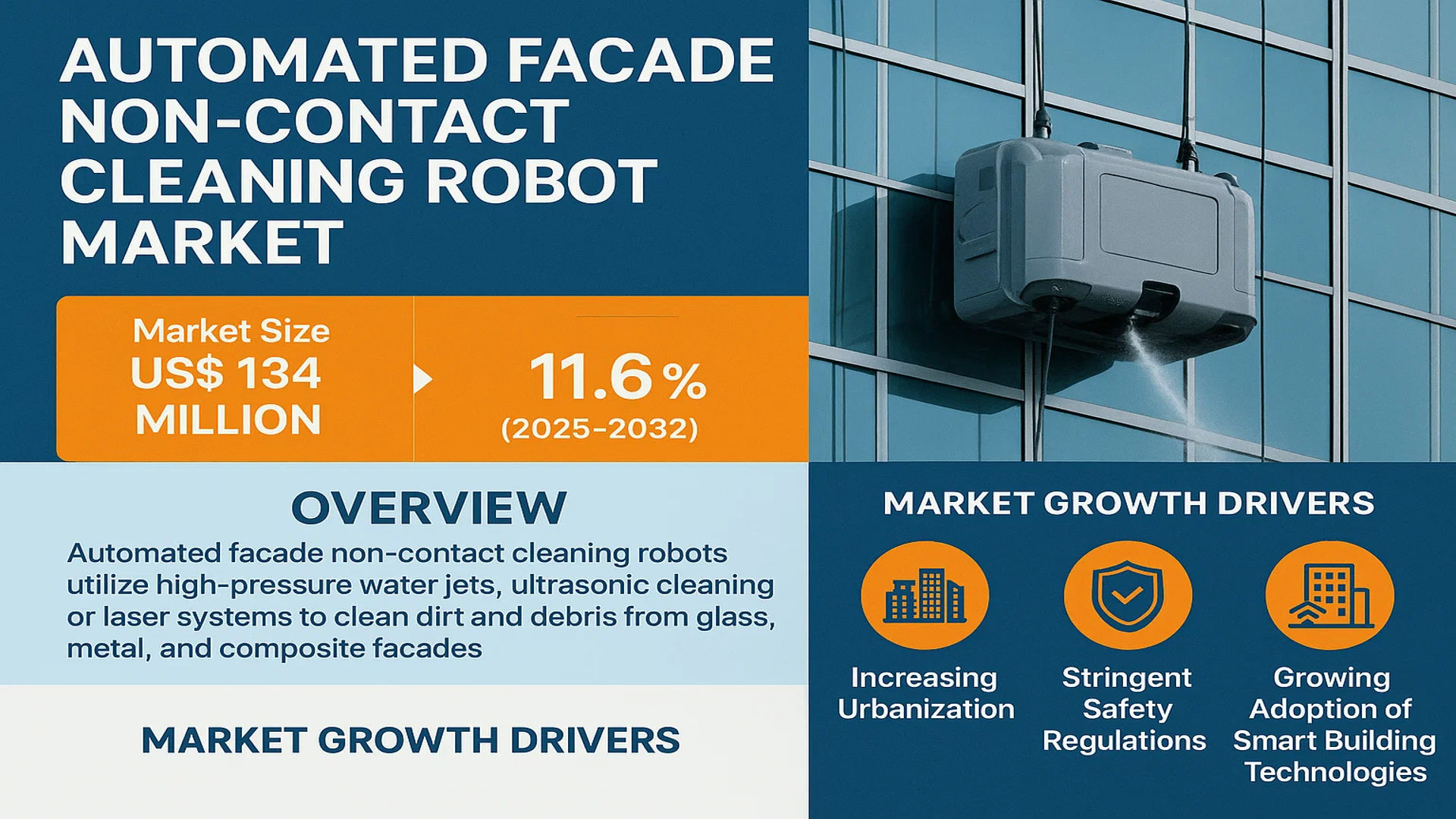
The global Automated Facade Non-contact Cleaning Robot Market size was valued at US$ 134 million in 2024 and is projected to reach US$ 289 million by 2032, at a CAGR of 11.6% during the forecast period 2025-2032.
Automated facade non-contact cleaning robots are advanced robotic systems designed for exterior building maintenance without direct physical contact with surfaces. These robots utilize technologies such as high-pressure water jets, ultrasonic cleaning, or laser systems to remove dirt and debris from glass, metal, and composite facades. The primary advantage lies in their ability to clean delicate or high-rise structures safely while minimizing water usage compared to traditional methods.
The market growth is driven by increasing urbanization, stringent safety regulations for high-rise maintenance, and growing adoption of smart building technologies. However, high initial costs and technical limitations in complex architectural designs present challenges. Key players like Skyline Robotics and Serbot AG are advancing autonomous navigation and AI-powered cleaning algorithms, with the cable-operated segment currently dominating due to reliability in vertical applications.
MARKET DYNAMICS
MARKET DRIVERS
Rising Urbanization and Demand for High-Rise Building Maintenance to Drive Adoption
The global shift toward urbanization has led to a rapid increase in high-rise buildings, particularly in metropolitan areas across Asia-Pacific and North America. This growth creates substantial demand for efficient facade cleaning solutions as manual methods become increasingly impractical and unsafe. Non-contact cleaning robots provide a solution that minimizes risk to workers while maintaining glass integrity through advanced jet-washing and suction technologies. High adoption rates in commercial real estate, where building aesthetics directly impact property values, are propelling market expansion.
Stricter Worker Safety Regulations Accelerating Automation Adoption
Heightened focus on occupational safety standards worldwide has made traditional rope-access cleaning methods increasingly non-compliant. Regulatory bodies are imposing stringent guidelines for high-altitude work, with penalties for violations reaching up to 6-8% of annual revenue in some jurisdictions. Automated facade cleaners eliminate these risks while reducing insurance liabilities by 30-40% compared to manual methods. Major construction firms are now including robotic cleaning systems in building maintenance contracts to ensure compliance.
Technological Advancements Enhancing Operational Efficiency
Recent innovations in robotics and AI have enabled significant improvements in cleaning accuracy and speed. Modern systems can now complete facade cleaning 50% faster than traditional methods while using 20-30% less water through advanced recirculation systems. Features like ultrasonic sensors and machine-learning algorithms allow for real-time surface mapping and adaptive cleaning patterns. These capabilities are driving adoption among facility managers seeking to optimize operational budgets without compromising on building aesthetics.
MARKET RESTRAINTS
High Initial Investment Costs Limiting Market Penetration
The substantial capital expenditure required for automated facade cleaning systems, typically ranging from $50,000 to $500,000 per unit depending on capabilities, presents a significant barrier for small and medium-sized enterprises. Many building owners hesitate to invest in these systems when traditional cleaning methods appear to have lower upfront costs, even though the total cost of ownership may be higher when factoring in labor and insurance expenses. This cost sensitivity is particularly acute in emerging markets where financial resources are constrained.
Complexity in Handling Architectural Variability
While robotic cleaners excel on standard glass facades, they face challenges when encountering complex building geometries featuring ornate designs, curved surfaces, or mixed materials. The need for customized solutions increases both deployment costs and technical difficulties, with some specialized architectural elements requiring supplementary manual cleaning. This limitation currently restricts the addressable market to buildings with more standardized designs, particularly in the commercial sector.
Limited Power and Water Infrastructure in Developing Regions
Effective operation of automated cleaning systems requires reliable access to water and electricity, which remain inconsistent in many developing economies. The substantial water requirements of recirculation systems (typically 50-100 liters per minute) and the high power draw of robotic arms (averaging 5-10 kW per system) create operational challenges in areas with infrastructure limitations. Until these fundamental utilities become more widely available, market growth in emerging regions will remain constrained.
MARKET OPPORTUNITIES
Expansion of Smart City Initiatives Creating New Growth Avenues
Government-led smart city programs worldwide are incorporating automated facade maintenance as a key component of sustainable urban development. These initiatives are allocating 15-20% of their infrastructure budgets toward intelligent maintenance solutions, presenting significant opportunities for robotic cleaning system providers. Integration with building management systems allows for predictive cleaning schedules based on environmental sensors, opening new revenue streams through service-based business models.
Advancements in Renewable Energy Integration
The development of solar-powered cleaning robots with extended operational durations is addressing key limitations in energy-intensive applications. New models incorporating photovoltaic panels can operate for 8-10 continuous hours without grid connection, reducing operational costs by 25-35%. These innovations are particularly attractive for LEED-certified buildings seeking to reduce their carbon footprint while maintaining green building standards.
Growing Demand for Water Conservation Solutions
With water scarcity becoming a critical concern globally, the water recycling capabilities of automated cleaning systems are gaining attention. Advanced filtration systems can now achieve 90-95% water reuse rates, providing substantial savings in regions facing water restrictions. Municipalities are increasingly mandating water-efficient cleaning methods in drought-prone areas, creating regulatory tailwinds for adoption of robotic solutions.
MARKET CHALLENGES
Lack of Standardized Regulations Across Regions
The absence of uniform safety and performance standards for automated facade cleaning creates uncertainty for both manufacturers and end-users. Certification requirements vary significantly between jurisdictions, with some markets requiring extensive testing while others have minimal oversight. This regulatory fragmentation increases compliance costs and slows product launches, particularly for companies attempting to operate across multiple countries.
Workforce Resistance to Automation Adoption
Trade unions and labor groups in many markets oppose robotic cleaning systems due to concerns about job displacement. In some regions, regulations limit the extent to which building maintenance can be automated, preserving traditional cleaning roles. Overcoming this resistance requires demonstrating how automation can create higher-value maintenance jobs while improving worker safety.
Technical Limitations in Extreme Weather Conditions
Current robotic systems struggle to perform optimally during heavy rain, strong winds, or extreme temperatures – conditions that account for 25-30% of operating days in many climates. Sensor performance degrades in adverse weather, while mechanical components face accelerated wear. Developing robust systems capable of reliable operation across diverse environmental conditions remains an ongoing engineering challenge.
AUTOMATED FACADE NON-CONTACT CLEANING ROBOT MARKET TRENDS
Integration of AI and Robotics to Revolutionize Facade Cleaning
The global market for automated facade non-contact cleaning robots is undergoing rapid transformation due to advancements in artificial intelligence (AI) and robotic automation. Unlike traditional methods that rely on physical contact, these robots employ high-pressure water jets, ultrasonic waves, or air-based cleaning systems to remove dirt without damaging delicate surfaces. The incorporation of AI-driven navigation systems has significantly improved efficiency, allowing robots to map building facades dynamically and optimize cleaning paths. Recent developments indicate that leading manufacturers are investing in machine learning algorithms to enhance obstacle detection, ensuring seamless operation in complex architectural environments. Key markets like North America and Asia-Pacific are witnessing accelerated adoption, with commercial applications driving nearly 65% of demand in 2024.
Other Trends
Sustainability and Regulatory Compliance
The push for sustainable building maintenance solutions has amplified demand for water-efficient and energy-saving cleaning technologies. Non-contact robots reduce water consumption by up to 40% compared to conventional methods while mitigating risks associated with chemical cleaners. Stringent safety regulations in Europe and North America are further accelerating adoption, particularly in high-rise buildings where manual cleaning poses significant hazards. For instance, cities like New York and London have introduced compliance frameworks mandating eco-friendly facade maintenance, creating lucrative opportunities for automation providers. Meanwhile, innovations such as solar-powered cleaning robots are gaining traction in sun-rich regions, aligning with global net-zero targets.
Expansion in Smart City Infrastructure
The proliferation of smart city projects worldwide is a pivotal driver for market growth. Governments and urban planners are prioritizing automated facade cleaning solutions to maintain modern skyscrapers and heritage structures efficiently. In China, over 50% of new commercial constructions now include provisions for robotic cleaning systems in their blueprints, fueling the cable-operated robot segment which is projected to grow at 12% CAGR through 2032. Similarly, Middle Eastern nations are investing heavily in automated infrastructure to support megaprojects like NEOM and Expo City Dubai. These developments underscore a broader shift toward intelligent urban ecosystems where automation and IoT-enabled devices play central roles in operational efficiency.
COMPETITIVE LANDSCAPE
Key Industry Players
Innovation and Automation Drive Competition in Facade Maintenance Solutions
The global automated facade non-contact cleaning robot market features a dynamic competitive environment where technological leadership and regional market penetration determine success. Yantai Haitelin and Beijing Litu currently dominate the Asian sector, leveraging localized manufacturing advantages and government smart city initiatives. Their combined market share exceeded 28% in 2024, according to industry surveys.
European competitors such as Serbot and Fraunhofer maintain strong positions through precision engineering and eco-friendly cleaning solutions. The German-made systems particularly excel in handling historic architecture while meeting stringent EU environmental regulations. These players are increasingly targeting Middle Eastern markets where skyscraper development fuels demand.
Strategic partnerships define the North American landscape, with Skyline Robotics collaborating with major property management firms to integrate AI-driven cleaning schedules. Meanwhile, WCB Robotics recently expanded its cable-based systems portfolio to address safety concerns in high-rise maintenance. The U.S. accounts for approximately 35% of global deployments, creating intense rivalry among domestic and international suppliers.
Emerging players like Autonopia are disrupting traditional models through modular designs that retrofit existing building maintenance equipment. This approach reduces adoption barriers for commercial property owners, potentially reshaping competitive dynamics in the coming years.
List of Key Automated Facade Cleaning Robot Manufacturers
- Yantai Haitelin (China)
- Beijing Litu Intelligent Technology (China)
- Sypron Solutions (Poland)
- WCB Robotics (U.S.)
- Derson Arc Cleaners (South Korea)
- Welbot Technology (China)
- Serbot AG (Switzerland)
- Sky Pro CleanTech (UAE)
- Fraunhofer Institute for Manufacturing Engineering (Germany)
- Skyline Robotics (Israel)
- Autonopia SRL (Italy)
Segment Analysis:
By Type
Cable-Based Segment Dominates the Market Due to Higher Stability and Load Capacity
The market is segmented based on type into:
- Cable
- Subtypes: Single-cable and Multi-cable systems
- Wireless
- Subtypes: Battery-powered and Solar-powered
By Application
Commercial Segment Leads Due to High Adoption in Skyscrapers and Office Buildings
The market is segmented based on application into:
- Residential
- Commercial
By Cleaning Method
Water-Jet Cleaning Segment Holds Major Share Due to Superior Cleaning Efficiency
The market is segmented based on cleaning method into:
- Water-Jet Cleaning
- Ultrasonic Cleaning
- Others
By Operation Mode
Fully Autonomous Segment Gains Traction With Advancements in AI and IoT
The market is segmented based on operation mode into:
- Fully Autonomous
- Remote-Controlled
Regional Analysis: Automated Facade Non-Contact Cleaning Robot Market
Asia-Pacific
Asia-Pacific dominates the global automated facade non-contact cleaning robot market, driven by rapidly expanding urbanization and high-rise building construction. China is the largest contributor, with over 50% of global skyscrapers built in the last decade. Major cities like Shanghai and Hong Kong increasingly adopt robotic cleaning solutions to maintain glass facades cost-effectively while complying with stringent building safety regulations. Japan leads in technology adoption, with local players like WCB Robotics developing advanced AI-enabled cleaning systems. However, price sensitivity and reliance on manual labor in developing countries like India remain key challenges despite growing awareness of automation benefits.
North America
The North American market shows strong growth potential, primarily driven by the U.S. commercial real estate sector’s focus on smart building maintenance. Stringent OSHA regulations regarding worker safety at heights have accelerated adoption. Emerging startups like Skyline Robotics have gained traction with AI-powered systems, particularly in major metropolitan areas with dense high-rise clusters. The Canadian market remains smaller but growing, with increasing investments in sustainable building technologies. While the initial high cost of robotic systems poses a barrier, long-term ROI through reduced liability and labor costs is driving market expansion.
Europe
Europe represents a mature market characterized by stringent environmental regulations and advanced building automation infrastructure. Germany leads in adoption, with companies like Fraunhofer developing cutting-edge robotic solutions that integrate with smart building systems. The EU’s focus on sustainable urban development and carbon-neutral buildings has boosted demand for water-efficient cleaning technologies. Southern European countries show slower adoption due to lower high-rise density, while Nordic nations emphasize harsh weather-resistant robotic systems. The market faces challenges from restrictive drone regulations in some countries where aerial cleaning solutions are being tested.
Middle East & Africa
The Middle East, particularly the UAE and Saudi Arabia, presents significant opportunities due to ambitious smart city projects and iconic skyscraper developments. Dubai’s mandatory facade cleaning regulations for high-rises have created a robust market, with adopters valuing robotic systems’ ability to operate in extreme heat conditions. Sub-Saharan Africa remains in early stages, constrained by limited high-rise infrastructure and economic factors. However, growing commercial real estate development in key cities like Nairobi and Johannesburg indicates future potential as building maintenance standards evolve.
South America
South America shows nascent but promising growth, primarily concentrated in Brazil and Argentina. São Paulo’s dense high-rise landscape drives early adoption, though market expansion faces hurdles from economic volatility and preference for traditional cleaning methods. Recent investments in sustainable building certifications are gradually shifting attitudes toward automated solutions. Manufacturers focus on cost-effective robotic systems tailored for the region’s building architectures and glass types, but widespread adoption requires greater awareness of long-term operational benefits.
Report Scope
This market research report provides a comprehensive analysis of the global Automated Facade Non-contact Cleaning Robot market, covering the forecast period 2024–2032. It offers detailed insights into market dynamics, technological advancements, competitive landscape, and key trends shaping the industry.
Key focus areas of the report include:
- Market Size & Forecast: Historical data and future projections for revenue, unit shipments, and market value across major regions and segments. The market is projected to grow at a steady CAGR of 11.6% during the forecast period.
- Segmentation Analysis: Detailed breakdown by product type (cable vs. wireless), application (residential vs. commercial), and end-user industry to identify high-growth segments and investment opportunities.
- Regional Outlook: Insights into market performance across North America, Europe, Asia-Pacific, Latin America, and the Middle East & Africa, with specific focus on key markets like the U.S. and China.
- Competitive Landscape: Profiles of leading market participants, including their product offerings, R&D focus, manufacturing capacity, pricing strategies, and recent developments such as mergers, acquisitions, and partnerships.
- Technology Trends & Innovation: Assessment of emerging technologies in facade cleaning automation, including AI integration, sensor technologies, and advanced cleaning methods.
- Market Drivers & Restraints: Evaluation of factors driving market growth such as urbanization and high-rise building construction, along with challenges like regulatory hurdles and high initial costs.
- Stakeholder Analysis: Insights for equipment manufacturers, building service providers, facility management companies, investors, and policymakers regarding the evolving ecosystem and strategic opportunities.
Primary and secondary research methods are employed, including interviews with industry experts, data from verified sources, and real-time market intelligence to ensure the accuracy and reliability of the insights presented.
FREQUENTLY ASKED QUESTIONS:
What is the current market size of Global Automated Facade Non-contact Cleaning Robot Market?
-> Automated Facade Non-contact Cleaning Robot Market size was valued at US$ 134 million in 2024 and is projected to reach US$ 289 million by 2032, at a CAGR of 11.6% during the forecast period 2025-2032.
Which key companies operate in this market?
-> Key players include Yantai Haitelin, Beijing Litu, Sypron, WCB Robotics, Derson Arc Cleaners, Welbot Technology, Serbot, Sky Pro, Fraunhofer, and Skyline Robotics.
What are the key growth drivers?
-> Key growth drivers include increasing high-rise building construction, workplace safety regulations, and demand for efficient facade maintenance solutions.
Which region dominates the market?
-> Asia-Pacific shows the highest growth potential, driven by rapid urbanization in China and other developing economies, while North America maintains significant market share.
What are the emerging trends?
-> Emerging trends include integration of AI for autonomous navigation, waterless cleaning technologies, and modular robot designs for diverse building types.

Get Sample Report PDF for Exclusive Insights
Report Sample Includes
- Table of Contents
- List of Tables & Figures
- Charts, Research Methodology, and more...
 Download Sample Report PDF