MARKET INSIGHTS
The global Audio and Voice DSP Market was valued at US$ 3.8 billion in 2024 and is projected to reach US$ 7.2 billion by 2032, at a CAGR of 8.1% during the forecast period 2025-2032.
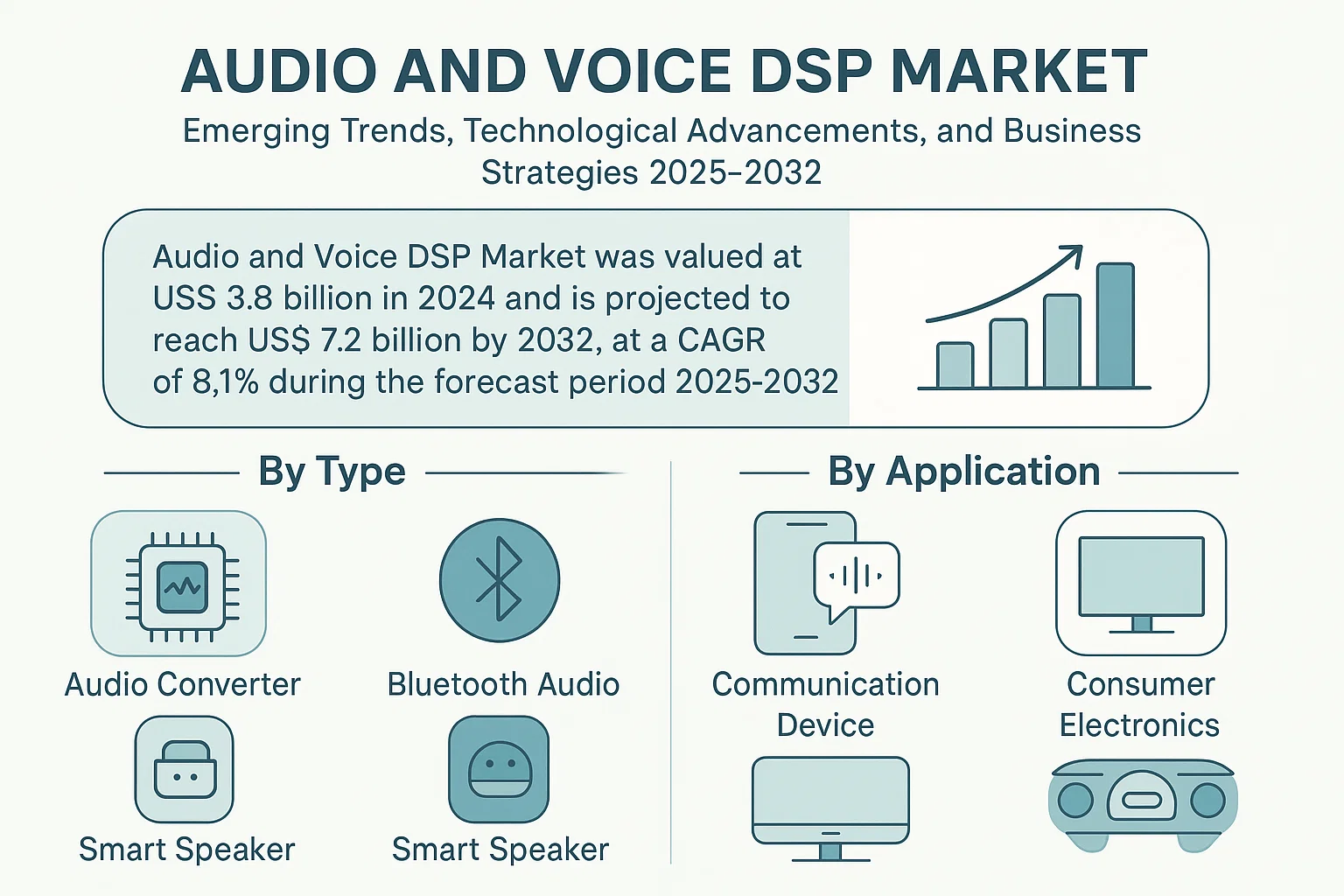
Audio and voice DSP (Digital Signal Processing) chips are specialized integrated circuits designed to process and enhance audio signals in real-time. These components play a crucial role in converting analog audio signals into digital formats while optimizing sound quality, noise reduction, and echo cancellation. Key applications include consumer electronics, automotive infotainment systems, and communication devices.
Market growth is being driven by increasing demand for smart audio devices, advancements in AI-powered voice recognition, and the rapid adoption of IoT technologies. While North America currently dominates the market with a 38% revenue share, the Asia-Pacific region is expected to witness the fastest growth due to expanding electronics manufacturing. Recent developments, such as Qualcomm’s 2024 launch of its S7 Pro Gen 2 audio platform, demonstrate ongoing innovation in this space.
MARKET DYNAMICS
MARKET DRIVERS
Proliferation of Smart Devices and IoT Ecosystems Fueling Market Expansion
The global audio and voice DSP market is experiencing robust growth due to the rapid adoption of smart devices and IoT ecosystems. With over 650 million smart speakers shipped globally between 2021-2024, the demand for advanced audio processing solutions has surged exponentially. Audio DSPs play a critical role in enabling voice assistants, noise cancellation, and spatial audio features that consumers increasingly expect. As smart home integration becomes more sophisticated, requiring seamless voice control across multiple devices simultaneously, DSP solutions that can handle complex acoustic environments are becoming indispensable.
Automotive Voice Recognition Systems Creating New Growth Frontiers
Modern vehicles are transforming into advanced digital cockpits, with voice recognition emerging as the primary human-machine interface. Automotive manufacturers are integrating sophisticated DSP solutions that can filter road noise while accurately processing voice commands in multi-lingual environments. This sector is projected to maintain >15% CAGR through 2032, driven by consumer demand for hands-free operation and regulatory initiatives promoting driver safety. Advanced beamforming technologies in DSPs enable voice recognition systems to pinpoint the speaker’s location within the vehicle, even with multiple occupants talking simultaneously.
Content Streaming Revolution Demanding Higher Audio Fidelity
The global shift toward digital content consumption is pushing audio quality standards to new heights. Streaming platforms now deliver lossless and spatial audio formats that require powerful DSP processing. This has created substantial demand for high-performance audio conversion and enhancement technologies across both content creation tools and playback devices. Music streaming alone represents a technology segment growing at nearly 20% annually, with DSP solutions being critical for format conversion, dynamic range optimization, and multi-channel rendering across diverse playback systems.
MARKET CHALLENGES
Complex Integration Requirements Hampering Time-to-Market
While demand grows rapidly, the integration of audio DSP solutions into end products presents significant technical hurdles. Modern consumer electronics require DSPs to interface with multiple sensors, wireless modules, and processing units while maintaining low power consumption. This complex integration often extends development cycles by 30-40% compared to conventional audio solutions. System architects must balance processing latency, power budgets and acoustic performance, requiring increasingly specialized engineering expertise that’s in short supply.
Other Challenges
Power Consumption Constraints in Portable Devices
The push for always-on voice assistants in mobile devices creates intense pressure on battery life, with DSPs needing to process audio inputs using minimal power. Achieving sub-1-watt operation while maintaining recognition accuracy remains an engineering challenge, particularly for multilingual support and far-field capture scenarios.
Regional Language Support Complexities
As voice technology expands globally, supporting diverse languages and dialects requires extensive DSP tuning. Many regional languages exhibit phonetic characteristics that challenge conventional speech recognition algorithms, necessitating customized DSP firmware for different markets.
MARKET RESTRAINTS
Semiconductor Supply Chain Disruptions Impacting Production Schedules
The audio DSP market continues grappling with semiconductor supply chain volatility that emerged during global chip shortages. Lead times for certain DSP components remain inconsistent, creating production bottlenecks for device manufacturers. This has forced some companies to redesign products around available components rather than optimal solutions, potentially compromising audio performance. While capacity is gradually improving, geopolitical factors and materials shortages suggest these constraints may persist through 2025.
Standardization Gaps Creating Compatibility Issues
The lack of universal standards for voice assistant ecosystems presents ongoing integration challenges. Different platforms utilize proprietary wake word detection and audio processing pipelines, requiring DSP manufacturers to maintain multiple firmware branches. This fragmentation increases development costs and can delay feature rollouts. Furthermore, the absence of standardized benchmarking for audio processing performance makes objective product comparisons difficult for consumers and industry buyers alike.
MARKET OPPORTUNITIES
AI-Enhanced DSP Architectures Opening New Application Areas
The integration of machine learning accelerators with traditional DSP cores is creating breakthrough capabilities in real-time audio processing. These hybrid architectures enable adaptive noise suppression, voice isolation and acoustic scene analysis that were previously impossible. Particularly promising is the healthcare sector, where AI-powered DSPs can assist in medical diagnostics through cough analysis and respiratory pattern recognition. Investment in these specialized DSP applications is expected to triple current levels by 2027 as the technology matures.
5G-Enabled Edge Computing Driving Distributed Audio Processing
The rollout of 5G networks enables sophisticated audio processing to move closer to end-users through edge computing infrastructures. This architecture combines local DSP processing with cloud-based resources, allowing for more complex audio applications without taxing device batteries. Telecommunications providers are actively investing in edge-based DSP solutions for applications like real-time language translation during calls and enhanced conference calling features. These developments could redefine audio communication standards across multiple industries.
AUDIO AND VOICE DSP MARKET TRENDS
Integration of AI and Machine Learning to Accelerate Market Growth
The Audio and Voice Digital Signal Processing (DSP) market is witnessing rapid transformation due to the integration of Artificial Intelligence (AI) and Machine Learning (ML) capabilities. Voice recognition systems, noise suppression algorithms, and advanced acoustic processing techniques are now being enhanced through AI-powered DSP solutions. Companies such as Qualcomm and Texas Instruments are investing heavily in AI-enhanced DSP chipsets, enabling real-time voice processing with higher accuracy. The growing demand for smart assistants like Alexa, Siri, and Google Assistant is further fueling innovation. Recent reports estimate that AI-driven DSP solutions account for nearly 40% of the market share in voice processing applications.
Other Trends
Wireless Audio and Smart Speaker Boom
The proliferation of wireless audio devices, including Bluetooth headphones, earbuds, and smart speakers, is significantly boosting the adoption of DSP technologies. Smart speakers alone are projected to grow at a CAGR of 16% through 2030, with DSP chips playing a critical role in enhancing voice clarity and noise cancellation. Brands like Sony, Apple, and Samsung are incorporating advanced DSP solutions to improve audio fidelity in wireless products. Furthermore, the rise of True Wireless Stereo (TWS) earbuds has increased the need for low-power, high-performance DSP chips, creating substantial revenue opportunities for semiconductor manufacturers.
In-Vehicle Infotainment Systems Driving Demand
The automotive sector is emerging as a key growth driver for Audio and Voice DSPs, primarily due to advancements in in-vehicle infotainment (IVI) systems. As vehicles integrate voice-activated controls, surround sound processing, and AI-based virtual assistants, DSP-equipped chips are becoming crucial. Leading automakers are collaborating with semiconductor firms such as NXP and STMicroelectronics to deploy DSP solutions that deliver seamless audio experiences.
COMPETITIVE LANDSCAPE
Key Industry Players
Innovation and Strategic Expansion Drive Market Leadership in Audio & Voice DSP Space
The global Audio and Voice DSP market features a dynamic competitive ecosystem where semiconductor giants and specialized DSP providers vie for technological supremacy. Texas Instruments currently dominates the landscape, leveraging its diversified analog and embedded processing portfolio to capture approximately 18% of the 2024 market share. The company’s strength stems from deep-rooted relationships with automotive and industrial clients, along with its cost-efficient DSP architectures.
Trailing closely, Analog Devices and Qualcomm have emerged as formidable competitors with distinct strategic advantages. Analog Devices holds technical leadership in high-fidelity audio conversion chips, while Qualcomm’s Snapdragon Sound technology integrates DSP capabilities with wireless connectivity – a critical advantage as Bluetooth audio solutions grow at 9.2% CAGR through 2032.
NXP Semiconductors and STMicroelectronics are making significant inroads in the automotive DSP segment, particularly for in-vehicle infotainment applications which accounted for 28% of 2024 DSP deployments. Both companies are actively pursuing design wins with European and Asian automakers, with NXP recently securing a major contract with a leading EV manufacturer in China.
The competitive intensity is further amplified by second-tier players like Cirrus Logic and DSP Group, who are carving out niches in specialized applications. Cirrus Logic dominates the premium consumer audio segment with its Smart Codec solutions, while DSP Group focuses on voice-enabled IoT devices – a segment projected to grow at 11.4% annually through 2030.
List of Key Audio & Voice DSP Solution Providers
- Texas Instruments (U.S.)
- Analog Devices, Inc. (U.S.)
- NXP Semiconductors (Netherlands)
- STMicroelectronics (Switzerland)
- Cirrus Logic (U.S.)
- Qualcomm Technologies, Inc. (U.S.)
- ON Semiconductor (U.S.)
- DSP Group, Inc. (U.S.)
- AMD (U.S.)
- NJR Semiconductor (Japan)
- Renesas Electronics (Japan)
- Sony Semiconductor Solutions (Japan)
Segment Analysis:
By Type
Audio Converter Segment Leads Market Growth Due to High Demand in Consumer Electronics
The market is segmented based on type into:
- Audio Converter
- Bluetooth Audio
- Smart Speaker
- Others
By Application
Consumer Electronics Segment Dominates Due to Proliferation of Smart Devices and Voice Assistants
The market is segmented based on application into:
- Communication Device
- Consumer Electronics
- In-vehicle Infotainment
- Others
By End User
Automotive Industry Shows Strong Growth Potential for Voice DSP Integration
The market is segmented based on end user into:
- Consumer Electronics Manufacturers
- Automotive OEMs
- Telecommunication Providers
- Industrial Equipment Producers
- Others
Regional Analysis: Audio and Voice DSP Market
North America
The North American Audio and Voice DSP market is characterized by rapid technological advancements and strong adoption across consumer electronics, automotive, and communication sectors. The U.S. dominates the region, accounting for approximately 70% of the market share, driven by high demand for smart speakers, in-vehicle infotainment systems, and AI-driven voice assistants. Major players like Qualcomm, Texas Instruments, and Analog Devices play a pivotal role in shaping the market through continuous R&D investments. The region also benefits from stringent regulatory frameworks that encourage innovation in noise cancellation, echo suppression, and voice recognition technologies. However, high manufacturing costs and supply chain dependencies create challenges for mid-tier manufacturers.
Europe
Europe remains a competitive hub for Audio and Voice DSP solutions, particularly in automotive and industrial applications. Germany and France lead the market due to the presence of premium automotive brands integrating advanced audio processing systems into their vehicles. The European market favors ultra-low-power DSP chips, complying with the EU’s Green Deal initiative to minimize energy consumption. While voice-enabled smart home devices gain traction, privacy concerns under GDPR regulations pose hurdles for cloud-based voice processing solutions. STMicroelectronics and NXP are key innovators in this region, focusing on edge computing to reduce latency in real-time audio applications.
Asia-Pacific
As the fastest-growing market, Asia-Pacific thrives due to expanding electronics manufacturing in China, Japan, and South Korea. China alone captures over 45% of the region’s DSP demand, supported by government initiatives like “Made in China 2025” that incentivize semiconductor self-sufficiency. The proliferation of affordable smart devices, coupled with rising disposable incomes, accelerates the adoption of voice DSPs in smartphones and IoT products. However, market fragmentation and intense price competition limit profit margins for vendors. Companies like Hisilicon and Sony leverage local supply chains to deliver cost-effective solutions, though quality control remains inconsistent across smaller manufacturers.
South America
South America presents nascent opportunities in the Audio and Voice DSP sector, primarily fueled by Brazil’s growing automotive and telecommunications industries. Economic instability, however, restricts large-scale investments, leading to reliance on imported DSP components. Budget-friendly consumer electronics dominate the region, with limited penetration of high-end audio processing technologies. Nonetheless, increasing smartphone penetration and regional efforts to modernize public communication infrastructure indicate steady long-term potential. Partnerships between global players and local distributors are crucial to overcoming logistical barriers in this price-sensitive market.
Middle East & Africa
This region is at an early stage of DSP adoption, with the UAE, Saudi Arabia, and South Africa showing gradual uptake in smart city projects and luxury automotive markets. The lack of local semiconductor fabrication facilities results in complete import dependency, making the supply chain vulnerable to geopolitical disruptions. Voice assistant functionalities in hospitality and retail sectors drive niche demand, while weak standardization hampers large-scale deployments. Despite these challenges, increasing digitization efforts and foreign investments in tech infrastructure signal future prospects for audio DSP integration in emerging applications.
Report Scope
This market research report provides a comprehensive analysis of the global and regional Audio and Voice DSP markets, covering the forecast period 2024–2032. It offers detailed insights into market dynamics, technological advancements, competitive landscape, and key trends shaping the industry.
Key focus areas of the report include:
- Market Size & Forecast: Historical data and future projections for revenue, unit shipments, and market value across major regions and segments. The global Audio and Voice DSP market was valued at USD million in 2024 and is projected to reach USD million by 2032.
- Segmentation Analysis: Detailed breakdown by product type (Audio Converter, Bluetooth Audio, Smart Speaker, Others) and application (Communication Device, Consumer Electronics, In-vehicle Infotainment, Others) to identify high-growth segments and investment opportunities.
- Regional Outlook: Insights into market performance across North America, Europe, Asia-Pacific, Latin America, and the Middle East & Africa, including country-level analysis. The U.S. market size is estimated at USD million in 2024, while China is expected to reach USD million by 2032.
- Competitive Landscape: Profiles of leading market participants including Texas Instruments, Analog Devices, NXP, STMicroelectronics, and Cirrus Logic, covering their product offerings, R&D focus, and recent developments.
- Technology Trends & Innovation: Assessment of emerging technologies including AI-powered voice processing, low-power DSP designs, and advanced noise cancellation techniques.
- Market Drivers & Restraints: Evaluation of factors driving market growth such as increasing demand for smart speakers and voice assistants, along with challenges like supply chain constraints and semiconductor shortages.
- Stakeholder Analysis: Insights for component suppliers, OEMs, system integrators, and investors regarding the evolving ecosystem and strategic opportunities in the audio processing market.
Primary and secondary research methods are employed, including interviews with industry experts, data from verified sources, and real-time market intelligence to ensure the accuracy and reliability of the insights presented.
FREQUENTLY ASKED QUESTIONS:
What is the current market size of Global Audio and Voice DSP Market?
-> The global Audio and Voice DSP Market was valued at US$ 3.8 billion in 2024 and is projected to reach US$ 7.2 billion by 2032, at a CAGR of 8.1% during the forecast period 2025-2032.
Which key companies operate in Global Audio and Voice DSP Market?
-> Key players include Texas Instruments, Analog Devices, NXP, STMicroelectronics, Cirrus Logic, Qualcomm, and ON Semiconductor, among others.
What are the key growth drivers?
-> Key growth drivers include rising demand for smart home devices, automotive infotainment systems, and voice recognition technologies.
Which region dominates the market?
-> Asia-Pacific is the fastest-growing region, driven by China’s electronics manufacturing sector, while North America leads in technological innovation.
What are the emerging trends?
-> Emerging trends include AI-powered voice processing, ultra-low power DSP designs, and integration of DSPs in IoT devices.

Get Sample Report PDF for Exclusive Insights
Report Sample Includes
- Table of Contents
- List of Tables & Figures
- Charts, Research Methodology, and more...
 Download Sample Report PDF