Key Statistics
Key Takeaways
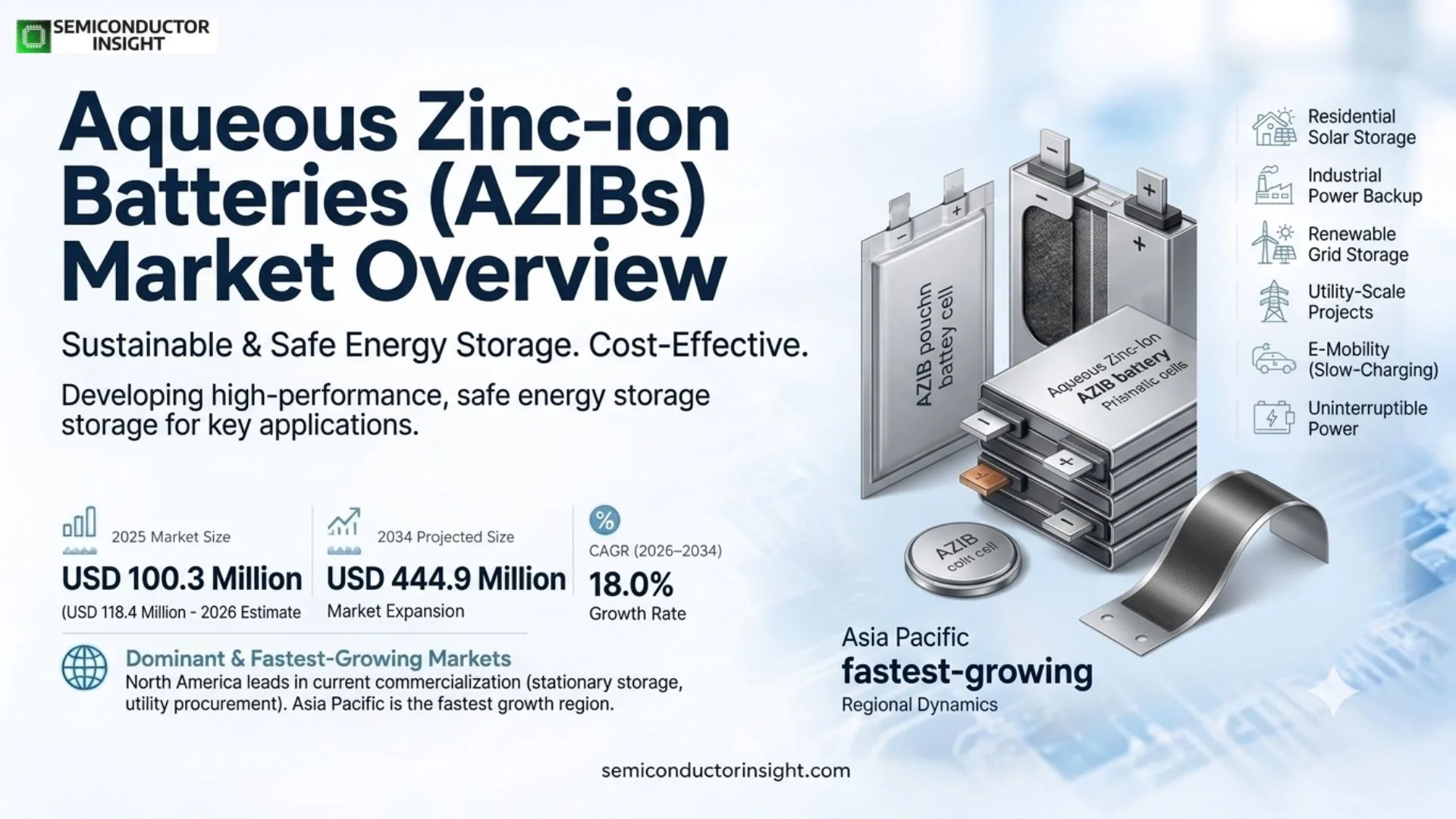
- Market size: The market stands at USD 100.3 million in 2025 and is projected to reach USD 444.9 million by 2034, representing a 18.0% CAGR across 2026–2034.
- Stationary storage is the clearest commercialization path because aqueous zinc systems can trade lower energy density for non-flammable electrolytes, abundant materials and long multi-hour discharge.
- North America leads the 2025 market, while Asia Pacific is the fastest growth region as grid-storage deployment and local battery manufacturing expand.
- Industrial and utility applications are the highest-value segments because resilience, renewable shifting and multi-hour capacity have direct economic value.
- Manufacturing scale and field validation remain the main adoption gates, requiring repeatable cycle life, quality control and bankable project performance.
Aqueous Zinc-ion Batteries (AZIBs) Market Overview
Aqueous Zinc-ion Batteries Market is valued at USD 100.3 million in 2025 and is projected to reach USD 444.9 million by 2034, expanding at a 18.0% CAGR during 2026–2034. The 2026 market level is USD 118.4 million. North America holds the leading 2025 market position, while Asia Pacific is the fastest growth region. The technology is gaining attention for stationary energy storage because aqueous electrolytes reduce fire risk and zinc is abundant, but commercialization depends on cycle life, zinc-anode stability, round-trip efficiency and scalable production.
Aqueous zinc-ion batteries use a zinc-based negative electrode and water-based electrolyte to store and release energy through reversible ion movement. Their key strengths are non-flammable electrolytes, relatively low-cost materials and established zinc supply chains. The technology is best suited to stationary applications where safety, lifetime and cost per stored kilowatt-hour can outweigh the lower gravimetric energy density that would limit adoption in electric vehicles or compact portable electronics.
The main technical challenge is controlling zinc plating, dendrite formation, hydrogen evolution, cathode dissolution and electrolyte stability over thousands of cycles. Developers use electrode additives, separators, protective interfaces and tailored electrolytes to improve reversibility and suppress side reactions. The wider commercial zinc-battery ecosystem also includes zinc-bromide and zinc-hybrid systems, which provide useful stationary-storage evidence even though their electrochemistry differs from classical intercalation-type aqueous zinc-ion cells.
Commercial buyers evaluate complete storage economics rather than cell chemistry alone. Utilities and industrial users need validated degradation, fire safety, controls, warranty support and service over many years. Aqueous zinc systems can create value where site safety, long-duration discharge and domestic material sourcing matter, but suppliers must prove automated manufacturing and project bankability. First-of-a-kind deployments therefore carry more strategic value than laboratory energy-density records because they reduce financing and performance uncertainty.
Segment Analysis: By Type
By type, the market is segmented into batteries under development and next-generation batteries. Early commercial systems are still moving through pilot, demonstration and first-of-a-kind deployment, while next-generation designs focus on improved cycle life, energy density, operating temperature and system cost. The distinction reflects a market where many technologies remain below the manufacturing maturity of lithium-ion.
| Type | Technical / commercial role | Market position |
|---|---|---|
| Battery Under Development | Pilot and early-commercial cells or modules moving through validation, demonstration and limited deployment. | Largest current development pool; focus is cycle life, zinc stability and repeatable manufacturing. |
| Next Generation Battery | Advanced chemistries and architectures targeting better energy density, lifetime and system economics. | Higher-growth segment as developers move from laboratory performance toward bankable grid-storage products. |
Additional Segmentation: By End User
End-user demand is led by utilities and grid operators, followed by commercial and industrial users and selected residential customers. Utilities value long-duration discharge, safety and lower material risk, while commercial facilities focus on resilience, peak management and renewable integration. Residential demand is smaller because footprint and installed-system cost remain important compared with mature lithium-ion alternatives.
| End User | Demand characteristics |
|---|---|
| Utility & Grid Operators | Long-duration storage, renewable shifting, capacity and grid resilience. |
| Commercial & Industrial Users | Peak management, backup, microgrids and behind-the-meter renewable integration. |
| Residential Users | Home backup and solar storage where safety and lifetime can offset a larger footprint. |
Segment Analysis: By Application
By application, residential, industrial and other uses represent different project economics. Industrial demand is the strongest near-term commercial segment because factories, data centers and campuses can monetize resilience and multi-hour energy shifting. Residential applications remain cost-sensitive, while the Others category includes utility-scale renewable integration, microgrids, telecom and remote power where safety and long-duration operation are particularly valuable.
| Application | Demand characteristics |
|---|---|
| Residential | Home solar storage and backup where non-flammable chemistry and long calendar life are valued. |
| Industrial | Factories, data centers and campuses using multi-hour storage for resilience and energy-cost management. |
| Others | Utility-scale grids, microgrids, telecom and remote infrastructure requiring safe long-duration storage. |
Additional Segmentation: By System Configuration
System configuration ranges from cell and module products to racks, cabinets and containerized battery energy storage systems. Cell and module suppliers target integrators, while rack and cabinet products reduce engineering work for commercial users. Containerized BESS is the most important route for utility and large industrial projects because it integrates controls, power electronics, monitoring and site-ready enclosures into a bankable project package.
| System Configuration | Commercial relevance |
|---|---|
| Cell / Module Systems | Core electrochemical products for integrators, pilots and specialized storage systems. |
| Rack & Cabinet Systems | Integrated modules and controls for commercial, industrial and microgrid applications. |
| Containerized BESS | Utility and large industrial systems combining batteries, controls, safety and power conversion. |
Regional Analysis
North America leads current commercialization through stationary-storage developers, utility procurement and domestic manufacturing initiatives. Asia Pacific is the fastest growth region because China and other markets combine large storage deployment, battery manufacturing and zinc supply chains. Europe is active in long-duration storage and renewable integration, while South America and the Middle East & Africa remain earlier-stage but relevant for remote grids and renewables.
Why does regional demand differ across the Aqueous Zinc-ion Batteries (AZIBs) market?
Regional adoption depends on electricity-market needs, project financing, safety rules and local manufacturing rather than consumer-electronics demand. North America offers strong grid-resilience economics, Asia Pacific combines manufacturing scale and large storage deployment, and Europe emphasizes renewable integration and safety. South America and the Middle East & Africa offer long-term potential where remote grids, mining and renewable-heavy systems reward safe multi-hour storage.
| Region | Position | Growth outlook | Demand profile | Supplier selection |
|---|---|---|---|---|
| Asia Pacific | Fast growth | Very high | Grid storage, manufacturing | Scale and commercialization |
| North America | Largest | High | LDES, utility projects | Bankability and manufacturing |
| Europe | Strategic | Steady-high | Renewables, grid balancing | Safety and project economics |
| South America | Emerging | Moderate | Remote grids, mining | Financing and service |
| Middle East & Africa | Emerging | Selective | Renewables, resilience | Project access and support |
Competitive Landscape
The commercial field remains fragmented and early-stage. Salient Energy and Enerpoly are specifically identified aqueous zinc-ion developers, while the broader zinc-based stationary-storage ecosystem includes Eos and other companies pursuing aqueous zinc chemistries. Competition centers on cycle life, safety, energy efficiency, manufacturing simplicity and the ability to finance and support multi-megawatt projects rather than on cell energy density alone.
Manufacturing credibility is a major differentiator because many technologies are still scaling. Customers evaluate automated production, warranty terms, safety validation and system integration in addition to chemistry. Suppliers that demonstrate repeatable operation at hundreds of megawatt-hours can establish reference projects that lower financing risk for later deployments. This makes field performance and factory scale central competitive assets.
Commercial relationships are durable because a aqueous zinc-ion battery is rarely changed without qualification, integration work or performance validation. This raises switching costs and rewards suppliers that provide dependable support, transparent roadmaps and long-term product continuity. New entrants can still gain share when they demonstrate a clear advantage in cost, performance, manufacturing scale or integration, but customer reference projects are usually required before large-volume adoption.
| Competitive tier | Representative companies | Primary differentiation |
|---|---|---|
| Aqueous zinc-ion developers | Salient Energy, Enerpoly | Zinc-ion cell chemistry, modular stationary storage and commercialization of aqueous systems. |
| Commercial zinc-based LDES | Eos Energy Enterprises | Aqueous zinc-based long-duration storage with U.S. manufacturing and utility-scale project deployment. |
| Research / emerging developers | Universities, startups and regional battery companies | Cathode, electrolyte and zinc-anode innovations targeting cycle life and energy density. |
Key companies profiled
Salient Energy and Enerpoly are specifically identified in the market scope, while the broader commercial context includes Eos Energy Enterprises as a significant aqueous zinc-based stationary-storage manufacturer. Because zinc chemistries differ, company comparisons should be made by electrochemical architecture, storage duration, cycle-life evidence, manufacturing scale and target application rather than treating every zinc battery as identical.
Production Capacity Analysis
Manufacturing capacity depends on electrode preparation, cathode processing, separator and electrolyte handling, cell assembly, formation, module integration and quality testing. Aqueous systems can avoid some dry-room and thermal-management requirements associated with lithium-ion, but commercial scale still requires tight control of electrolyte fill, electrode uniformity and sealing. Yield and repeatability are the real constraints during early manufacturing ramps.
System capacity also depends on module, rack, controls and power-conversion integration. Eos began commercial production at a second facility in June 2026 and stated that the expansion supports a path toward 4 GWh of annualized capacity. While Eos uses a broader zinc-based aqueous architecture, the scale-up illustrates the manufacturing challenge facing non-lithium stationary batteries: automated production must reach bankable quality before project demand can be served reliably.
Market Dynamics
The AZIB market is growing because grid operators and industrial users need safer, longer-duration and less resource-constrained storage alternatives. Zinc’s abundance and aqueous electrolytes create an attractive cost and safety profile, but commercial success depends on zinc reversibility, cycle life and manufacturing scale. Stationary storage is the main opportunity because footprint is less critical and project economics reward safety, long life and multi-hour discharge.
Market Drivers
| Driver | Impact | Commercial mechanism |
|---|---|---|
| Long-duration grid storage | High | Renewable-heavy grids need multi-hour storage. |
| Safety advantage | High | Water-based electrolytes reduce fire risk. |
| Material availability | Medium-High | Zinc is abundant and supported by established supply chains. |
| Domestic storage manufacturing | Medium | Governments and utilities want non-lithium supply-chain diversification. |
Long-duration grid storage
Solar and wind growth creates longer periods of surplus and deficit, increasing the value of storage that can discharge for many hours. Aqueous zinc systems prioritize durability, safety and lower-cost materials rather than vehicle-level energy density, making utility and industrial stationary storage the clearest commercial pathway. The commercial implication is that buyers in the Aqueous Zinc-ion Batteries (AZIBs) market evaluate the complete operating context, including validation history, integration effort, reliability, lifecycle support, supply continuity and measurable system-level value rather than a single headline specification.
Safety advantage
Fire safety is a major siting issue for batteries near buildings and critical infrastructure. Aqueous systems can reduce thermal-runaway risk and simplify some safety controls. Independent abuse testing of commercial zinc-based systems shows how validated safety can become a permitting and financing advantage rather than only a laboratory claim. The commercial implication is that buyers in the Aqueous Zinc-ion Batteries (AZIBs) market evaluate the complete operating context, including validation history, integration effort, reliability, lifecycle support, supply continuity and measurable system-level value rather than a single headline specification.
Material availability
Zinc is widely mined, refined and recycled, reducing exposure to lithium, nickel or cobalt supply chains. This can improve price visibility and support domestic sourcing strategies. Material availability does not guarantee low battery cost, but it creates a structural advantage if manufacturing yield and cycle life reach commercial targets. The commercial implication is that buyers in the Aqueous Zinc-ion Batteries (AZIBs) market evaluate the complete operating context, including validation history, integration effort, reliability, lifecycle support, supply continuity and measurable system-level value rather than a single headline specification.
Domestic storage manufacturing
Energy-storage policy increasingly favors local manufacturing, local content and resilience. Zinc-based technologies can benefit because they use broadly available materials and can be manufactured outside dominant lithium-ion supply chains. New factories and capacity reservations can accelerate commercialization if project financing follows. The commercial implication is that buyers in the Aqueous Zinc-ion Batteries (AZIBs) market evaluate the complete operating context, including validation history, integration effort, reliability, lifecycle support, supply continuity and measurable system-level value rather than a single headline specification.
Market Restraints
| Restraint | Impact | Commercial consequence |
|---|---|---|
| Cycle-life uncertainty | High | Long-term zinc reversibility must be proven. |
| Lower energy density | Medium-High | Aqueous zinc systems require more space for the same energy. |
| Early manufacturing scale | Medium-High | Few suppliers have demonstrated high-volume automated production. |
| Bankability and financing | Medium | Project lenders need operating history and credible guarantees. |
Cycle-life uncertainty
Dendrites, hydrogen evolution, cathode dissolution and electrolyte changes can reduce capacity over repeated cycling. Laboratory results may not translate directly to multi-year field operation. Utilities therefore require degradation models, testing and warranty confidence before committing to large projects, slowing adoption compared with mature lithium-ion systems. The commercial implication is that buyers in the Aqueous Zinc-ion Batteries (AZIBs) market evaluate the complete operating context, including validation history, integration effort, reliability, lifecycle support, supply continuity and measurable system-level value rather than a single headline specification.
Lower energy density
Stationary projects can tolerate larger footprints better than vehicles, but land, containers and balance-of-system cost still matter. Lower energy density can increase site preparation and enclosure requirements. Developers must offset this with lower safety infrastructure, longer life or lower material cost. The commercial implication is that buyers in the Aqueous Zinc-ion Batteries (AZIBs) market evaluate the complete operating context, including validation history, integration effort, reliability, lifecycle support, supply continuity and measurable system-level value rather than a single headline specification.
Early manufacturing scale
Pilot cells can be built manually, but commercial projects require thousands of consistent modules with traceable quality. Scaling coating, electrolyte fill, sealing and formation without yield loss is difficult. Limited installed manufacturing also creates supply risk for developers and lenders considering large projects. The commercial implication is that buyers in the Aqueous Zinc-ion Batteries (AZIBs) market evaluate the complete operating context, including validation history, integration effort, reliability, lifecycle support, supply continuity and measurable system-level value rather than a single headline specification.
Bankability and financing
New chemistries lack the field history of mature lithium-ion. Developers must provide warranty structures, independent testing and financially credible counterparties. The cost of capital can remain high until multiple large projects demonstrate predictable degradation, availability and maintenance requirements. The commercial implication is that buyers in the Aqueous Zinc-ion Batteries (AZIBs) market evaluate the complete operating context, including validation history, integration effort, reliability, lifecycle support, supply continuity and measurable system-level value rather than a single headline specification.
Market Opportunities
Utility long-duration storage
Four-to-sixteen-hour storage is a major opportunity because renewable-heavy grids need capacity that can shift energy across longer daily windows. Zinc-based systems can compete where safety, cycle life and low-cost materials outweigh footprint disadvantages. The commercial implication is that buyers in the Aqueous Zinc-ion Batteries (AZIBs) market evaluate the complete operating context, including validation history, integration effort, reliability, lifecycle support, supply continuity and measurable system-level value rather than a single headline specification.
Commercial and industrial resilience
Factories, campuses and data centers can use aqueous zinc storage for backup, peak management and renewable integration. Non-flammable chemistry can be valuable where batteries are installed near occupied buildings or critical infrastructure. The commercial implication is that buyers in the Aqueous Zinc-ion Batteries (AZIBs) market evaluate the complete operating context, including validation history, integration effort, reliability, lifecycle support, supply continuity and measurable system-level value rather than a single headline specification.
Domestic manufacturing partnerships
Local-content policies and supply-chain diversification create opportunities for licensing, joint ventures and regional factories. Zinc-based systems can use established metals and plastics supply chains, making localization more practical if cell manufacturing is standardized. The commercial implication is that buyers in the Aqueous Zinc-ion Batteries (AZIBs) market evaluate the complete operating context, including validation history, integration effort, reliability, lifecycle support, supply continuity and measurable system-level value rather than a single headline specification.
Hybrid storage systems
Aqueous zinc can be paired with lithium-ion or other fast-response technologies so each chemistry performs the duty cycle that best matches its strengths. Hybrid projects can use lithium for short bursts and zinc for long-duration energy shifting. The commercial implication is that buyers in the Aqueous Zinc-ion Batteries (AZIBs) market evaluate the complete operating context, including validation history, integration effort, reliability, lifecycle support, supply continuity and measurable system-level value rather than a single headline specification.
Supply Chain Analysis
Materials. Zinc metal, cathode materials, salts, separators, plastics and electrolyte ingredients form the upstream base. Purity and consistency matter because contaminants can accelerate side reactions or reduce cycle life. Recycling and established zinc processing can support a lower-risk materials supply chain. The commercial implication is that buyers in the Aqueous Zinc-ion Batteries (AZIBs) market evaluate the complete operating context, including validation history, integration effort, reliability, lifecycle support, supply continuity and measurable system-level value rather than a single headline specification.
Cell manufacturing. Electrode preparation, separator placement, electrolyte filling, sealing and formation determine cell consistency. Manufacturers must control zinc surface behavior and water balance across many cycles. Automated inspection and traceability become essential as production scales from pilot lines to gigawatt-hour factories. The commercial implication is that buyers in the Aqueous Zinc-ion Batteries (AZIBs) market evaluate the complete operating context, including validation history, integration effort, reliability, lifecycle support, supply continuity and measurable system-level value rather than a single headline specification.
System integration. Cells are assembled into modules, racks or containers with monitoring, power electronics and thermal or fluid management where required. Stationary customers buy a complete storage service, so control software, fire-safety evidence, warranty terms and site integration strongly influence system value. The commercial implication is that buyers in the Aqueous Zinc-ion Batteries (AZIBs) market evaluate the complete operating context, including validation history, integration effort, reliability, lifecycle support, supply continuity and measurable system-level value rather than a single headline specification.
Deployment. Utilities and industrial users qualify systems through project engineering, interconnection, permitting and commissioning. Long-duration assets must maintain availability over years of cycling, making service capability and spare parts important. Successful reference projects reduce risk for later deployments and can accelerate financing. The commercial implication is that buyers in the Aqueous Zinc-ion Batteries (AZIBs) market evaluate the complete operating context, including validation history, integration effort, reliability, lifecycle support, supply continuity and measurable system-level value rather than a single headline specification.
Recent Developments in the Aqueous Zinc-ion Batteries (AZIBs) Market
Developments tracked through September 2026. Entries are limited to events that materially affect product capability, manufacturing capacity, customer adoption, channel access or the competitive structure of the market.
- 16 June 2026
Eos Energy Enterprises launched commercial production at its second manufacturing facility in Pennsylvania and stated that the expansion supports its path toward 4 GWh of annualized capacity. The scale-up provides a commercial benchmark for aqueous zinc-based stationary storage. Source - 22 June 2026
Eos reported independent abuse testing of its zinc-based Z3 modules, with no thermal runaway, sustained fire or propagation under tested direct-flame and overcharge scenarios. Safety validation is increasingly important for stationary-storage permitting and financing. Source - 18 June 2026
Eos announced the first purchase order under a 2 GWh capacity reservation agreement with Frontier Power USA, supporting a 100 MW / 400 MWh Texas project. The order demonstrates commercial interest in zinc-based long-duration storage at utility scale. Source
Report Scope & Segmentation
| Attribute | Scope |
|---|---|
| Base year | 2025 |
| Estimated year | 2026 |
| Forecast period | 2026–2034 |
| 2025 market size | USD 100.3 million |
| 2026 estimated size | USD 118.4 million |
| 2034 projected size | USD 444.9 million |
| CAGR (2026–2034) | 18.0% |
| Largest market in 2025 | North America |
| By Type | Battery Under Development; Next Generation Battery |
| By Application | Residential; Industrial; Others |
| By End User | Utility & Grid Operators; Commercial & Industrial Users; Residential Users |
| By System Configuration | Cell/Module Systems; Rack & Cabinet Systems; Containerized BESS |
| Companies profiled | Salient Energy; Enerpoly; selected zinc-based stationary-storage developers including Eos Energy Enterprises |
Frequently Asked Questions
What is the aqueous zinc-ion batteries market size in 2025?
The global AZIB market is valued at USD 100.3 million in 2025 and covers aqueous zinc-based rechargeable batteries used mainly in stationary residential, industrial and grid-storage applications. The commercial implication is that buyers in the Aqueous Zinc-ion Batteries (AZIBs) market evaluate the complete operating context, including validation history, integration effort, reliability, lifecycle support, supply continuity and measurable system-level value rather than a single headline specification.
What is the market forecast for 2034?
The market is projected to reach USD 444.9 million by 2034, representing an 18.0% CAGR during 2026–2034. The corresponding 2026 market level is USD 118.4 million. The commercial implication is that buyers in the Aqueous Zinc-ion Batteries (AZIBs) market evaluate the complete operating context, including validation history, integration effort, reliability, lifecycle support, supply continuity and measurable system-level value rather than a single headline specification.
Which region leads the market?
North America leads the current market, while Asia Pacific is the fastest growth region because of large battery-manufacturing ecosystems and expanding stationary-storage demand. The commercial implication is that buyers in the Aqueous Zinc-ion Batteries (AZIBs) market evaluate the complete operating context, including validation history, integration effort, reliability, lifecycle support, supply continuity and measurable system-level value rather than a single headline specification.
Why are aqueous zinc batteries attractive?
They use water-based electrolytes and abundant zinc, offering a strong safety and material-availability profile for stationary storage where footprint is less critical than in vehicles. The commercial implication is that buyers in the Aqueous Zinc-ion Batteries (AZIBs) market evaluate the complete operating context, including validation history, integration effort, reliability, lifecycle support, supply continuity and measurable system-level value rather than a single headline specification.
What are the main applications?
Industrial and grid storage are the strongest opportunities, followed by residential backup and solar storage. Long-duration renewable integration is the most important strategic use case. The commercial implication is that buyers in the Aqueous Zinc-ion Batteries (AZIBs) market evaluate the complete operating context, including validation history, integration effort, reliability, lifecycle support, supply continuity and measurable system-level value rather than a single headline specification.
What technical challenges remain?
Developers must control zinc dendrites, hydrogen evolution, cathode degradation, electrolyte stability and cycle-life consistency across thousands of cycles. The commercial implication is that buyers in the Aqueous Zinc-ion Batteries (AZIBs) market evaluate the complete operating context, including validation history, integration effort, reliability, lifecycle support, supply continuity and measurable system-level value rather than a single headline specification.
How do they compare with lithium-ion?
Aqueous zinc systems generally have lower energy density but can offer lower fire risk, abundant materials and strong suitability for multi-hour stationary storage. The commercial implication is that buyers in the Aqueous Zinc-ion Batteries (AZIBs) market evaluate the complete operating context, including validation history, integration effort, reliability, lifecycle support, supply continuity and measurable system-level value rather than a single headline specification.
Who are the key companies?
Salient Energy and Enerpoly are identified in the market scope. The broader commercial zinc-storage ecosystem also includes companies such as Eos Energy Enterprises using aqueous zinc-based chemistries. The commercial implication is that buyers in the Aqueous Zinc-ion Batteries (AZIBs) market evaluate the complete operating context, including validation history, integration effort, reliability, lifecycle support, supply continuity and measurable system-level value rather than a single headline specification.
What limits commercial adoption?
Limited manufacturing scale, bankability, long-term field data and system energy density are the main constraints. Large reference projects and automated factories are required to reduce those risks. The commercial implication is that buyers in the Aqueous Zinc-ion Batteries (AZIBs) market evaluate the complete operating context, including validation history, integration effort, reliability, lifecycle support, supply continuity and measurable system-level value rather than a single headline specification.
What will drive growth through 2034?
Renewable integration, long-duration grid storage, domestic battery manufacturing, safety requirements and demand for non-lithium supply chains will support expansion. The commercial implication is that buyers in the Aqueous Zinc-ion Batteries (AZIBs) market evaluate the complete operating context, including validation history, integration effort, reliability, lifecycle support, supply continuity and measurable system-level value rather than a single headline specification.
Research Sources & Evidence Base
View research sources used in this market overview
- Eos Energy Enterprises – Technology. Commercial aqueous zinc-based long-duration storage architecture and operating profile.
- Eos Energy Enterprises – Second manufacturing facility launch. 2026 manufacturing-capacity expansion evidence.
- Eos Energy Enterprises – Independent fire testing. 2026 safety-test evidence.
- Semiconductor Insight – Aqueous Zinc-ion Batteries Market. Market anchors, segmentation and regional position.

Get Sample Report PDF for Exclusive Insights
Report Sample Includes
- Table of Contents
- List of Tables & Figures
- Charts, Research Methodology, and more...