
APD Chips Market Insights
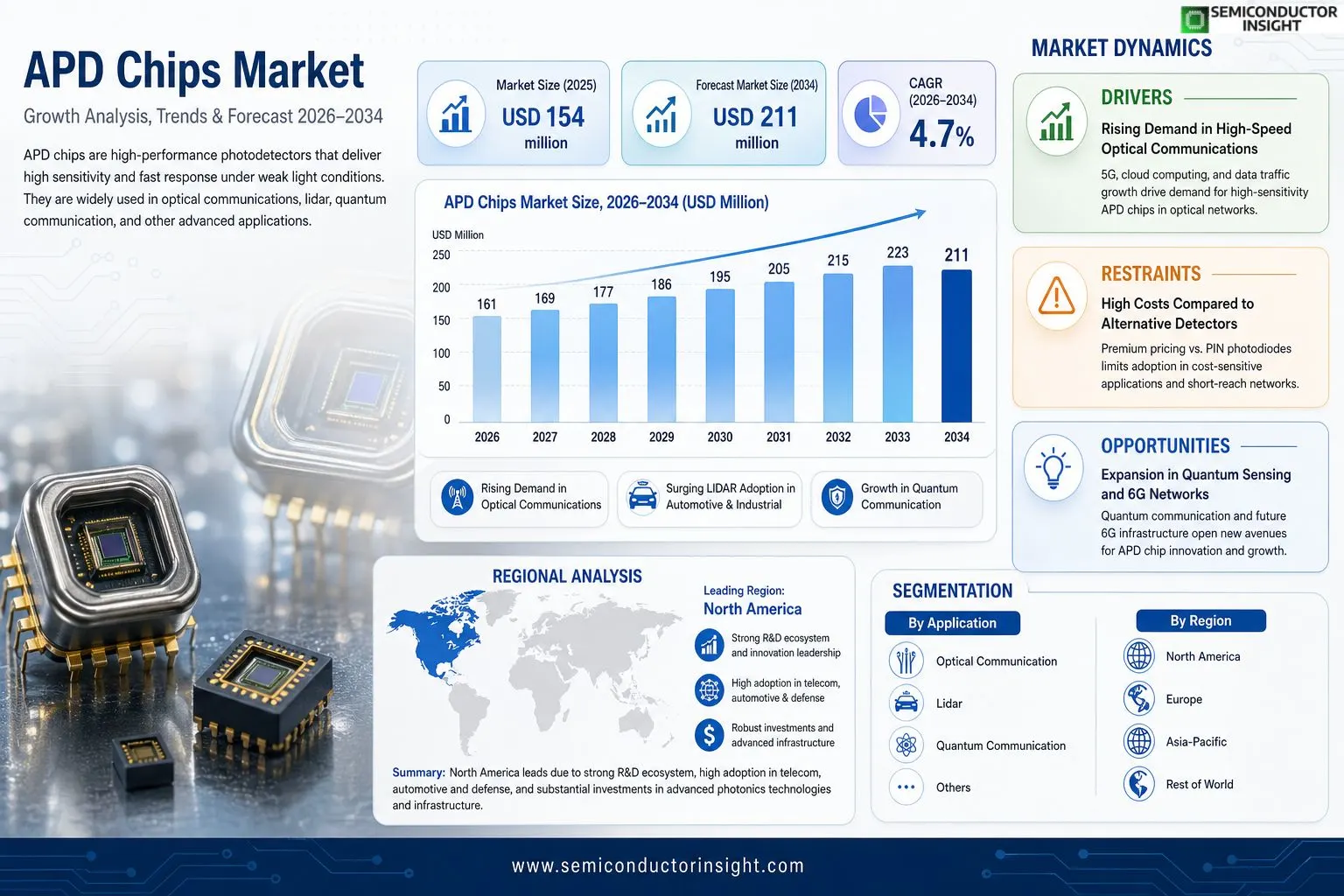
Global APD Chips market size was valued at USD 154 million in 2025. The market is projected to reach USD 211 million by 2034, exhibiting a CAGR of 4.7% during the forecast period.
APD chips are high-performance photodetectors that provide high sensitivity and fast response under weak light conditions. When photons strike the semiconductor material, they generate electron-hole pairs. Under high reverse bias, these carriers accelerate in a strong electric field, colliding with lattice atoms to produce more pairs through avalanche multiplication, thereby amplifying the optical signal into a detectable electrical output. They are widely used in optical communications, lidar, quantum communication, and others.
The market is experiencing steady growth due to rising demand for high-speed optical networks, LiDAR in autonomous vehicles and security monitoring, and advancements in photon detection technologies. Key players such as Lumentum Operations, Sumitomo Electric, Mitsubishi Electric, EMCORE Corporation, Wooriro, Albis Optoelectronics, Broadcom, MACOM, and Beijing Infraytech hold significant shares, driving innovation through product development and expanded portfolios in linear and Geiger modes.
MARKET DRIVERS
Rising Demand in High-Speed Optical Communications
APD Chips Market is propelled by the exponential growth in data traffic, driven by 5G deployments and cloud computing expansion. Avalanche photodiodes offer superior sensitivity and gain, making them essential for long-haul fiber optic networks where signal detection at low power levels is critical. With global data center capacity projected to increase by 15% annually, demand for high-performance APD chips in transceivers has surged.
Advancements in Automotive LIDAR Systems
Integration of APD chips in solid-state LIDAR for autonomous vehicles represents a key growth factor in APD Chips Market. These chips enable precise 3D mapping in varying light conditions, supporting Level 4 autonomy targets. The automotive sector’s shift toward electric and self-driving cars has boosted adoption, with LIDAR shipments expected to reach 10 million units by 2025.
➤ APD Chips Market benefits from telecom infrastructure investments exceeding $300 billion globally in 2023, enhancing bandwidth capabilities.
Additionally, defense and aerospace applications further drive APD Chips Market, as these sectors prioritize rugged, high-reliability detectors for satellite communications and remote sensing.
MARKET CHALLENGES
Manufacturing Complexities and Yield Issues
APD Chips Market faces hurdles from intricate fabrication processes involving materials like InGaAs and InP, which demand precise epitaxial growth to achieve uniform avalanche multiplication. Low yields increase production costs, limiting scalability for high-volume applications and pressuring margins in competitive segments.
Other Challenges
Performance Variability Under Temperature Fluctuations
APD chips exhibit gain variations across temperature ranges, complicating designs in outdoor telecom and automotive uses within APD Chips Market. Calibration efforts add to system expenses.
Supply Chain Disruptions for Semiconductor Substrates
Geopolitical tensions and raw material shortages have impacted APD Chips Market reliability, delaying deliveries and inflating prices amid global chip shortages.
MARKET RESTRAINTS
High Costs Compared to Alternative Detectors
Premium pricing of APD chips versus standard PIN photodiodes restrains broader adoption in cost-sensitive consumer electronics and short-reach networks within APD Chips Market. While APDs provide higher bandwidth and sensitivity, their 2-3x higher cost deters mass-market penetration.Intense competition from emerging Si-photonics integrated detectors poses another restraint, as these offer comparable performance at lower costs, capturing share in data center applications central to APD Chips Market.Regulatory standards for eye safety in high-power laser systems linked to APD receivers further limit design flexibility, slowing innovation timelines.
MARKET OPPORTUNITIES
Expansion in Quantum Sensing and 6G Networks
Emerging quantum communication protocols present significant opportunities for APD Chips Market, leveraging their single-photon detection capabilities. With governments investing over $5 billion in quantum tech, APD-based receivers are poised for growth in secure networks.Development of 6G infrastructure, emphasizing terahertz frequencies, opens avenues for next-gen APD chips with enhanced bandwidth, targeting a market segment forecasted to grow at 20% CAGR.Hybrid integration with CMOS processes could reduce costs, unlocking opportunities in biomedical imaging and AR/VR wearables within APD Chips Market.
APD Chips Market Trends
Rising Demand in Optical Communications
APD Chips Market continues to see strong momentum driven by the expansion of optical communication networks, where these high-sensitivity photodetectors excel in converting weak light signals into amplified electrical signals through the avalanche multiplication effect. This technology generates electron-hole pairs under high reverse bias, enabling collision with lattice atoms to produce more pairs and amplify signals effectively. As data transmission rates increase in fiber-optic infrastructures, APD chips provide the fast response times essential for high-bandwidth applications, supporting the global shift toward denser, more efficient communication systems. Key manufacturers like Lumentum Operations and Sumitomo Electric are enhancing their offerings to meet this demand, focusing on reliability in long-haul and metro networks.
Other Trends
Expansion in Lidar Applications
Lidar systems represent a significant growth area within APD Chips Market, particularly in automotive and industrial sensing, where the photodetectors’ ability to operate under low-light conditions ensures precise distance measurement and object detection. Linear Mode APDs dominate this segment due to their linear response characteristics, while integration with solid-state technologies is improving resolution and reducing costs. Industry surveys highlight lidar’s role in autonomous vehicles and robotics, with suppliers such as Mitsubishi Electric and EMCORE Corporation advancing designs for compact, high-performance modules that withstand environmental challenges.
Emerging Role in Quantum Communication
Quantum communication applications are emerging as a pivotal trend in APD Chips Market, with Geiger Mode APDs gaining traction for single-photon detection capabilities critical to quantum key distribution and secure networks. These chips leverage the avalanche effect for ultra-low noise performance, enabling reliable signal amplification in photon-starved environments. Developments from players like Broadcom and Beijing Infraytech underscore the market’s evolution toward specialized variants, as regional expansions in Asia, particularly China and Japan, bolster infrastructure for next-generation secure communications. Overall, competitive dynamics among top global players foster innovation, addressing challenges like power efficiency and integration while capitalizing on drivers such as heightened security needs and technological miniaturization.
COMPETITIVE LANDSCAPE
Key Industry Players
Leading Manufacturers Driving APD Chips Market Growth
APD Chips Market exhibits a moderately concentrated structure, led by established global leaders such as Lumentum Operations, Sumitomo Electric, and Mitsubishi Electric. These top-tier players leverage advanced semiconductor fabrication capabilities and extensive R&D investments to dominate revenue share, with the global top five manufacturers collectively holding a substantial portion of the market in 2025. Lumentum Operations stands out for its high-performance photodetectors tailored for optical communications and LIDAR applications, benefiting from strong integration in telecommunications infrastructure. Sumitomo Electric and Mitsubishi Electric further solidify their positions through vertically integrated supply chains, enabling reliable avalanche multiplication technology essential for weak light signal amplification. This oligopolistic dynamic fosters innovation while maintaining high barriers to entry via proprietary fabrication processes and patents.
Beyond the frontrunners, a diverse array of niche and emerging players contributes to market dynamism, particularly in specialized segments like quantum communication and security monitoring. Companies such as EMCORE Corporation, Wooriro, and Albis Optoelectronics offer customized APD solutions with fast response times, carving out roles in high-sensitivity applications. Asian firms, including Beijing Infraytech, Yuanjie Semiconductor Technology, and Accelink Technologies, are rapidly expanding through cost-effective manufacturing and regional demand in LIDAR and optical networks. Firms like Broadcom, MACOM, and Global Communication Semiconductors provide complementary technologies, enhancing ecosystem competition. This tiered landscape drives pricing pressures and technological advancements, with Chinese entrants challenging incumbents amid a projected CAGR of 4.7% through 2034.
List of Key APD Chips Companies Profiled
- Lumentum Operations
- Sumitomo Electric
- Mitsubishi Electric
- EMCORE Corporation
- Wooriro
- Albis Optoelectronics
- Broadcom
- MACOM
- Global Communication Semiconductors
- Beijing Infraytech
- Yuanjie Semiconductor Technology
- Hebei Opto-sensor
- Wuhan Mindsemi
- Guilin GLsun Science and Tech Group
- Shenzhen PHOGRAIN
- Accelink Technologies
- Zhejiang Guangte Technology
Segment Analysis:
| Segment Category | Sub-Segments | Key Insights |
| By Type |
|
Linear Mode
|
| By Application |
|
Optical Communication
|
| By End User |
|
Telecommunications Providers
|
| By Material |
|
InGaAs-based
|
| By Wavelength Range |
|
1100-1700 nm
|
Regional Analysis: APD Chips Market
North America
North America’s universities and national labs pioneer APD chip enhancements, improving quantum efficiency and bandwidth for telecom and sensing. Strategic funding bolsters prototypes transitioning to mass production, solidifying technological superiority in APD Chips Market.
Dominant use in LiDAR for self-driving cars and defense optics underscores versatility. Fiber optic networks rely on APD chips for long-haul data, while medical imaging benefits from precise photon detection, diversifying revenue streams.
Localized fabrication facilities and robust vendor networks ensure component availability. Partnerships with silicon foundries enable custom APD designs, enhancing resilience against global disruptions in APD Chips Market.
Venture capital flows into startups specializing in APD integration for 5G and beyond. Government grants support scaling, positioning the region for exponential growth in high-performance photonics applications.
Europe
Europe exhibits steady growth in APD Chips Market, anchored by precision engineering traditions and collaborative R&D frameworks. Telecommunications upgrades across the continent drive demand for APD chips in dense wavelength division multiplexing systems, improving network capacities. Automotive and industrial automation sectors adopt these components for machine vision and proximity sensing, supported by stringent quality standards. Key research consortia focus on eco-friendly manufacturing processes, integrating APD technology into sustainable photonics solutions. Strategic alliances between chip designers and system integrators facilitate market penetration, particularly in renewable energy monitoring. Despite supply chain dependencies, Europe’s emphasis on innovation clusters like Silicon Saxony nurtures a competitive landscape, with opportunities in space applications enhancing long-term prospects.
Asia-Pacific
Asia-Pacific emerges as a dynamic force in APD Chips Market, fueled by rapid industrialization and telecom expansions. High-volume manufacturing capabilities enable cost-effective APD chip production for consumer electronics and data centers. The region’s burgeoning 5G rollouts and smart city initiatives amplify demand for high-speed detectors in optical networks. Automotive LiDAR adoption accelerates with local OEMs prioritizing domestic suppliers, fostering ecosystem development. Government incentives promote semiconductor self-reliance, spurring investments in advanced APD fabs. Collaborative ventures with global leaders bridge technology gaps, positioning Asia-Pacific for substantial market share gains through scale and agility.
South America
South America presents nascent yet promising dynamics in APD Chips Market, driven by infrastructure modernization efforts. Telecommunications investments in fiber broadband networks create initial demand for reliable APD chips. Emerging industrial sectors, including mining and agriculture, utilize these components for advanced sensing in harsh environments. Regional partnerships with international firms introduce technology transfers, building local expertise. Challenges like import reliance are offset by growing interest in defense applications, with potential in renewable energy projects enhancing photon detection needs. Gradual capacity buildup signals future competitiveness.
Middle East & Africa
The Middle East & Africa region shows emerging potential in APD Chips Market, propelled by diversification from oil dependency into tech. Smart infrastructure projects in the Gulf states drive APD adoption in surveillance and telecom backhauls. Africa’s mining and telecom expansions require robust detectors for fiber monitoring. Strategic free trade zones attract manufacturing investments, easing component access. Collaborations with Asian suppliers accelerate deployment, while oil & gas sectors explore APDs for pipeline inspection. Visionary policies lay groundwork for sustained regional advancement.
Report Scope
This market research report provides a comprehensive analysis of the APD Chips Market , covering the forecast period 2026–2034. It offers detailed insights into market dynamics, technological advancements, competitive landscape, and key trends shaping the industry.
Key focus areas of the report include:
- Market Overview: The report begins with an overview outlining its current market scenario, key growth indicators, and industry transformation drivers. It discusses macroeconomic factors, demand–supply balance, regulatory landscape, and the strategic role of semiconductors in powering advancements across industries such as automotive, telecommunications, consumer electronics, and industrial automation.
- Market Size & Forecast: Historical data and future projections for revenue, unit shipments, and market value across major regions and segments.
- Segmentation Analysis: Detailed breakdown by product type, technology, application, and end-user industry to identify high-growth segments and investment opportunities.
- Regional Insights: Insights into market performance across North America, Europe, Asia-Pacific, Latin America, and the Middle East & Africa, including country-level analysis where relevant.
- Competitive Landscape: Profiles of leading market participants, including their product offerings, R&D focus, manufacturing capacity, pricing strategies, and recent developments such as mergers, acquisitions, and partnerships.
- Technology Trends & Innovation: Assessment of emerging technologies, integration of AI/IoT, semiconductor design trends, fabrication techniques, and evolving industry standards.
- Market Drivers & Restraints: Evaluation of factors driving market growth along with challenges, supply chain constraints, regulatory issues, and market-entry barriers.
- Stakeholder Insights: Insights for component suppliers, OEMs, system integrators, investors, and policymakers regarding the evolving ecosystem and strategic opportunities.
Primary and secondary research methods are employed, including interviews with industry experts, data from verified sources, and real-time market intelligence to ensure the accuracy and reliability of the insights presented.
FREQUENTLY ASKED QUESTIONS:
What is the current market size of APD Chips Market?
-> APD Chips Market was valued at USD 154 million in 2025 and is expected to reach USD 211 million by 2034, at a CAGR of 4.7% during the forecast period.
Which key companies operate in APD Chips Market?
-> Key players include Lumentum Operations, Sumitomo Electric, Mitsubishi Electric, EMCORE Corporation, Wooriro, Albis Optoelectronics, Broadcom, MACOM, Global Communication Semiconductors, Beijing Infraytech, among others.
What are the key growth drivers?
-> Key growth drivers include demand for high-sensitivity photodetectors in optical communications, lidar, quantum communication, and security monitoring.
Which region dominates the market?
-> Asia is the fastest-growing region with key players in China, while North America (U.S.) holds significant market share.
What are the emerging trends?
-> Emerging trends include advancements in avalanche multiplication for weak light detection, growth in lidar applications, and expansion into quantum communication.

Get Sample Report PDF for Exclusive Insights
Report Sample Includes
- Table of Contents
- List of Tables & Figures
- Charts, Research Methodology, and more...
 Download Sample Report PDF



