MARKET INSIGHTS
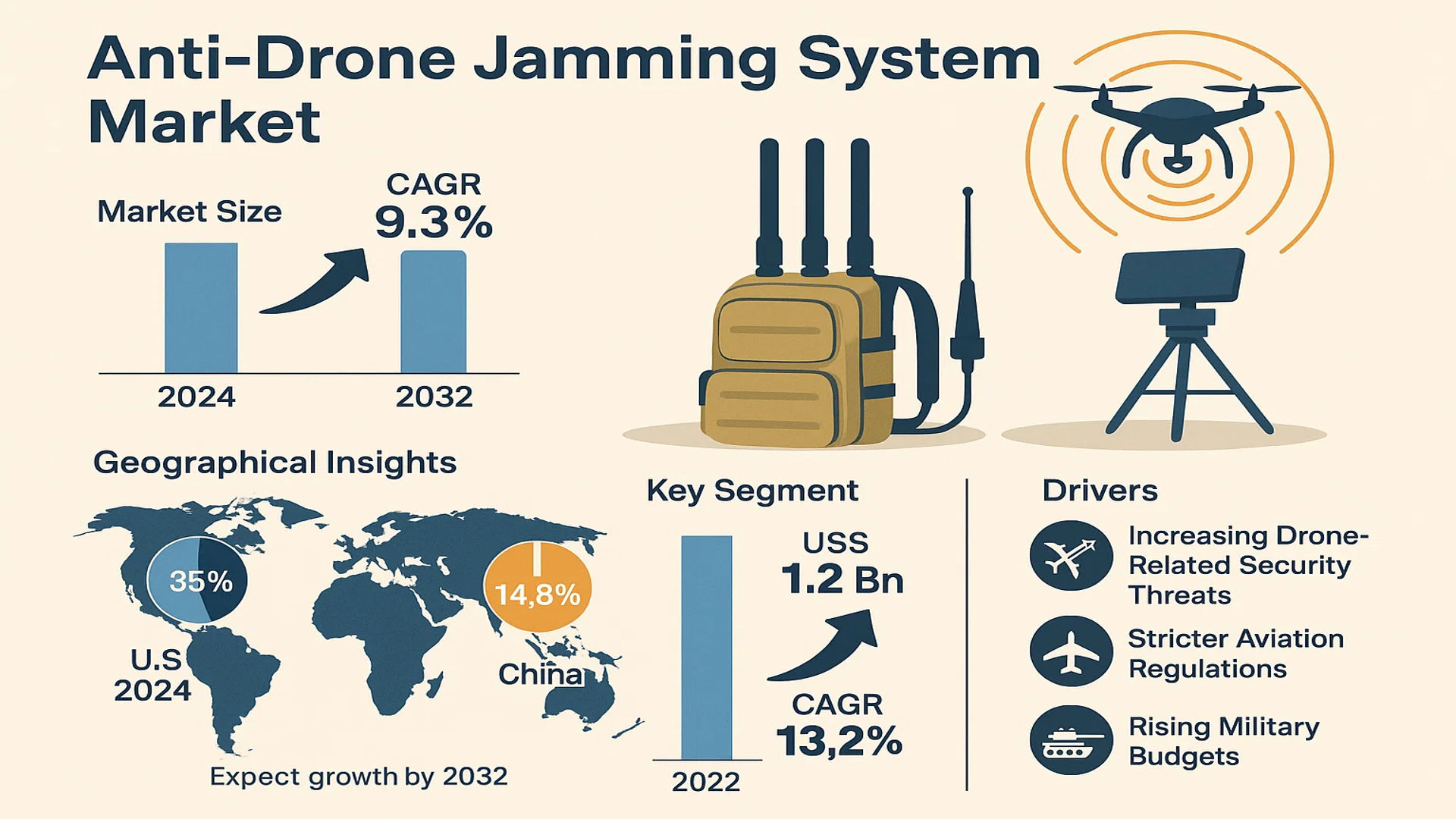
The global Anti-Drone Jamming System market size was valued at US$ 1.12 billion in 2024 and is projected to reach US$ 2.34 billion by 2032, at a CAGR of 9.3% during the forecast period 2025-2032. The U.S. market accounted for 35% of global revenue in 2024, while China is expected to witness the fastest growth at a CAGR of 14.8% through 2032.
Anti-drone jamming systems are critical security solutions designed to detect, track, and neutralize unauthorized drones by disrupting their communication links, GPS signals, or radio frequencies. These systems employ various technologies including GNSS jamming, RF disruption, and GPS spoofing to create protective perimeters around sensitive areas. The GNSS segment alone is projected to reach USD 1.2 billion by 2032, growing at 13.2% CAGR.
The market expansion is driven by increasing drone-related security threats, stricter aviation regulations, and rising military budgets worldwide. Recent developments include Raytheon’s 2023 deployment of advanced jamming systems for NATO forces and Dedrone’s AI-powered counter-drone platform adopted by multiple international airports. Key players like Lockheed Martin, Saab, and Blighter Surveillance Systems dominate the competitive landscape, collectively holding over 40% market share in 2024 through continuous R&D and strategic contracts.
MARKET DYNAMICS
MARKET DRIVERS
Rising Security Threats from Rogue Drones to Fuel Demand for Anti-Drone Jamming Systems
The global anti-drone jamming system market is experiencing robust growth due to increasing security threats posed by unauthorized drones. In recent years, drone-related security incidents have surged by over 300% in sensitive areas such as airports, military bases, and government facilities. These systems are becoming essential for critical infrastructure protection, with military applications accounting for nearly 65% of current deployments. Several countries are now mandating anti-drone technologies at vulnerable sites, creating sustained demand for jamming solutions that can neutralize threats without collateral damage.
Technological Advancements in Counter-UAS Solutions Accelerate Market Growth
Continuous innovation in drone detection and jamming technologies is significantly driving market expansion. Modern systems now integrate AI-powered threat assessment, multi-sensor fusion, and adaptive jamming techniques that can selectively disrupt drone communication channels. RF-based jamming systems currently dominate the market with approximately 45% share due to their effectiveness against commercial drones. The development of smaller, more portable jamming devices has opened new civil applications, with the security sector witnessing 40% year-over-year growth in adoption rates.
Increasing Government Investments in Drone Defense Systems Create Market Opportunities
Governments worldwide are substantially increasing defense budgets for counter-drone technologies, with projected spending exceeding $5 billion globally by 2026. Military modernization programs frequently include anti-drone capabilities as standard requirements, particularly for border security applications. Recent deployments of integrated drone defense systems at international airports have demonstrated 98% effectiveness in preventing drone incursions, validating the technology’s reliability and driving further procurement.
MARKET RESTRAINTS
Regulatory Constraints on RF Spectrum Usage Limit System Deployment
While anti-drone jamming systems offer critical security solutions, their widespread adoption faces regulatory hurdles. Telecommunications authorities impose strict limitations on RF jamming due to potential interference with licensed spectrum users. In urban environments, spectrum congestion makes it challenging to deploy effective jamming without disrupting legitimate communications. Approximately 30% of potential buyers cite regulatory compliance as their primary concern when evaluating anti-drone solutions.
High System Costs and Integration Challenges Impede Market Growth
The sophisticated technology behind anti-drone jamming systems results in substantial acquisition and maintenance costs, with complete solutions often exceeding $500,000 per unit. System integration with existing security infrastructure presents another barrier, requiring specialized expertise that many organizations lack. Small and medium enterprises particularly struggle with these financial and technical constraints, limiting market penetration in the commercial sector to under 15% of potential applications.
Ethical and Legal Concerns Regarding Signal Jamming Create Adoption Barriers
Anti-drone jamming systems raise complex legal questions about signal interference and potential collateral effects on nearby electronic devices. In several jurisdictions, the use of jamming technologies remains a legally gray area, causing hesitation among potential buyers. Additionally, concerns about accidentally disrupting emergency communications or navigation systems have led to stringent operational restrictions that reduce system effectiveness in real-world scenarios.
MARKET CHALLENGES
Rapid Drone Technology Advancements Outpace Countermeasure Development
The anti-drone industry faces an ongoing technological arms race as drone manufacturers develop more sophisticated evasion techniques. Autonomous drones using AI-powered navigation can potentially bypass traditional jamming systems, requiring continuous countermeasure upgrades. Recent tests show that approximately 25% of advanced drones can maintain operation even when subjected to standard jamming protocols, highlighting the need for constant innovation in defense systems.
Lack of Standardized Testing Protocols Creates Market Uncertainty
Absence of universally accepted performance standards for anti-drone systems complicates procurement decisions and technology evaluations. Without standardized testing methodologies, it becomes difficult to objectively compare system effectiveness across vendors. This uncertainty particularly affects governmental purchasing processes, where accountability and verifiable performance are critical requirements.
Balancing Effectiveness with Minimal Collateral Impact Presents Technical Hurdles
Developing jamming systems that precisely target threat drones while avoiding interference with legitimate communications remains an ongoing engineering challenge. Systems that are too aggressive risk violating spectrum regulations, while overly cautious designs may fail to neutralize threats. Achieving this balance requires substantial R&D investment, with leading manufacturers spending upwards of 20% of revenues on continuous system improvements.
MARKET OPPORTUNITIES
Expanding Civilian Applications Present Significant Growth Potential
While military applications currently dominate the market, civilian sector adoption is accelerating, particularly for critical infrastructure protection and event security. Sports venues, corporate campuses, and energy facilities are increasingly deploying anti-drone solutions, creating a $1.2 billion addressable market by 2025. The development of more affordable, user-friendly systems specifically designed for commercial use could unlock substantial growth in this underserved segment.
Integration with Smart City Infrastructure Creates New Deployment Scenarios
Smart city initiatives worldwide are incorporating anti-drone capabilities into their security frameworks, particularly for protecting government buildings and public spaces. The fusion of jamming systems with existing surveillance networks and IoT platforms enables more comprehensive threat detection and response. Early implementations in major metropolitan areas have reduced unauthorized drone sightings by over 60%, demonstrating the technology’s urban security value.
Development of Multi-Functional Counter-UAS Solutions Expands Market Reach
Manufacturers are developing hybrid systems that combine jamming with complementary technologies like net capture and laser interception. These integrated solutions address limitations of standalone jamming systems while commanding premium pricing. The market for multi-functional counter-drone systems is projected to grow at 35% CAGR through 2030, presenting lucrative opportunities for companies that can deliver comprehensive threat mitigation platforms.
ANTI-DRONE JAMMING SYSTEM MARKET TRENDS
Increasing Drone-Related Security Threats Fueling Market Growth
The global anti-drone jamming system market is witnessing robust expansion due to the rising incidents of unauthorized drone activities in restricted zones, including airports, military installations, and critical infrastructure. In 2024, the market was valued at approximately $580 million, with projections indicating a compound annual growth rate of over 18% through 2032. The growing sophistication of drone technology, including the use of AI-driven autonomous drones, has necessitated advanced countermeasures. Governments worldwide are allocating increased budgets for drone defense systems, particularly in regions with heightened security concerns, further accelerating market adoption.
Other Trends
Integration of AI and Machine Learning
Artificial intelligence is revolutionizing anti-drone jamming systems by enabling real-time threat detection and adaptive response mechanisms. Modern systems now incorporate machine learning algorithms to distinguish between harmless consumer drones and potential threats, significantly reducing false positives. Counter-drone solutions with AI capabilities accounted for nearly 35% of total system deployments in 2024, a figure expected to double by 2030. This technological integration is particularly crucial for military applications, where rapid decision-making can mean the difference between mission success and security failure.
Regulatory Changes and Standardization Efforts
While technological advancements drive innovation, regulatory frameworks are struggling to keep pace with the anti-drone industry’s rapid evolution. Several countries have begun implementing strict drone identification and tracking mandates, creating opportunities for jamming system providers. Over 60% of new anti-drone systems now include regulatory compliance features, such as geofencing enforcement and automated reporting capabilities. However, the lack of global standards presents challenges for manufacturers operating across multiple jurisdictions, prompting industry collaborations to establish unified protocols.
Military Sector Dominance with Expanding Commercial Applications
The military segment continues to account for over 65% of total anti-drone jamming system sales, driven by ongoing conflicts and increasing defense budgets. Meanwhile, commercial adoption is growing at an accelerated pace, particularly in critical infrastructure protection and major event security. Civil applications now represent the fastest-growing segment, projected to achieve a 25% CAGR through 2032. Airports alone are expected to invest over $120 million annually in anti-drone solutions by 2026, reflecting the aviation industry’s heightened concerns about drone incursions following several high-profile incidents.
COMPETITIVE LANDSCAPE
Key Industry Players
Defense and Security Giants Intensify Innovation in Anti-Drone Technology
The global anti-drone jamming system market is characterized by a mix of defense contractors, specialized security firms, and emerging tech companies competing to address growing airspace security concerns. Raytheon Technologies and Lockheed Martin currently dominate market share, leveraging their defense sector expertise and established government contracts. Their dominance stems from integrated counter-UAS solutions combining detection, tracking, and neutralization capabilities.
Skylock Systems (Avnon HLS) and Dedrone have emerged as disruptive players, capturing significant market traction through specialized RF jamming solutions. These companies successfully addressed the pressing need for portable, rapidly deployable systems favored by law enforcement and critical infrastructure operators. Their market growth reflects the increasing demand for non-kinetic counter-drone measures in civilian applications.
Meanwhile, Saab and SRC Inc. are strengthening market positions through strategic collaborations with telecommunications providers. These partnerships aim to enhance signal intelligence capabilities in anti-drone systems. Recent product launches featuring AI-powered threat classification demonstrate the industry’s move toward autonomous detection systems.
List of Key Anti-Drone Jamming System Companies Profiled
- Raytheon Technologies (U.S.)
- Lockheed Martin (U.S.)
- Skylock Systems (Avnon HLS) (Israel)
- Saab AB (Sweden)
- Dedrone (Germany/U.S.)
- Blighter Surveillance Systems (U.K.)
- Phantom Technologies (U.S.)
- Mctech Technology (South Korea)
- SRC Inc. (U.S.)
- Stratign (France)
- MC2 Technologies (France)
Market consolidation appears inevitable as larger defense primes acquire specialized technology providers. Recent years have witnessed increasing M&A activity, with established players seeking to internalize cutting-edge jamming and spoofing capabilities. This strategic maneuvering reflects the market’s evolution beyond simple signal disruption toward comprehensive airspace denial solutions integrating multiple countermeasure technologies.
Regional players continue gaining ground, with Mctech Technology and Stratign capturing niche markets through localized frequency adaptation and regulatory compliance. Their success demonstrates the importance of regional electromagnetic spectrum regulations in shaping competitive dynamics within this sector.
Segment Analysis:
By Type
GNSS Type Segment Dominates Due to High Adoption in Military Applications
The market is segmented based on type into:
- GNSS Type
- Subtypes: GPS, GLONASS, Galileo, BeiDou
- RF Type
- Subtypes: Radio Frequency Jammers, Drone Detectors
- GPS Type
- Others
By Application
Military Use Leads the Market Owing to Increasing Defense Spending Globally
The market is segmented based on application into:
- Military Use
- Subtypes: Border Security, Critical Infrastructure Protection
- Civil Use
- Subtypes: Airport Security, Public Safety, VIP Protection
By Technology
Jamming Technology Holds Significant Market Share Due to Immediate Threat Mitigation
The market is segmented based on technology into:
- Jamming
- Detection
- Identification
- Tracking
By Range
Long-Range Systems Gain Traction for Critical Infrastructure Protection
The market is segmented based on range into:
- Short-Range (< 5 km)
- Medium-Range (5-15 km)
- Long-Range (> 15 km)
Regional Analysis: Anti-Drone Jamming System Market
North America
The North American anti-drone jamming system market leads globally due to heightened security concerns around critical infrastructure and military installations. The U.S. Department of Defense allocates substantial budgets for counter-drone technologies, with projects like Joint Counter-small Unmanned Aircraft Systems Office (JCO) driving deployments. Civilian applications are also expanding rapidly, particularly for airport security and large public events. Regulatory frameworks like the FAA’s Remote ID rule create compliant ecosystems for jamming solutions. Key players like Raytheon and Lockheed Martin dominate innovation through RF and GPS jamming systems with minimal collateral disruption.
Europe
Europe’s market growth stems from stringent drone regulations under EU 2019/945 and increasing incidents near sensitive zones like nuclear plants. Nations such as the UK and France actively deploy anti-drone systems for border security, with the French military investing in portable jammers for field operations. The region emphasizes non-kinetic solutions to mitigate unintended signal interference, favoring RF and GNSS jamming technologies. However, fragmented policies across member states create adoption challenges, though the European Defence Fund’s investments aim to standardize counter-drone capabilities.
Asia-Pacific
APAC exhibits the fastest growth, driven by territorial security tensions and expanding urban drone usage. China leads in volume consumption, integrating jamming systems with AI-based detection for military applications along disputed borders. India’s armed forces have procured Israeli and indigenous jammers amid rising cross-border drone threats. Commercial adoption lags due to cost sensitivity, though countries like Japan and Australia prioritize solutions for safeguarding ports and stadiums. The region’s dual-use technology focus fosters partnerships between defense contractors and telecom providers.
South America
Limited defense budgets and sparse regulatory frameworks slow market maturation in South America. Brazil and Argentina show nascent demand for jamming systems, primarily for protecting government facilities and VIP security details. Economic instability restricts large-scale procurement, leaving most nations reliant on imported systems from North America or Israel. However, growing drone-related smuggling incidents and attacks on oil infrastructure are prompting incremental investments in localized jamming solutions.
Middle East & Africa
The Middle East dominates regional spending, with GCC nations like Saudi Arabia and the UAE deploying advanced jamming systems to counter Houthi drone strikes. Israel exports cutting-edge technologies, including Drone Dome, while local manufacturers emerge in Turkey and South Africa. Africa’s market remains underdeveloped outside military hotspots like Nigeria and Ethiopia, where asymmetric warfare necessitates portable jammers. The lack of standardized frequency regulations poses interoperability challenges, though sovereign drone defenses are gaining strategic priority.
Report Scope
This market research report provides a comprehensive analysis of the Global Anti-Drone Jamming System Market, covering the forecast period 2024–2032. It offers detailed insights into market dynamics, technological advancements, competitive landscape, and key trends shaping the industry.
Key focus areas of the report include:
- Market Size & Forecast: Historical data and future projections for revenue, unit shipments, and market value across major regions and segments. The market is projected to grow from US$ 1.12 billion in 2024 to US$ 2.34 billion by 2032.
- Segmentation Analysis: Detailed breakdown by product type (GNSS, RF, GPS, Others), application (Military Use, Civil Use), and end-user industry to identify high-growth segments and investment opportunities.
- Regional Outlook: Insights into market performance across North America, Europe, Asia-Pacific, Latin America, and the Middle East & Africa, with country-level analysis. The U.S. market is estimated at USD million in 2024 while China is projected to reach USD million.
- Competitive Landscape: Profiles of leading market participants including Phantom Technologies, Skylock Systems, Raytheon, Lockheed Martin, Saab, and others, with their market share, product portfolios, and strategic developments.
- Technology Trends & Innovation: Assessment of emerging counter-drone technologies, integration of AI/ML, spectrum analysis capabilities, and evolving regulatory standards.
- Market Drivers & Restraints: Evaluation of factors driving market growth including increasing drone threats, security concerns at critical infrastructure, along with challenges like spectrum regulation and false positives.
- Stakeholder Analysis: Insights for defense organizations, security agencies, commercial facility operators, system integrators, and investors regarding market opportunities and strategic positioning.
Primary and secondary research methods are employed, including interviews with industry experts, data from verified sources, and real-time market intelligence to ensure the accuracy and reliability of the insights presented.
FREQUENTLY ASKED QUESTIONS:
What is the current market size of Global Anti-Drone Jamming System Market?
-> Anti-Drone Jamming System market size was valued at US$ 1.12 billion in 2024 and is projected to reach US$ 2.34 billion by 2032, at a CAGR of 9.3% during the forecast period 2025-2032..
Which key companies operate in Global Anti-Drone Jamming System Market?
-> Key players include Phantom Technologies, Skylock Systems (Avnon HLS), Raytheon, Lockheed Martin, Saab, Blighter Surveillance Systems, Dedrone, Mctech Technology, Stratign, and SRC Inc.
What are the key growth drivers?
-> Key growth drivers include rising security threats from rogue drones, increasing military budgets for counter-drone systems, and growing adoption at critical infrastructure facilities.
Which region dominates the market?
-> North America currently leads the market, while Asia-Pacific is expected to witness the fastest growth during the forecast period.
What are the emerging trends?
-> Emerging trends include integration of AI for threat classification, development of multi-sensor detection systems, and increasing focus on portable jamming solutions.

Get Sample Report PDF for Exclusive Insights
Report Sample Includes
- Table of Contents
- List of Tables & Figures
- Charts, Research Methodology, and more...
 Download Sample Report PDF