MARKET INSIGHTS
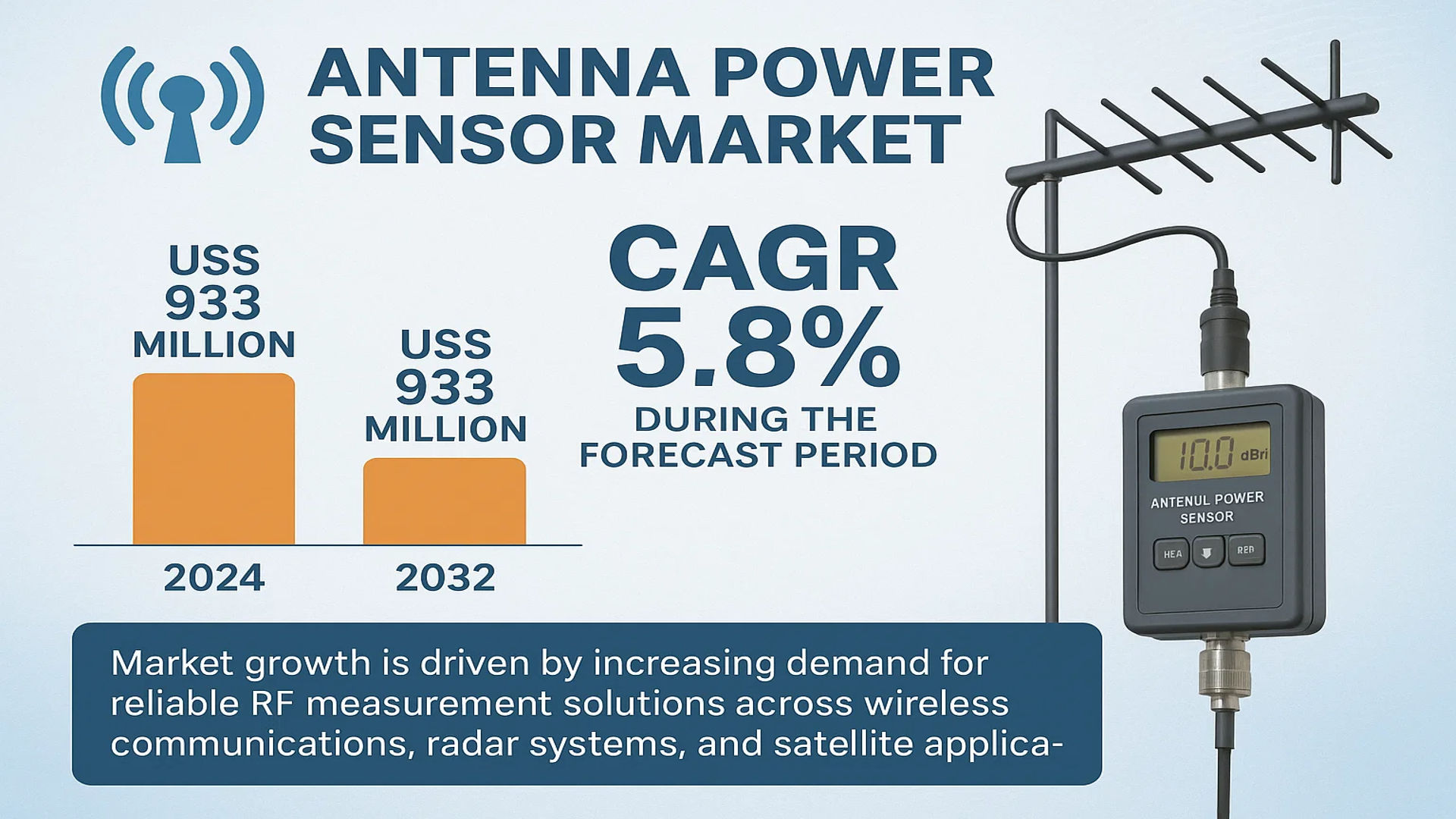
The global Antenna Power Sensor Market was valued at 631 million in 2024 and is projected to reach US$ 933 million by 2032, at a CAGR of 5.8% during the forecast period.
Antenna power sensors are precision instruments designed to measure the radio frequency (RF) power transmitted or received by antennas. These devices play a critical role in converting electromagnetic signal power into quantifiable electrical signals, enabling accurate monitoring and optimization of wireless systems. Common types include thermocouple-based, thermistor-based, and diode-based sensors, each offering distinct advantages in terms of accuracy, frequency range, and thermal stability.
The market growth is driven by increasing demand for reliable RF measurement solutions across wireless communications, radar systems, and satellite applications. While North America leads in market share due to advanced military and aerospace applications, Asia-Pacific is emerging as a high-growth region because of rapid 5G deployment. Key players such as Keysight Technologies, Rohde & Schwarz, and Anritsu dominate the competitive landscape, collectively holding over 45% of the 2024 market revenue. Recent advancements in broadband sensor technology and the integration of IoT capabilities are further expanding market opportunities.
MARKET DYNAMICS
MARKET DRIVERS
Rapid Expansion of 5G Networks Accelerating Antenna Power Sensor Demand
The global rollout of 5G technology continues at an unprecedented pace, with over 300 commercially deployed 5G networks worldwide as of 2024. This expansion directly fuels demand for antenna power sensors, as 5G’s higher frequency bands and complex antenna systems require precise power measurement capabilities. Network operators must maintain strict power control to ensure signal integrity while meeting regulatory requirements. The millimeter wave spectrum used in 5G particularly benefits from specialized power sensors that can handle frequencies up to 100 GHz with minimal measurement uncertainty—a capability becoming standard for modern antenna power measurement systems.
Military Modernization Programs Boosting Adoption of Advanced Measurement Solutions
Defense sectors across major economies are investing heavily in electronic warfare and radar modernization, with global military radar spending projected to exceed $16 billion annually by 2026. Antenna power sensors play a critical role in these systems, ensuring proper electromagnetic pulse shaping and directional accuracy. Modern military applications demand ruggedized sensors that can operate in extreme environments while maintaining ±0.5 dB measurement accuracy. This precision requirement is driving investments in advanced calibration technologies and multi-band power sensing capabilities across defense applications.
Satellite Communications Evolution Creating New Measurement Requirements
The satellite communication sector is undergoing transformation through low Earth orbit (LEO) constellations and high-throughput satellites, with over 5,000 active satellites currently in orbit. Ground station operators and satellite manufacturers increasingly require antenna power sensors capable of measuring ultra-wide bandwidth signals with fast response times. The growing adoption of flexible payload technology in satellites further emphasizes the need for power sensors with real-time monitoring capabilities. These technological shifts create opportunities for sensor manufacturers to develop specialized products for space applications, where reliability and measurement consistency are paramount.
MARKET RESTRAINTS
High Equipment Costs and Budget Constraints Limiting Market Penetration
Premium antenna power sensors incorporating cutting-edge measurement technologies can command prices exceeding $15,000 per unit, creating adoption barriers for cost-sensitive users. While telecommunications operators and defense contractors can justify these investments, many smaller enterprises and research institutions find the capital expenditure prohibitive. The situation is exacerbated in developing markets where currency fluctuations and import duties further inflate equipment costs. This pricing dynamic creates a two-tier market where high-end users benefit from advanced capabilities while others continue using older, less accurate measurement solutions.
Increasing Complexity of Measurement Scenarios Posing Technical Challenges
Contemporary RF systems now frequently combine multiple modulation schemes, wide instantaneous bandwidths, and dynamic power control—characteristics that challenge conventional power measurement approaches. The industry reports that signal analysis accuracy degrades by 15-20% when measuring modern waveforms compared to traditional continuous wave signals. Sensor manufacturers must invest substantially in digital signal processing algorithms and hardware filtering to maintain measurement integrity. These technical hurdles slow product development cycles and increase research costs, potentially limiting the pace of market innovation.
Regulatory Compliance Burdens Adding Implementation Friction
Globally fragmented electromagnetic spectrum regulations require antenna power sensors to meet diverse certification standards across different jurisdictions. The certification process for a single sensor model can take 6-12 months and cost upwards of $50,000 when accounting for testing and documentation. This regulatory complexity discourages manufacturers from offering region-specific product variations, potentially limiting functionality for certain markets. Furthermore, evolving standards around RF exposure safety continue to modify permissible power measurement tolerances, requiring periodic hardware and software updates to maintain compliance.
MARKET OPPORTUNITIES
Emergence of AI-Powered Predictive Maintenance Creating New Application Areas
The integration of artificial intelligence with antenna power monitoring presents transformative potential for infrastructure management. Intelligent power sensors capable of predictive analysis could reduce base station maintenance costs by up to 30% by identifying degradation patterns before failure occurs. Telecom operators increasingly recognize the value of continuous power monitoring as they transition to open RAN architectures, where standardized interfaces allow for enhanced sensor integration. This trend is creating demand for power sensors with onboard analytics capabilities rather than simple measurement functionality.
Automotive Radar Development Opening New Measurement Requirements
Advanced driver assistance systems (ADAS) and autonomous vehicle development rely heavily on millimeter-wave radar operating at 77-81 GHz. The automotive sector’s stringent reliability requirements create opportunities for specialized antenna power sensors that can perform in-vehicle measurements with automotive-grade environmental resilience. With over 50 million automotive radar units expected to ship annually by 2026, sensor manufacturers have begun developing compact, automotive-qualified power measurement solutions specifically for this high-growth segment.
Expanding Satellite Internet Services Driving Ground Equipment Demand
The proliferation of satellite internet constellations requires extensive ground infrastructure, with estimates suggesting over 50,000 new VSAT terminals will be deployed annually by commercial providers. Each terminal requires precise antenna power calibration to maintain optimal link budgets against moving satellites. This creates substantial demand for field-portable power sensors designed specifically for phased array antenna alignment and power verification. Manufacturers addressing this niche can capitalize on the recurring need for measurement equipment as constellation operators continuously expand and upgrade their ground networks.
MARKET CHALLENGES
Intense Competition from Alternative Measurement Technologies
Traditional antenna power sensors face competitive pressure from emerging measurement approaches, particularly integrated monitoring solutions that combine power measurement with other RF parameters. Some system manufacturers are incorporating power sensing directly into active antenna elements, bypassing standalone sensor needs. Additionally, software-defined radio platforms increasingly offer power measurement capabilities that, while less precise, satisfy basic monitoring requirements at lower cost. This technology convergence requires dedicated power sensor manufacturers to continuously differentiate their value proposition through superior accuracy or specialized measurement capabilities.
Supply Chain Vulnerabilities for Precision Components
The antenna power sensor industry relies on specialized semiconductors and RF components with limited global production capacity. Single-source dependencies for critical detector diodes and microwave integrated circuits create supply chain risks, with lead times for certain components extending beyond 52 weeks. These constraints delay product deliveries and complicate inventory management, particularly for sensors targeting higher frequency ranges where component alternatives are scarce. Manufacturers must balance dual-sourcing strategies with the technical challenges of qualifying alternative components without compromising measurement accuracy.
Shortage of RF Measurement Specialists Constraining Market Growth
The growing complexity of antenna systems has created a widening skills gap in RF measurement practices. Industry surveys indicate that 40% of organizations face difficulties finding personnel qualified to operate advanced power measurement equipment effectively. This talent shortage limits adoption of sophisticated power sensor capabilities, as many end-users struggle to fully utilize available features. Sensor manufacturers must consequently invest more heavily in training programs and intuitive user interfaces to make advanced functionality accessible to less specialized operators, adding to product development costs.
ANTENNA POWER SENSOR MARKET TRENDS
5G Network Expansion Driving Demand for High-Accuracy Sensors
The global rollout of 5G networks is significantly boosting the antenna power sensor market, as these systems require precise power measurement for optimal performance. With telecom operators investing heavily in infrastructure modernization, the demand for advanced RF testing equipment has surged. The antenna power sensor market is projected to grow at a CAGR of 5.8%, reaching $933 million by 2032, with wireless communications being the largest application segment. Additionally, the increasing adoption of millimeter-wave frequencies in 5G networks demands sensors capable of handling higher frequencies with minimal signal loss.
Other Trends
Miniaturization and Portability in Sensor Design
Manufacturers are increasingly focusing on compact and portable antenna power sensors to cater to field-testing applications in defense and satellite communications. Key players like Keysight Technologies and Rohde & Schwarz have introduced lightweight, battery-operated sensors with enhanced real-time data logging capabilities. This aligns with the rising demand for handheld testing instruments in electronic warfare and aerospace applications, where mobility and quick setup are crucial.
Integration of Smart Technologies in Power Sensing Systems
The antenna power sensor market is witnessing increased adoption of AI-based predictive analytics and IoT-enabled monitoring. Modern sensors now incorporate features like automated calibration, remote diagnostics, and cloud-based data storage to improve reliability. The thermocouple segment, expected to grow steadily through 2032, benefits from these smart capabilities, particularly in industrial and military applications where precise thermal management is essential. Furthermore, the integration of advanced DSP (digital signal processing) in diode-based sensors enhances measurement accuracy in high-frequency radar systems.
Growing Demand from Aerospace & Defense Applications
The aerospace and defense sector remains a key growth driver due to extensive usage in radar, electronic warfare, and satellite communication systems. Governments worldwide are increasing defense budgets, with the U.S. accounting for a significant share of the antenna power sensor market. Recent geopolitical tensions have accelerated the need for reliable RF power measurement in military communications, further fueling advancements in ruggedized, high-precision sensor solutions.
COMPETITIVE LANDSCAPE
Key Industry Players
Innovation and Precision Drive Market Leadership in Antenna Power Sensors
The global antenna power sensor market exhibits a moderately competitive landscape, characterized by a mix of established multinational corporations and specialized regional players. Keysight Technologies emerges as a dominant force in the sector, leveraging its extensive R&D capabilities and comprehensive product portfolio that serves critical applications in wireless communications and defense systems. The company accounted for approximately 22% of global revenue share in 2024, according to market analysis.
Rohde & Schwarz and Anritsu maintain strong positions in the market, particularly in Europe and Asia-Pacific, where their high-accuracy sensors are widely adopted for 5G network testing and satellite communication applications. These companies have accelerated innovation cycles, with Anritsu launching three new precision sensor models in Q1 2024 alone.
The market has seen increasing competition from Chinese manufacturers like Shenzhen Odyssey Precision Instruments and Chengdu Tianyi Measurement, who are gaining traction through competitive pricing and rapid customization capabilities. While these regional players currently hold smaller market shares, their aggressive expansion strategies could reshape the competitive dynamics in coming years.
Strategic alliances are becoming a key differentiator, with Bird Technologies recently partnering with a major defense contractor to develop specialized sensor solutions for electronic warfare applications. Meanwhile, Teledyne Technologies continues to strengthen its market position through targeted acquisitions, having purchased two sensor specialty firms since 2022.
List of Key Antenna Power Sensor Companies Profiled
- Keysight Technologies (U.S.)
- Rohde & Schwarz (Germany)
- Anritsu Corporation (Japan)
- Bird Technologies (U.S.)
- Teledyne Technologies (U.S.)
- Giga-tronics (U.S.)
- LadyBug Technologies (U.S.)
- Berkeley Nucleonics (U.S.)
- Boonton Electronics (U.S.)
- Shenzhen Odyssey Precision Instruments (China)
- Chengdu Tianyi Measurement and Control Technology (China)
- Dongguan Junjia Technology (China)
As the market approaches the $1 billion threshold, competitive intensity is expected to increase, particularly in the thermocouple sensor segment which shows the highest growth potential. Companies are focusing on developing solutions with broader frequency ranges and higher accuracy to meet evolving 6G and quantum communication requirements.
Segment Analysis:
By Type
Thermocouple Segment Leads Due to High Precision and Wide Frequency Range
The global antenna power sensor market is segmented based on technology type into:
- Thermocouple
- Thermistor
- Diode
- Others
By Application
Wireless Communications Segment Dominates with Increasing 5G Deployment
The market is segmented based on application areas into:
- Wireless Communications
- Radar and Electronic Warfare
- Satellite Communications
- Others
By Frequency Range
High Frequency Range Segment Captures Significant Market Share
The antenna power sensor market is classified by frequency capability:
- Low Frequency (Below 1 GHz)
- Medium Frequency (1-6 GHz)
- High Frequency (Above 6 GHz)
By End-User
Telecommunication Sector Holds Major Market Position
The market is categorized by end-use industries:
- Telecommunication Companies
- Defense and Aerospace
- Research and Development Organizations
- Satellite Service Providers
- Others
Regional Analysis: Antenna Power Sensor Market
North America
The North American antenna power sensor market is driven by robust investments in wireless communication infrastructure and defense modernization programs. With the U.S. leading the region, significant demand comes from 5G network deployments, where antenna power sensors play a critical role in signal monitoring. In 2024, a substantial portion of the allocated $42 billion from the U.S. Broadband Equity, Access, and Deployment (BEAD) Program is expected to fuel 5G expansion, creating sustained demand. Key players like Keysight Technologies and Teledyne Technologies maintain strong market positions by offering high-precision sensors for aerospace and telecommunications applications. Stringent FCC regulations further drive innovation toward compliant, interference-free sensor solutions.
Asia-Pacific
As the fastest-growing market, Asia-Pacific dominates global antenna power sensor consumption, primarily due to China’s extensive 5G rollout and India’s expanding satellite communication sector. China alone accounts for over 35% of global 5G base stations, necessitating precise power measurement tools from domestic manufacturers like Shenzhen Odyssey Precision Instruments. Meanwhile, rising defense budgets in India and Japan amplify demand for radar and electronic warfare applications, where sensor accuracy is paramount. Despite cost sensitivity favoring local suppliers, multinational corporations are increasing investments to capitalize on this high-growth region, particularly in Southeast Asia’s emerging telecom markets.
Europe
Europe’s market thrives on its well-established aerospace sector and stringent RF emission standards under EU directives. Countries like Germany and France lead in R&D for advanced antenna power sensors, with companies such as Rohde & Schwarz focusing on modular and IoT-compatible designs. The region’s emphasis on satellite navigation systems (e.g., Galileo program) and renewable energy infrastructure also contributes to steady demand. However, slower 5G adoption compared to Asia and North America tempers growth, pushing manufacturers to diversify into niche industrial and automotive radar applications.
Middle East & Africa
This region shows promising but uneven growth, spearheaded by Gulf nations investing in smart city projects and military modernization. The UAE and Saudi Arabia are key markets, leveraging antenna power sensors for large-scale telecom deployments and边境监控 systems. While limited local manufacturing capabilities create reliance on imports, partnerships with global firms are emerging to address infrastructure gaps. Africa’s growth remains nascent, hindered by funding constraints, though undersea cable projects and mobile network expansions present long-term opportunities.
South America
Market progress in South America is gradual, with Brazil and Argentina leading demand for antenna sensors in broadcast and amateur radio sectors. Economic volatility and fragmented regulatory frameworks slow large-scale adoption, although Brazil’s Plano Nacional de Banda Larga (National Broadband Plan) offers some stimulus. Most sensors are imported, but local assembly initiatives are gaining traction to curb costs. The region’s potential hinges on political stability enabling sustained telecom and defense investments.
Report Scope
This market research report provides a comprehensive analysis of the global Antenna Power Sensor market, covering the forecast period 2024–2032. It offers detailed insights into market dynamics, technological advancements, competitive landscape, and key trends shaping the industry.
Key focus areas of the report include:
- Market Size & Forecast: Historical data and future projections for revenue, unit shipments, and market value across major regions and segments. The global Antenna Power Sensor market was valued at USD 631 million in 2024 and is projected to reach USD 933 million by 2032, growing at a CAGR of 5.8%.
- Segmentation Analysis: Detailed breakdown by product type (thermocouple, thermistor, diode, others), application (wireless communications, radar & electronic warfare, satellite communications), and end-user industry to identify high-growth segments.
- Regional Outlook: Insights into market performance across North America, Europe, Asia-Pacific, Latin America, and Middle East & Africa. The U.S. and China are key markets, with Asia-Pacific showing the fastest growth.
- Competitive Landscape: Profiles of leading market participants including Keysight Technologies, Rohde & Schwarz, Anritsu, Bird Technologies, and Teledyne Technologies, covering their product portfolios, market share, and strategic developments.
- Technology Trends & Innovation: Assessment of emerging measurement technologies, integration with IoT systems, and advancements in RF power measurement accuracy.
- Market Drivers & Restraints: Evaluation of factors such as growing 5G deployment, defense spending increases, and challenges like component shortages and technical complexity.
- Stakeholder Analysis: Insights for test equipment manufacturers, defense contractors, telecom operators, and investors regarding market opportunities.
The report employs primary and secondary research methods, including expert interviews and verified market data, to ensure accuracy and reliability.
FREQUENTLY ASKED QUESTIONS:
What is the current market size of Global Antenna Power Sensor Market?
-> Antenna Power Sensor Market was valued at 631 million in 2024 and is projected to reach US$ 933 million by 2032, at a CAGR of 5.8% during the forecast period.
Which key companies operate in Global Antenna Power Sensor Market?
-> Key players include Keysight Technologies, Rohde & Schwarz, Anritsu, Bird Technologies, Teledyne Technologies, Giga-tronics, and LadyBug Technologies.
What are the key growth drivers?
-> Growth is driven by 5G network expansion, increasing defense budgets, satellite communication growth, and rising demand for accurate RF power measurement.
Which region dominates the market?
-> North America currently leads the market, while Asia-Pacific is expected to show the highest growth rate during the forecast period.
What are the emerging trends?
-> Emerging trends include miniaturization of sensors, higher frequency capabilities, integration with IoT platforms, and AI-powered predictive maintenance.

Get Sample Report PDF for Exclusive Insights
Report Sample Includes
- Table of Contents
- List of Tables & Figures
- Charts, Research Methodology, and more...