MARKET INSIGHTS
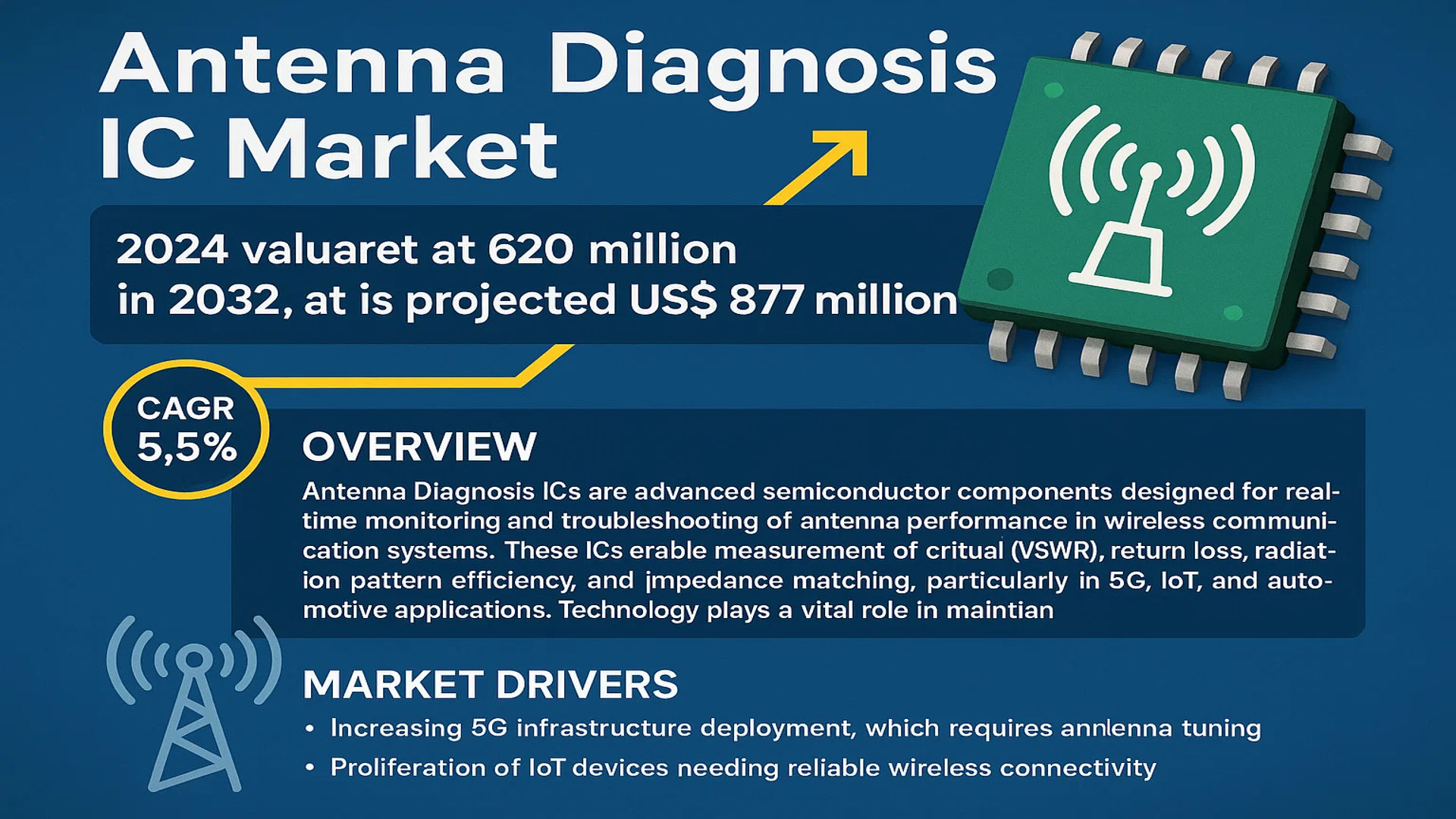
The global Antenna Diagnosis IC Market was valued at 620 million in 2024 and is projected to reach US$ 877 million by 2032, at a CAGR of 5.5% during the forecast period.
Antenna Diagnosis ICs are advanced semiconductor components designed for real-time monitoring and troubleshooting of antenna performance in wireless communication systems. These integrated circuits enable measurement of critical parameters such as standing wave ratio (VSWR), return loss, radiation pattern efficiency, and impedance matching, particularly in 5G, IoT, and automotive applications. The technology plays a vital role in maintaining optimal signal integrity across diverse wireless platforms.
The market growth is driven by increasing 5G infrastructure deployment, which requires precise antenna tuning, and the proliferation of IoT devices needing reliable wireless connectivity. However, design complexity and lack of standardization pose challenges. Key players like Texas Instruments and Infineon Technologies are innovating with AI-enabled diagnostic solutions, while the automotive sector emerges as a high-growth segment due to rising adoption of V2X communication systems.
MARKET DYNAMICS
MARKET DRIVERS
Global 5G Rollout Accelerates Demand for Precise Antenna Diagnostics
The rapid deployment of 5G networks worldwide is significantly propelling the antenna diagnosis IC market forward. As 5G networks require highly efficient antenna systems capable of handling millimeter-wave frequencies, the need for real-time performance monitoring has become paramount. Carriers are investing heavily in network optimization solutions to ensure seamless connectivity, with antenna diagnostic ICs playing a crucial role in maintaining signal quality. The complexity of massive MIMO (Multiple Input Multiple Output) antenna arrays used in 5G infrastructure further amplifies the importance of these specialized integrated circuits.
Expansion of IoT Ecosystems Creates New Application Areas
The proliferation of IoT devices across multiple sectors is generating substantial demand for compact, low-power antenna diagnostic solutions. Smart city implementations alone are projected to deploy millions of connected sensors by 2032, each requiring reliable wireless connectivity. Antenna diagnosis ICs enable predictive maintenance of these devices through continuous performance monitoring, reducing costly field repairs. Automotive applications are particularly promising, with modern vehicles incorporating dozens of antennas for navigation, telematics, and vehicle-to-everything (V2X) communications.
Industrial IoT applications present another growth frontier, where antenna diagnostics help maintain critical communication links in harsh manufacturing environments. The ability to detect and compensate for antenna performance degradation before system failures occur provides significant value in mission-critical applications.
MARKET RESTRAINTS
High Development Costs Limit Market Penetration
Despite strong demand, the antenna diagnosis IC market faces significant barriers due to high research and development costs. Designing chips capable of accurately measuring complex RF parameters across multiple frequency bands requires specialized expertise and sophisticated simulation tools. The semiconductor shortage has further exacerbated cost pressures, particularly for components requiring advanced node processes. These economic factors make product development challenging for smaller players and potentially slow innovation in the sector.
Manufacturing complexities represent another substantial hurdle, as antenna diagnosis ICs must maintain precise calibration while operating in variable environmental conditions. Achieving the necessary performance specifications often requires expensive testing equipment and specialized packaging solutions that increase production costs. These technical and financial barriers may restrict adoption among cost-sensitive applications and limit market expansion in developing regions.
MARKET CHALLENGES
Integration Complexity with Diverse Antenna Architectures
The growing diversity of antenna designs presents significant technical challenges for diagnosis IC manufacturers. Modern wireless systems increasingly employ sophisticated architectures including phased arrays, metamaterial antennas, and reconfigurable designs, each with unique interface requirements. Developing compatible diagnostic solutions that can adequately monitor these varied antenna types requires extensive customization, slowing time-to-market and increasing development costs.
Other Challenges
Standardization Gaps
The absence of universal standards for antenna diagnostic interfaces complicates product development and implementation. Different manufacturers utilize varying communication protocols and measurement methodologies, forcing IC designers to accommodate multiple standards or develop application-specific solutions. This fragmentation increases engineering overhead and may delay industry-wide adoption of advanced diagnostic capabilities.
Power Consumption Constraints
Energy efficiency requirements create additional challenges for implementing comprehensive antenna diagnostic features in battery-powered devices. Continuous monitoring operations must balance extensive diagnostic capabilities with strict power budgets, often requiring trade-offs between measurement accuracy and longevity. These constraints are particularly acute in IoT applications where devices are expected to operate for years on small batteries.
MARKET OPPORTUNITIES
AI Integration Creates New Value Propositions
The convergence of antenna diagnosis ICs with artificial intelligence presents transformative opportunities for the market. Machine learning algorithms can leverage real-time diagnostic data to predict antenna degradation patterns and optimize system performance adaptively. This predictive maintenance capability is particularly valuable in automotive and industrial applications where unexpected communication failures can have significant consequences. AI-enhanced diagnostic solutions may command premium pricing while delivering measurable operational benefits to end users.
Satellite communication represents another promising growth avenue, as next-generation constellations require sophisticated antenna monitoring solutions. The commercial space sector’s expansion is driving demand for reliable ground station and satellite terminal components, including advanced diagnostic capabilities. Antenna diagnosis ICs capable of handling the unique challenges of satellite links (such as Doppler compensation and beam steering verification) could capture substantial market share in this high-value segment.
Partnerships between semiconductor companies and system integrators are accelerating product innovation in this space. Recent collaborations have demonstrated how integrated antenna diagnostic solutions can reduce total system costs while improving reliability. These strategic alliances help bridge the gap between component-level technologies and complete system implementations, creating new business models across the value chain.
ANTENNA DIAGNOSIS IC MARKET TRENDS
5G and IoT Expansion Accelerates Demand for Antenna Diagnosis ICs
The global deployment of 5G networks and the rapid proliferation of IoT devices have significantly increased the need for antenna performance optimization, driving the adoption of antenna diagnosis ICs. These ICs enable real-time monitoring of critical antenna parameters such as voltage standing wave ratio (VSWR) and return loss, ensuring optimal signal transmission in high-frequency 5G environments. With over 1.3 billion 5G subscribers projected by 2024, the demand for precise antenna diagnostics has become crucial for maintaining network efficiency. Furthermore, the growing complexity of MIMO and beamforming technologies in 5G infrastructure necessitates advanced diagnostic solutions to minimize signal interference and maximize coverage.
Other Trends
Integration with AI for Predictive Maintenance
Manufacturers are increasingly incorporating artificial intelligence algorithms into antenna diagnosis ICs to enable predictive maintenance and fault detection. These smart ICs analyze historical performance data to predict potential antenna degradation before failures occur, reducing downtime in critical applications like autonomous vehicles and industrial IoT. This trend aligns with the broader shift toward condition-based monitoring in wireless systems, where proactive maintenance can significantly lower operational costs. The automotive sector, in particular, is adopting these solutions for vehicle-to-everything (V2X) communication systems that require continuous antenna performance verification.
Miniaturization and Power Efficiency Innovations
The push for smaller, more energy-efficient wireless devices is driving innovation in antenna diagnosis IC design. Recent advancements have produced ICs that combine multiple diagnostic functions into single-chip solutions while consuming less than 10mW of power, making them ideal for battery-operated IoT devices. This miniaturization trend is particularly important for wearable technology and smart sensors where space constraints limit antenna size and placement options. Additionally, the development of wideband diagnostic ICs capable of covering multiple frequency ranges from sub-6GHz to millimeter wave bands addresses the growing need for versatile solutions in heterogeneous network environments. While these innovations create new opportunities, they also increase design complexity and raise development costs for semiconductor manufacturers.
COMPETITIVE LANDSCAPE
Key Industry Players
Semiconductor Leaders Accelerate Innovation to Dominate the Antenna Diagnosis IC Market
The global antenna diagnosis IC market features a dynamic competitive environment, with established semiconductor giants and emerging specialists vying for market share. Texas Instruments and Infineon Technologies currently lead the sector, leveraging their extensive RF semiconductor expertise and widespread manufacturing capabilities. Texas Instruments’ recent 5G-optimized antenna diagnostic solutions have particularly strengthened its position in automotive and telecom applications.
NXP Semiconductors has emerged as another key player, with its focus on AI-integrated antenna diagnostic ICs for smart city infrastructure and industrial IoT applications. The company’s partnerships with major automotive OEMs have given it significant traction in vehicle-to-everything (V2X) communication systems. Meanwhile, STMicroelectronics has gained market share through its energy-efficient chips designed for battery-powered IoT devices.
These leading companies are actively expanding their portfolios through both organic R&D and strategic acquisitions. For instance, Infineon’s acquisition of Cypress Semiconductor in 2020 enhanced its capabilities in connected device technologies, while Qorvo’s ongoing investments in millimeter-wave solutions position it strongly for future 5G infrastructure demands.
The market also sees strong competition from specialized players like ABLIC and Elmos Semiconductor, who focus on niche applications such as medical devices and precision industrial equipment. These companies compete through customization capabilities and rapid prototyping services that larger players often cannot match.
List of Key Antenna Diagnosis IC Manufacturers
- Texas Instruments (U.S.)
- Infineon Technologies (Germany)
- NXP Semiconductors (Netherlands)
- STMicroelectronics (Switzerland)
- Qorvo (U.S.)
- ABLIC (Japan)
- Microchip Technology (U.S.)
- Elmos Semiconductor (Germany)
- EM Microelectronic (Switzerland)
- YITOA Micro Technology (China)
Segment Analysis:
By Type
Single Channel Antenna Diagnosis IC Leads Due to Cost-Effectiveness and Wide Compatibility
The market is segmented based on type into:
- Single Channel
- Dual Channel
By Application
Automotive Segment Dominates with Increasing Integration in Connected Vehicles and ADAS
The market is segmented based on application into:
- Automotive
- Subtypes: Connected vehicles, ADAS, V2X communication
- Construction Sector
- Subtypes: IoT-based monitoring systems, Smart infrastructure
- Industrial IoT
- Subtypes: Smart manufacturing, Robotics, Automation
- Telecommunications
- Subtypes: 5G infrastructure, Base stations, Small cells
- Others
By Technology
MIMO-Based Solutions Gain Traction for Enhanced Signal Processing in 5G Networks
The market is segmented based on technology into:
- MIMO (Multiple Input Multiple Output)
- Beamforming
- VSWR Measurement
- Impedance Matching
- Others
By Frequency Range
Sub-6 GHz Segment Remains Dominant While mmWave Applications Show Rapid Growth
The market is segmented based on frequency range into:
- Sub-6 GHz
- mmWave (24-100 GHz)
- HF/UHF (3-30 MHz/300 MHz-3 GHz)
- Others
Regional Analysis: Antenna Diagnosis IC Market
Asia-Pacific
The Asia-Pacific region, led by China, Japan, and South Korea, dominates the global antenna diagnosis IC market due to rapid 5G deployment, widespread IoT adoption, and strong semiconductor manufacturing ecosystems. China alone accounts for over 35% of global demand, driven by aggressive infrastructure investments by Huawei and other telecom equipment suppliers. Meanwhile, Japan’s precision engineering expertise underpins high-end IC production for automotive and industrial applications. While cost sensitivity remains a challenge in emerging markets like India, increased R&D partnerships between local firms and multinationals are accelerating technology adoption across the region. The expanding smart city initiatives further amplify the need for reliable antenna monitoring solutions.
North America
North America’s advanced 5G infrastructure and stringent FCC performance standards create strong demand for sophisticated antenna diagnostic solutions. The U.S. market benefits from concentrated R&D investments by semiconductor leaders like Texas Instruments and Qorvo, particularly in beamforming and millimeter-wave applications. Defense and aerospace sectors also contribute significantly to regional growth, given their need for mission-critical RF monitoring systems. However, complex certification processes and supply chain dependencies on Asian foundries occasionally disrupt market stability. The growing emphasis on V2X communication for autonomous vehicles presents new opportunities for integrated antenna diagnostic solutions.
Europe
European demand is characterized by stringent ETSI regulations and focus on energy-efficient IC designs. Germany’s automotive sector and France’s telecom industry drive innovation in antenna fault detection, particularly for industrial IoT applications. The EU’s Horizon Europe program has allocated substantial funding for next-generation RF technologies, supporting local manufacturers like Infineon and STMicroelectronics. However, market fragmentation across diverse national standards and slower 5G rollout compared to Asia temper growth prospects. Recent collaborations between academic institutions and chipmakers aim to bridge this gap through standardized testing protocols.
Middle East & Africa
This emerging market shows promising growth in GCC countries where smart city projects and oil/gas infrastructure modernization programs are creating niche opportunities. The UAE’s focus on becoming a 5G leader in the region has spurred demand for antenna monitoring solutions, though overall adoption remains constrained by limited local manufacturing capabilities. South Africa serves as an emerging hub for telecommunications infrastructure, with gradual uptake of diagnostic ICs in mining and logistics sectors. The region’s growth trajectory is uneven but demonstrates long-term potential as digital transformation accelerates.
South America
Market development in South America faces challenges from economic volatility and fragmented telecom regulations, though Brazil and Argentina show increasing interest in antenna diagnostic technologies for urban connectivity projects. The prevalence of legacy 4G networks delays widespread 5G adoption, consequently limiting immediate demand for advanced ICs. Local assembly of IoT devices and automotive electronics presents incremental growth opportunities, particularly as regional trade agreements facilitate technology transfers. Investment in satellite communication infrastructure may provide alternative growth avenues given the region’s geographical diversity.
Report Scope
This market research report provides a comprehensive analysis of the global and regional Antenna Diagnosis IC markets, covering the forecast period 2025–2032. It offers detailed insights into market dynamics, technological advancements, competitive landscape, and key trends shaping the industry.
Key focus areas of the report include:
- Market Size & Forecast: Historical data and future projections for revenue, unit shipments, and market value across major regions and segments.
- Segmentation Analysis: Detailed breakdown by product type, technology, application, and end-user industry to identify high-growth segments and investment opportunities.
- Regional Outlook: Insights into market performance across North America, Europe, Asia-Pacific, Latin America, and the Middle East & Africa, including country-level analysis where relevant.
- Competitive Landscape: Profiles of leading market participants, including their product offerings, R&D focus, manufacturing capacity, pricing strategies, and recent developments such as mergers, acquisitions, and partnerships.
- Technology Trends & Innovation: Assessment of emerging technologies, integration of AI/IoT, semiconductor design trends, fabrication techniques, and evolving industry standards.
- Market Drivers & Restraints: Evaluation of factors driving market growth along with challenges, supply chain constraints, regulatory issues, and market-entry barriers.
- Stakeholder Analysis: Insights for component suppliers, OEMs, system integrators, investors, and policymakers regarding the evolving ecosystem and strategic opportunities.
Primary and secondary research methods are employed, including interviews with industry experts, data from verified sources, and real-time market intelligence to ensure the accuracy and reliability of the insights presented.
FREQUENTLY ASKED QUESTIONS:
What is the current market size of Global Antenna Diagnosis IC Market?
-> Antenna Diagnosis IC Market was valued at 620 million in 2024 and is projected to reach US$ 877 million by 2032, at a CAGR of 5.5% during the forecast period.
Which key companies operate in Global Antenna Diagnosis IC Market?
-> Key players include ABLIC, Texas Instruments, Infineon Technologies, Microchip, YITOA Micro Technology, NXP Semiconductors, Elmos Semiconductor, STMicroelectronics, Qorvo, and EM Microelectronic.
What are the key growth drivers?
-> Key growth drivers include 5G network deployment, increasing IoT adoption, demand for automotive electronics, and advancements in smart manufacturing.
Which region dominates the market?
-> Asia-Pacific leads the market due to rapid industrialization and 5G adoption, while North America remains a significant player with strong R&D investments.
What are the emerging trends?
-> Emerging trends include AI-powered diagnostics, integration with MIMO technology, low-power IC designs, and applications in autonomous vehicles.

Get Sample Report PDF for Exclusive Insights
Report Sample Includes
- Table of Contents
- List of Tables & Figures
- Charts, Research Methodology, and more...
 Download Sample Report PDF