Precision Analog-to-Digital Converter Chip Market Insights
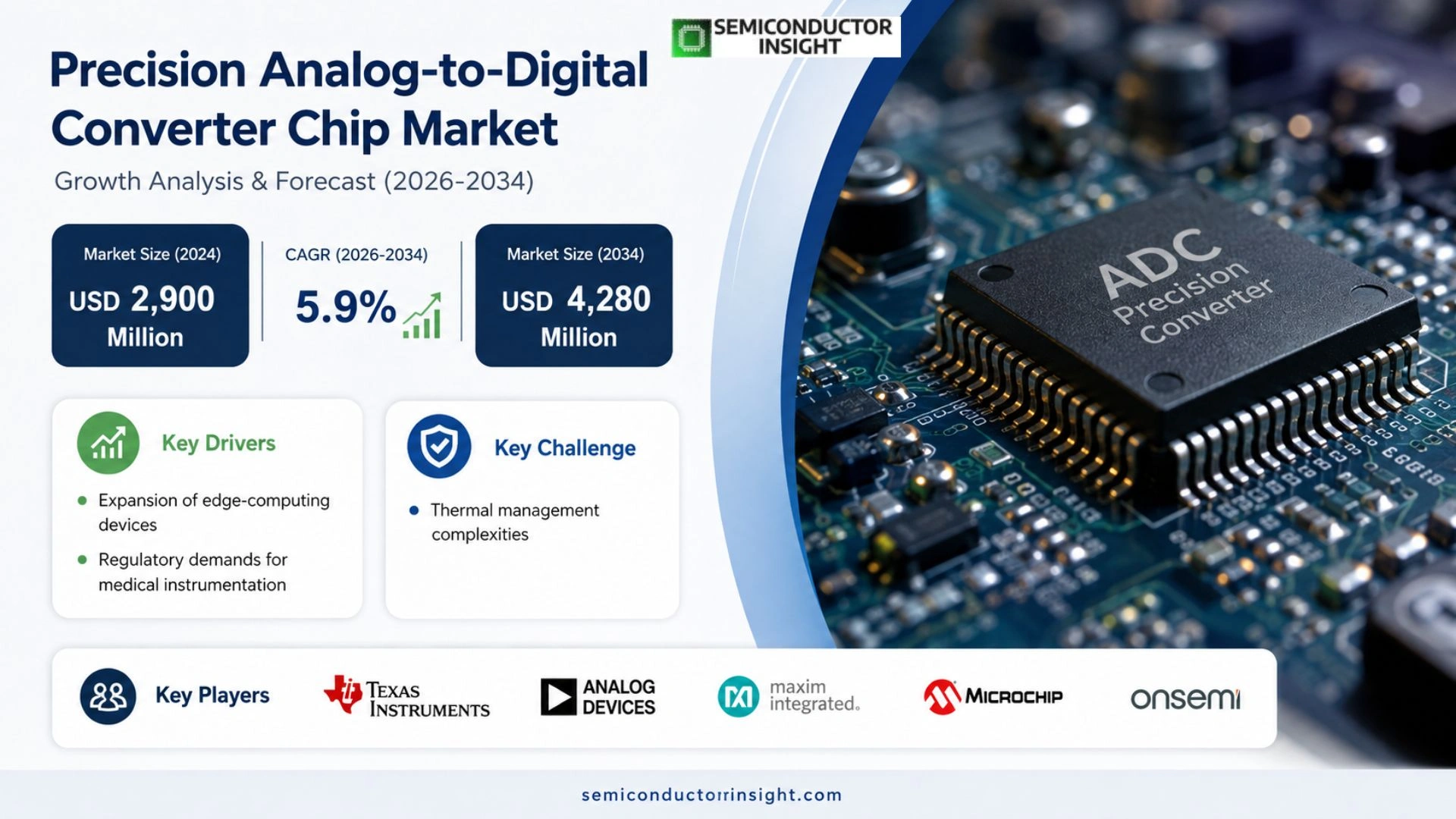
Precision Analog-to-Digital Converter Chip market was valued at USD 2,900 million in 2024 and is expected to reach USD 4,280 million by 2034, reflecting a CAGR of 5.9% over the forecast period.
Precision Analog-to-Digital Converter chips translate continuous analog signals into discrete digital codes with high resolution and low error rates, supporting applications such as medical imaging, automotive safety systems, industrial automation and consumer wearables.
The surge in IoT deployments, expanding demand for advanced driver‑assistance systems, and tighter power‑efficiency requirements are accelerating adoption. At the same time, advances in silicon‑on‑insulator processes enable higher sampling speeds while reducing energy draw, prompting leading suppliers,including ADI, Texas Instruments and STMicroelectronics,to broaden their precision ADC portfolios.
MARKET DRIVERS
Expansion of Edge‑Computing Devices
The surge in edge‑computing deployments across factories, smart‑city sensors and autonomous vehicles pushes designers to seek higher‑resolution digitisation. Precision Analog-to-Digital Converter Chip Market participants that can deliver sub‑microvolt noise floors are gaining preference because downstream signal‑processing chains depend on clean data to meet latency constraints.
Regulatory Demands for Medical Instrumentation
Stringent FDA and EU MDR guidelines for diagnostic equipment mandate quantifiable accuracy across the entire measurement range. Manufacturers therefore allocate a larger portion of bill‑of‑materials to ADCs that guarantee linearity and temperature stability, creating a tangible uplift in component orders.
➤ OEMs that integrate multi‑channel, low‑power converters can differentiate their platforms while trimming board‑space costs.
In addition, the rollout of 5G‑enabled infrastructure is prompting data‑center architects to redesign high‑speed acquisition modules. The need for converters that operate seamlessly at gigasample rates without sacrificing precision is translating into a steady influx of design wins for niche players.
MARKET CHALLENGES
Thermal Management Complexities
As converters push envelope sampling frequencies, dissipated power rises sharply. Engineers grapple with maintaining thermal uniformity, especially in densely packed modules where heat sinks add weight and cost. Failure to control temperature gradients can degrade linearity, forcing redesign cycles that erode time‑to‑market.
Other Challenges
Supply‑Chain Volatility
The semiconductor ecosystem is still wrestling with capacity constraints at foundries specialising in mixed‑signal processes. Limited wafer allocations mean that even well‑funded OEMs may encounter lead‑time extensions, prompting them to seek alternative qualification pathways or to stockpile critical parts.
MARKET RESTRAINTS
Cost Sensitivity in Consumer‑Grade Applications
While high‑end sectors prize precision, mass‑market products such as wearables and entry‑level IoT nodes remain highly price‑competitive. The premium associated with ADCs that deliver >16‑bit resolution can deter adoption, leading designers to opt for lower‑spec alternatives that satisfy only baseline requirements.
MARKET OPPORTUNITIES
Emerging AI‑Edge Inference Accelerators
AI inference at the edge relies on accurate sensor data to train lightweight models directly on devices. Companies that package ultra‑low‑latency, high‑resolution converters alongside integrated calibration routines are positioned to capture a growing slice of Precision Analog-to-Digital Converter Chip Market. Early collaborations with chipset vendors developing AI‑centric MCUs could unlock new revenue streams and differentiate product portfolios.
Precision Analog-to-Digital Converter Chip Market Trends
Shift Toward Integrated SAR Architectures
The market recorded revenue of roughly $2.9 billion in 2024 and is on track to exceed $4.2 billion by 2031. Growth is being fueled by the adoption of successive‑approximation register (SAR) designs that combine high resolution with low power consumption, a blend that matches the tightening energy budgets of edge devices. Designers are increasingly embedding SAR converters directly into mixed‑signal System‑on‑Chip (SoC) platforms to trim board‑level component counts and reduce signal‑path latency. This integration not only trims BOM costs but also accelerates time‑to‑market for IoT sensors, wearables, and portable medical instruments, creating a feedback loop that pushes silicon vendors to expand their SAR portfolios.
Other Trends
Automotive Power‑Management Demands
Electrified powertrains and advanced driver‑assistance systems (ADAS) rely on precise voltage regulation and rapid feedback loops, making high‑accuracy analog‑to‑digital conversion a safety‑critical function. The automotive segment now accounts for a double‑digit share of total shipments, with manufacturers favouring sigma‑delta converters for motor‑control loops and flash converters for ultra‑fast fault detection. Supply‑chain constraints in traditional discrete components are prompting OEMs to source integrated converter solutions that can survive harsh temperature cycles while delivering the resolution needed for torque‑vectoring algorithms. Consequently, tier‑one suppliers are negotiating long‑term contracts with chipmakers, reshaping the revenue mix toward higher‑margin automotive applications.
Emergence of AI‑Enabled Test Equipment
Artificial‑intelligence‑augmented measurement platforms are redefining how converter performance is validated during development. By coupling machine‑learning models with high‑speed digitizers, test rigs can predict non‑linear distortion patterns and suggest on‑chip calibration tweaks in real time. This capability shortens verification cycles, allowing design houses to iterate more aggressively and bring differentiated products to market faster. The ripple effect is a modest uplift in demand for conversion chips that support built‑in self‑test (BIST) features and programmable reference architectures, as customers seek to leverage the efficiency gains offered by AI‑driven validation workflows.
COMPETITIVE LANDSCAPE
Key Industry Players
Precision Analog-to-Digital Converter Chip Competitive Overview
Precision Analog-to-Digital Converter Chip market is anchored by a handful of large‑scale integrated‑circuit manufacturers whose product portfolios span SAR, sigma‑delta, and flash architectures. Analog Devices (ADI) commands the top‑tier share, leveraging its deep R&D pipeline and long‑standing patents to secure design wins in high‑performance instrumentation and aerospace sectors. Texas Instruments follows closely, exploiting its extensive analog foundry capacity and aggressive volume pricing to dominate automotive infotainment and industrial control applications. These two firms together shape pricing benchmarks and drive specification creep, compelling smaller competitors to specialize or partner with original equipment manufacturers (OEMs) for niche adoption. Their ability to offer end‑to‑end design‑in‑package solutions, from silicon to reference design, further entrenches their position and forces customers to prioritize ecosystem compatibility over marginal cost advantages.
Beyond the dominant duopoly, a constellation of midsize and specialist firms injects diversity into the competitive set. STMicroelectronics, ON Semiconductor, and Microchip Technology concentrate on automotive safety and IoT sensor front‑ends, where cost efficiency and low‑power operation outweigh raw performance. Renesas (through its Intersil legacy), Cirrus Logic, and Maxim Integrated focus on audio‑centric and consumer‑electronics converters, capitalizing on tight integration with digital signal processors. Xilinx, now under AMD, pursues programmable data‑converter blocks that appeal to accelerated computing and 5G infrastructure. Infineon Technologies and Skyworks Solutions carve out market share in power‑management and wireless‑link modules, respectively, by bundling ADCs with complementary analog functions. These players sustain innovation pressure on the market leaders, often introducing differentiated architectures such as pipelined SAR or hybrid sigma‑delta designs that address emerging application bottlenecks in automotive ADAS and edge‑AI deployments.
List of Key Precision Analog-to-Digital Converter Chip Companies Profiled
- Analog Devices, Texas Instruments, NXP Semiconductors, Renesas Electronics (Intersil), Maxim Integrated
- STMicroelectronics, ON Semiconductor, Microchip Technology
- Cirrus Logic, Xilinx (AMD), Infineon Technologies, Skyworks Solutions, Skyworks Solutions
Segment Analysis:
| Segment Category | Sub-Segments | Key Insights |
| By Type |
|
Sigma‑Delta Type continues to dominate precision applications because it delivers exceptional resolution and noise‑shaping capabilities.
|
| By Application |
|
Automotive emerges as the leading application segment, driven by the increasing integration of advanced driver‑assistance systems (ADAS) and electric‑vehicle power‑train control.
|
| By End User |
|
OEMs lead the end‑user landscape as they embed precision ADC chips directly into flagship products across sectors.
|
| By Architecture |
|
Delta‑Sigma is the preferred architecture for ultra‑high‑resolution needs, especially in precision measurement and medical instrumentation.
|
| By Performance Tier |
|
High‑Resolution dominates the performance‑tier discussion because modern applications increasingly require sub‑microvolt accuracy.
|
Regional Analysis: Precision Analog-to-Digital Converter Chip Market
North America
Engineers are layering digital calibration onto analog cores, allowing a single converter to serve multiple bandwidth regimes. This modularity cuts board‑level component count and accelerates platform convergence, a trend especially visible in IoT gateways where space is at a premium.
Foundries have instituted multi‑fab strategies to hedge against capacity shocks. Strategic inventory buffers for silicon wafers are now common, ensuring that contract manufacturers can meet the just‑in‑time schedules demanded by automotive OEMs.
Harmonized electromagnetic‑compatibility standards across the U.S. and Canada simplify certification pathways. Companies that embed compliance testing early in the design flow are gaining an edge in fast‑moving markets such as wearables and tele‑health.
Legacy silicon giants are leveraging extensive IP portfolios to bundle converters with signal‑processing blocks. At the same time, boutique firms differentiate through ultra‑low‑noise architectures aimed at niche scientific instrumentation, creating a bifurcated competitive landscape.
Europe
The European Union’s emphasis on green technology fuels adoption of precision converters in renewable‑energy inverters and smart‑grid nodes. Countries such as Germany and France incentivize firms that embed energy‑efficient analog front‑ends, prompting a shift toward sub‑microwatt power domains. Meanwhile, the automotive sector, anchored by stringent safety regulations, is pushing suppliers to certify converters for autonomous‑driving sensors. Cross‑border collaboration among research institutes accelerates the development of silicon‑photonic interfaces, a niche that could broaden Europe’s value chain beyond traditional silicon fabs.
Asia‑Pacific
Rapid growth in consumer electronics and 5G rollout across China, South Korea, and India drives volume demand for compact, high‑speed converters. OEMs in the region favor foundry partners that can offer quick design‑turnaround and localized support, leading to a proliferation of design‑service hubs. Government initiatives aimed at building semiconductor ecosystems are encouraging joint ventures that blend design expertise with mature process technology, thereby reducing reliance on external supply sources.
South America
Emerging automotive assembly plants in Brazil and Argentina create modest but steady demand for automotive‑grade converters. Local manufacturers are increasingly sourcing from North American suppliers to satisfy quality benchmarks, yet cost‑sensitivity drives a parallel interest in lower‑priced Asian alternatives. Limited R&D capacity means many firms rely on technology transfer agreements, positioning the region as a downstream assembler rather than a primary innovator.
Middle East & Africa
Investment in data‑center infrastructure and oil‑field monitoring systems fuels niche demand for high‑resolution converters that can operate under harsh environmental conditions. Countries such as the United Arab Emirates are launching technology parks that attract global fab partners, although the overall market remains small relative to other regions. Partnerships with European research entities are helping local firms adopt advanced calibration techniques, gradually elevating the technical competence of the regional supply base.
Report Scope
This market research report provides a comprehensive analysis of the Precision Analog-to-Digital Converter Chip Market , covering the forecast period 2026–2034. It offers detailed insights into market dynamics, technological advancements, competitive landscape, and key trends shaping the industry.
Key focus areas of the report include:
- Market Overview: The report begins with an overview outlining its current market scenario, key growth indicators, and industry transformation drivers. It discusses macroeconomic factors, demand–supply balance, regulatory landscape, and the strategic role of semiconductors in powering advancements across industries such as automotive, telecommunications, consumer electronics, and industrial automation.
- Market Size & Forecast: Historical data and future projections for revenue, unit shipments, and market value across major regions and segments.
- Segmentation Analysis: Detailed breakdown by product type, technology, application, and end-user industry to identify high-growth segments and investment opportunities.
- Regional Insights: Insights into market performance across North America, Europe, Asia-Pacific, Latin America, and the Middle East & Africa, including country-level analysis where relevant.
- Competitive Landscape: Profiles of leading market participants, including their product offerings, R&D focus, manufacturing capacity, pricing strategies, and recent developments such as mergers, acquisitions, and partnerships.
- Technology Trends & Innovation: Assessment of emerging technologies, integration of AI/IoT, semiconductor design trends, fabrication techniques, and evolving industry standards.
- Market Drivers & Restraints: Evaluation of factors driving market growth along with challenges, supply chain constraints, regulatory issues, and market-entry barriers.
- Stakeholder Insights: Insights for component suppliers, OEMs, system integrators, investors, and policymakers regarding the evolving ecosystem and strategic opportunities.
Primary and secondary research methods are employed, including interviews with industry experts, data from verified sources, and real-time market intelligence to ensure the accuracy and reliability of the insights presented.
FREQUENTLY ASKED QUESTIONS:
What is the current market size of Precision Analog-to-Digital Converter Chip Market?
-> Precision Analog-to-Digital Converter Chip Market was valued at USD 2,900 million in 2024 and is expected to reach USD 4,280 million by 2031, growing at a CAGR of 5.9% during the forecast period.
Which key companies operate in Precision Analog-to-Digital Converter Chip Market?
-> Key players include ADI, TI, Intersil (Renesas Electronics Corporation), STMicroelectronics, ON Semiconductor, Microchip, NXP, Cirrus Logic, Xilinx.
What are the key growth drivers?
-> Key growth drivers include rising demand for signal conversion, automotive-specific analog applications, power‑management solutions, and the expanding IoT ecosystem that fuels the need for high‑precision analog‑to‑digital conversion.
Which region dominates the market?
-> Asia‑Pacific leads the market, driven by strong semiconductor manufacturing bases, extensive consumer electronics production, and rapid adoption of automotive and industrial IoT solutions.
What are the emerging trends?
-> Emerging trends encompass enhanced signal‑conversion architectures, integration of AI/ML for adaptive calibration, automotive‑grade precision converters, and power‑efficient designs targeting edge‑computing and wearable devices.
Get Sample Report PDF for Exclusive Insights
Report Sample Includes
- Table of Contents
- List of Tables & Figures
- Charts, Research Methodology, and more...
 Download Sample Report PDF