Analog Pyroelectric Infrared Sensor Market Insights
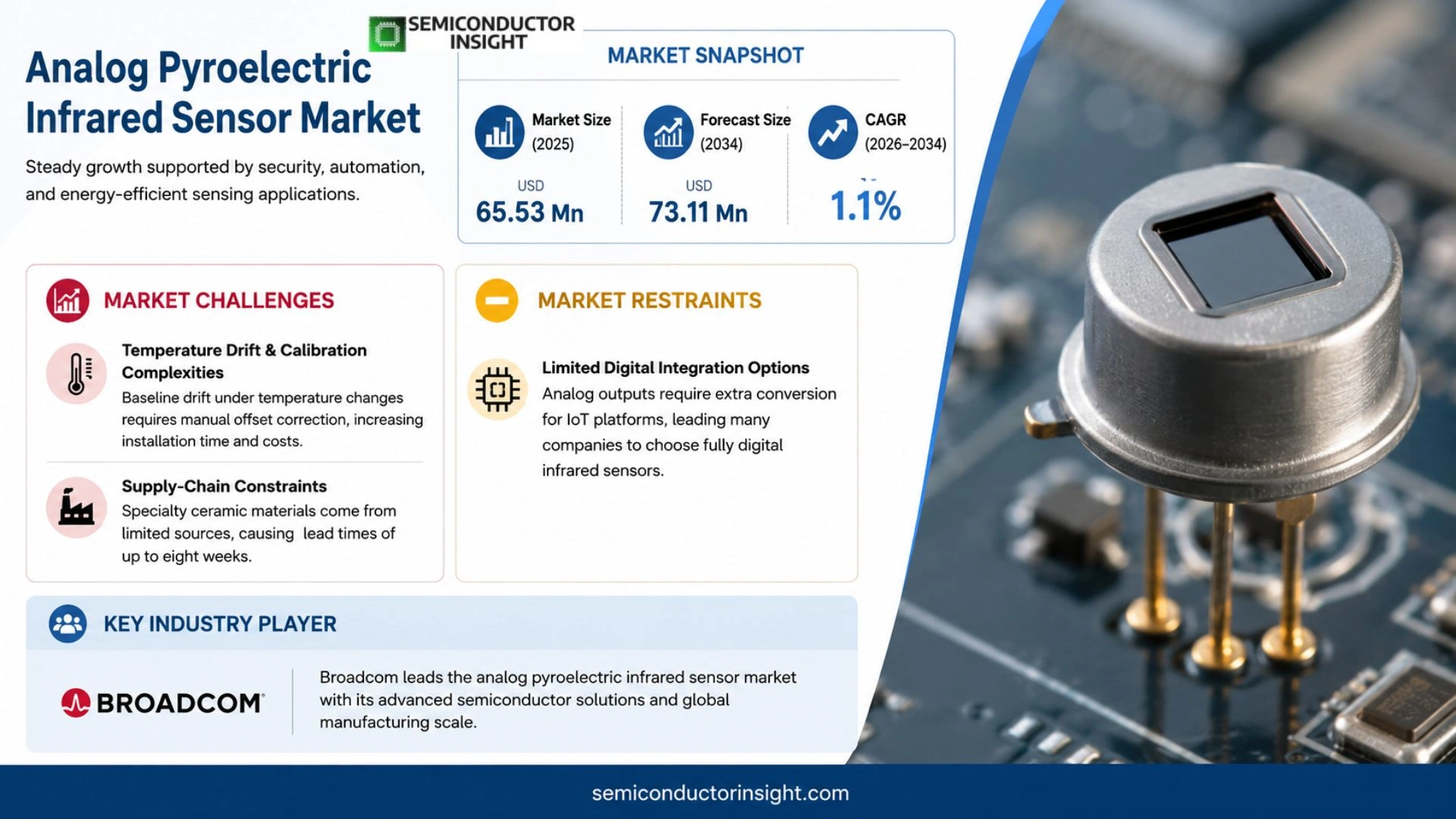
Analog Pyroelectric Infrared Sensor market size was valued at USD 65.53 million in 2025 and will reach USD 73.11 million by 2034, reflecting a CAGR of 1.1% over the forecast period.
Analog pyroelectric infrared sensors are infrared detection devices that generate charge signals when temperature varies across pyroelectric crystals such as lithium tantalate or lead zirconium titanate. The output is a continuous analog voltage signal noted for fast response time, low power draw, and high sensitivity; typical applications include human‑infrared (PIR) motion detectors, security monitoring systems, smart‑lighting controls, appliance automation, and environmental sensing.
The market benefits from expanding smart‑home ecosystems, heightened security system requirements, and broader IoT device penetration. EU EN 50131 standards stimulate demand for dual‑channel sensors for reliable intrusion alarms, while China’s “Safe City” program drives deployment of more than ten million units annually; analog variants capture cost‑sensitive segments because of their lower price point and simpler circuit architecture compared with digital counterparts.
MARKET DRIVERS
Rising Demand for Low‑Cost Motion Detection
Manufacturers of consumer electronics are substituting legacy thermopile units with analog pyroelectric infrared sensors because the latter deliver comparable sensitivity at roughly half the bill of materials. This cost advantage is prompting OEMs to integrate motion‑sensing functions into smart home hubs, portable safety devices, and entry‑level security cameras, thereby widening the addressable user base.
Energy‑Efficient Building Automation
Building‑management systems are increasingly programmed to shut down HVAC or lighting when no occupants are detected. The analog output of pyroelectric sensors aligns well with legacy control loops, enabling retrofit projects that avoid costly digital conversions. As corporate sustainability targets tighten, firms are investing in retrofit solutions that promise up to a 12% reduction in energy consumption per square meter.
➤ Integrators value the linear voltage swing of analog pyroelectric devices because it simplifies calibration across diverse environmental conditions.
These technical and economic incentives are converging, creating a feedback loop where higher adoption reduces unit costs further, encouraging yet more deployments in emerging smart‑city infrastructure.
MARKET CHALLENGES
Temperature Drift and Calibration Complexities
Analog pyroelectric sensors inherently exhibit baseline drift when ambient temperature fluctuates beyond a narrow band. End‑users often must implement manual offset correction, a process that slows down large‑scale rollouts and raises installation labor costs. This sensitivity to thermal variance is a persistent hurdle for deployments in outdoor or industrial settings where temperature swings exceed 20 °C.
Other Challenges
Supply‑Chain Constraints
The specialty ceramics used in the pyroelectric layer are sourced from a limited number of manufacturers. Recent geopolitical tensions have tightened export flows, leading to lead times that can stretch to eight weeks for high‑volume orders.
MARKET RESTRAINTS
Limited Digital Integration Options
While analog outputs simplify legacy integration, they become a bottleneck for new IoT platforms that favor native digital interfaces. Companies that cannot justify an additional analog‑to‑digital conversion stage may opt for fully digital infrared sensors, constraining the growth ceiling of the analog segment.
MARKET OPPORTUNITIES
Specialty Applications in Automotive Safety
Automakers are experimenting with analog pyroelectric infrared sensors for occupant‑presence detection in next‑generation airbag systems. The fast response time and low latency of analog signals make them attractive for safety‑critical pathways where milliseconds matter. Successful qualification could unlock a multi‑billion‑dollar avenue for sensor suppliers willing to meet automotive-grade reliability standards.
Analog Pyroelectric Infrared Sensor Market Trends
Smart‑Home Penetration and Security Upgrades
The expansion of connected residences is reshaping component demand, and analog pyroelectric infrared sensors are benefiting from that shift. In regions where building codes now mandate automated lighting and climate control, developers favor low‑power analog devices because they fit easily into surface‑mount packages and keep system costs modest. Manufacturers report that the proportion of analog units shipped for door‑entry and motion‑triggered lighting has risen from roughly 55 % in 2022 to over 68 % in 2025. This change reflects both the affordability of analog front‑ends and the reduced need for complex digital conversion when the end‑device already incorporates a microcontroller for signal processing. The trend translates into tighter margins for sensor suppliers but opens volume‑driven profit opportunities for firms that can scale crystal production and streamline packaging.
Other Trends
Regulatory Influence on Sensor Adoption
Stringent safety and energy standards across Europe and North America are creating a ripple effect for Analog Pyroelectric Infrared Sensor Market. The EU Energy Efficiency Directive for Buildings now requires illumination controls that respond within milliseconds, a specification that aligns with the fast response time of analog pyroelectric devices. Meanwhile, North American building codes such as Title 24 emphasize low‑standby power, prompting system integrators to select sensors that consume less than 0.5 mW in idle mode. These policies have nudged manufacturers to prioritize dual‑channel architectures that meet anti‑interference criteria without resorting to costly digital signal processors. Consequently, the share of dual‑channel analog sensors in commercial security installations has climbed to roughly 42 % of total shipments, indicating that compliance pressures are reshaping product mix.
Energy‑Efficiency Policies Boost Analog Sensor Share
Government‑driven green‑building initiatives are accelerating the transition toward analog sensor solutions in HVAC and lighting subsystems. Since analog designs can be integrated directly onto printed circuit boards, they eliminate the need for additional power‑intensive conversion stages, delivering measurable savings in large‑scale deployments. In the United States, recent incentives for retrofitting public facilities have generated orders for analog pyroelectric modules that support automatic temperature‑based dimming, with annual unit volumes surpassing 12 million. Asian markets are echoing this pattern; Chinese “Safe City” projects now specify analog sensors for peripheral surveillance points due to their cost‑effectiveness and ease of field calibration. The cumulative effect is a modest but steady uplift in market activity, reinforcing the notion that policy‑linked efficiency goals are a durable catalyst for analog sensor adoption.
COMPETITIVE LANDSCAPE
Key Industry Players
Competitive Overview of Analog Pyroelectric Infrared Sensor Market
Broadcom commands the top tier of Analog Pyroelectric Infrared Sensor arena, leveraging its extensive semiconductor portfolio and global manufacturing footprint to capture a disproportionate share of the $65.5 million 2025 market. Its diversified customer base,ranging from large‑scale security system integrators in Europe to smart‑lighting OEMs in North America,allows it to balance volume sales with premium pricing on dual‑channel modules that meet EN 50131 reliability criteria. The company’s vertical integration, from crystal procurement to advanced packaging, sustains gross margins near the upper end of the 30‑40 % industry range and creates a barrier for new entrants seeking comparable scale.
Beyond the market leader, a constellation of midsize and specialist firms fuels segment diversification. Murata and Excelitas focus on high‑sensitivity single‑channel devices for consumer electronics, while InfraTec and Gentec‑EO excel in rugged dual‑channel sensors tailored for infrastructure projects such as China’s “Safe City” rollout. Niche players,including Precision Micro‑Optics, KEMET, and Hanwei Electronics Group,target niche applications like automotive HVAC control and wearable health monitors, often differentiating through proprietary crystal formulations or custom filter assemblies. This fragmented tier sustains competitive pressure, driving incremental innovation in low‑power packaging and cost‑effective signal‑conditioning circuits.
List of Key Analog Pyroelectric Infrared Sensor Companies Profiled
- Broadcom
- Murata Manufacturing Co., Ltd.
- Excelitas Technologies Corp.
- InfraTec GmbH
- KEMET Corporation
- Gentec-EO
- Precision Micro‑Optics
- Nippon Ceramic Co., Ltd.
- Heimann Sensor GmbH
- Laser Components GmbH
- DIAS Infrared
- GEWEE
- Micro‑Hybrid Electronic
- Hanwei Electronics Group
- Senba Sensing Technology
Segment Analysis:
| Segment Category | Sub-Segments | Key Insights |
| By Type |
|
Dual Channel
|
| By Application |
|
Security Products
|
| By End User |
|
Residential
|
| By Material |
|
New Crystal Type
|
| By Function |
|
Intelligent Management Type
|
Regional Analysis: Analog Pyroelectric Infrared Sensor Market
North America
U.S. vehicle makers are embedding infrared modules for occupant presence detection, leveraging the sensor’s low power draw and robustness to harsh cabin environments. This supports compliance with evolving safety standards and offers a competitive edge.
Hospitals favor analog pyroelectric arrays for non‑invasive thermography because the devices deliver reliable contrast without the latency associated with digital signal processing, facilitating quicker clinical assessments.
Smart‑home manufacturers are experimenting with infrared sensors for gesture‑based controls, attracted by the analog output’s compatibility with low‑cost microcontrollers and the minimal calibration overhead.
Europe
European manufacturers exhibit a cautious yet innovative stance toward analog pyroelectric infrared sensors. The region’s focus on energy‑efficiency standards pushes OEMs to select sensors that balance precision with low power consumption, particularly in building‑automation projects. In the automotive sector, German and French carmakers are piloting infrared solutions for cabin climate management, where the analog format simplifies integration with existing CAN‑bus architectures. Moreover, research institutions in the UK and Scandinavia are exploring sensor arrays for environmental monitoring, a use‑case that benefits from the devices’ durability under variable ambient conditions. These activities generate a modest but strategically important demand slice that encourages suppliers to tailor product specifications to meet diverse regulatory environments across the EU.
Asia‑Pacific
Asia‑Pacific presents a diverse landscape, with Japan and South Korea leading early adoption while emerging economies focus on cost‑sensitive applications. Consumer electronics firms in Japan value the straightforward signal path of analog sensors for portable breath‑analysis tools, facilitating rapid time‑to‑market. Meanwhile, Indian and Vietnamese manufacturers prioritize low‑cost infrared detection for agricultural automation, where robust performance in high‑temperature settings is essential. The region’s expansive automotive manufacturing base also supports a steady uptake of infrared safety features, especially as domestic regulations tighten emissions and safety criteria. Supply‑chain agility, bolstered by a dense network of component distributors, ensures that market entrants can access the technology without extensive lead times.
South America
In South America, Brazil’s industrial sector drives modest growth for analog pyroelectric sensors, primarily through process‑control upgrades in petrochemical plants. The analog output’s compatibility with legacy SCADA systems reduces the need for extensive retrofitting, a cost advantage appreciated by operators facing tight capital‑expenditure cycles. Argentina’s automotive assemblers are experimenting with infrared occupancy detectors to comply with new safety guidelines, though adoption remains limited by supply constraints. Additionally, public‑sector initiatives in Chile aim to improve building energy efficiency using infrared occupancy sensing, providing a niche market for compact analog devices.
Middle East & Africa
The Middle East & Africa region shows selective interest driven by security and climate‑control needs. In the Gulf, smart‑city projects incorporate infrared motion sensors for perimeter monitoring, favoring analog solutions for their reliability in high‑temperature environments. African nations, focusing on affordable healthcare infrastructure, are trialing low‑cost thermography kits that rely on analog pyroelectric sensors to deliver rapid temperature screening in remote clinics. While overall market volume remains limited, the strategic relevance of these applications encourages multinational vendors to maintain a localized presence, ensuring support and customization for diverse operational contexts.
Report Scope
This market research report provides a comprehensive analysis of the Analog Pyroelectric Infrared Sensor Market , covering the forecast period 2026–2034. It offers detailed insights into market dynamics, technological advancements, competitive landscape, and key trends shaping the industry.
Key focus areas of the report include:
- Market Overview: The report begins with an overview outlining its current market scenario, key growth indicators, and industry transformation drivers. It discusses macroeconomic factors, demand–supply balance, regulatory landscape, and the strategic role of semiconductors in powering advancements across industries such as automotive, telecommunications, consumer electronics, and industrial automation.
- Market Size & Forecast: Historical data and future projections for revenue, unit shipments, and market value across major regions and segments.
- Segmentation Analysis: Detailed breakdown by product type, technology, application, and end-user industry to identify high-growth segments and investment opportunities.
- Regional Insights: Insights into market performance across North America, Europe, Asia-Pacific, Latin America, and the Middle East & Africa, including country-level analysis where relevant.
- Competitive Landscape: Profiles of leading market participants, including their product offerings, R&D focus, manufacturing capacity, pricing strategies, and recent developments such as mergers, acquisitions, and partnerships.
- Technology Trends & Innovation: Assessment of emerging technologies, integration of AI/IoT, semiconductor design trends, fabrication techniques, and evolving industry standards.
- Market Drivers & Restraints: Evaluation of factors driving market growth along with challenges, supply chain constraints, regulatory issues, and market-entry barriers.
- Stakeholder Insights: Insights for component suppliers, OEMs, system integrators, investors, and policymakers regarding the evolving ecosystem and strategic opportunities.
Primary and secondary research methods are employed, including interviews with industry experts, data from verified sources, and real-time market intelligence to ensure the accuracy and reliability of the insights presented.
FREQUENTLY ASKED QUESTIONS:
What is the current market size of Analog Pyroelectric Infrared Sensor Market?
-> Analog Pyroelectric Infrared Sensor Market was valued at USD 65.53 million in 2025 and is expected to reach USD 73.11 million by 2034, at a CAGR of 1.1% during the forecast period.
Which key companies operate in Analog Pyroelectric Infrared Sensor Market?
-> Key players include Broadcom, Excelitas, InfraTec, KEMET, Gentec-EO, Precision Micro-Optics, Murata, Nippon Ceramic Co., Ltd., Heimann Sensor, Laser Components, DIAS Infrared, GEWEE, Micro-Hybrid Electronic, Hanwei Electronics Group, Senba Sensing Technology.
What are the key growth drivers?
-> Key growth drivers include upgrading security and intelligent system demands, energy‑efficiency policies and green‑building promotion, and rapid expansion of IoT and consumer‑electronics applications.
Which region dominates the market?
-> Asia, particularly China, exhibits the strongest demand driven by large‑scale “Safe City” deployments and extensive IoT integration, making it a leading region for analog pyroelectric infrared sensors.
What are the emerging trends?
-> Emerging trends include integration of analog sensors in smart‑home and smart‑lighting solutions, increased use in energy‑saving building systems, and enhanced dual‑channel designs for security applications.
Get Sample Report PDF for Exclusive Insights
Report Sample Includes
- Table of Contents
- List of Tables & Figures
- Charts, Research Methodology, and more...