Alloy Resistors Market Insights
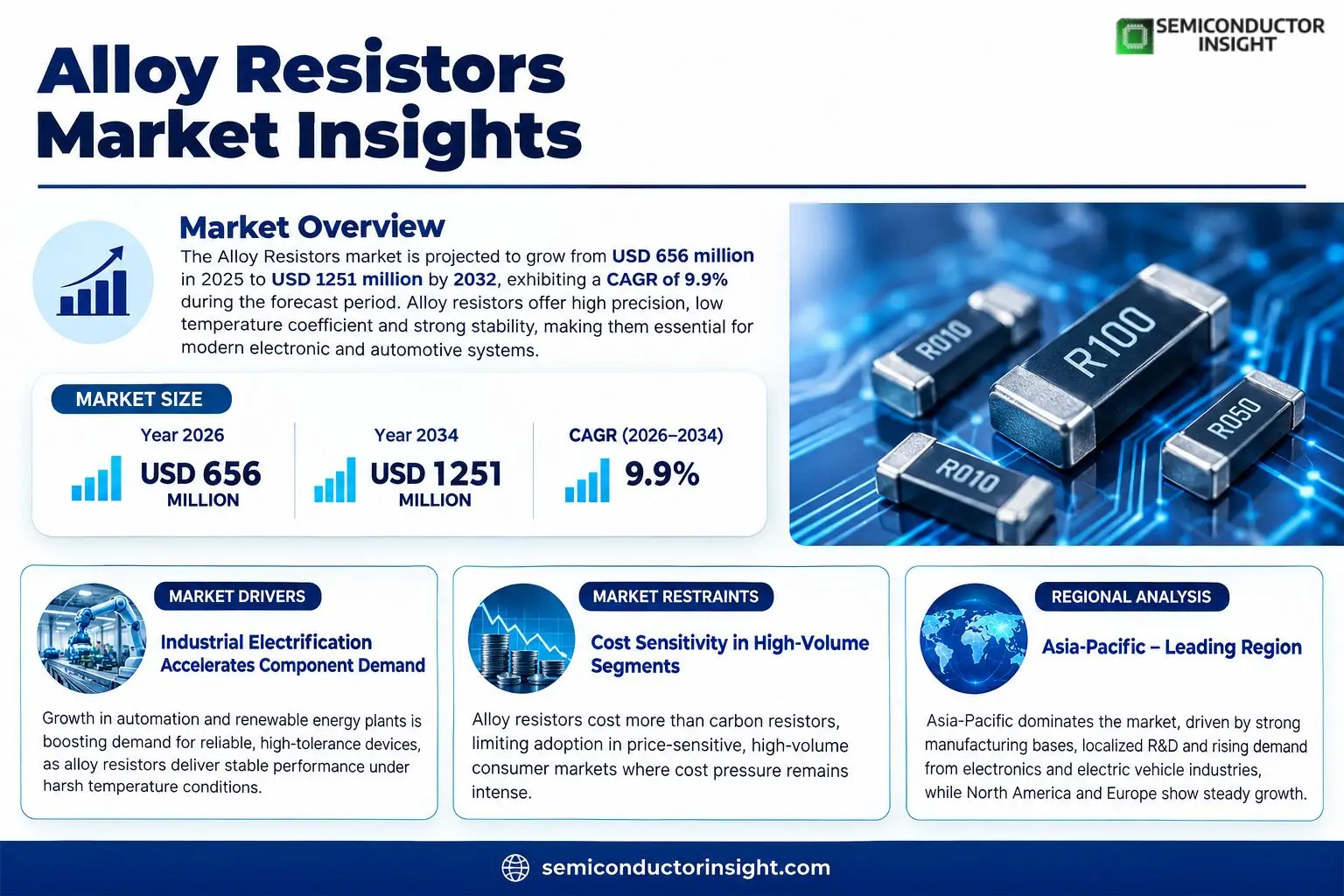
Alloy Resistors market size was valued at USD 656 million in 2025. The market is projected to grow from USD 656 million in 2025 to USD 1251 million by 2032, exhibiting a CAGR of 9.9% during the forecast period.
Alloy Resistor is a type of chip resistor, also known as a metal‑sampling or current‑sensing resistor. It typically handles resistance values between 0.2 mΩ and 750 mΩ, offering high precision, low temperature coefficient and strong stability. The segment covers pure alloy resistors, alloy‑film/foil resistors and alloy shunts, each suited to different performance‑cost trade‑offs.The market is expanding because alloy‑film resistors dominate mid‑range applications thanks to roughly 10% lower cost versus pure alloy parts, making them attractive for consumer electronics and small appliances. In high‑end devices such as electric‑vehicle control modules, pure alloy resistors are preferred for their superior temperature drift control and overload capacity. Packaging trends show the 1206 package holding about 65% share for low‑current wearables, while larger 2512 units are gaining traction in on‑board chargers for new‑energy vehicles. Key manufacturersincluding YAGEO, UNI‑ROYAL, TA‑I Technology, Vishay and ROHMare investing in capacity expansion and product innovation to meet rising demand from automotive electrification, fast‑charging infrastructure and portable consumer gadgets.
MARKET DRIVERS
Industrial Electrification Accelerates Component Demand
The surge in automation across automotive factories and renewable‑energy plants is compelling OEMs to replace legacy components with more reliable, high‑tolerance devices. Alloy Resistors Market benefits because alloy resistors deliver stable performance under temperature fluctuations typical of such environments, prompting procurement teams to favor them over carbon‑film alternatives.
Miniaturisation of Portable Electronics
Design engineers are compressing bill of material footprints to meet consumer expectations for thinner, lighter gadgets. The compact form factor of alloy resistors, combined with their low inductance, makes them indispensable in power‑management modules, driving volume purchases in the consumer‑electronics segment.
➤ Manufacturers that streamline their alloy‑resistor supply chain can shave up to 8% off total component cost, creating a tangible competitive edge.
Regulatory pushes toward energy‑efficient design are also nudging manufacturers to adopt components with tighter tolerance bands. By integrating alloy resistors, firms achieve compliance while preserving design margins, a win‑win that fuels market momentum.
MARKET CHALLENGES
Supply‑Chain Volatility
Recent geopolitical tensions have disrupted the flow of nickel‑copper alloys, the raw material foundation for precision resistors. Shortages force buyers to secure inventory at premium prices, compressing profit pools for assemblers that cannot pass costs downstream.
Other Challenges
Technological Substitution Risk
Advances in thin‑film resistor technology are narrowing the performance gap, prompting some design teams to consider alternatives that promise even smaller footprints, thereby eroding demand for traditional alloy‑type units.
MARKET RESTRAINTS
Cost Sensitivity in High‑Volume Segments
While alloy resistors excel in stability, their unit cost remains higher than bulk‑produced carbon resistors. In sectors such as mass‑produced consumer appliances, price pressure compels buyers to opt for lower‑cost solutions, limiting the addressable share for alloy‑based parts.
MARKET OPPORTUNITIES
Emerging Semiconductor Packaging
The rise of advanced packaging formatssuch as SiP (System in Package) and power‑module stackscreates a niche for high‑precision resistors that can survive thermal cycling. Companies that tailor alloy‑resistor specifications to these packaging constraints stand to capture a growing slice of Alloy Resistors Market.
Strategic Partnerships with EV Manufacturers
Electric‑vehicle power‑train designers demand components that can sustain continuous high‑current loads while maintaining tight tolerance. Forming joint‑development agreements with EV tier‑1 suppliers enables resistor producers to embed their products early in vehicle architectures, unlocking long‑term revenue streams.
Alloy Resistors Market Trends
Cost‑Driven Segmentation in Alloy Resistors Market
The market separates itself along a clear cost‑performance axis. Alloy film resistors capture the middle‑range segment because they can be manufactured about ten percent cheaper than pure‑alloy equivalents while still delivering the temperature stability required for consumer electronics and compact appliances. This price advantage explains why manufacturers of smart‑watch modules, true‑wireless earbuds and small‑capacity chargers routinely specify 1206‑ or 0805‑size film parts. In contrast, pure‑alloy devices retain a niche in premium equipment where overload tolerance and minimal temperature drift translate directly into longer product lifetimes, such as high‑resolution audio gear or industrial control units. The dual‑track strategy forces suppliers to maintain parallel production lines, creating opportunities for firms that can switch efficiently between the two material families.
Other Trends
Form‑Factor Evolution
The physical footprint of resistors continues to shape design decisions. The 1206 package dominates with roughly sixty‑five percent of all units shipped, a share driven by its ability to meet the low‑power needs of wearable devices and portable peripherals. The 0805 series follows closely, offering a smaller footprint for densely populated printed‑circuit boards without sacrificing the 0.5 mR to 500 mR resistance range typical of most signal‑conditioning circuits. Meanwhile, the larger 2512 size has carved a solid position in high‑current domains, notably on‑board chargers for new‑energy vehicles where its higher power rating mitigates thermal stress. This size diversification forces OEMs to manage broader inventory portfolios and prompts component distributors to adopt tiered stocking models that align with the distinct demand cycles of consumer versus automotive sectors.
Automotive Electrification as a Demand Engine
Electrified powertrains are reshaping Alloy Resistors Market by injecting sizable new volumes into the automotive supply chain. Battery‑management systems, motor‑control modules and fast‑charging infrastructure rely on the precise current‑sensing capabilities of pure‑alloy shunts to protect batteries and optimize energy flow. The rapid adoption of electric vehicles in China, backed by supportive policy and expanding charging networks, generates a steady climb in the required quantity of high‑precision resistors. Suppliers that can certify automotive‑grade reliability and traceability are therefore gaining a competitive edge, while those focused solely on low‑cost consumer segments may miss out on the higher margin opportunities presented by the EV ecosystem.
COMPETITIVE LANDSCAPE
Key Industry Players
Alloy Resistors Market – Competitive Outlook
YAGEO dominates alloy‑resistor arena, leveraging a vertically integrated supply chain that spans raw‑material sourcing, thin‑film deposition, and high‑precision testing. Its broad portfoliocovering pure alloy, alloy‑film, and shunt variantsallows it to serve both cost‑sensitive consumer‑electronics makers and high‑end automotive OEMs. The company’s aggressive pricing model, paired with a 1206‑size production capacity that captures roughly two‑thirds of the volume market, forces rivals to specialize or consolidate. Vishay and ROHM sit just behind YAGEO, each carving out niches: Vishay excels in power‑dense 2512 devices for electric‑vehicle charging systems, while ROHM’s strong foothold in Asian automotive electronics stems from long‑term joint‑development agreements with tier‑1 suppliers. This triad shapes a tiered competitive structure where scale, application focus, and regional partnerships dictate market share.Beyond the three giants, a constellation of midsize and boutique firms sustains innovation in specialized segments. Uni‑Royal and TA‑I Technology have built reputations on ultra‑low temperature‑coefficient alloy‑film resistors for precision instrumentation, attracting demand from medical‑device manufacturers. Fenghua Advanced Technology and Juneway Electronics focus on high‑current shunt products, capitalising on the burgeoning EV battery‑management market in China. Companies such as Everohms, Susumu, and TT Electronics maintain steady footholds in niche markets like aerospace and defense, where reliability outweighs cost. Smaller playersCyntec, Isabellenhütte, Sartfuse, and Shenzhen Yezhan Electronicsoperate as supply‑chain enablers, offering custom packaging and rapid prototyping that larger firms cannot match quickly. Their agility keeps the overall market responsive to emerging standards and component‑size trends.
List of Key Alloy Resistors Companies Profiled
- YAGEO
- Vishay
- ROHM
- Uni‑Royal
- TA‑I Technology
- Fenghua Advanced Technology
- Juneway Electronics
- Everohms
- Susumu
- TT Electronics
- Samsung Electro‑Mechanics
- Cyntec
- Isabellenhütte
- Sartfuse
- Shenzhen Yezhan Electronics
Segment Analysis:
| Segment Category | Sub-Segments | Key Insights |
| By Type |
|
Alloy Film Resistor is recognized as the leading segment because of its balanced cost‑effectiveness and reliable performance. Key qualitative observations include:
|
| By Application |
|
Automotive Electronics emerges as the dominant application segment, driven by the increasing electronic complexity of modern vehicles. Qualitative drivers include:
|
| By End User |
|
Automobile OEMs lead this category because of the extensive use of alloy resistors in safety‑critical control modules. Key insights:
|
| By Packaging Size |
|
1206 size dominates because it aligns with the majority of low‑current consumer applications. Qualitative observations:
|
| By Technology Trend |
|
High‑Precision Alloy is gaining traction as designers prioritize tighter tolerance in critical circuits. Key qualitative drivers:
|
Regional Analysis: Alloy Resistors Market
Asia‑Pacific
Manufacturers are consolidating component sourcing within the region, leveraging clustered semiconductor hubs to shorten logistics loops. This proximity cushions the market from global freight volatility and supports just‑in‑time production models that favour alloy resistor suppliers with agile fulfilment capabilities.
Emerging environmental standards push firms toward lead‑free alloy formulations. Compliance incentives in China, Japan, and South Korea are reshaping material specifications, prompting vendors to invest in greener processes without sacrificing performance thresholds.
The rise of high‑frequency communication modules incentivizes the adoption of low‑inductance alloy resistors. Local design teams are experimenting with thinner film architectures, a trend that is likely to cascade to adjacent markets such as power electronics and automotive infotainment.
End‑users in the region prioritize reliability under temperature swings, prompting a shift toward tighter tolerance grades. This preference amplifies demand for premium alloy resistor lines, compelling suppliers to balance cost efficiencies with quality assurances.
North America
North America remains a mature segment where legacy design cycles intersect with a growing appetite for high‑power consumption devices. The market is characterised by a strong emphasis on component traceability and long‑term supplier relationships, which sustains demand for alloy resistors that meet stringent reliability criteria. Defense and aerospace contracts continue to shape procurement patterns, favouring distributors capable of delivering consistent batch performance. At the same time, the resurgence of domestic semiconductor fabs introduces a modest upswing in volume orders, prompting local manufacturers to refine capacity planning and diversify material sourcing to mitigate import exposure.
Europe
European manufacturers balance stringent environmental regulations with a tradition of precision engineering, a combination that drives selective adoption of alloy resistors with low‑noise characteristics. The region’s focus on renewable energy and electric mobility translates into niche applications where thermal endurance is paramount. Procurement strategies often involve collaborative development programmes between component makers and automotive OEMs, fostering bespoke alloy formulations. Market participants that align with EU circular‑economy initiatives, offering recyclable packaging and reduced hazardous substances, tend to secure longer‑term contracts.
South America
In South America, market expansion is closely tied to the electrification of transport infrastructure and the rollout of broadband networks. While overall volume remains modest compared to the leading region, local assemblers are increasingly seeking cost‑effective components without compromising on temperature stability. Trade agreements that lower tariffs on electronic parts have softened price pressures, allowing suppliers to introduce mid‑range alloy resistor families. However, fragmented distribution channels pose a logistical challenge that firms address through regional warehousing hubs.
Middle East & Africa
The Middle East & Africa cluster exhibits a heterogeneous landscape, with affluent Gulf states investing heavily in data‑center capacity and African nations focusing on basic telecommunications expansion. Alloy resistors find relevance in both high‑end server farms, where reliability under continuous load is critical, and in rugged rural equipment that must endure extreme temperature fluctuations. Public‑private partnerships in the Gulf are accelerating demand for components that meet both performance and sustainability benchmarks, while emerging African markets prioritize affordability and supply‑chain resilience.
Report Scope
This market research report provides a comprehensive analysis of the Alloy Resistors Market , covering the forecast period 2026–2034. It offers detailed insights into market dynamics, technological advancements, competitive landscape, and key trends shaping the industry.
Key focus areas of the report include:
- Market Overview: The report begins with an overview outlining its current market scenario, key growth indicators, and industry transformation drivers. It discusses macroeconomic factors, demand–supply balance, regulatory landscape, and the strategic role of semiconductors in powering advancements across industries such as automotive, telecommunications, consumer electronics, and industrial automation.
- Market Size & Forecast: Historical data and future projections for revenue, unit shipments, and market value across major regions and segments.
- Segmentation Analysis: Detailed breakdown by product type, technology, application, and end-user industry to identify high-growth segments and investment opportunities.
- Regional Insights: Insights into market performance across North America, Europe, Asia-Pacific, Latin America, and the Middle East & Africa, including country-level analysis where relevant.
- Competitive Landscape: Profiles of leading market participants, including their product offerings, R&D focus, manufacturing capacity, pricing strategies, and recent developments such as mergers, acquisitions, and partnerships.
- Technology Trends & Innovation: Assessment of emerging technologies, integration of AI/IoT, semiconductor design trends, fabrication techniques, and evolving industry standards.
- Market Drivers & Restraints: Evaluation of factors driving market growth along with challenges, supply chain constraints, regulatory issues, and market-entry barriers.
- Stakeholder Insights: Insights for component suppliers, OEMs, system integrators, investors, and policymakers regarding the evolving ecosystem and strategic opportunities.
Primary and secondary research methods are employed, including interviews with industry experts, data from verified sources, and real-time market intelligence to ensure the accuracy and reliability of the insights presented.
FREQUENTLY ASKED QUESTIONS:
What is the current market size of Alloy Resistors Market?
-> Alloy Resistors Market was valued at USD 656 million in 2025 and is expected to reach USD 1251 million by 2032 at a CAGR of 9.9% during the forecast period.
Which key companies operate in Alloy Resistors Market?
-> Key players include YAGEO, UNI-ROYAL, TA-I Technology, Fenghua Advanced Technology, Juneway Electronics, Viking, Everohms, Susumu, ROHM, Vishay, TT Electronics, Samsung, among others.
What are the key growth drivers?
-> Key growth drivers include rapid adoption of electric vehicles, expanding fast‑charging and battery management systems, and increasing demand for compact, high‑precision components in consumer electronics.
Which region dominates the market?
-> Asia-Pacific holds the largest market share, driven by strong manufacturing bases in China, Japan, and South Korea, while North America and Europe also show steady growth.
What are the emerging trends?
-> Emerging trends include greater use of alloy‑film resistors for cost‑effective mid‑range applications, a shift toward 1206 package size for low‑current wearables, and intensified focus on high‑temperature stability for EV power‑train modules.

Get Sample Report PDF for Exclusive Insights
Report Sample Includes
- Table of Contents
- List of Tables & Figures
- Charts, Research Methodology, and more...
 Download Sample Report PDF