Market Insights
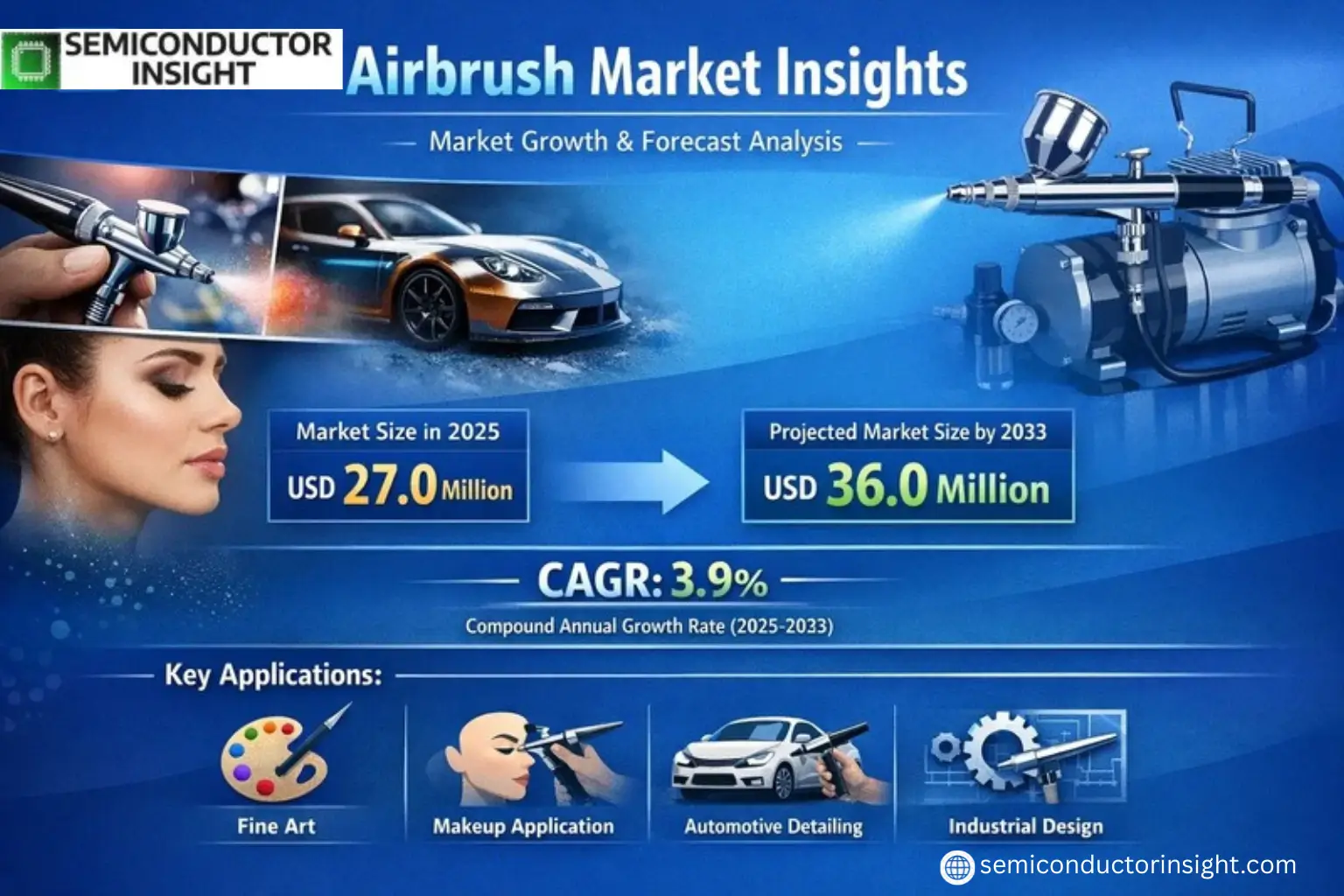
Global Airbrush Market size was valued at USD 27.0 million in 2025 and is projected to reach USD 36.0 million by 2033, exhibiting a CAGR of 3.9% during the forecast period.
An airbrush is a precision tool used for fine art, makeup application, automotive detailing, and industrial design. It operates by spraying paint or ink through a nozzle using compressed air, allowing for controlled gradients and intricate detailing. The device is widely adopted across industries due to its ability to deliver smooth finishes with high accuracy.
The market growth is driven by increasing demand in artistic applications, professional makeup artistry, and industrial customization. Technological advancements such as micro-piezoelectric inkjet heads achieving 0.1mm precision lines enhance adoption rates in high-end applications. Additionally, environmental regulations promoting water-based coatings have led to innovations like anti-clogging nozzles with a 35% adoption rate in eco-friendly models.
MARKET DRIVERS
Growing Demand in Cosmetic and Automotive Industries
Airbrush Market is experiencing significant growth due to rising demand from the cosmetics and automotive sectors. Makeup artists increasingly rely on airbrush technology for flawless, long-lasting applications, while automotive refinishing shops utilize airbrushing for precision paint jobs. Global airbrush equipment market is projected to grow at a CAGR of 5.2% over the next five years.
Technological Advancements in Airbrush Equipment
Manufacturers are introducing innovative features like dual-action triggers, ergonomic designs, and advanced nozzle systems, enhancing precision and user experience. Digital integration with airbrush compressors allows for better pressure control, appealing to professional users.
Rising disposable income in developing nations is further propelling the adoption of high-quality airbrush systems for both commercial and personal use.
MARKET CHALLENGES
High Initial Costs and Technical Skill Requirements
Professional-grade airbrush systems require substantial investment, with complete setups often costing over USD 500. The learning curve for mastering airbrush techniques discourages potential users, limiting market expansion.
Other Challenges
Maintenance Demands
Regular cleaning and part replacements increase operational costs, with nozzle assemblies needing replacement every 6-12 months under heavy use.
Regulatory Compliance
Stringent VOC emission standards in North America and Europe are challenging manufacturers to develop compliant paint formulations.
MARKET RESTRAINTS
Limited Consumer Awareness in Emerging Markets
In developing regions, awareness about professional airbrush applications remains low, with traditional painting methods still dominating. The Asian market penetration for high-end airbrush products remains below 20% despite growing industrial sectors.
MARKET OPPORTUNITIES
Expansion in Customization and Personalization Trends
The growing demand for customized products in fashion, accessories, and automotive detailing presents significant opportunities. The airbrush tattoo market alone is projected to exceed USD 120 million globally by 2025.
E-commerce Expansion for Airbrush Products
Online sales channels now account for 28% of total airbrush equipment sales, with platforms offering educational content alongside products attracting higher conversion rates.
Airbrush Market Growth and Innovation Trends
Technological Advancements Driving Market Expansion
Global Airbrush Market is undergoing significant transformation through technological innovations, with precision engineering leading the charge. The adoption of micro-piezoelectric inkjet head technology enables 0.1mm line precision, catering to professional artists and industrial applications. Market projections indicate that high-end inkjet pens will capture over 40% market share by 2025, with premium pricing reflecting their enhanced capabilities.
Other Trends
Eco-Friendly Material Adoption
Environmental compliance is reshaping product development, with water-based coating nozzles now representing 35% of offerings. Manufacturers are investing heavily in biodegradable materials, with R&D spending growing 25% annually. These innovations align with strict EU REACH regulations while maintaining performance standards.
Diversified Application Scenarios Fueling Demand
Airbrush Market is experiencing vertical expansion across multiple sectors. Educational institutions are driving 22% of sales growth through digital art curriculum adoption. Industrial applications show particular promise, with 18% penetration in automotive touch-up and aerospace applications requiring micron-level precision. The art reproduction sector is similarly benefiting from museum-grade replication technologies that deliver unprecedented fidelity.
Regional Market Dynamics
North America and Europe dominate the premium segment, while Asia-Pacific shows strongest growth at 4.8% CAGR through 2033. This regional variation reflects differing adoption rates across artistic, industrial, and cosmetic applications.
Competitive Landscape Innovation
Market leaders including ANEST IWATA and Harder & Steenbeck are differentiating through precision engineering and software integration. The industry is trending toward smart airbrush systems that automatically adjust PS parameters, commanding 30-50% price premiums. These developments position the market to reach USD 36 million by 2033.
COMPETITIVE LANDSCAPE
Key Industry Players
Technological Innovation Shapes Airbrush Market Competition
Global Airbrush Market is dominated by established manufacturers like ANEST IWATA and Harder & Steenbeck, which hold significant market share through their precision engineering and industrial-grade solutions. These market leaders are investing heavily in micro-piezoelectric technology and pressure sensor integration, commanding premium pricing (30-50% higher) for professional-grade equipment. The market structure shows increasing consolidation among top players, with strategic acquisitions enhancing their technological portfolios.
Specialty players like DINAIR and TEMPTU have carved strong niches in cosmetic airbrushing, while TAMIYA and Mr.hobby dominate the model-making segment. Emerging Asian manufacturers such as Ningbo Lis and Rongpeng are gaining traction through cost-competitive offerings, particularly in educational and entry-level markets. The competitive landscape is further diversified by companies like Paasche AirBrush and Sparmax that focus on hybrid solutions bridging artistic and industrial applications.
List of Key Airbrush Companies Profiled
- ANEST IWATA
- TAMIYA
- Badger
- Harder & Steenbeck
- Paasche AirBrush
- Sparmax
- Testor
- Mr.hobby
- Hollywood air
- Dinair
- TEMPTU
- Luminess
- Nien Tsz Lee
- Airbase
- Ningbo Lis
Segment Analysis:
| Segment Category | Sub-Segments | Key Insights |
| By Type |
|
0.3mm-0.5mm dominates as the most versatile option for both artistic and industrial applications.
|
| By Application |
|
Art and illustration remains the cornerstone of airbrush innovation and adoption.
|
| By End User |
|
Professional Artists drive premium product innovation and technological advancements.
|
| By Technology |
|
Digitally Integrated systems show the strongest growth momentum.
|
| By Material Compatibility |
|
Water-based systems are gaining market preference due to environmental factors.
|
Regional Analysis: Global Airbrush Market
North American auto shops extensively use airbrush systems for custom paint jobs and touch-ups, with growing adoption of dual-action airbrushes that offer superior control for intricate designs.
Airbrush makeup systems gain traction in professional studios and home use, supported by beauty influencers and salon chains promoting flawless application techniques.
Leading manufacturers introduce IoT-enabled airbrush systems with pressure control sensors and app connectivity, particularly valued in industrial coating applications.
Well-established airbrush training academies and certification programs across major cities ensure skilled workforce availability, maintaining quality standards.
Europe
Europe’s Airbrush Market thrives on artistic communities and industrial applications, particularly in Germany’s automotive sector and Italy’s fashion industry. Strict EU regulations promote eco-friendly airbrush formulations, while the UK’s body art sector drives demand for precision equipment. Cultural festivals and commercial art projects fuel sales of specialized airbrush kits.
Asia-Pacific
The APAC region shows rapid growth with expanding manufacturing hubs in China and India. Japan leads in technological innovations while Southeast Asian countries witness surging demand from textile printing and temporary tattoo sectors. Developing infrastructure for artistic education creates new market opportunities.
South America
Brazil dominates the regional Airbrush Market through vibrant carnival arts and automotive customization culture. Growing middle-class expenditure on beauty services boosts professional airbrush makeup adoption. Local manufacturers focus on cost-effective solutions for emerging artists.
Middle East & Africa
The UAE leads regional growth with luxury automotive and event decoration applications. South Africa’s developing art scene drives beginner-level airbrush demand. Limited local manufacturing creates import reliance, though distribution networks are expanding.
Report Scope
This market research report provides a comprehensive analysis of the Airbrush Market, covering the forecast period 2025–2033. It offers detailed insights into market dynamics, technological advancements, competitive landscape, and key trends shaping the industry.
Key focus areas of the report include:
- Market Overview: The report begins with an overview outlining its current market scenario, key growth indicators, and industry transformation drivers. It discusses macroeconomic factors, demand–supply balance, regulatory landscape, and the strategic role of airbrush technology in powering advancements across industries such as artistic applications, makeup, industrial precision, and nail art.
- Market Size & Forecast: Historical data and future projections for revenue, unit shipments, and market value across major regions and segments.
- Segmentation Analysis: Detailed breakdown by product type, technology, application, and end-user industry to identify high-growth segments and investment opportunities.
- Regional Insights: Insights into market performance across North America, Europe, Asia-Pacific, Latin America, and the Middle East & Africa, including country-level analysis where relevant.
- Competitive Landscape: Profiles of leading market participants, including their product offerings, R&D focus, manufacturing capacity, pricing strategies, and recent developments such as mergers, acquisitions, and partnerships.
- Technology Trends & Innovation: Assessment of emerging technologies, integration of micro-piezoelectric inkjet heads, pressure sensors, and evolving industry standards.
- Market Drivers & Restraints: Evaluation of factors driving market growth along with challenges, supply chain constraints, regulatory issues, and market-entry barriers.
- Stakeholder Insights: Insights for component suppliers, OEMs, system integrators, investors, and policymakers regarding the evolving ecosystem and strategic opportunities.
Primary and secondary research methods are employed, including interviews with industry experts, data from verified sources, and real-time market intelligence to ensure the accuracy and reliability of the insights presented.
FREQUENTLY ASKED QUESTIONS:
What is the current market size of Airbrush Market?
-> Airbrush Market size was valued at USD 27.0 million in 2025 and is projected to reach USD 36.0 million by 2033, exhibiting a CAGR of 3.9% during the forecast period.
Which key companies operate in Airbrush Market?
-> Key players include ANEST IWATA, TAMIYA, Badger, Harder & Steenbeck, Paasche AirBrush, Sparmax, Testor, Mr.hobby, Hollywood air, Dinair, TEMPTU, Luminess, Nien Tsz Lee, Airbase, Ningbo Lis, Rongpeng, and Auarita.
What are the key growth drivers?
-> Key growth drivers include technological upgrades (micro-piezoelectric inkjet heads with 0.1mm precision), expansion in education sector applications (22% market share by 2025), and industrial precision restoration (18% penetration in automotive/spacecraft scenarios).
Which region dominates the market?
-> Asia-Pacific shows significant growth potential driven by digital reforms in K12 art education, while North America maintains strong demand across artistic and industrial applications.
What are the emerging trends?
-> Emerging trends include environmentally friendly materials adoption (35% water-based coating nozzles), degradable ink container R&D (+25% annual growth), and advanced software integration for creative efficiency (30%-50% price premium).

Get Sample Report PDF for Exclusive Insights
Report Sample Includes
- Table of Contents
- List of Tables & Figures
- Charts, Research Methodology, and more...