AI Wearable Processor Market Insights
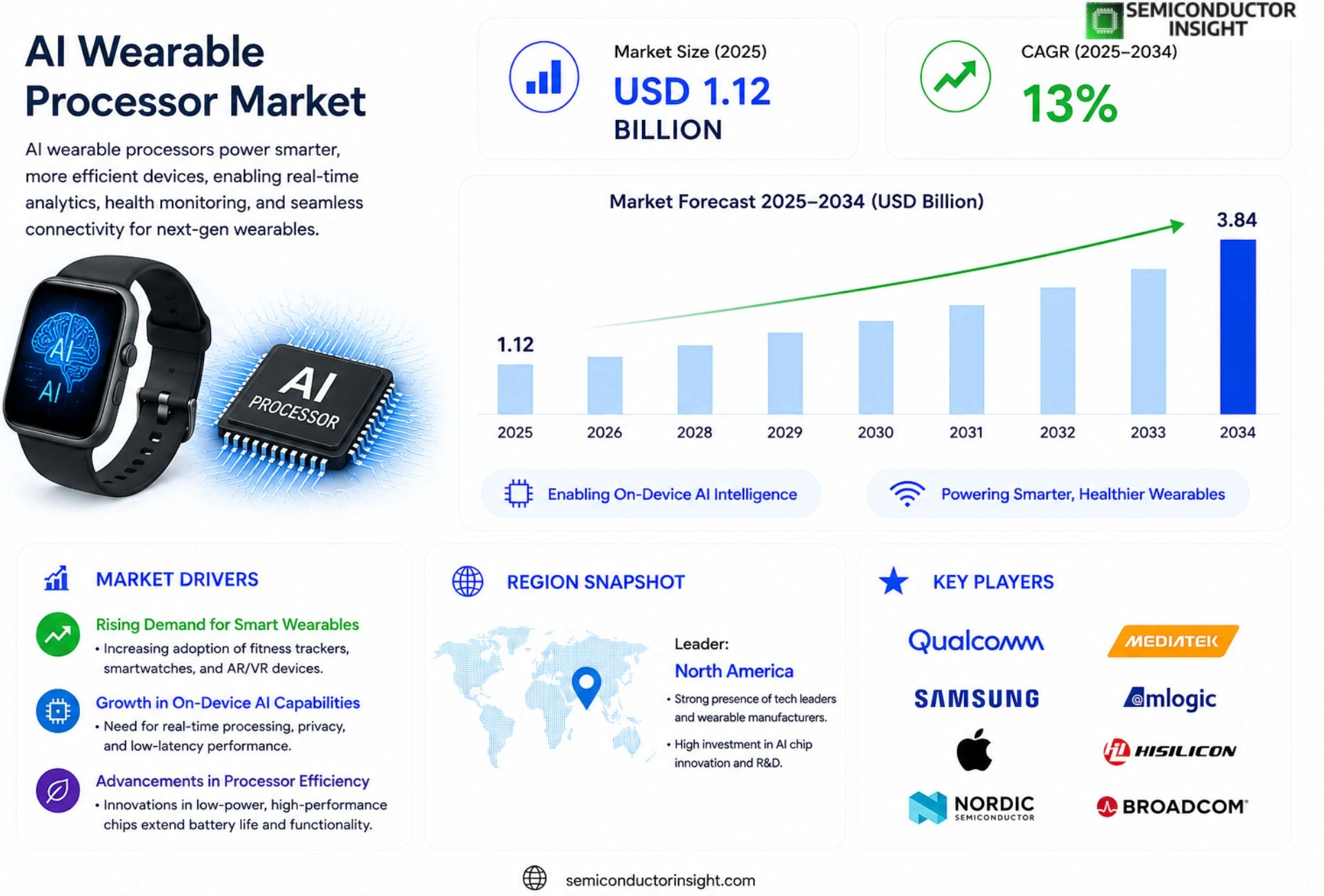
Global AI Wearable Processor Market size was valued at USD 1.05 billion in 2025. The market is projected to grow from USD 1.12 billion in 2025 to USD 3.84 billion by 2034, exhibiting a CAGR 13% during the forecast period.
AI wearable processors are ultra‑low‑power micro‑architectures designed to execute artificial‑intelligence algorithms directly on wrist‑worn or body‑mounted devices. These chips integrate neural‑network accelerators, sensor‑fusion engines and secure enclaves, enabling real‑time health analytics, gesture recognition and contextual awareness without relying on cloud connectivity.
The market is accelerating because consumer demand for continuous health monitoring and personalized fitness insights is expanding rapidly.Furthermore, advancements in edge‑AI frameworks reduce latency and power consumption, making integration feasible for manufacturers of smart watches and medical wearables alike.Recent collaborations,such as Qualcomm’s partnership with Samsung Electronics announced in March 2024,to co‑develop next‑generation AI cores illustrate how leading semiconductor firms are positioning themselves alongside emerging startups like GreenWaves Technologies and Syntiant.
MARKET DRIVERS
Growing Adoption of Edge AI in Wearables
AI Wearable Processor Market is being propelled by the surge in consumer demand for real‑time health and fitness insights. Edge‑AI capabilities enable devices to analyze biometric data locally, delivering instant feedback without reliance on cloud connectivity, which enhances user privacy and reduces latency.
Advancements in Low‑Power Semiconductor Technologies
Recent breakthroughs in sub‑10nm process nodes and heterogeneous integration have dramatically lowered the power envelope of AI chips. This allows manufacturers to embed sophisticated models into wrist‑worn and patch‑type devices while maintaining battery life that meets consumer expectations.
➤ Integrating AI processors directly into wearables cuts data transmission delays and extends operational time by up to 30% compared with traditional microcontrollers.
As developers race to create more personalized experiences, the convergence of AI and wearable form factors is expected to unlock new revenue streams for OEMs, reinforcing the upward trajectory of AI Wearable Processor Market.
MARKET CHALLENGES
Technical Integration and Standardization
Designers face complex challenges when integrating heterogeneous AI accelerators with existing sensor suites. The lack of unified standards for model deployment across diverse hardware platforms can increase time‑to‑market and engineering costs.
Other Challenges
Regulatory and Privacy Concerns
Stringent data protection regulations require that AI‑driven wearables implement robust on‑device encryption and anonymization, adding further layers of development effort and validation.
MARKET RESTRAINTS
High Development Costs and Capital Investment
Bringing an AI‑enabled processor from concept to production demands substantial R&D expenditure, advanced fabrication partnerships, and extensive testing, which can deter smaller players from entering AI Wearable Processor Market.
MARKET OPPORTUNITIES
Emerging Applications in Healthcare Monitoring
Continuous glucose monitoring, cardiac rhythm analysis, and early disease detection are poised to benefit from on‑device AI inference. These high‑value use cases present a compelling growth avenue for firms that can deliver clinically accurate, low‑latency processing within a wearable form factor.
AI Wearable Processor Market Trends
Edge AI Integration Accelerating Adoption
AI Wearable Processor Market is being reshaped by the rapid maturation of edge‑AI frameworks that enable inference directly on the device. Ultra‑low‑power micro‑architectures combine neural‑network accelerators with sensor‑fusion engines, allowing smart watches and medical wearables to deliver real‑time health analytics, gesture recognition, and contextual awareness without reliance on cloud connectivity. This shift reduces latency, conserves battery life, and satisfies consumer expectations for instant, private insights. Manufacturers are therefore prioritizing chips that balance computational depth with stringent power envelopes, creating a clear pathway for broader market penetration.
Other Trends
Sensor Fusion and Real‑Time Health Analytics
Advances in sensor‑fusion technology are a cornerstone of AI Wearable Processor Market’s evolution. By integrating data from optical, inertial, and bio‑electrical sensors, processors can generate comprehensive health metrics such as continuous heart‑rate variability, oxygen saturation trends, and stress indicators. These capabilities support personalized fitness recommendations and early detection of abnormal physiological patterns, driving demand from both consumer wellness brands and clinical monitoring device makers. The analytical depth offered by on‑chip processing also enhances data security, as sensitive information remains encrypted within a secure enclave before any transmission.
Strategic Partnerships Expanding the Ecosystem
Collaboration between semiconductor leaders and device manufacturers is intensifying, illustrating the strategic importance of AI Wearable Processor Market. Recent joint ventures have produced next‑generation AI cores optimized for wearable form factors, while emerging startups contribute specialized accelerator IP that complements larger vendors’ portfolios. These alliances accelerate time‑to‑market for innovative products and foster a robust ecosystem of software tools, reference designs, and validation kits. As the ecosystem matures, developers gain clearer pathways to integrate AI capabilities, further cementing the market’s forward momentum.
COMPETITIVE LANDSCAPE
Key Industry Players
Intensifying Competition and Strategic Alliances Redefine AI Wearable Processor Market
AI Wearable Processor Market is characterized by a dynamic and increasingly consolidated competitive landscape, with a handful of vertically integrated semiconductor giants commanding significant market share. Qualcomm Technologies leads the space through its Snapdragon Wear platform, which integrates dedicated neural processing units tailored for ultra-low-power wearable applications. The company further solidified its position through a co-development partnership with Samsung Electronics, announced in March 2024, targeting next-generation AI cores optimized for smartwatches and fitness wearables. Apple Inc. remains a formidable force, leveraging its proprietary S-series and W-series chip architectures across Apple Watch product lines to deliver tightly integrated on-device health intelligence. MediaTek and NXP Semiconductors also maintain substantial footholds by supplying AI-capable processors to a broad base of Android wearable OEMs, competing aggressively on performance-per-milliwatt benchmarks and platform ecosystem support.
Beyond the established semiconductor leaders, a growing cohort of specialized and emerging players is reshaping competitive dynamics across niche segments of AI Wearable Processor Market. GreenWaves Technologies has gained recognition for its GAP series of ultra-low-power AI processors, purpose-built for always-on sensing and inference at the extreme edge. Syntiant Corp. differentiates through its neuromorphic deep learning inference chips, enabling voice and gesture recognition at sub-milliwatt power envelopes. Ambiq Micro focuses on sub-threshold computing architectures that extend battery life significantly in continuous health monitoring wearables. Additionally, companies such as Eta Compute, Perceive, and Axera Technology are accelerating product roadmaps targeting biosignal processing and anomaly detection in medical-grade wearables. Collectively, this competitive intensity is driving rapid innovation cycles, compelling both incumbents and challengers to deepen investments in edge-AI frameworks, sensor fusion capabilities, and secure computation to capture share in a market projected to grow at a 13% CAGR through 2034.
List of Key AI Wearable Processor Companies Profiled
- Qualcomm Technologies, Inc.
- Apple Inc.
- MediaTek Inc.
- NXP Semiconductors N.V.
- Samsung Electronics Co., Ltd.
- GreenWaves Technologies
- Syntiant Corp.
- Ambiq Micro, Inc.
- Eta Compute Inc.
- Perceive Corporation
- Axera Technology Co., Ltd.
- Texas Instruments Incorporated
- Nordic Semiconductor ASA
- Arm Holdings plc
- Hisilicon Technologies Co., Ltd.
Segment Analysis:
| Segment Category | Sub-Segments | Key Insights |
| By Type |
|
Neural‑Network Accelerators
|
| By Application |
|
Health Monitoring
|
| By End User |
|
Consumers
|
| By Connectivity |
|
Bluetooth Low Energy
|
| By Functionality |
|
Real‑time Analytics
|
Regional Analysis: North America
North America
Significant investments in AI research and development, coupled with a strong consumer acceptance of new technologies, are key drivers of AI Wearable Processor Market in North America. The region’s strong venture capital ecosystem also fuels the growth of startups developing innovative wearable solutions.
The integration of advanced sensors, enhanced battery technologies, and improved AI algorithms are shaping the future of AI wearable processors in North America. A growing focus on health and wellness is further fueling demand for wearables with sophisticated health monitoring capabilities.
The North American market features a mix of established technology giants and emerging players, leading to intense competition and innovation. Companies are focusing on developing specialized AI processors optimized for the power constraints of wearable devices.
Europe
Europe presents a substantial market for AI Wearable Processor Market, characterized by a strong emphasis on data privacy and security regulations, which are influencing the development and adoption of wearable technologies. The region’s advanced manufacturing capabilities and a growing focus on health and wellness are key growth drivers. European consumers are increasingly receptive to wearable devices that offer personalized health insights and convenience. However, stringent data protection laws necessitate careful consideration of data handling and processing within these devices. The market is witnessing a rise in smartwatches and fitness trackers, supported by innovations in AI algorithms for health monitoring and activity tracking. The integration of AI in wearables is also being explored for applications in healthcare, such as remote patient monitoring and personalized medicine. While the market is mature in some segments, there is significant potential for growth in niche areas driven by technological advancements and evolving consumer preferences. The commitment to sustainable technologies also impacts the design and manufacturing of wearable devices in Europe, favoring energy-efficient AI processors.
Asia-Pacific
Asia-Pacific is emerging as the fastest-growing market for AI Wearable Processor Market, driven by rapid economic expansion, a large and tech-savvy population, and increasing disposable incomes. Countries like China, Japan, and South Korea are leading the way in the adoption of wearable devices powered by AI. The region’s robust manufacturing base and strong supply chains further contribute to the growth of this market. The demand for smartwatches, fitness trackers, and augmented reality glasses is particularly high in Asia-Pacific, fueled by a culture of early tech adoption and a strong emphasis on health and fitness. Government initiatives promoting technological innovation and digitalization are also supporting the growth of AI Wearable Processor Market. However, the market is also characterized by intense competition from local players and the need to address concerns related to data privacy and security. The increasing penetration of smartphones in the region is also driving the demand for AI-powered wearables that can seamlessly integrate with existing mobile ecosystems.
South America
South America represents an untapped market opportunity for AI Wearable Processor Market, with a growing interest in wearable technologies among younger demographics. Increasing smartphone penetration and rising disposable incomes are contributing to the demand for smartwatches and fitness trackers. The region’s focus on health and wellness is also driving the adoption of wearables for activity tracking and health monitoring. However, challenges such as economic instability, infrastructure limitations, and varying levels of digital literacy pose obstacles to market growth. The market is expected to witness significant growth in the coming years as these challenges are addressed and consumer awareness of wearable technologies increases. The demand for affordable AI-powered wearables is particularly strong in South America, reflecting the region’s price-sensitive consumer base.
Middle East & Africa
The Middle East & Africa region offers a promising, albeit nascent, market for AI Wearable Processor Market. Increasing disposable incomes, a growing focus on health and fitness, and a rising adoption of smartphones are driving the demand for wearable devices. The region’s young population and high mobile penetration rates further contribute to market growth. However, challenges such as limited infrastructure, varying levels of digital literacy, and cultural factors pose hurdles to widespread adoption. The market is expected to witness significant growth in the coming years as these challenges are overcome and greater awareness of the benefits of wearable technology emerges. The demand for wearables with health monitoring features is particularly strong in the region, reflecting a growing interest in preventative healthcare and wellness.
Report Scope
This market research report provides a comprehensive analysis of the AI Wearable Processor Market , covering the forecast period 2026–2034. It offers detailed insights into market dynamics, technological advancements, competitive landscape, and key trends shaping the industry.
Key focus areas of the report include:
- Market Overview: The report begins with an overview outlining its current market scenario, key growth indicators, and industry transformation drivers. It discusses macroeconomic factors, demand–supply balance, regulatory landscape, and the strategic role of semiconductors in powering advancements across industries such as automotive, telecommunications, consumer electronics, and industrial automation.
- Market Size & Forecast: Historical data and future projections for revenue, unit shipments, and market value across major regions and segments.
- Segmentation Analysis: Detailed breakdown by product type, technology, application, and end-user industry to identify high-growth segments and investment opportunities.
- Regional Insights: Insights into market performance across North America, Europe, Asia-Pacific, Latin America, and the Middle East & Africa, including country-level analysis where relevant.
- Competitive Landscape: Profiles of leading market participants, including their product offerings, R&D focus, manufacturing capacity, pricing strategies, and recent developments such as mergers, acquisitions, and partnerships.
- Technology Trends & Innovation: Assessment of emerging technologies, integration of AI/IoT, semiconductor design trends, fabrication techniques, and evolving industry standards.
- Market Drivers & Restraints: Evaluation of factors driving market growth along with challenges, supply chain constraints, regulatory issues, and market-entry barriers.
- Stakeholder Insights: Insights for component suppliers, OEMs, system integrators, investors, and policymakers regarding the evolving ecosystem and strategic opportunities.
Primary and secondary research methods are employed, including interviews with industry experts, data from verified sources, and real-time market intelligence to ensure the accuracy and reliability of the insights presented.
FREQUENTLY ASKED QUESTIONS:
What is the current market size of AI Wearable Processor Market?
-> AI Wearable Processor Market was valued at USD 1.05 billion in 2025 and is expected to reach USD 3.84 billion by 2034, reflecting a 13% CAGR during the forecast period.
Which key companies operate AI Wearable Processor Market?
-> Key players include Qualcomm, Samsung Electronics, MediaTek, Apple, STMicroelectronics, GreenWaves Technologies, Syntiant, NVIDIA, among others.
What are the key growth drivers?
-> Key growth drivers include rising consumer demand for continuous health monitoring, advancements in ultra‑low‑power edge‑AI architectures, and increasing integration of sensor‑fusion engines in smart wearables.
Which region dominates the market?
-> Asia-Pacific is the fastest‑growing region, while Europe remains a dominant market due to strong adoption in medical‑grade wearables.
What are the emerging trends?
-> Emerging trends include edge‑AI frameworks that minimize latency, secure enclave technologies for data privacy, and multi‑sensor fusion platforms that enhance contextual awareness.

Get Sample Report PDF for Exclusive Insights
Report Sample Includes
- Table of Contents
- List of Tables & Figures
- Charts, Research Methodology, and more...
 Download Sample Report PDF