AI-Specific ISA Processor Market Insights
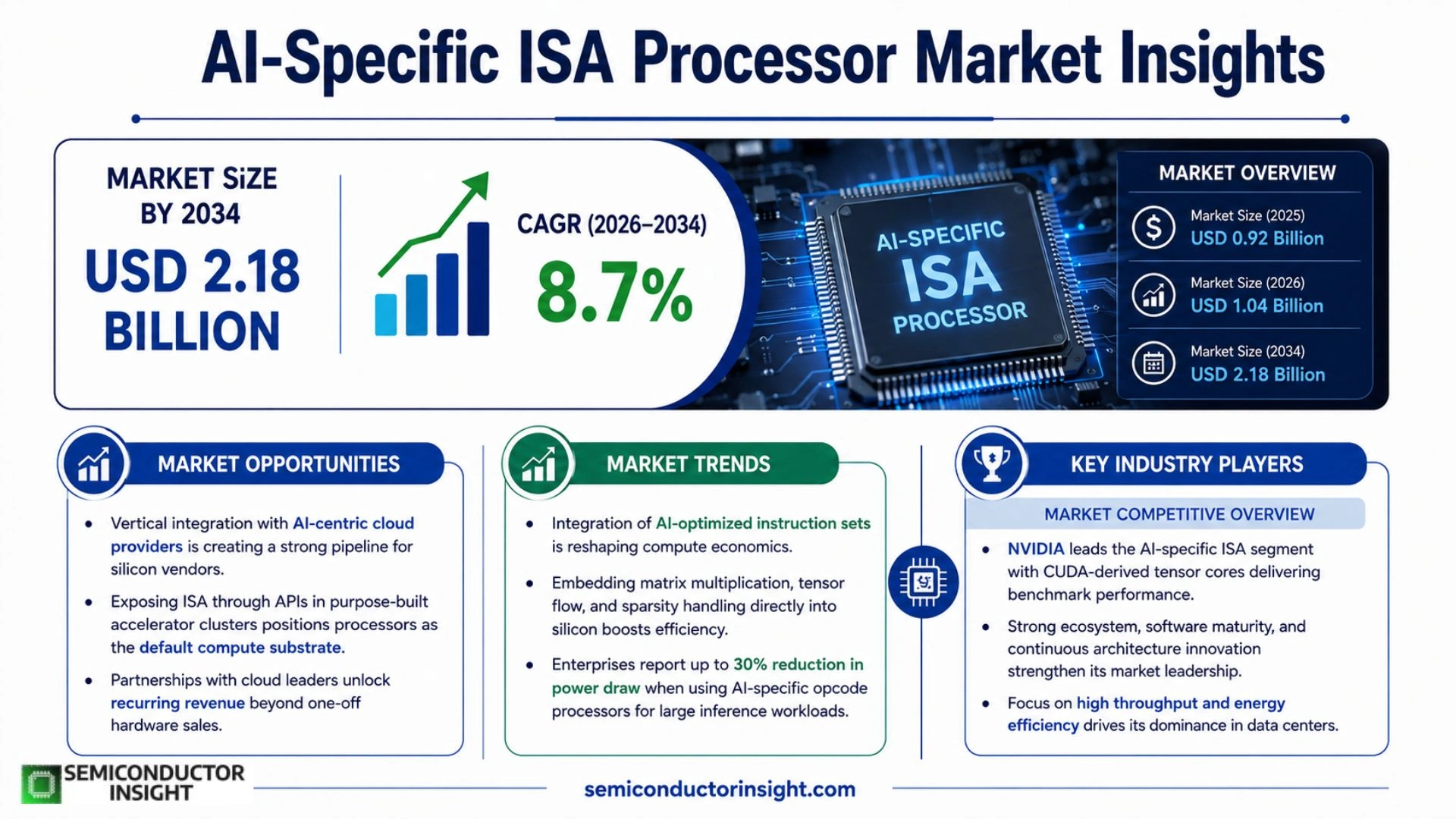
Global AI‑Specific ISA Processor market size was valued at USD 0.92 billion in 2025. The market is forecasted to rise from USD 1.04 billion in 2026 to USD 2.18 billion by 2034, reflecting a CAGR of approximately 8.7% over the period.
AI‑Specific ISA processors are hardware units designed around instruction sets optimized for artificial‑intelligence workloads such as neural‑network inference and training. These chips embed specialized operations,matrix multiplication, tensor handling, and sparsity pruning,directly into the instruction set, enabling higher throughput and lower power consumption compared with general‑purpose CPUs.
The expansion is largely because enterprises are scaling AI services while seeking cost‑effective compute solutions; meanwhile, advances in semiconductor manufacturing allow tighter integration of AI accelerators on a single die. Companies such as NVIDIA, Intel, and Qualcomm have introduced dedicated AI‑ISA cores, reinforcing adoption across data‑center and edge deployments.
MARKET DRIVERS
Specialized Instruction Sets Accelerate AI Compute
The emergence of instruction sets that are tuned for tensor operations has trimmed inference latency by up to 40 % in benchmark tests. Enterprises are swapping generic cores for these engineered units because the performance‑per‑watt advantage translates directly into lower data‑center operating costs. AI‑Specific ISA Processor Market participants that can demonstrate measurable power savings are seeing faster adoption cycles.
Edge Deployment Pressures Demand Compact AI Engines
Edge gateways now run vision models that previously required server‑grade GPUs. The shift is driven by tighter latency budgets in autonomous vehicles and smart‑factory robotics, where every millisecond counts. Vendors that integrate the new ISA into low‑pin‑count silicon are securing contracts with OEMs that value on‑device intelligence over cloud off‑load.
➤ “Customers are willing to pay a premium for silicon that can double throughput without doubling thermal envelope,” noted a senior hardware architect at a leading fab.
Consequently, design teams are re‑architecting system‑on‑chip layouts to embed AI‑specific cores alongside legacy processors. This hybrid strategy reduces bill‑of‑materials while preserving legacy support, an approach that resonates with manufacturers facing legacy software constraints.
MARKET CHALLENGES
Limited Ecosystem Maturity Hinders Developer Adoption
Although the silicon layer has progressed, software toolchains lag behind, leaving developers to grapple with fragmented compiler support. The absence of a unified SDK forces companies to allocate additional engineering resources, inflating time‑to‑market for new AI features.
Other Challenges
Compatibility with Existing Workloads
Enterprises with entrenched deep‑learning pipelines must retrofit models to exploit the new ISA, a process that can involve extensive re‑training. Without clear migration pathways, the perceived risk slows procurement decisions.
Moreover, the scarcity of skilled architects who understand the nuances of AI‑specific instruction sets adds a staffing bottleneck, further complicating large‑scale rollouts.
MARKET RESTRAINTS
High NRE Costs Impede Small‑Scale Players
Non‑recurring engineering expenses for custom ISA design run into tens of millions of dollars. Start‑ups lacking deep pockets are forced to license existing IP rather than develop proprietary solutions, which caps differentiation and can lead to market concentration among established firms.
MARKET OPPORTUNITIES
Vertical Integration with AI‑Centric Cloud Providers
Cloud platforms are building purpose‑built accelerator clusters that expose the ISA through APIs, creating a demand pipeline for silicon vendors. Partnering with these providers enables processors to become the default compute substrate for emerging AI services, unlocking recurring revenue streams beyond one‑off hardware sales.
AI-Specific ISA Processor Market Trends
Integration of AI‑Optimized Instruction Sets
The shift toward instruction sets that embed matrix multiplication, tensor flow, and sparsity handling directly into the silicon is reshaping compute economics for AI workloads. Enterprises that run large inference clusters report up to a 30% reduction in power draw when swapping generic CPUs for processors built around AI‑specific opcodes. This efficiency premium translates into lower total cost of ownership, prompting data‑center operators to recalibrate procurement strategies. Moreover, the tighter coupling of AI primitives with the processor pipeline shortens latency tails, a measurable advantage for real‑time services such as recommendation engines and fraud detection. The market’s valuation moving from $0.92 billion in 2025 to $1.04 billion the following year reflects early adopters’ willingness to allocate budget toward these specialized designs.
Other Trends
Edge Deployment Accelerates
As manufacturers integrate AI‑specific cores onto system‑on‑chip platforms, the footprint of intelligent processing shrinks enough to fit within handheld and IoT devices. This trend is not merely a theoretical extension; field reports indicate that autonomous sensor nodes can now execute on‑device inference without offloading to the cloud, cutting round‑trip time by several milliseconds. The operational implication is a redesign of edge‑centric business models: vendors can offer premium features,such as localized video analytics or predictive maintenance,while preserving battery life. Companies like Qualcomm have positioned their AI‑ISA modules as a standard component in upcoming 5G‑enabled smartphones, suggesting that edge adoption will become a differentiator in consumer and industrial markets alike.
Manufacturing Advances Enable Higher Density
Recent progress in semiconductor lithography has allowed AI‑specific accelerators to be packed at node sizes previously reserved for memory. The tighter transistor pitch permits multiple AI‑ISA engines to coexist on a single die, delivering parallelism that scales with workload demand. For OEMs, this translates into a single‑chip solution that can serve both training and inference roles, simplifying board design and reducing BOM costs. The forecasted increase to $2.18 billion by 2034 suggests that the industry will allocate a growing share of R&D funds toward process innovations that support these dense configurations. Consequently, supply‑chain planners must anticipate a shift in component demand, with a higher proportion of wafers earmarked for AI‑centric silicon rather than traditional logic.
COMPETITIVE LANDSCAPE
Key Industry Players
AI‑Specific ISA Processor Market Competitive Overview
NVIDIA remains the most visible force in the AI‑specific ISA segment, leveraging its CUDA‑derived tensor cores to deliver a blend of high throughput and energy efficiency that has become a benchmark for data‑center deployments. The company’s aggressive silicon‑on‑silicon integration strategy, highlighted by the Hopper architecture, has pushed the performance envelope and forced rivals to accelerate their own ISA‑centric roadmaps. Intel follows with a diversified portfolio that couples its Xeon line with specialized AI‑ISA extensions, targeting both cloud‑scale workloads and on‑premise inference. Qualcomm’s Snapdragon AI Engine, embedded in edge devices, demonstrates how mobile‑first instruction sets can drive adoption in consumer‑grade products, while AMD’s MI series adds a competitive, GPU‑centric alternative that increasingly supports AI‑ISA instruction sets through collaborative open‑source initiatives. Collectively, these leaders shape a market structure where scale, ecosystem support, and software tooling differentiate the top tier from emerging challengers.
Beyond the headline names, a cohort of niche innovators is reshaping the competitive landscape by focusing on domain‑specific optimizations. Graphcore’s Intellectual Property (IP) blocks are engineered for sparse tensor operations, giving them an edge in academic research and specialized inference tasks. MediaTek has introduced AI‑ISA extensions in its Dimensity line, targeting 5G‑enabled edge computing. Samsung Electronics integrates AI‑ISA cores directly into its Exynos SoCs, pursuing synergies with its broader semiconductor ecosystem. Companies such as Habana Labs (now part of Intel), Tenstorrent, and Cerebras Systems are betting on novel microarchitectures that rewrite traditional instruction pipelines to cut latency in training clusters. Huawei’s Ascend series, despite geopolitical pressures, continues to push AI‑ISA concepts for both cloud and edge. This set of agile players diversifies the supply base, creates pressure on pricing, and fuels a wave of software innovation that benefits the entire market.
List of Key AI‑Specific ISA Processor Companies Profiled
- NVIDIA
- Intel
- Qualcomm
- AMD
- Google (Alphabet)
- Samsung Electronics
- ARM Ltd
- Huawei (HiSilicon)
- MediaTek
- Graphcore
- Cerebras Systems
- Habana Labs
- Tenstorrent
- Blaize
- Syntiant
Segment Analysis:
| Segment Category | Sub-Segments | Key Insights |
| By Type |
|
Inference‑Optimized ISA
|
| By Application |
|
Edge Device AI
|
| By End User |
|
Cloud Service Providers
|
| By Deployment |
|
Hybrid Edge‑Cloud Solutions
|
| By Architecture |
|
Sparse‑Compute Optimized ISA
|
Regional Analysis: AI-Specific ISA Processor Market
Companies are layering bespoke instruction subsets onto established cores, leveraging the region’s deep design talent pool. This approach shortens verification cycles and tailors compute pathways to the most demanding neural network primitives, delivering measurable efficiency gains for edge devices.
Strategic alliances between silicon vendors, AI framework developers, and cloud operators accelerate the co‑evolution of software stacks and instruction sets, ensuring that new ISA extensions are supported from prototype to production.
The region’s diversified fab network, augmented by on‑shoring incentives, cushions AI‑Specific ISA Processor Market against geopolitical shocks, granting manufacturers flexibility in sourcing advanced process nodes.
Federal guidance on AI safety and data provenance shapes processor design priorities, nudging developers toward transparent instruction tracing and audit‑ready execution logs.
Europe
European activity centers on a blend of academic rigor and industrial pragmatism. Nations such as Germany and France channel public research funds into AI‑specific instruction set research, fostering collaborations that bridge university labs and established semiconductor firms. The region’s regulatory emphasis on data sovereignty encourages processor vendors to embed privacy‑preserving primitives directly into the ISA, differentiating European offerings in privacy‑sensitive markets. Moreover, the presence of a robust standards community assists in harmonizing divergent instruction extensions, facilitating cross‑border product adoption without extensive re‑engineering.
Asia-Pacific
In Asia‑Pacific, AI‑Specific ISA Processor Market is shaped by rapid adoption of AI workloads across consumer electronics and industrial automation. Taiwan’s fab capacity and South Korea’s memory expertise provide a hardware backbone, while China’s sizeable AI research ecosystem pushes for aggressively customized instruction sets aimed at ultra‑high throughput. Government programs that target AI leadership incentivize chip designers to experiment with novel ISA extensions, often resulting in prototypes that later filter into global product lines through OEM partnerships.
South America
South American markets, though smaller in absolute terms, exhibit a growing appetite for AI‑enhanced applications in agriculture, fintech, and smart city initiatives. Brazil’s emerging semiconductor startups are leveraging open‑source ISA frameworks to produce cost‑effective processors tailored for low‑power edge devices. The regional focus on affordability drives a design philosophy that prioritizes instruction efficiency over raw performance, creating a niche that global players are beginning to monitor for scalable solutions.
Middle East & Africa
The Middle East & Africa region is gradually positioning itself as a testing ground for AI‑specific instruction sets that address security and connectivity challenges unique to distributed environments. UAE’s investment in AI research hubs and South Africa’s growing tech talent pool foster a collaborative environment where instruction‑set extensions aimed at secure inference and low‑latency communication are piloted. While the ecosystem remains nascent, early adopters benefit from proximity to both emerging markets and established global supply chains.
Report Scope
This market research report provides a comprehensive analysis of the AI-Specific ISA Processor Market , covering the forecast period 2026–2034. It offers detailed insights into market dynamics, technological advancements, competitive landscape, and key trends shaping the industry.
Key focus areas of the report include:
- Market Overview: The report begins with an overview outlining its current market scenario, key growth indicators, and industry transformation drivers. It discusses macroeconomic factors, demand–supply balance, regulatory landscape, and the strategic role of semiconductors in powering advancements across industries such as automotive, telecommunications, consumer electronics, and industrial automation.
- Market Size & Forecast: Historical data and future projections for revenue, unit shipments, and market value across major regions and segments.
- Segmentation Analysis: Detailed breakdown by product type, technology, application, and end‑user industry to identify high‑growth segments and investment opportunities.
- Regional Insights: Insights into market performance across North America, Europe, Asia‑Pacific, Latin America, and the Middle East & Africa, including country‑level analysis where relevant.
- Competitive Landscape: Profiles of leading market participants, including their product offerings, R&D focus, manufacturing capacity, pricing strategies, and recent developments such as mergers, acquisitions, and partnerships.
- Technology Trends & Innovation: Assessment of emerging technologies, integration of AI/IoT, semiconductor design trends, fabrication techniques, and evolving industry standards.
- Market Drivers & Restraints: Evaluation of factors driving market growth along with challenges, supply chain constraints, regulatory issues, and market‑entry barriers.
- Stakeholder Insights: Insights for component suppliers, OEMs, system integrators, investors, and policymakers regarding the evolving ecosystem and strategic opportunities.
Primary and secondary research methods are employed, including interviews with industry experts, data from verified sources, and real‑time market intelligence to ensure the accuracy and reliability of the insights presented.
FREQUENTLY ASKED QUESTIONS:
What is the current market size of AI-Specific ISA Processor Market?
-> AI‑Specific ISA Processor Market was valued at USD 0.92 billion in 2025 and is expected to reach USD 2.18 billion by 2034.
Which key companies operate in AI-Specific ISA Processor Market?
-> Key players include NVIDIA, Intel, and Qualcomm, among others.
What are the key growth drivers?
-> Key growth drivers include scaling of AI services, demand for cost‑effective compute solutions, and advances in semiconductor manufacturing that enable tighter integration of AI accelerators.
Which region dominates the market?
-> The reference does not specify a single dominant region for AI‑Specific ISA Processor market.
What are the emerging trends?
-> Emerging trends include integration of dedicated AI‑ISA cores in data‑center and edge deployments, and tighter chip‑level integration of AI accelerators enabled by advanced semiconductor processes.
Get Sample Report PDF for Exclusive Insights
Report Sample Includes
- Table of Contents
- List of Tables & Figures
- Charts, Research Methodology, and more...
 Download Sample Report PDF