AI-Specific Hardware Security Module Market Insights
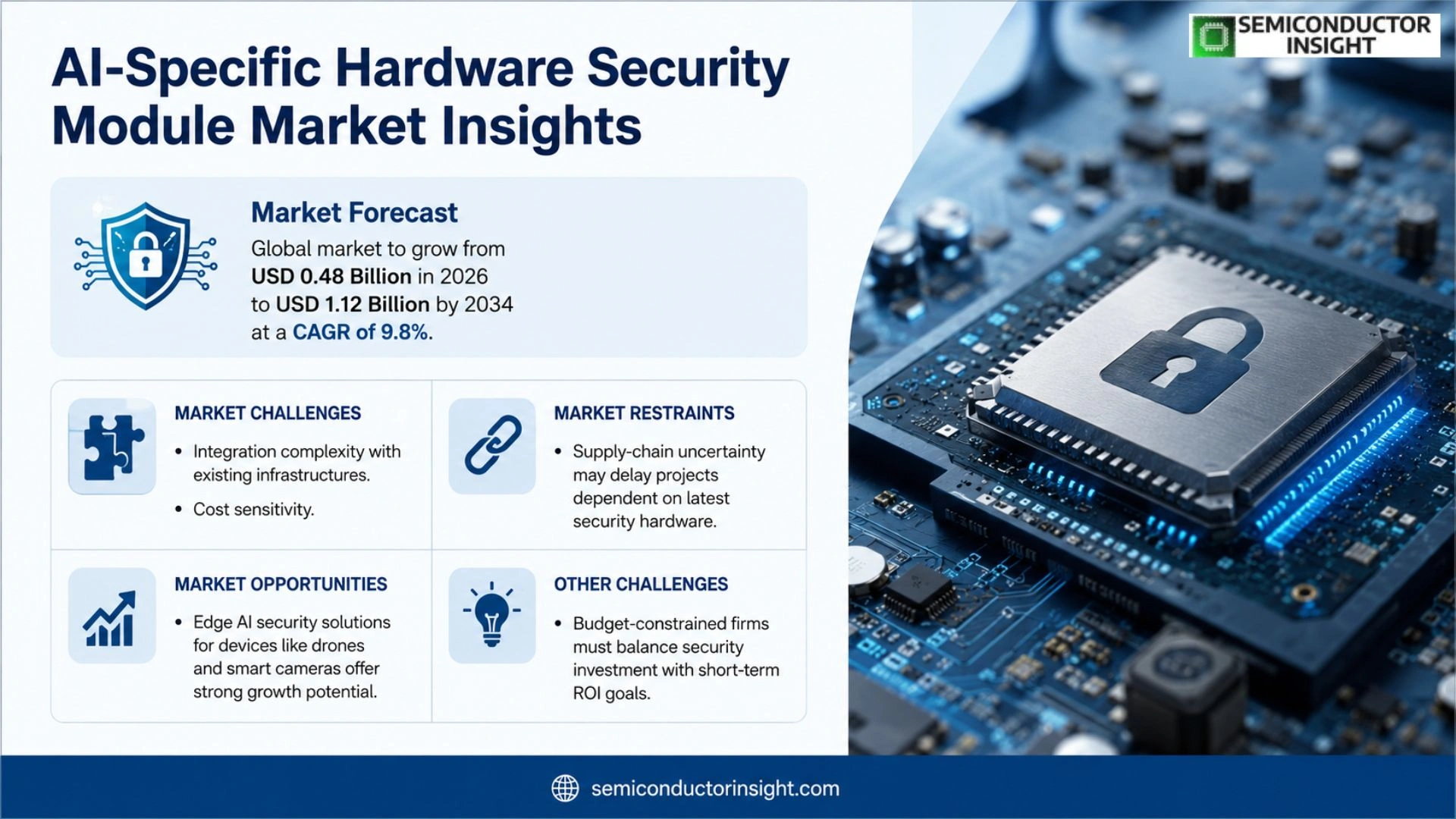
Global AI-specific hardware security module market size was valued at USD 0.45 billion in 2025. The market is forecasted to increase from USD 0.48 billion in 2026 to USD 1.12 billion by 2034, reflecting a CAGR of 9.8% over the forecast horizon.
AI‑specific hardware security modules are tamper‑resistant devices engineered to safeguard cryptographic keys and model parameters used during artificial‑intelligence training and inference workloads. They integrate secure enclaves, side‑channel resistance, and attestation mechanisms tailored for high‑throughput neural‑network operations.
The expansion of this segment stems from heightened investment in generative‑AI platforms, stricter data‑privacy regulations demanding verifiable model integrity, and growing concerns over model theft in cloud environments. Recent collaborations illustrate this momentum,for example, Nvidia partnered with Thales in March 2024 to embed secure key management within its DGX systems, while Intel announced an enhanced SGX‑based offering for confidential AI inference later that year. Established vendors such as IBM, Gemalto (Thales), and Marvell continue broadening their portfolios through firmware updates and dedicated accelerator cards.
MARKET DRIVERS
AI Model Confidentiality Requirements
Enterprises handling large‑scale neural networks are confronting heightened scrutiny over data leakage. The AI‑Specific Hardware Security Module Market gains traction because firms need tamper‑resistant enclaves that can isolate model weights and inference logs from hostile software layers. This demand creates a premium for modules engineered with low‑latency cryptographic accelerators that keep pace with AI workloads.
Regulatory Compliance Pressures
New data‑privacy statutes across Europe and Asia now reference “algorithmic provenance,” pushing vendors to prove that AI pipelines are protected end‑to‑end. Organizations that ignore these obligations risk fines and loss of market reputation, encouraging them to embed dedicated security chips into inference servers and edge devices. The shift from generic TPMs to purpose‑built modules reflects a strategic response to evolving legal expectations.
➤ “Secure AI execution is becoming a non‑negotiable baseline for any organization that monetizes machine‑learning services.”
Beyond compliance, the rise of AI‑driven services in finance and healthcare amplifies the need for tamper‑proof key management. Providers that integrate AI‑specific security modules can bundle assurance guarantees with their offerings, differentiating themselves in a crowded market while reducing the likelihood of intellectual‑property theft.
MARKET CHALLENGES
Integration Complexity with Existing Infrastructures
Many data centers were designed around general‑purpose processors and conventional security modules. Retrofitting AI‑specific hardware often requires firmware redesign, driver development, and extensive validation cycles. Companies without deep‑stack engineering resources may postpone adoption, preferring to wait for standardized integration toolkits.
Other Challenges
Cost Sensitivity
The specialized nature of these modules translates into higher unit prices compared with legacy solutions. Budget‑constrained firms, particularly startups, must weigh the security premium against the immediate ROI of scaling AI models.
MARKET RESTRAINTS
Supply‑Chain Uncertainty
Production of AI‑optimized silicon relies on a limited set of foundries that are already operating near capacity. Any disruption,from geopolitical tensions to raw‑material shortages,can delay shipments, forcing customers to postpone projects that depend on the latest security hardware.
MARKET OPPORTUNITIES
Edge AI Security Solutions
Deployments of AI inference at the network edge,such as autonomous drones or smart cameras,create a niche where traditional data‑center security cannot be applied. Vendors that offer compact, low‑power security modules tailored for edge processors can capture a growing segment of the AI‑Specific Hardware Security Module Market, especially as edge AI applications proliferate across industries.
AI-Specific Hardware Security Module Market Trends
Surge in Demand Linked to Generative‑AI Deployments
AI-Specific Hardware Security Module Market has moved beyond niche security applications toward becoming a foundational element of modern AI infrastructure. Firms that host large‑scale language models now treat tamper‑resistant key storage as a prerequisite for protecting both training data and inference outputs. The shift is evident in the incremental rise from a valuation of roughly USD 0.45 billion in 2025 to an estimated USD 1.12 billion by 2034, reflecting a compound growth rate close to 10 percent annually. This momentum is not merely a function of revenue growth; it signals a strategic re‑allocation of capital toward hardware that can guarantee model integrity while satisfying rigorous compliance checks. Companies that embed secure enclaves directly into accelerator cards are able to differentiate their offerings, reduce the risk of intellectual‑property exfiltration, and meet the heightened expectations of enterprise AI buyers.
Other Trends
Strategic Partnerships Reinforce Ecosystem Expansion
Collaboration between chipset manufacturers and security specialists has accelerated the rollout of purpose‑built solutions. A notable example is the March 2024 agreement between Nvidia and Thales, which integrated secure key management modules into the DGX line, thereby delivering end‑to‑end protection for high‑performance training clusters. Later that year Intel introduced an SGX‑enhanced platform tailored for confidential inference, reinforcing the trend of embedding cryptographic safeguards directly within processor silicon. Meanwhile, established vendors such as IBM, Gemalto (Thales), and Marvell have broadened their portfolios through firmware upgrades that extend side‑channel resistance and attestation capabilities. These alliances reduce time‑to‑market for customers and create a virtuous cycle where increased adoption fuels further joint development, strengthening the overall value proposition of the AI‑Specific Hardware Security Module Market.
Regulatory Scrutiny Drives Robust Security Architectures
Emerging data‑privacy statutes across Europe, North America, and Asia are compelling cloud providers to demonstrate verifiable safeguards for AI workloads. Regulations now require demonstrable model provenance and cryptographic assurance that only authorized entities can access sensitive parameters. As a result, organizations are upgrading legacy security appliances with hardware modules that support rapid attestation and secure boot processes tailored for neural‑network workloads. This regulatory pressure not only raises the barriers to entry for smaller players but also creates a differentiated market segment where vendors that can certify compliance gain a competitive edge. The confluence of legal requirements and technical necessity is reshaping procurement strategies, making the AI‑Specific Hardware Security Module Market an essential consideration for any enterprise looking to scale AI responsibly.
COMPETITIVE LANDSCAPE
Key Industry Players
AI‑Specific HSM Market: Competitive Overview
Nvidia, leveraging its DGX AI infrastructure, has become a de‑facto anchor for hardware‑based key protection, especially after its 2024 collaboration with Thales to embed tamper‑resistant modules directly on accelerator boards. Intel follows a parallel path, extending its SGX enclave technology to deliver confidential inference workloads, a move that positions the chip‑maker as a pivotal supplier for cloud‑centric AI providers. Thales (owner of Gemalto) retains a broad portfolio that spans traditional banking HSMs to AI‑tailored secure processors, allowing it to serve both legacy and emerging AI customers. IBM’s acquisition of Red Hat’s security capabilities has resulted in a cross‑platform HSM offering that bridges on‑premises data‑center needs with hybrid cloud AI deployments. Marvell, known for its high‑bandwidth ASICs, recently announced a dedicated security accelerator that isolates model parameters while maintaining throughput, an approach that resonates with hyperscale compute farms. Collectively, these firms account for the majority of revenue in the segment, the market displaying a clear oligopolistic pattern where strategic alliances and joint‑development programs drive differentiation.
Beyond the headline names, a cadre of specialized vendors is expanding the ecosystem. Google Cloud’s Titan HSM provides a cloud‑native key vault that is increasingly integrated with its Vertex AI services, appealing to enterprise customers demanding end‑to‑end provenance. AMD’s emerging confidential compute line incorporates a hardened key store designed for its EPYC processors, targeting workloads that require both performance and secrecy. ARM’s TrustZone continues to evolve, offering a lightweight enclave for edge AI devices, while Samsung’s Knox‑based HSM solutions focus on mobile‑centric inference engines. Asian cloud giants such as Alibaba Cloud and Huawei Cloud have launched proprietary AI HSMs to satisfy regional data‑sovereignty requirements. Cisco’s security portfolio now includes an AI‑focused module that can be slotted into its UCS servers. Start‑up players like Rambus and Cynet are introducing silicon‑level protections that specialize in side‑channel resistance for generative‑AI models. The diversity of these participants underscores a market where niche expertise,whether in edge devices, cloud services, or specific regulatory regimes,creates opportunities for differentiated value propositions.
List of Key AI‑Specific Hardware Security Module Companies Profiled
- Nvidia
- Intel
- Thales (Gemalto)
- IBM
- Marvell Technology Group
- Google Cloud (Titan HSM)
- AMD
- ARM
- Samsung Electronics
- Alibaba Cloud
- Huawei Cloud
- Cisco Systems
- Rambus
- Cynet
- Xilinx (now part of AMD)
Segment Analysis:
| Segment Category | Sub-Segments | Key Insights |
| By Type |
|
Tamper‑Resistant HSMs are the leading segment because they directly address the core concern of protecting cryptographic keys and model parameters against physical intrusion and invasive attacks.
|
| By Application |
|
Generative AI Model Protection stands out as the primary application focus, driven by heightened concerns over model theft and intellectual property leakage.
|
| By End User |
|
Cloud Service Providers dominate this segment as they manage large‑scale AI workloads and must guarantee model confidentiality for diverse clientele.
|
| By Deployment Model |
|
On‑Premise Appliances are emerging as a critical deployment model for organizations with strict data‑sovereignty mandates.
|
| By Security Feature |
|
Side‑Channel Resistant Designs attract attention as adversaries increasingly target subtle leakage pathways in high‑performance AI hardware.
|
Regional Analysis: AI-Specific Hardware Security Module Market
North America
Recent amendments to data‑protection statutes in the United States and Canada explicitly reference cryptographic modules for AI models, prompting vendors to certify their hardware against emerging standards. This regulatory pressure accelerates the adoption of tamper‑evident designs, nudging OEMs toward design‑for‑security practices that were previously optional.
Large‑scale AI projects now intersect with heightened risk assessments, and CIOs are demanding hardware that can isolate model weights from external access. The assurance of on‑chip key storage reduces reliance on software vaults, directly influencing budgeting cycles for AI‑centric digital transformation initiatives.
A handful of North American chipmakers have rolled out AI‑optimized secure elements that integrate with major DL accelerators. Their strategic alliances with system integrators give them leverage in shaping reference architectures that become de‑facto industry templates.
Proximity of silicon fabs to major AI research hubs shortens design‑to‑production loops, allowing rapid iteration on security features. This geographic advantage also mitigates geopolitical disruptions that can stall hardware rollout in other regions.
Europe
European firms are reconfiguring their AI strategies to embed security at the silicon level, spurred by the EU’s emphasis on trustworthy AI and the forthcoming Crypto‑Secure Hardware directive. Market participants see a shift from legacy TPMs toward modules that can certify model provenance, a move that aligns with cross‑border data‑sharing agreements. Suppliers that can demonstrate compliance with both GDPR and emerging AI security standards are rapidly gaining traction among pan‑European conglomerates, especially in the automotive and fintech sectors.
Asia‑Pacific
In the Asia‑Pacific corridor, the AI‑Specific Hardware Security Module market is being shaped by aggressive national AI agendas and burgeoning manufacturing ecosystems. Countries such as Japan and South Korea are investing heavily in secure AI chips to protect intellectual property within dense semiconductor clusters. Meanwhile, the rapid expansion of cloud data centers in Southeast Asia is prompting service providers to integrate hardware‑based key isolation to reassure multinational customers wary of supply‑chain vulnerabilities.
South America
South American enterprises are beginning to recognize the strategic advantage of securing AI workloads at the hardware tier, driven by rising cyber‑risk awareness in the financial services industry. Regional startups are collaborating with North American vendors to localize secure module designs, a partnership that helps bridge the technology gap while adhering to local compliance frameworks. The nascent but growing demand is encouraging policymakers to draft incentives that favor hardware security investments.
Middle East & Africa
The Middle East & Africa region is witnessing a tentative but steady uptake of AI hardware security solutions, largely fueled by government‑led digital transformation programs that target critical infrastructure protection. Sovereign wealth funds are allocating capital to niche hardware developers that can offer tamper‑resistant AI accelerators, viewing them as essential components for future smart‑city initiatives. Although market penetration remains modest, the strategic emphasis on secure AI hints at a longer‑term acceleration as regional adoption matures.
Report Scope
This market research report provides a comprehensive analysis of the AI-Specific Hardware Security Module Market , covering the forecast period 2026–2034. It offers detailed insights into market dynamics, technological advancements, competitive landscape, and key trends shaping the industry.
Key focus areas of the report include:
- Market Overview: The report begins with an overview outlining its current market scenario, key growth indicators, and industry transformation drivers. It discusses macroeconomic factors, demand–supply balance, regulatory landscape, and the strategic role of semiconductors in powering advancements across industries such as automotive, telecommunications, consumer electronics, and industrial automation.
- Market Size & Forecast: Historical data and future projections for revenue, unit shipments, and market value across major regions and segments.
- Segmentation Analysis: Detailed breakdown by product type, technology, application, and end-user industry to identify high-growth segments and investment opportunities.
- Regional Insights: Insights into market performance across North America, Europe, Asia-Pacific, Latin America, and the Middle East & Africa, including country-level analysis where relevant.
- Competitive Landscape: Profiles of leading market participants, including their product offerings, R&D focus, manufacturing capacity, pricing strategies, and recent developments such as mergers, acquisitions, and partnerships.
- Technology Trends & Innovation: Assessment of emerging technologies, integration of AI/IoT, semiconductor design trends, fabrication techniques, and evolving industry standards.
- Market Drivers & Restraints: Evaluation of factors driving market growth along with challenges, supply chain constraints, regulatory issues, and market-entry barriers.
- Stakeholder Insights: Insights for component suppliers, OEMs, system integrators, investors, and policymakers regarding the evolving ecosystem and strategic opportunities.
Primary and secondary research methods are employed, including interviews with industry experts, data from verified sources, and real-time market intelligence to ensure the accuracy and reliability of the insights presented.
FREQUENTLY ASKED QUESTIONS:
What is the current market size of AI-Specific Hardware Security Module Market?
-> AI-specific hardware security module market is forecasted to increase from USD 0.48 billion in 2026 to USD 1.12 billion by 2034.
Which key companies operate in AI-Specific Hardware Security Module Market?
-> Key players include Nvidia, Thales (including Gemalto), Intel, IBM, and Marvell, among others.
What are the key growth drivers?
-> Key growth drivers include heightened investment in generative‑AI platforms, stricter data‑privacy regulations demanding verifiable model integrity, and growing concerns over model theft in cloud environments.
Which region dominates the market?
-> The market is global with strong activity across major regions; no single region is identified as dominant in the reference data.
What are the emerging trends?
-> Emerging trends include strategic collaborations such as Nvidia‑Thales secure key integration, Intel’s SGX‑based confidential AI inference solutions, and continuous firmware updates & dedicated accelerator cards from established vendors.
Get Sample Report PDF for Exclusive Insights
Report Sample Includes
- Table of Contents
- List of Tables & Figures
- Charts, Research Methodology, and more...
 Download Sample Report PDF