AI Smart TV Image Quality Processor Market Insights
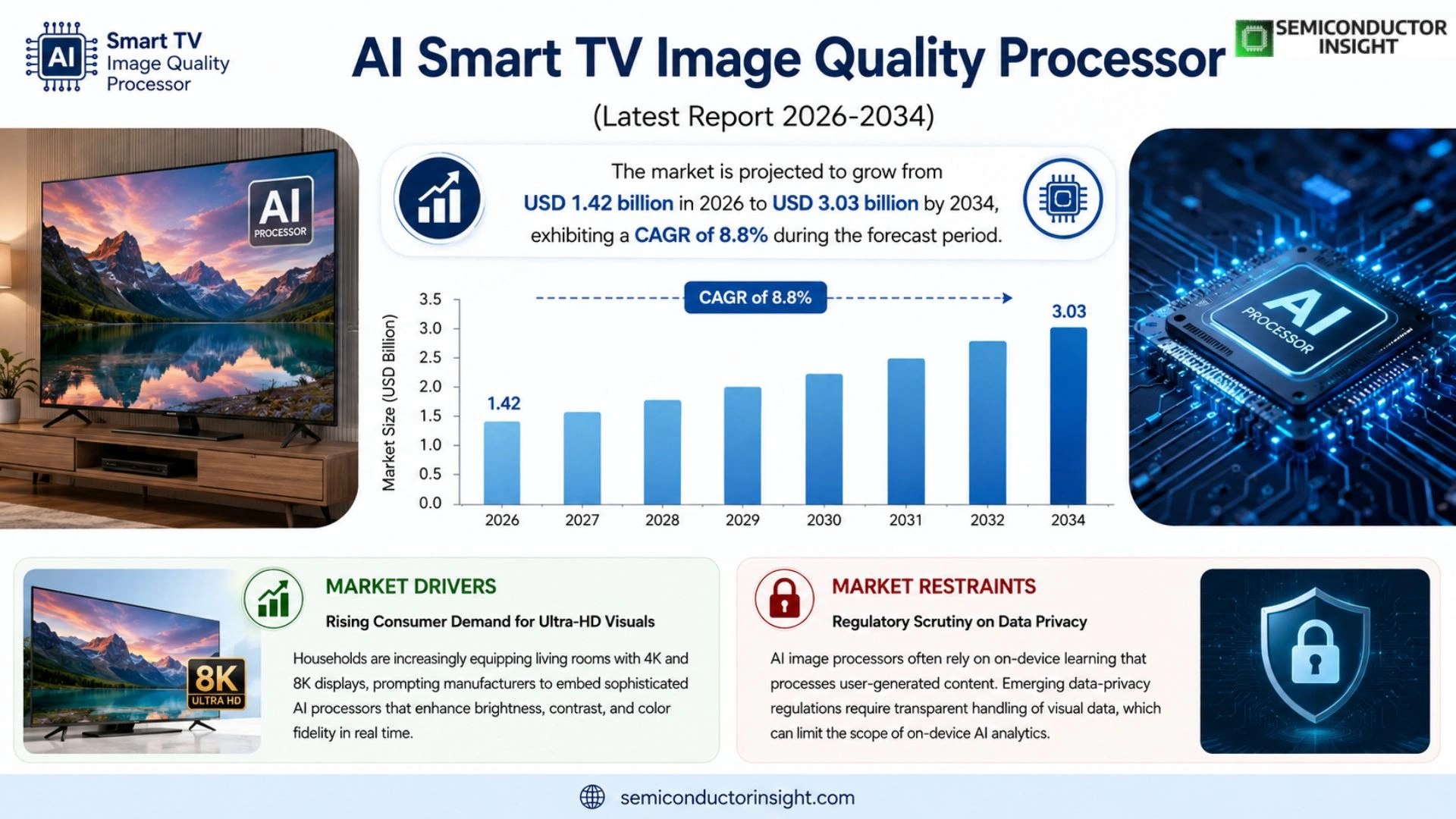
Global AI Smart TV Image Quality Processor market size is projected to grow from USD 1.42 billion in 2025 to USD 3.03 billion by 2034, exhibiting a CAGR of 8.8% during the forecast period.
AI Smart TV Image Quality Processors are specialized semiconductor and software solutions that apply deep‑learning algorithms to enhance picture fidelity in real time,upscaling low‑resolution content, optimizing HDR tone‑mapping, reducing noise, and dynamically adjusting color balance based on scene analysis.
The market is experiencing rapid growth because consumer demand for cinematic‑grade viewing experiences is rising alongside broader adoption of ultra‑high‑definition (UHD) displays. Furthermore, decreasing costs of edge‑AI chips and strategic collaborations,such as Nvidia’s partnership with Samsung Electronics to integrate Tensor cores into next‑generation QLED panels,are accelerating deployment rates.
MARKET DRIVERS
Rising Consumer Demand for Ultra‑HD Visuals
AI Smart TV Image Quality Processor Market is being propelled by a noticeable shift toward premium viewing experiences. Households are increasingly equipping living rooms with 4K and 8K displays, prompting manufacturers to embed sophisticated AI processors that enhance brightness, contrast, and color fidelity in real time.
Advancements in AI‑Based Upscaling Algorithms
Recent breakthroughs in deep‑learning upscaling enable low‑resolution content to be rendered at near‑native 4K quality. Companies report that AI‑driven pixel‑reconstruction can improve perceived sharpness by up to 30 %, creating a strong value proposition for both OEMs and end‑users.
➤ Industry analysts project a cumulative annual growth rate of 12 % for AI‑enhanced image processors through 2032, driven primarily by algorithmic innovation and price‑competitive silicon.
In parallel, streaming platforms are rolling out HDR10+, Dolby Vision, and dynamic metadata, which require real‑time AI processing to unlock their full potential. This synergy further accelerates market adoption and justifies higher price points for AI‑equipped televisions.
MARKET CHALLENGES
High Development Costs for Proprietary AI Models
Building and training proprietary AI models for image enhancement demands substantial investment in data acquisition, GPU infrastructure, and talent. Smaller manufacturers often lack the financial bandwidth to compete, leading to a fragmented competitive landscape.
Other Challenges
Integration with legacy hardware is another hurdle; retrofitting older TV architectures with advanced AI chips can increase bill‑of‑materials costs and complexity, discouraging OEMs from updating existing product lines.
Supply‑Chain Vulnerabilities
Global semiconductor shortages have intermittently constrained the availability of high‑performance AI processors, causing production delays and amplifying price volatility for end‑customers.
MARKET RESTRAINTS
Regulatory Scrutiny on Data Privacy
AI image processors often rely on on‑device learning that processes user‑generated content. Emerging data‑privacy regulations require transparent handling of visual data, which can limit the scope of on‑device AI analytics and increase compliance costs.
Additionally, some jurisdictions are introducing standards for AI explainability, compelling manufacturers to disclose algorithmic decision pathways. This extra layer of documentation can slow product launches and deter rapid feature iteration.
MARKET OPPORTUNITIES
Expansion into Emerging Smart‑Home Ecosystems
Beyond traditional television sets, AI image processors are finding applications in smart mirrors, digital signage, and automotive infotainment displays. Leveraging the same AI cores for diverse form factors opens new revenue streams and widens market penetration.
Furthermore, partnerships with cloud‑based content providers enable hybrid AI models that combine on‑device speed with server‑side computational depth, delivering superior upscaling without compromising latency. This collaborative approach is poised to unlock premium service bundles and subscription‑based enhancements.
AI Smart TV Image Quality Processor Market Trends
Accelerated Adoption Driven by Edge‑AI Chip Cost Reductions
AI Smart TV Image Quality Processor Market is witnessing a rapid shift as manufacturers embed edge‑AI chips directly into display panels. Lower silicon costs and higher integration densities enable real‑time upscaling, HDR tone‑mapping, and noise reduction without compromising power efficiency. This technical evolution aligns with consumer expectations for cinema‑like experiences on home screens, especially as ultra‑high‑definition panels become mainstream. Collaborative projects, such as the integration of Tensor cores into next‑generation QLED panels, illustrate how strategic partnerships are shortening the deployment cycle and expanding the functional envelope of smart televisions.
Other Trends
Integration of AI Accelerators in QLED and OLED Modules
Leading panel producers are embedding dedicated AI accelerators within both QLED and OLED modules. These accelerators execute deep‑learning models that analyze scene composition in milliseconds, dynamically adjusting color balance, contrast, and sharpness. The result is a perceptual improvement that is measurable in reduced motion blur and more accurate color reproduction across varied content sources. Such integration reduces reliance on external processing units, streamlining the supply chain and enabling slimmer form factors.
Firmware‑Driven Feature Expansion Enhances Longevity
Beyond hardware, the market is leveraging over‑the‑air firmware updates to introduce new image enhancement algorithms after product launch. This approach extends device lifecycles and provides manufacturers with a platform to test innovative processing techniques in a live environment. Consumers benefit from continuous performance improvements, while OEMs gather usage data that informs subsequent hardware revisions. The cumulative effect is a virtuous cycle of incremental value addition that sustains demand for AI‑enabled display solutions.
COMPETITIVE LANDSCAPE
Key Industry Players
AI Smart TV Image Quality Processor Market: Competitive Overview
AI Smart TV Image Quality Processor Market is anchored by a handful of technology powerhouses that combine deep‑learning ASICs with television OEM ecosystems. Nvidia’s Tensor‑core accelerators, integrated through a strategic partnership with Samsung Electronics, set a performance benchmark for real‑time upscaling and HDR tone‑mapping. Samsung leverages its extensive QLED panel portfolio to embed AI chips directly into display modules, creating a vertically integrated solution that limits reliance on third‑party silicon. LG Display and MediaTek follow a similar model, with LG supplying AI‑enhanced panels to multiple brands while MediaTek offers cost‑effective edge‑AI SoCs that enable mid‑range smart TVs to deliver near‑premium picture quality. This concentration of semiconductor and OEM capabilities results in a tiered market structure: a core of vertically integrated giants, supplemented by specialized IP providers that license technology to a broader array of manufacturers.
Beyond the leading tier, niche players contribute depth and differentiation to the competitive set. Hisense and TCL exploit proprietary AI pipelines to differentiate their budget‑friendly 4K models, focusing on noise reduction and color balance algorithms tuned for regional content. Sony and Panasonic emphasize advanced picture‑processing engines that integrate AI with legacy image‑enhancement technologies, targeting high‑end audiophile segments. Sharp, Philips, and Xiaomi adopt hybrid approaches, bundling MediaTek or Qualcomm AI chips with custom firmware to balance cost and performance. Intel and AMD have entered the space with AI‑accelerated graphics solutions for next‑generation TV‑on‑PC convergent devices, while Google leverages its TV‑centric AI stack to deliver cloud‑enhanced upscaling for Android‑TV platforms.
List of Key AI Smart TV Image Quality Processor Companies Profiled
- Nvidia
- Samsung Electronics
- LG Display
- MediaTek
- Hisense
- TVNZ (TCL)
- Sony Corporation
- Panasonic
- Sharp
- Philips
- Intel
- AMD
- Qualcomm
- Google (Android TV)
Segment Analysis:
| Segment Category | Sub-Segments | Key Insights |
| By Type |
|
Chipset Solutions
|
| By Application |
|
HDR Tone‑Mapping
|
| By End User |
|
Premium Home Entertainment
|
| By Integration Level |
|
Embedded SoC
|
| By Algorithmic Approach |
|
Convolutional Neural Networks (CNN)
|
Regional Analysis: AI Smart TV Image Quality Processor Market
The appetite for AI‑enhanced picture quality stems from rising expectations for cinematic experiences at home, coupled with the rollout of 4K/8K content. Consumers increasingly seek televisions that automatically adapt scenes, delivering vivid color and deep contrast without manual calibration, fueling demand for sophisticated processors.
Manufacturers are embedding neural‑network based up‑scaling engines and real‑time noise reduction modules, leveraging on‑chip AI accelerators. This trend is reinforced by open‑source AI frameworks that reduce development cycles and enable rapid feature iteration.
The market is characterized by a handful of dominant chipset providers competing on performance per watt, alongside emerging startups focusing on niche algorithms for low‑light enhancement and motion interpolation, intensifying innovation pressure.
While regulatory scrutiny remains limited, standards bodies are establishing guidelines for AI transparency and energy efficiency, prompting OEMs to balance processing power with sustainability commitments.
Europe
European consumers exhibit a strong preference for high‑definition visual fidelity, encouraging manufacturers to prioritize AI‑based contrast optimization and color management. The region’s fragmented market, with multiple local brands, drives collaboration with software firms to differentiate products through unique picture modes. Energy‑efficiency regulations also shape processor design, prompting a shift toward low‑power AI chips that comply with stringent ecological standards while maintaining visual excellence.
Asia‑Pacific
In Asia‑Pacific, rapid urbanization and expanding middle‑class incomes accelerate adoption of premium smart TVs equipped with AI image processors. Local OEMs leverage cost‑effective semiconductor solutions to embed sophisticated up‑scaling capabilities, targeting price‑sensitive yet quality‑conscious buyers. Regional content providers increasingly offer HDR and 8K streams, further stimulating demand for processors that can dynamically enhance low‑resolution sources.
South America
South American markets are witnessing a gradual shift from budget‑oriented sets to higher‑end models that incorporate AI‑driven image enhancement. Consumers are becoming more discerning, valuing features like automatic scene recognition that improve viewing in diverse lighting conditions. Growing broadband access and localized content initiatives support the uptake of advanced processing technologies, albeit at a measured pace.
Middle East & Africa
The Middle East and Africa region presents a mix of luxury‑focused demand and emerging growth. Wealthier segments in the Gulf states adopt premium AI‑enabled televisions to complement high‑end home entertainment setups, while African markets prioritize affordability, prompting manufacturers to offer tiered AI solutions that balance cost with essential picture improvements.
Report Scope
This market research report provides a comprehensive analysis of the AI Smart TV Image Quality Processor Market , covering the forecast period 2026–2034. It offers detailed insights into market dynamics, technological advancements, competitive landscape, and key trends shaping the industry.
Key focus areas of the report include:
- Market Overview: The report begins with an overview outlining its current market scenario, key growth indicators, and industry transformation drivers. It discusses macroeconomic factors, demand–supply balance, regulatory landscape, and the strategic role of semiconductors in powering advancements across industries such as automotive, telecommunications, consumer electronics, and industrial automation.
- Market Size & Forecast: Historical data and future projections for revenue, unit shipments, and market value across major regions and segments.
- Segmentation Analysis: Detailed breakdown by product type, technology, application, and end-user industry to identify high-growth segments and investment opportunities.
- Regional Insights: Insights into market performance across North America, Europe, Asia-Pacific, Latin America, and the Middle East & Africa, including country-level analysis where relevant.
- Competitive Landscape: Profiles of leading market participants, including their product offerings, R&D focus, manufacturing capacity, pricing strategies, and recent developments such as mergers, acquisitions, and partnerships.
- Technology Trends & Innovation: Assessment of emerging technologies, integration of AI/IoT, semiconductor design trends, fabrication techniques, and evolving industry standards.
- Market Drivers & Restraints: Evaluation of factors driving market growth along with challenges, supply chain constraints, regulatory issues, and market-entry barriers.
- Stakeholder Insights: Insights for component suppliers, OEMs, system integrators, investors, and policymakers regarding the evolving ecosystem and strategic opportunities.
Primary and secondary research methods are employed, including interviews with industry experts, data from verified sources, and real-time market intelligence to ensure the accuracy and reliability of the insights presented.
FREQUENTLY ASKED QUESTIONS:
What is the current market size of AI Smart TV Image Quality Processor Market?
-> AI Smart TV Image Quality Processor market size is projected to grow from USD 1.42 billion in 2025 to USD 3.03 billion by 2034, exhibiting a CAGR of 8.8%.
Which key companies operate in AI Smart TV Image Quality Processor Market?
-> Key players include LG Display, MediaTek, Hisense, Sony Corporation, and Panasonic, among others.
What are the key growth drivers?
-> Key growth drivers include rising consumer demand for cinematic‑grade viewing experiences, broader adoption of ultra‑high‑definition (UHD) displays, decreasing costs of edge‑AI chips, and strategic collaborations such as Nvidia’s partnership with Samsung Electronics.
Which region dominates the market?
-> The reference does not specify a dominant region for this market.
What are the emerging trends?
-> Emerging trends include AI‑driven upscaling, HDR tone‑mapping optimization, real‑time noise reduction, and dynamic scene‑based color balancing.
Get Sample Report PDF for Exclusive Insights
Report Sample Includes
- Table of Contents
- List of Tables & Figures
- Charts, Research Methodology, and more...
 Download Sample Report PDF