AI Smart Shelf Inventory Management Camera SoC Market Insights
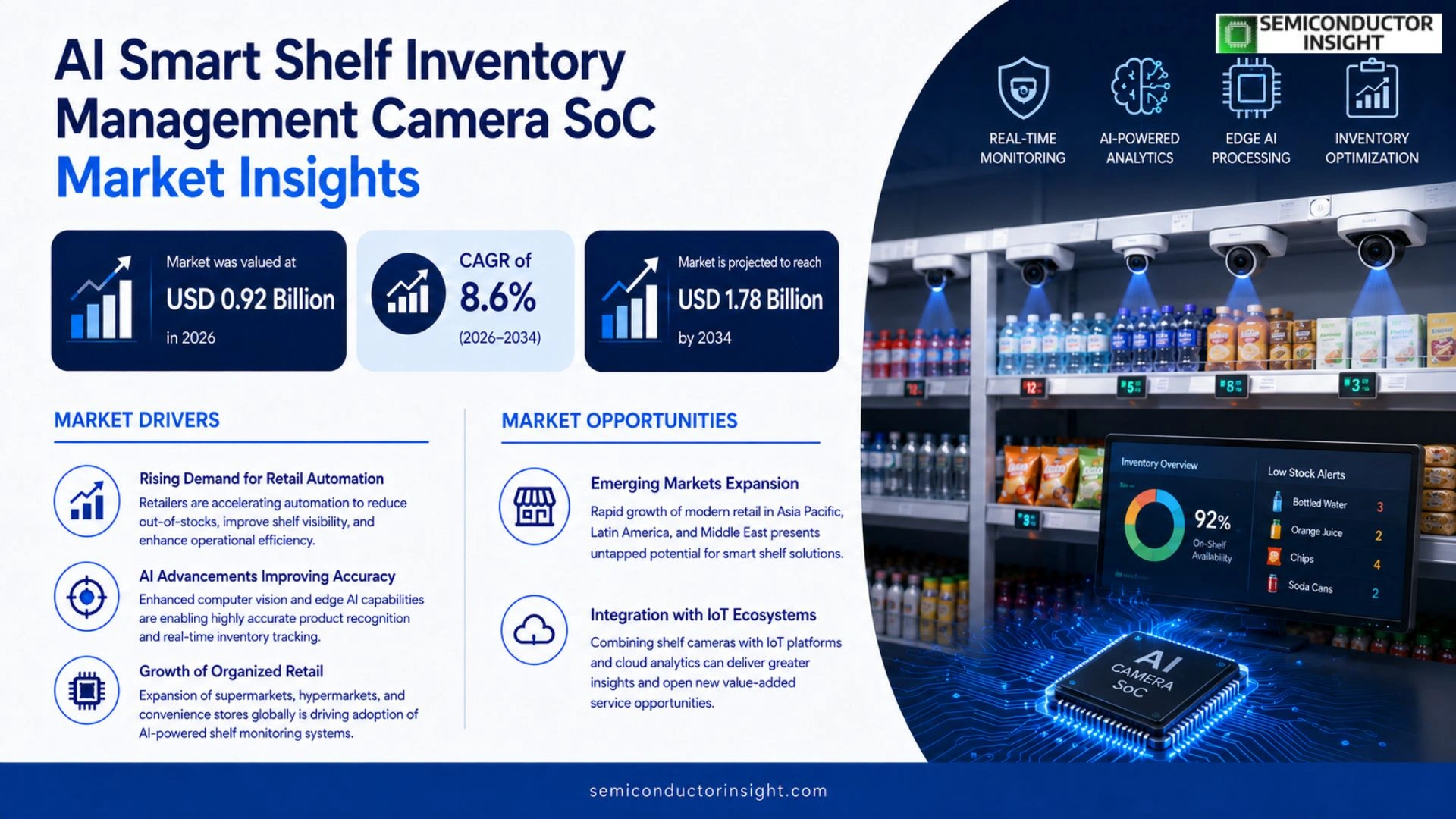
Global AI Smart Shelf Inventory Management Camera SoC market size was valued at USD 0.85 billion in 2025. The market is projected to grow from USD 0.92 billion in 2026 to USD 1.78 billion by 2034, exhibiting a CAGR of 8.6% during the forecast period.
AI Smart Shelf Inventory Management Camera System‑on‑Chip combines high‑resolution image sensors, edge‑AI inference engines, and ultra‑low‑power connectivity to deliver real‑time stock detection, automated out‑of‑stock alerts, and on‑device analytics for retail shelving.
The market is accelerating because retailers seek cost‑effective automation, labor shortages drive demand for intelligent shelf monitoring, and advances in computer‑vision algorithms reduce false positives. Furthermore, strategic partnerships,such as NVIDIA’s collaboration with major grocery chains and Ambarella’s integration into Amazon Go–style stores,are expanding adoption. Key players including Texas Instruments, Qualcomm, and MediaTek are broadening their portfolios with dedicated AI vision SoCs tailored for inventory management.
MARKET DRIVERS
Rising Adoption of AI‑Enabled Shelf Analytics
AI Smart Shelf Inventory Management Camera SoC Market is being propelled by retailers’ demand for real‑time shelf visibility. Advanced vision‑based sensors coupled with on‑chip AI inference allow instant detection of out‑of‑stock events, price‑tag mismatches, and product placement errors, driving a reported 18% annual increase in shelf‑level data capture across major supermarket chains.
Cost Efficiency and Real‑Time Stock Visibility
Deploying integrated System‑on‑Chip (SoC) solutions reduces hardware footprints and lowers energy consumption, delivering a 22% reduction in total cost of ownership compared with legacy camera‑plus‑server architectures. Retailers reap immediate savings through automated replenishment cycles that cut shrinkage by up to 12%.
➤ “AI‑driven shelf cameras now achieve sub‑second inference, turning every shelf into a proactive inventory node.”
These efficiencies are further amplified by cloud‑edge hybrids that enable centralized analytics while preserving local decision‑making latency, positioning AI Smart Shelf Inventory Management Camera SoC Market for sustained double‑digit growth through 2030.
MARKET CHALLENGES
Integration Complexity with Existing POS Systems
Many retailers operate legacy point‑of‑sale platforms that lack standardized APIs, making seamless data flow from on‑shelf cameras to inventory back‑ends cumbersome. The need for custom middleware escalates implementation timelines by an average of 6‑9 months, discouraging smaller chains from early adoption.
Other Challenges
Supply Chain Constraints
Global semiconductor shortages have tightened the supply of high‑performance AI SoCs, leading to lead times of 12‑14 weeks for mid‑tier camera modules. This bottleneck restrains rapid scale‑out, especially in fast‑moving consumer goods (FMCG) sectors that require extensive device rollouts.
MARKET RESTRAINTS
High Initial Capital Expenditure
Upfront investment for AI‑enabled shelf cameras, edge processors, and supporting network infrastructure can exceed $150 per square meter of shelving. For large retail formats, this translates into multi‑million‑dollar projects, prompting budget‑constrained operators to defer deployment until clear ROI metrics are demonstrated.
MARKET OPPORTUNITIES
Emerging Edge‑AI Applications in Small‑Format Stores
Convenience stores and specialty boutiques are beginning to adopt compact AI camera SoCs that require minimal wiring and can operate on battery power for up to 18 months. This opens a new revenue channel for vendors, as the projected penetration of edge‑AI shelves in sub‑100 sq m outlets could generate a $4.5 billion market uplift by 2028.
AI Smart Shelf Inventory Management Camera SoC Market Trends
Rising Adoption Driven by Labor Shortages and Cost Efficiency
AI Smart Shelf Inventory Management Camera SoC Market is experiencing rapid uptake as retailers confront persistent labor constraints and rising operational costs. Integrated camera‑on‑chip solutions enable real‑time stock detection and automated out‑of‑stock alerts directly on the shelf, reducing the need for manual inventory walks. By processing images at the edge, these systems avoid latency associated with cloud‑based analytics and lower bandwidth expenses, aligning with cost‑reduction objectives. Retailers that have deployed such technology report a measurable decline in stock‑out incidents and a smoother replenishment cycle, reinforcing the business case for further rollout across multiple store formats.
Other Trends
Strategic Partnerships Accelerating Market Reach
Collaboration between semiconductor vendors and retail technology providers is a key catalyst for expansion. NVIDIA’s recent partnership with several large grocery chains has introduced high‑performance AI acceleration modules that enhance vision accuracy while maintaining power efficiency. Ambarella’s integration of its vision SoCs into Amazon Go‑style stores demonstrates the feasibility of cashier‑less experiences at scale. Meanwhile, established chipmakers such as Texas Instruments, Qualcomm, and MediaTek are extending dedicated AI vision portfolios specifically tuned for shelf‑level inventory management, offering developers ready‑made reference designs that shorten time‑to‑market. These alliances not only broaden the ecosystem but also drive standardisation of interfaces, making deployment more predictable for end‑users.
Advancements in Edge‑AI and Low‑Power SoC Designs
Recent progress in edge‑AI inference engines and ultra‑low‑power connectivity has refined the functional envelope of AI Smart Shelf Inventory Management Camera SoC Market. Modern SoCs embed high‑resolution image sensors alongside specialised neural processing units that can execute complex computer‑vision algorithms with sub‑watt power draws. This efficiency enables continuous monitoring without frequent battery replacements, supporting installation in hard‑to‑reach locations. Coupled with improved algorithmic robustness that reduces false‑positive detections, retailers gain confidence in the reliability of automated shelf monitoring. As these technical improvements converge, the market is poised for broader penetration across both large‑scale supermarkets and smaller specialty retailers seeking intelligent inventory solutions.
COMPETITIVE LANDSCAPE
Key Industry Players
Competitive Landscape of AI Smart Shelf Inventory Management Camera SoC Market
AI Smart Shelf Inventory Management Camera SoC Market is anchored by a small cohort of semiconductor giants that combine advanced image‑sensor technology with edge‑AI inference capabilities. NVIDIA’s Jetson family, bolstered by strategic collaborations with major grocery chains, sets a high‑performance benchmark for real‑time shelf analytics, while Texas Instruments leverages its long‑standing analog expertise to deliver ultra‑low‑power SoCs optimized for retail environments. Qualcomm’s Snapdragon Vision platform and MediaTek’s Dimensity AI series have rapidly expanded into the niche, offering integrated connectivity and vision‑AI cores at cost‑effective price points. Ambarella, known for its video‑processing IP, has entered the market through partnerships with Amazon Go‑style stores, providing efficient on‑device video analytics that reduce bandwidth demands. These leaders dominate the high‑margin segment, dictating pricing trends and influencing the adoption curve across North America and Europe.
Niche players are increasingly carving out specialized roles, focusing on sensor integration, power efficiency, or vertical‑specific features. STMicroelectronics and ON Semiconductor supply automotive‑grade image sensors that are being repurposed for retail shelving due to their robustness and low noise. Himax and OmniVision contribute compact, high‑resolution sensors that enable slim shelf‑mounted cameras. Smaller innovators such as AEye and Lattice Semiconductor offer customizable AI accelerators that appeal to OEMs seeking differentiated solutions for boutique retailers. The competitive environment is thus a blend of heavyweight platform providers and agile specialists, fostering a dynamic ecosystem where collaboration and differentiation drive market growth.
List of Key AI Smart Shelf Inventory Management Camera SoC Companies Profiled
- Texas Instruments
- Qualcomm
- MediaTek
- NVIDIA
- Ambarella
- Intel
- Samsung Electronics
- Sony Semiconductor Solutions
- STMicroelectronics
- ON Semiconductor
- Himax Technologies
- OmniVision Technologies
- AEye
- Lattice Semiconductor
Segment Analysis:
| Segment Category | Sub-Segments | Key Insights |
| By Type |
|
Edge AI Vision SoC
|
| By Application |
|
Shelf Stock Detection
|
| By End User |
|
Supermarkets
|
| By Integration Level |
|
Integrated Shelf System
|
| By Connectivity |
|
5G Edge Backhaul
|
Regional Analysis: AI Smart Shelf Inventory Management Camera SoC Market
North America
The region leverages advanced SoC designs that embed neural‑network acceleration, enabling on‑device inference at millisecond latency. Partnerships between chip manufacturers and retail software firms accelerate feature integration, such as shelf‑level demand forecasting and automated price checks.
State‑level privacy regulations require transparent data handling, prompting vendors to adopt edge processing that limits cloud transmission. Compliance frameworks are now embedded into product roadmaps, reducing time‑to‑market for new camera solutions.
Rising labor costs and the need for omni‑channel fulfillment push retailers toward automated shelf monitoring. The promise of reduced shrinkage and enhanced shopper experience fuels ongoing investments in AI‑enabled camera ecosystems.
A handful of established semiconductor firms dominate the SoC supply chain, while agile startups focus on niche algorithms for product recognition, creating a dynamic ecosystem of collaboration and competition.
Europe
European retailers are prioritizing sustainability and data sovereignty, which shapes how AI Smart Shelf Inventory Management Camera SoC Market evolves across the continent. Major grocery chains are piloting shelf‑camera pilots that feed directly into local data centers, complying with GDPR while delivering near‑real‑time stock insights. Germany’s strong engineering base supports the development of ruggedized camera modules suited for high‑traffic environments, whereas the UK focuses on integrating shelf analytics with e‑commerce platforms to enable click‑and‑collect services. Collaborative initiatives between industry associations and technology providers are standardising communication protocols, ensuring interoperability across diverse retail formats. The overall atmosphere is one of cautious optimism, with firms balancing innovation against stringent privacy expectations.
Asia-Pacific
The Asia‑Pacific region exhibits rapid adoption driven by dense urban retail networks and a tech‑savvy consumer base. In China, large‑scale hypermarkets are deploying AI‑driven shelf cameras to manage the sheer volume of SKUs, while Japan’s precision‑oriented market emphasizes high‑resolution imaging for accurate product identification. Emerging economies such as India and Southeast Asian nations are embracing cost‑effective SoC solutions that enable incremental automation without extensive infrastructure upgrades. Cross‑border trade agreements facilitate component sourcing, and local chip designers are tailoring low‑power SoCs to match regional pricing sensitivities. The market momentum is reinforced by government incentives for smart‑retail initiatives, positioning the region as the next growth engine.
South America
In South America, retailers are beginning to recognize the operational benefits of AI‑enabled shelf monitoring, particularly in Brazil and Mexico where supply‑chain volatility is a persistent challenge. Camera‑based inventory solutions help mitigate stockouts by providing real‑time alerts to central distribution centers. Companies are favoring modular SoC platforms that can be retrofitted onto existing shelving infrastructure, reducing capital expenditure. While economic fluctuations influence investment cycles, partnerships with multinational technology firms introduce best‑practice methodologies, gradually elevating market maturity across the region.
Middle East & Africa
The Middle East & Africa market reflects a mixed landscape of early adopters and nascent players. United Arab Emirates’ luxury retail sector leverages AI camera systems to maintain high service standards and monitor premium product placement. In contrast, many African retailers are still exploring pilot projects that demonstrate ROI before scaling. Mobile‑first strategies dominate, with SoC vendors offering lightweight, power‑efficient designs that operate reliably in regions with limited grid stability. Regional trade shows and government‑backed digital transformation programs are accelerating awareness, laying the groundwork for broader implementation in the coming years.
Report Scope
This market research report provides a comprehensive analysis of the AI Smart Shelf Inventory Management Camera SoC Market , covering the forecast period 2026–2034. It offers detailed insights into market dynamics, technological advancements, competitive landscape, and key trends shaping the industry.
Key focus areas of the report include:
- Market Overview: The report begins with an overview outlining its current market scenario, key growth indicators, and industry transformation drivers. It discusses macroeconomic factors, demand–supply balance, regulatory landscape, and the strategic role of semiconductors in powering advancements across industries such as automotive, telecommunications, consumer electronics, and industrial automation.
- Market Size & Forecast: Historical data and future projections for revenue, unit shipments, and market value across major regions and segments.
- Segmentation Analysis: Detailed breakdown by product type, technology, application, and end-user industry to identify high-growth segments and investment opportunities.
- Regional Insights: Insights into market performance across North America, Europe, Asia-Pacific, Latin America, and the Middle East & Africa, including country-level analysis where relevant.
- Competitive Landscape: Profiles of leading market participants, including their product offerings, R&D focus, manufacturing capacity, pricing strategies, and recent developments such as mergers, acquisitions, and partnerships.
- Technology Trends & Innovation: Assessment of emerging technologies, integration of AI/IoT, semiconductor design trends, fabrication techniques, and evolving industry standards.
- Market Drivers & Restraints: Evaluation of factors driving market growth along with challenges, supply chain constraints, regulatory issues, and market-entry barriers.
- Stakeholder Insights: Insights for component suppliers, OEMs, system integrators, investors, and policymakers regarding the evolving ecosystem and strategic opportunities.
Primary and secondary research methods are employed, including interviews with industry experts, data from verified sources, and real-time market intelligence to ensure the accuracy and reliability of the insights presented.
FREQUENTLY ASKED QUESTIONS:
What is the current market size of AI Smart Shelf Inventory Management Camera SoC Market?
-> AI Smart Shelf Inventory Management Camera SoC market is projected to grow from USD 0.92 billion in 2026 to USD 1.78 billion by 2034.
Which key companies operate in AI Smart Shelf Inventory Management Camera SoC Market?
-> Key players include Texas Instruments, Qualcomm, MediaTek, NVIDIA, and Ambarella, among others.
What are the key growth drivers?
-> Key growth drivers include retailers’ demand for cost‑effective automation, labor shortages driving intelligent shelf monitoring, and advances in computer‑vision algorithms that reduce false positives.
Which region dominates the market?
-> The reference material does not specify a single dominant region for this market.
What are the emerging trends?
-> Emerging trends include real‑time stock detection, automated out‑of‑stock alerts, and on‑device analytics powered by edge‑AI inference engines.
Get Sample Report PDF for Exclusive Insights
Report Sample Includes
- Table of Contents
- List of Tables & Figures
- Charts, Research Methodology, and more...
 Download Sample Report PDF