AI-Powered Emulation and Prototyping Efficiency Market Insights
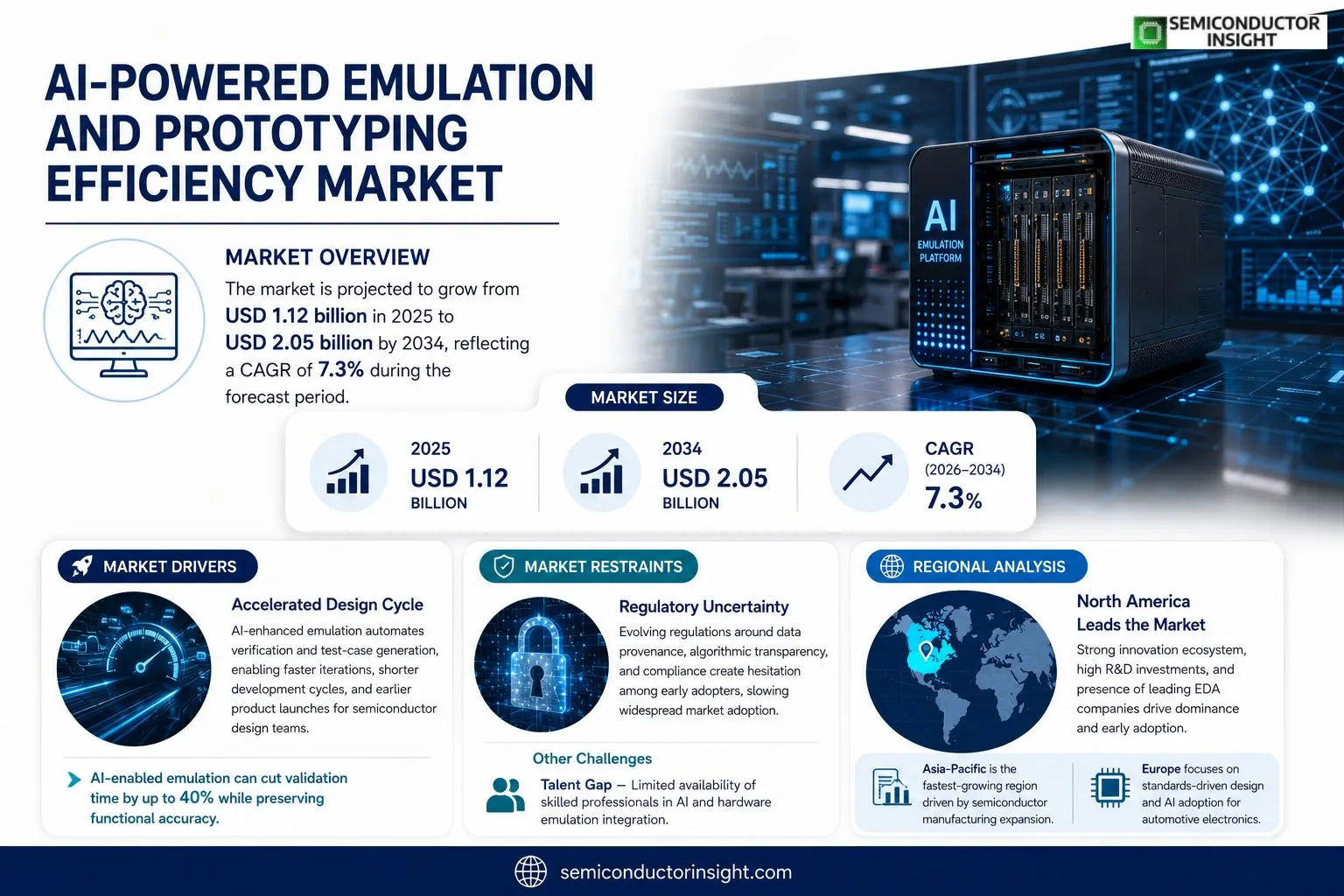
AI-Powered Emulation and Prototyping Efficiency Market size was valued at USD 1.02 billion in 2025. Forecasts indicate growth from USD 1.12 billion in 2025 to USD 2.05 billion by 2034, reflecting a CAGR of 7.3% during the forecast period.
AI‑powered emulation and prototyping tools enable rapid virtual validation of hardware designs by leveraging machine‑learning algorithms that predict performance bottlenecks, power consumption, and timing violations before silicon fabrication. These solutions combine high‑fidelity models with automated test‑case generation, reducing reliance on costly physical prototypes.The market is experiencing accelerated adoption because semiconductor manufacturers seek shorter time‑to‑market cycles while controlling R&D spend. Rising demand for edge‑AI devices pushes designers toward simulation environments capable of evaluating heterogeneous architectures efficiently.Recent collaborations, such as a January 2024 partnership between Synopsys and NVIDIA that embeds deep‑learning inference engines into emulation platforms, illustrate how ecosystem players expand functional coverage.Established vendors including Cadence Design Systems, Mentor Graphics (Siemens) and ANSYS continue broadening their portfolios with AI‑enhanced modules.
MARKET DRIVERS
Accelerated Design Cycle
Enterprises are compressing product development timelines to stay ahead of competitive pressure. AI‑enhanced emulation tools automate repetitive verification steps, allowing hardware teams to iterate designs several weeks faster than conventional workflows. This speed advantage translates into earlier market entry and better alignment with customer demand cycles.
Integration of Generative AI
Generative models now draft test‑bench configurations and suggest micro‑architectural tweaks with minimal human input. By embedding these capabilities into prototyping platforms, firms reduce manual engineering effort and uncover performance bottlenecks that would otherwise remain hidden until silicon tape‑out.
➤ AI‑enabled emulation can cut validation time by up to 40 % while preserving functional accuracy.
Beyond speed, the combination of predictive analytics and real‑time feedback improves risk assessment. Decision‑makers receive quantified confidence intervals for design choices, which strengthens investment justification and reduces costly re‑spins later in the product lifecycle.
MARKET CHALLENGES
Data Quality and Model Fidelity
Accurate AI outputs hinge on comprehensive training datasets that reflect the full spectrum of hardware behaviors. Incomplete or biased data sets generate models that misrepresent edge cases, leading to validation gaps that can surface during production. Companies must therefore invest in systematic data capture and cleansing processes to preserve model reliability.
Other Challenges
Talent Gap
The specialized knowledge required to fuse AI algorithms with hardware emulation creates a narrow talent pool. Organizations frequently encounter recruitment bottlenecks, which prolong project timelines and inflate labor costs.
MARKET RESTRAINTS
Regulatory Uncertainty
Jurisdictions are still defining compliance frameworks for AI‑assisted design tools, particularly regarding data provenance and algorithmic transparency. Ambiguous regulations can deter early adopters, as firms hesitate to commit capital without clear legal guidance.
MARKET OPPORTUNITIES
Emerging Edge‑Compute Requirements
The proliferation of edge devices demands rapid prototyping cycles that balance power efficiency with performance. AI‑powered emulation platforms uniquely address this need by delivering high‑fidelity simulations on commodity hardware, enabling manufacturers to iterate designs for diverse form factors without extensive physical testing.
AI-Powered Emulation and Prototyping Efficiency Market Trends
Accelerated Adoption Fueled by Edge‑AI Demands
The push toward compact, low‑latency edge‑AI devices has forced semiconductor firms to compress development timelines. AI‑driven emulation platforms now supply designers with predictive insights on power draw, timing margins, and thermal hotspots before silicon leaves the floor. By automating test‑case generation and merging high‑fidelity models with machine‑learning inference, these tools shave weeks off the validation cycle, directly translating into cost containment for R&D budgets. The practical impact is evident in design houses that report a noticeable reduction in physical prototype runs, allowing them to reallocate engineering resources toward architectural innovation rather than iterative debugging.
Other Trends
AI Integration with Established EDA Vendors
Legacy players such as Cadence, Mentor Graphics (Siemens) and ANSYS have each layered AI modules onto their existing suites, extending functionality without forcing customers to abandon familiar workflows. Their strategies revolve around embedding learned performance models into synthesis and placement engines, thereby enriching traditional rule‑based approaches with data‑derived optimizations. This incremental evolution eases the adoption curve for enterprises that value continuity while seeking the efficiency gains promised by intelligent simulation.
Strategic Partnerships Expanding Functional Coverage
A notable illustration of ecosystem collaboration emerged in January 2024 when Synopsys announced a joint effort with NVIDIA to fuse deep‑learning inference capabilities into its emulation platform. The partnership broadened the range of workloads that can be modeled, particularly for heterogeneous compute blocks that combine CPUs, GPUs, and specialized accelerators. Such alliances signal a market where tool vendors are no longer isolated developers but participants in a broader AI‑enabled design fabric, creating opportunities for customers to evaluate end‑to‑end system behavior within a single virtual environment. For the AI‑Powered Emulation and Prototyping Efficiency Market, this trend suggests a shift toward consolidated solutions that address both hardware fidelity and algorithmic performance in one workflow.
COMPETITIVE LANDSCAPE
Key Industry Players
AI‑Powered Emulation and Prototyping Efficiency Market Overview
Synopsys dominates the high‑end segment of the AI‑enabled emulation space, leveraging its long‑standing relationship with semiconductor fabs and a portfolio that now integrates NVIDIA’s inference engine. The firm’s flagship platform combines deep‑learning‑augmented signal‑integrity models with automated test‑case generation, allowing designers to identify timing bottlenecks before tape‑out. Recent strategic alliances, notably the 2024 joint effort between Synopsys and NVIDIA, illustrate how the ecosystem is coalescing around AI‑driven kernels. These collaborations create barriers to entry for newcomers because integrating proprietary inference stacks requires deep engineering expertise and sizable R&D budgets. Consequently, the market exhibits a three‑tier structure: Tier‑1 firms offering full‑stack AI emulation, Tier‑2 providers supplying modular AI add‑ons, and niche players focused on specialty domains such as mixed‑signal prototyping.Beyond the Tier‑1 incumbents, a cadre of specialist firms is expanding the functional envelope of AI‑enhanced prototyping. Keysight Technologies supplies high‑precision measurement models that feed machine‑learning algorithms for power‑budget forecasting, while Arm Ltd. contributes architecture‑aware performance libraries that accelerate early‑stage software validation. Imagination Technologies and Aldec deliver targeted solutions for graphics and FPGA design, embedding lightweight neural networks to predict synthesis outcomes. MathWorks leverages its Simulink environment to generate AI‑guided test vectors, a capability increasingly valued by academic labs and start‑ups. D2S Technologies and EVE focus on heterogeneous integration, offering AI‑based layout‑verification tools that address the rising complexity of chip‑in‑package architectures. These niche players, though modest in revenue, introduce innovative methodologies that pressure larger vendors to broaden AI capabilities or risk erosion of market share.
List of Key AI‑Powered Emulation and Prototyping Efficiency Companies Profiled
- Synopsys
- Cadence Design Systems
- Siemens (Mentor Graphics)
- ANSYS
- NVIDIA
- Keysight Technologies
- Arm Ltd.
- Imagination Technologies
- Aldec
- MathWorks
- D2S Technologies
- EVE
Segment Analysis:
| Segment Category | Sub-Segments | Key Insights |
| By Type |
|
Model‑Centric Emulation drives the market by offering deep‑learning‑enhanced prediction capabilities that streamline design verification.
|
| By Application |
|
Edge‑AI Device Development emerges as the leading application segment, as designers seek to validate heterogeneous architectures under strict power and latency constraints.
|
| By End User |
|
Semiconductor Design Houses dominate this dimension, leveraging AI‑enhanced platforms to compress development cycles while preserving design fidelity.
|
| By Technology Stack |
|
Deep‑Learning Inference Integrated Platforms are gaining prominence as they embed sophisticated neural‑network engines directly within emulation hardware.
|
| By Integration Level |
|
Full‑Stack Design Automation Platforms are identified as the most compelling integration approach, delivering seamless transitions from high‑level algorithm modeling to low‑level hardware validation.
|
Regional Analysis: AI-Powered Emulation and Prototyping Efficiency Market
North America
Boston’s microelectronics corridor and Austin’s chip design cluster act as magnets for R&D teams seeking to blend emulation with AI‑assisted verification. The proximity of research institutions fuels frequent knowledge transfer, enabling firms to prototype complex system‑on‑chip architectures within weeks rather than months.
The region enjoys a deep pipeline of engineers versed in both hardware description languages and data‑science techniques. Companies report that cross‑disciplinary expertise reduces hand‑off friction, allowing AI‑powered emulation tools to be integrated earlier in the design flow.
Federal guidelines promote the reuse of verified IP blocks, which aligns neatly with AI‑driven prototyping that emphasizes modularity. This regulatory support streamlines compliance checks, letting designers focus on performance rather than paperwork.
Recent funding rounds show investors prioritizing platforms that can automatically generate test vectors from high‑level specifications, a capability that directly accelerates the AI‑Powered Emulation and Prototyping Efficiency Market trajectory.
Europe
European manufacturers, anchored by Germany’s automotive chip suppliers and France’s telecom hardware firms, are adopting AI‑enhanced emulation to meet stringent safety standards. The emphasis on standards‑driven design means that any efficiency gain translates into reduced certification overhead. Moreover, collaborative EU programmes encourage shared tooling, allowing smaller players to access sophisticated prototyping environments without prohibitive capital outlays.
Asia-Pacific
In the Asia‑Pacific, fast‑growing economies such as South Korea and Taiwan leverage AI‑powered emulation to stay competitive against larger incumbents. The regional focus on cost‑effective mass production pushes firms to compress design cycles, and AI‑driven test generation offers a clear avenue to cut silicon wastage. Government incentives for advanced manufacturing further incentivize adoption, positioning the region as a burgeoning hub for next‑generation silicon solutions.
South America
South American players, particularly in Brazil, are beginning to explore AI‑assisted prototyping as part of broader digital transformation initiatives. While the market remains nascent, universities are partnering with local startups to develop customized emulation frameworks that address regional connectivity challenges. This collaborative approach helps create a foundation for future scaling as demand for locally‑designed IoT devices rises.
Middle East & Africa
The Middle East and Africa exhibit a cautious but optimistic stance toward AI‑enhanced emulation. Emerging tech parks in the United Arab Emirates and research consortia in South Africa focus on building localized expertise. By integrating AI into prototype validation, these regions aim to reduce reliance on overseas design services, fostering greater self‑sufficiency in critical infrastructure projects.
Report Scope
This market research report provides a comprehensive analysis of the AI-Powered Emulation and Prototyping Efficiency Market , covering the forecast period 2026–2034. It offers detailed insights into market dynamics, technological advancements, competitive landscape, and key trends shaping the industry.
Key focus areas of the report include:
- Market Overview: The report begins with an overview outlining its current market scenario, key growth indicators, and industry transformation drivers. It discusses macroeconomic factors, demand–supply balance, regulatory landscape, and the strategic role of semiconductors in powering advancements across industries such as automotive, telecommunications, consumer electronics, and industrial automation.
- Market Size & Forecast: Historical data and future projections for revenue, unit shipments, and market value across major regions and segments.
- Segmentation Analysis: Detailed breakdown by product type, technology, application, and end-user industry to identify high-growth segments and investment opportunities.
- Regional Insights: Insights into market performance across North America, Europe, Asia-Pacific, Latin America, and the Middle East & Africa, including country-level analysis where relevant.
- Competitive Landscape: Profiles of leading market participants, including their product offerings, R&D focus, manufacturing capacity, pricing strategies, and recent developments such as mergers, acquisitions, and partnerships.
- Technology Trends & Innovation: Assessment of emerging technologies, integration of AI/IoT, semiconductor design trends, fabrication techniques, and evolving industry standards.
- Market Drivers & Restraints: Evaluation of factors driving market growth along with challenges, supply chain constraints, regulatory issues, and market-entry barriers.
- Stakeholder Insights: Insights for component suppliers, OEMs, system integrators, investors, and policymakers regarding the evolving ecosystem and strategic opportunities.
Primary and secondary research methods are employed, including interviews with industry experts, data from verified sources, and real-time market intelligence to ensure the accuracy and reliability of the insights presented.
FREQUENTLY ASKED QUESTIONS:
What is the current market size of AI-Powered Emulation and Prototyping Efficiency Market?
-> AI-Powered Emulation and Prototyping Efficiency Market was valued at USD 1.02 billion in 2025 and is expected to reach USD 2.05 billion by 2034, reflecting a CAGR of 7.3% during the forecast period.
Which key companies operate in AI-Powered Emulation and Prototyping Efficiency Market?
-> Key players include Cadence Design Systems, Mentor Graphics (Siemens), ANSYS, Synopsys, and NVIDIA, among others.
What are the key growth drivers?
-> Key growth drivers include the need for shorter time‑to‑market cycles, cost‑effective R&D spend, and rising demand for edge‑AI devices that require advanced simulation environments.
Which region dominates the market?
-> North America currently leads in adoption, while Asia‑Pacific shows rapid growth driven by semiconductor manufacturing expansion.
What are the emerging trends?
-> Emerging trends include deep‑learning inference integration in emulation platforms, AI‑enhanced simulation modules, and strategic collaborations such as the Synopsys‑NVIDIA partnership.

Get Sample Report PDF for Exclusive Insights
Report Sample Includes
- Table of Contents
- List of Tables & Figures
- Charts, Research Methodology, and more...
 Download Sample Report PDF