AI Microprocessor Market Insights
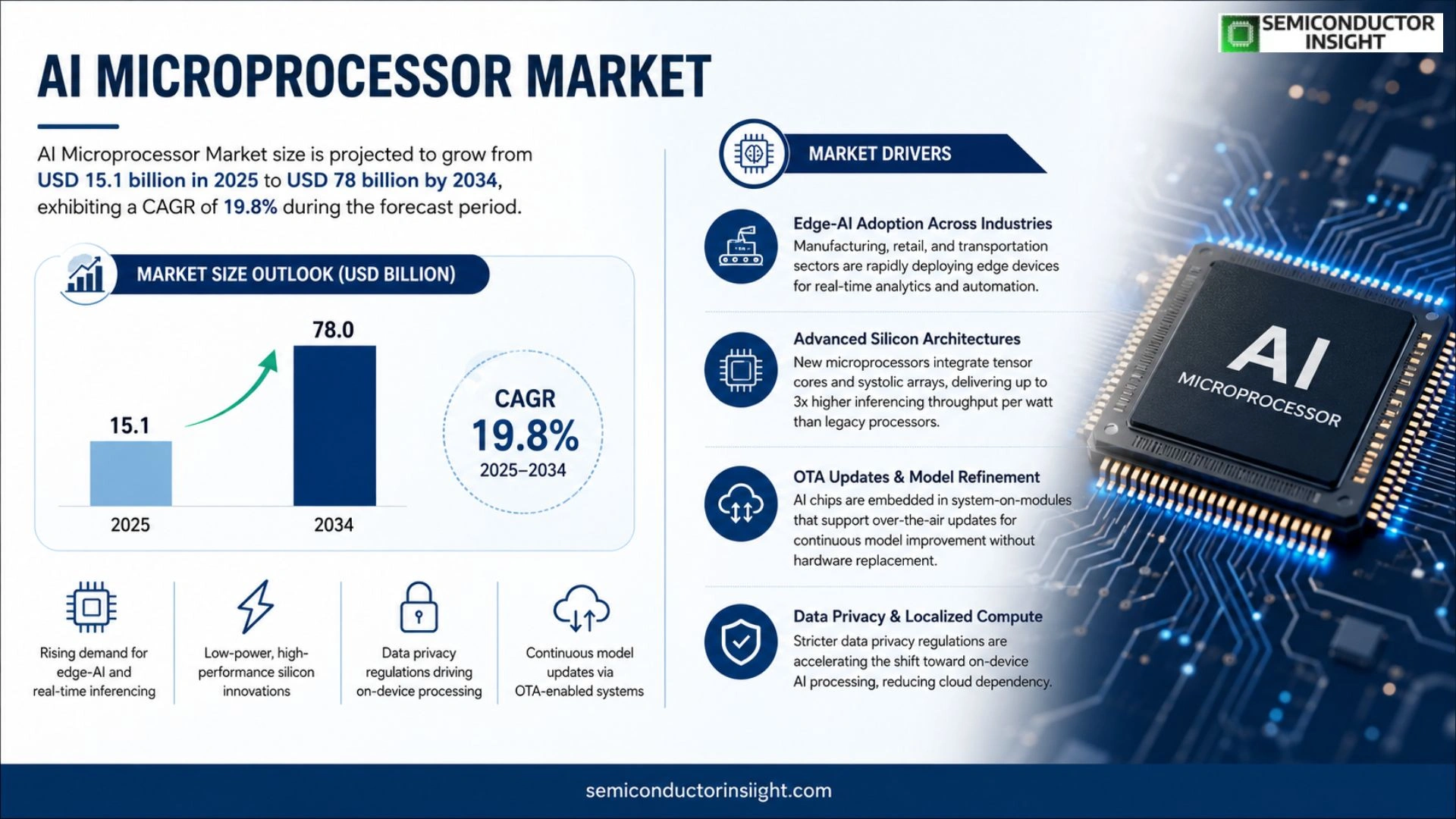
AI Microprocessor Market size was valued at USD 14.2 billion in 2025. The market is projected to grow from USD 15.1 billion in 2025 to USD 78 billion by 2034, exhibiting a CAGR of 19.8% during the forecast period.
AI microprocessors are purpose‑built semiconductor devices optimized for artificial‑intelligence workloads such as deep‑learning inference and training. They integrate specialized architectures,including tensor cores, systolic arrays and neuromorphic circuits,to accelerate matrix operations while reducing power consumption compared with general‑purpose CPUs.
The market is experiencing rapid growth because enterprises are scaling generative‑AI services, edge‑AI deployments and autonomous‑vehicle platforms demand ever‑more efficient compute. Furthermore, substantial capital infusion from venture firms into silicon startups and strategic alliances,e.g., Nvidia’s partnership with OpenAI and Qualcomm’s collaboration with Google on TPU alternatives,are fueling expansion. Key players such as Nvidia, AMD, Intel, Qualcomm and Apple continue broadening their portfolios through new product launches and ecosystem support.
MARKET DRIVERS
Rising Demand for Edge AI Compute
AI Microprocessor Market is being propelled by the exponential growth of edge devices that require low‑latency, high‑performance inference capabilities. Enterprises are deploying AI‑enabled sensors, cameras, and IoT gateways, creating a strong need for specialized microprocessors that deliver efficient compute while minimizing power consumption.
Data‑Center Acceleration Initiatives
Major cloud providers are scaling their AI services, prompting a surge in demand for data‑center‑grade AI microprocessors. These chips enable faster training of large language models and image‑recognition networks, reducing time‑to‑insight for customers across finance, healthcare, and automotive sectors.
➤ Strategic investments by leading semiconductor firms are accelerating the introduction of next‑generation AI cores, driving market expansion.
Additionally, the convergence of 5G connectivity and AI workloads is widening the addressable market, as telecom operators seek AI microprocessors to support real‑time analytics at the network edge.
MARKET CHALLENGES
Complexity of Chip Design and Validation
The design cycle for AI microprocessors involves intricate hardware‑software co‑optimization, which can extend time‑to‑market and increase development costs. Small and mid‑size players often lack the resources to meet these rigorous engineering demands.
Other Challenges
Supply‑Chain Volatility
Fluctuating availability of advanced lithography equipment and raw silicon wafers has introduced lead‑time uncertainties, affecting capacity planning for manufacturers.
Regulatory scrutiny over AI ethics and data privacy also adds a layer of compliance risk, requiring vendors to embed robust security features directly into the processor architecture.
MARKET RESTRAINTS
High Capital Expenditure
Establishing fab facilities capable of producing cutting‑edge AI microprocessors demands multi‑billion dollar investments, which limits entry to well‑capitalized incumbents. This financial barrier restricts competitive diversification in the market.
Moreover, the rapid pace of algorithmic innovation can render a silicon design obsolete within a few years, discouraging long‑term investment in specialized manufacturing lines.
The need for extensive testing to meet safety standards in automotive and industrial applications further constrains market rollout, adding both time and cost pressures.
MARKET OPPORTUNITIES
AI‑Optimized Chiplets and Heterogeneous Integration
Emerging modular chiplet architectures allow designers to combine AI cores with memory, sensors, and security blocks in a single package, opening new revenue streams for AI Microprocessor Market. This approach reduces development risk and accelerates time‑to‑market.
The growing emphasis on sustainable computing presents an opportunity for low‑power AI microprocessors that can deliver high performance with reduced carbon footprints, aligning with corporate ESG goals.
Finally, the expansion of generative AI applications across creative industries creates a fresh demand for specialized inference engines, positioning vendors that can deliver domain‑specific acceleration as market leaders.
AI Microprocessor Market Trends
Edge AI Expansion Driving Demand
AI Microprocessor Market is being reshaped by rapid adoption of edge‑AI solutions across manufacturing, retail, and transportation. Edge devices require compute that can process inference locally while minimizing latency and power draw. Recent product releases from leading silicon firms embed tensor cores and systolic arrays optimized for low‑power matrix multiplication, enabling real‑time analytics on cameras, sensors, and IoT gateways. Benchmarks show that edge‑optimized chips can deliver up to three times the inferencing throughput per watt compared with legacy processors. Manufacturers are integrating these silicon blocks into system‑on‑modules that support over‑the‑air updates, allowing continuous model refinement without hardware swaps. Moreover, data‑privacy regulations push processing to the device, reinforcing the shift toward localized AI compute and creating a steady pipeline of deployment projects that extend beyond data‑center workloads.
Other Trends
Specialized Architecture Innovations
Designers are advancing beyond traditional GPU‑based approaches by introducing neuromorphic circuits, configurable accelerators, and enhanced memory hierarchies that target specific AI workloads. These architectures reduce energy consumption by up to 40 % compared with general‑purpose CPUs while delivering higher throughput for deep‑learning inference. On‑chip networks such as NVDLA and cross‑core communication fabrics improve data movement efficiency, further lowering latency. The proliferation of open‑source instruction sets and modular design kits accelerates adoption, allowing startups and established vendors alike to tailor silicon to niche applications such as speech recognition on wearables and vision processing on drones. As a result, a broader ecosystem of reference designs and validation boards is emerging, shortening development cycles for OEMs.
Strategic Partnerships and Ecosystem Growth
Collaboration between chipmakers and AI platform providers is intensifying. High‑profile alliances,such as a major graphics firm partnering with a leading generative‑AI laboratory, and a leading mobile‑chip company co‑developing TPU‑compatible solutions with a cloud AI leader,are expanding the ecosystem. These joint efforts generate shared software stacks, developer tools, and reference designs that lower time‑to‑market for new AI workloads. Industry consortia are standardizing interfaces for model exchange and performance profiling, fostering interoperability across heterogeneous devices. As venture capital continues to back silicon startups, AI Microprocessor Market benefits from a steady flow of innovative products that broaden choice for OEMs and system integrators, positioning the sector for sustained growth through 2035.
COMPETITIVE LANDSCAPE
Key Industry Players
AI Microprocessor Market Competitive Overview
Nvidia continues to dominate the AI microprocessor segment, leveraging its CUDA ecosystem, tensor‑core GPUs, and strategic alliances with leading AI firms such as OpenAI. Its aggressive product cadence,evident in the Hopper and Ada architectures,has entrenched the company as the de‑facto standard for high‑performance inference and training workloads across data‑center, cloud, and edge environments. The firm’s expansive developer network, combined with strong OEM partnerships, supports a market structure where a few technology leaders capture the bulk of revenue while setting performance benchmarks that shape downstream adoption. Intel and AMD, with their Xeon and EPYC‑based AI accelerators, respectively, are closing the gap by integrating dedicated AI engines and offering heterogeneous compute platforms that appeal to enterprises seeking tighter CPU‑accelerator integration.
Beyond the tier‑one contenders, a diverse set of niche players is expanding the competitive landscape. Qualcomm’s AI‑focused Snapdragon series and Google’s Tensor chips address mobile and edge AI with power‑efficiency emphasis, while Apple’s custom silicon drives AI workloads on its consumer ecosystem. European and Asian startups,including Graphcore, Cerebras Systems, Tenstorrent, and MediaTek,introduce innovative architectures such as intelligent processing units (IPUs) and wafer‑scale engines that target specialized workloads like deep‑learning training at massive scale. Established silicon veterans like Samsung, Huawei, IBM, Broadcom, and Marvell Technology diversify the portfolio with neuromorphic and mixed‑signal solutions, fostering a fragmented yet rapidly evolving market where differentiation is driven by architectural novelty, software stack integration, and strategic partnerships.
List of Key AI Microprocessor Companies Profiled
- Nvidia
- AMD
- Intel
- Qualcomm
- Apple
- Google (Alphabet)
- Samsung
- Huawei
- Graphcore
- Cerebras Systems
- Tenstorrent
- MediaTek
- IBM
- Broadcom
- Marvell Technology
Segment Analysis:
| Segment Category | Sub-Segments | Key Insights |
| By Type |
|
Neural Processing Units (NPUs) are emerging as the preferred architecture for complex deep‑learning inference workloads.
|
| By Application |
|
Data Center AI drives the most sophisticated microprocessor designs.
|
| By End User |
|
Technology Companies lead the adoption curve.
|
| By Architecture |
|
Systolic Array remains dominant for high‑throughput matrix multiplication.
|
| By Deployment Model |
|
Cloud deployment drives ecosystem collaboration.
|
Regional Analysis: North America
Government funding and strategic policies are pivotal in fostering AI Microprocessor Market in the United States. These initiatives encourage research, development, and deployment of advanced AI technologies.
The healthcare sector is witnessing a surge in AI microprocessor adoption for applications like medical imaging analysis, drug discovery, and personalized medicine. This trend is fueled by the need for faster and more accurate diagnostic tools.
The development of autonomous vehicles is a major driver for AI microprocessor demand, requiring powerful processing capabilities for real-time decision-making and sensor data processing.
The financial technology sector utilizes AI microprocessors for fraud detection, algorithmic trading, and risk management, driving demand for high-performance and secure processing solutions.
Europe
European nations are progressively integrating AI microprocessors, with a strong emphasis on data privacy and ethical considerations. The region’s focus on industrial automation and smart cities presents significant opportunities for growth. While investment may lag behind the US, a growing ecosystem of startups and established players is contributing to innovation.
Asia-Pacific
The Asia-Pacific region, particularly China and Japan, is experiencing rapid expansion in AI Microprocessor Market. Driven by large-scale deployments in manufacturing, e-commerce, and telecommunications, the demand is substantial. Government support for AI development and a massive domestic market are key factors fueling this growth.
South America
South America represents a nascent market for AI microprocessors, with adoption primarily concentrated in the financial services and logistics sectors. The region’s growing digital infrastructure and increasing investment in technology are expected to drive future growth.
Middle East & Africa
The Middle East & Africa region is an emerging market with growing potential for AI microprocessor adoption. Investments in smart infrastructure, healthcare, and defense are creating new opportunities. The region’s increasing focus on technological advancement is expected to fuel market expansion.
Report Scope
This market research report provides a comprehensive analysis of the AI Microprocessor Market , covering the forecast period 2026–2034. It offers detailed insights into market dynamics, technological advancements, competitive landscape, and key trends shaping the industry.
Key focus areas of the report include:
- Market Overview: The report begins with an overview outlining its current market scenario, key growth indicators, and industry transformation drivers. It discusses macroeconomic factors, demand–supply balance, regulatory landscape, and the strategic role of semiconductors in powering advancements across industries such as automotive, telecommunications, consumer electronics, and industrial automation.
- Market Size & Forecast: Historical data and future projections for revenue, unit shipments, and market value across major regions and segments.
- Segmentation Analysis: Detailed breakdown by product type, technology, application, and end-user industry to identify high-growth segments and investment opportunities.
- Regional Insights: Insights into market performance across North America, Europe, Asia-Pacific, Latin America, and the Middle East & Africa, including country-level analysis where relevant.
- Competitive Landscape: Profiles of leading market participants, including their product offerings, R&D focus, manufacturing capacity, pricing strategies, and recent developments such as mergers, acquisitions, and partnerships.
- Technology Trends & Innovation: Assessment of emerging technologies, integration of AI/IoT, semiconductor design trends, fabrication techniques, and evolving industry standards.
- Market Drivers & Restraints: Evaluation of factors driving market growth along with challenges, supply chain constraints, regulatory issues, and market-entry barriers.
- Stakeholder Insights: Insights for component suppliers, OEMs, system integrators, investors, and policymakers regarding the evolving ecosystem and strategic opportunities.
Primary and secondary research methods are employed, including interviews with industry experts, data from verified sources, and real-time market intelligence to ensure the accuracy and reliability of the insights presented.
FREQUENTLY ASKED QUESTIONS:
What is the current market size of AI Microprocessor Market?
-> AI Microprocessor Market was valued at USD 14.2 billion in 2025 and is expected to reach USD 78 billion by 2034.
Which key companies operate in AI Microprocessor Market?
-> Key players include Nvidia, AMD, Intel, Qualcomm, and Apple, among others.
What are the key growth drivers?
-> Key growth drivers include scaling of generative‑AI services, edge‑AI deployments, autonomous‑vehicle platforms, substantial venture‑capital funding for silicon startups, and strategic alliances such as Nvidia‑OpenAI and Qualcomm‑Google collaborations.
Which region dominates the market?
-> The reference does not specify a single dominant region; market growth is observed globally with strong activity in major technology hubs.
What are the emerging trends?
-> Emerging trends include purpose‑built AI architectures (tensor cores, systolic arrays, neuromorphic circuits), increased integration of AI/IoT, and expanding ecosystem partnerships that accelerate specialized AI compute.
Get Sample Report PDF for Exclusive Insights
Report Sample Includes
- Table of Contents
- List of Tables & Figures
- Charts, Research Methodology, and more...