AI IPC Chips Market Insights
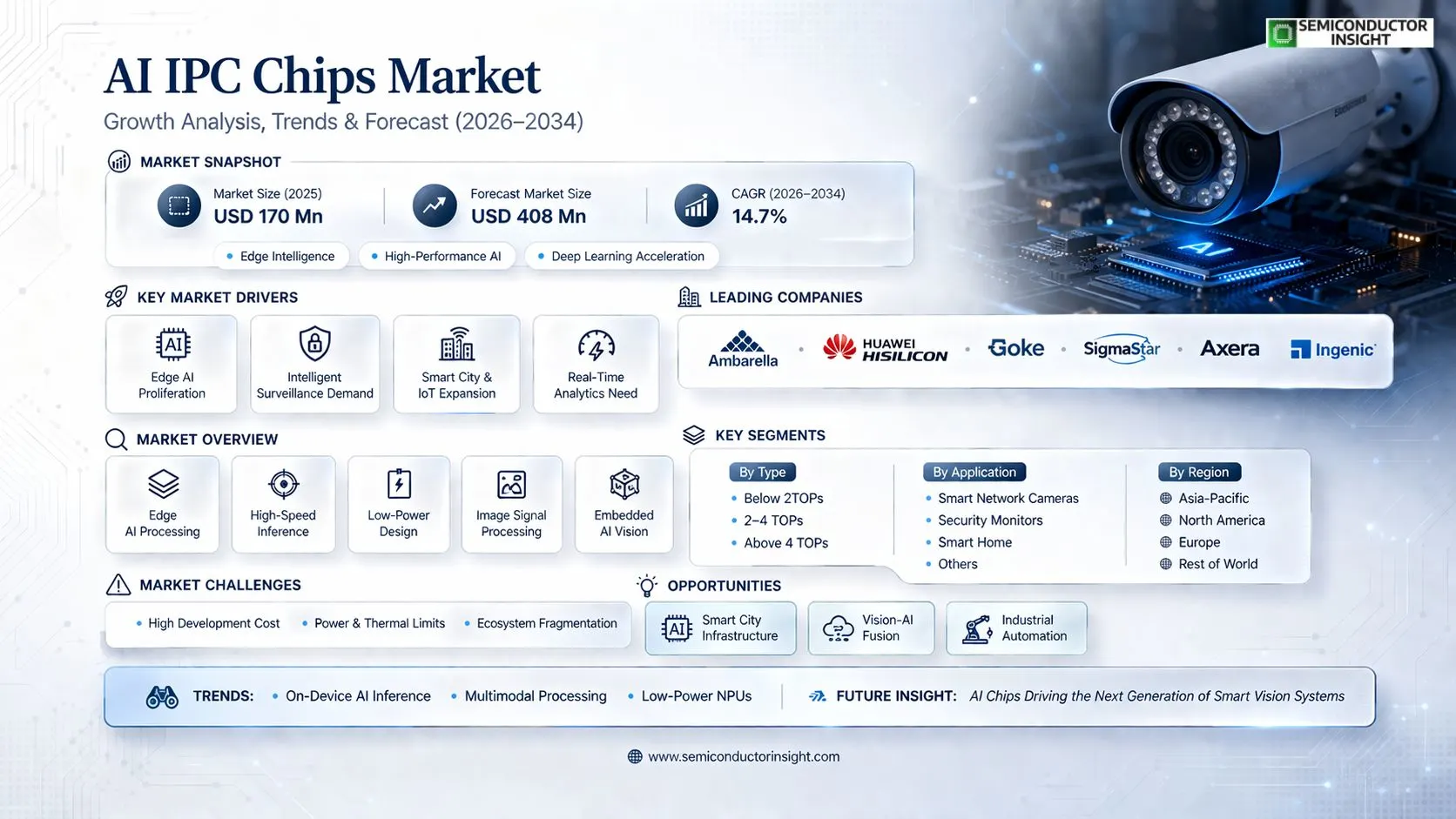
Global AI IPC chips market size was valued at USD 170 million in 2025. The market is projected to grow from USD 195 million in 2026 to USD 408 million by 2034, exhibiting a CAGR of 14.7% during the forecast period.
AI IPC chips are high-performance integrated circuits designed specifically for the security monitoring field, integrating advanced image processing and artificial intelligence technologies. These chips not only have the functions of traditional IPC chips, such as high-definition video encoding, image signal processing, and network transmission, but also integrate deep learning accelerators to efficiently perform complex image recognition and intelligent analysis tasks at the hardware level.
The market is experiencing rapid growth due to several factors, including escalating demand for intelligent security and surveillance systems globally and significant advancements in edge AI computing. Furthermore, the proliferation of smart city initiatives and the increasing adoption of IoT devices are major contributors to market expansion. Initiatives by key players in the market are also expected to fuel growth. For instance, leading companies like Ambarella and Huawei HiSilicon continuously launch new chip series with higher TOPS (Tera Operations Per Second) performance for more sophisticated analytics. Ambarella, Huawei HiSilicon, Goke Microelectronics, and SigmaStar Technology are some of the key players that operate in the market with a wide range of portfolios.
MARKET DRIVERS
Proliferation of Intelligent Edge Computing
The explosive demand for on-device artificial intelligence is a primary driver for the AI IPC chips market. As industries from smart manufacturing to autonomous vehicles require real-time, low-latency processing, the shift from cloud-based AI to edge deployments is accelerating. This necessitates specialized AI IPC chips that offer high performance-per-watt for inference tasks directly within cameras, sensors, and IoT gateways, reducing bandwidth costs and enhancing data privacy and security.
Advancements in Computer Vision and Surveillance
Security and automation applications are undergoing a transformation through sophisticated vision analytics. Modern AI IPC chips integrate dedicated neural processing units (NPUs) that enable advanced features like facial recognition, object counting, anomaly detection, and behavioral analysis directly at the edge. This capability is critical for scalable smart city infrastructure, retail analytics, and industrial quality control, pushing the adoption of next-generation intelligent cameras and visual systems.
➤ The integration of AI into traditional IPC SoCs is not an incremental upgrade but a fundamental architectural shift, creating a new product category focused on edge intelligence.
Furthermore, the standardization of AI models and frameworks, alongside declining sensor costs, creates a fertile ecosystem for AI IPC chip deployment. Chipmakers are now designing solutions that balance raw processing power with thermal efficiency and cost, making high-performance edge AI accessible for mainstream commercial and industrial applications. The continuous evolution of AI algorithms specifically optimized for edge hardware further solidifies this growth trajectory.
MARKET CHALLENGES
Technical and Design Complexity
Designing a competitive AI IPC chip requires balancing multiple, often conflicting, performance metrics. Engineers must integrate high-performance CPU cores, a capable GPU or VPU, a dedicated NPU for AI workloads, advanced image signal processing (ISP), and efficient memory controllers onto a single die while managing power consumption and thermal output. Achieving this balance for cost-sensitive, high-volume markets like consumer security cameras presents a significant barrier to entry and lengthens development cycles.
Other Challenges
Fragmented Ecosystem and Software Hurdles
The lack of a unified software stack across different AI IPC chip architectures creates fragmentation. Developers face challenges in porting and optimizing AI models across varied NPU instruction sets and proprietary SDKs, increasing time-to-market and development costs for device manufacturers.
Rapid Technological Obsolescence and Cost Pressure
The pace of innovation in AI models creates pressure for constant chip upgrades. AI IPC chips may become obsolete within shorter cycles as new, more complex neural network architectures emerge. Simultaneously, intense competition, especially from established silicon vendors and low-cost alternatives, exerts significant downward pressure on ASPs, squeezing margins.
MARKET RESTRAINTS
High Initial Development and Integration Costs
The significant R&D investment required to design, verify, and fabricate advanced AI IPC chips acts as a major restraint. For many small and medium-sized camera manufacturers, the cost of integrating a new AI-centric chipset,requiring redesign of hardware, firmware, and software,can be prohibitive. This economic barrier limits rapid, widespread adoption and often confines cutting-edge AI features to premium product segments, slowing overall market penetration across broader industrial and consumer applications.
Concerns Over Power Consumption and Thermal Management
While AI IPC chips are designed for efficiency, incorporating powerful AI accelerators inevitably increases power draw compared to traditional video processing chips. This creates design constraints for battery-powered or passively cooled devices, such as wireless security cameras or compact doorbell cameras. Managing heat dissipation in small form factors without expensive cooling solutions remains a critical engineering challenge that can limit performance or design aesthetics.
MARKET OPPORTUNITIES
Expansion Beyond Traditional Security
The AI IPC chips market is poised for growth by moving beyond conventional surveillance into diverse verticals. Significant opportunities exist in smart retail for customer behavior analytics and loss prevention, in industrial IoT for predictive maintenance via visual inspection, and in automotive for in-cabin monitoring and driver-assistance systems. Each application demands specialized AI capabilities, creating niches for chipmakers to develop tailored solutions with optimized performance profiles.
Rise of Multi-Modal and Multi-Function Edge AI
Future growth lies in chips capable of processing and correlating data from multiple sensor types,video, audio, radar, LiDAR,simultaneously. An AI IPC chip that can seamlessly fuse visual data with audio analytics for complex event detection, or with environmental sensors, will unlock new use cases in smart homes, healthcare monitoring, and advanced robotics. This integration of multi-modal sensing on a single, efficient platform represents the next frontier for the market.
Democratization Through Edge AIaaS Platforms
Opportunity exists for chip vendors and software partners to create comprehensive “AI as a Service” platforms for the edge. By offering pre-trained models, easy-to-use development tools, and robust middleware specifically for their AI IPC chips, they can lower the barrier to entry for application developers. This ecosystem approach can accelerate adoption, lock in customers, and generate recurring revenue streams, moving beyond one-time chip sales to a more sustainable solution-based business model.
Primary Trends in the AI IPC Chips Market
Hardware-Level AI Integration for Enhanced Security
The dominant trend in the AI IPC chips market is the full integration of neural processing units (NPUs) and deep learning accelerators directly onto the chip silicon. This hardware-level approach enables real-time, on-device execution of complex algorithms for facial recognition, object detection, and behavior analysis without relying on cloud resources. This architecture is crucial for applications requiring immediate response, such as perimeter security and behavioral anomaly detection in public spaces. The technical progression from supporting sub-2 TOPS to chips delivering over 4 TOPS of compute power reflects the market’s response to increasingly sophisticated AI models for video analytics.
Other Trends
Diversification into Mainstream Consumer Applications
While foundational in professional security monitoring, AI IPC chips are experiencing rapid adoption in smart homes and consumer-grade smart network cameras. Chipmakers are optimizing for power efficiency and cost, enabling features like package recognition, pet monitoring, and personalized alerts to become standard. This trend expands the total addressable market beyond traditional security, driving volume production and fostering innovation in low-power AI architectures.
Competitive Landscape and Regional Dynamics
The competitive environment is defined by specialized semiconductor firms like Ambarella and Huawei HiSilicon leading in high-performance segments, while other regional players target specific application or price segments. This competition is accelerating chip performance improvements while controlling costs. Geographically, Asia-Pacific, led by China, is a central hub for both manufacturing and consumption, influenced by large-scale deployments of smart city infrastructure and a robust consumer electronics ecosystem. The market’s evolution is closely tied to advancements in edge AI algorithms and Global emphasis on intelligent, automated security solutions.
COMPETITIVE LANDSCAPE
Key Industry Players
A Market Dominated by Specialists in Vision Processing and AI Acceleration
Global AI IPC Chips market features a consolidated competitive environment where technical expertise in AI acceleration and image signal processing (ISP) forms the primary competitive moat. The market is led by established semiconductor companies with deep roots in the security and vision processing sectors. Ambarella, with its renowned CVflow® architecture, is a preeminent force, particularly in high-performance segments, offering solutions that efficiently integrate deep learning for intelligent video analytics. Similarly, Huawei HiSilicon commands a significant market presence, leveraging its vertical integration and strong foothold in the Chinese security ecosystem. These leaders are characterized by their comprehensive product portfolios spanning different compute tiers (Below 2TOPs to Above 4TOPs) and their active engagement in developing next-generation solutions for smart network cameras and security monitors.
Beyond the top-tier players, a cohort of highly competitive niche specialists drives innovation and price-performance across various applications. Chinese fabless semiconductor companies such as Goke Microelectronics, SigmaStar Technology (a subsidiary of MediaTek), and Fullhan Microelectronics are key contenders, offering cost-optimized AI IPC solutions that fuel the proliferation of smart home devices and entry-level security systems. Specialized players like Axera Semiconductor focus on delivering balanced AI performance and power efficiency, while Shanghai ASR Microelectronics and Ingenic Semiconductor contribute with their connectivity and processing capabilities tailored for IoT-centric applications. This diverse competitive matrix fosters rapid technological iteration, pushing advancements in on-device AI for real-time facial recognition, object detection, and behavioral analysis.
List of Key AI IPC Chips Companies Profiled
- Ambarella
- Huawei HiSilicon
- Goke Microelectronics
- SigmaStar Technology
- Shanghai ASR Microelectronics
- Axera Semiconductor
- Zhuhai Eeasy Technology
- Ingenic Semiconductor
- Fullhan Microelectronics
- Xiongmai Technology
- Rockchip Electronics
- Novatek Microelectronics
- Texas Instruments
- NXP Semiconductors
- MStar Semiconductor (a MediaTek company)
Segment Analysis:
| Segment Category | Sub-Segments | Key Insights |
| By Type |
|
2TOPs-4TOPs Segment is witnessing significant growth due to its optimal balance of performance and cost-effectiveness for mainstream security applications. This performance tier supports a wide range of intelligent video analytics tasks essential for modern surveillance, such as accurate facial recognition in crowded environments and advanced object classification. The segment is favored for enabling multi-channel processing in network video recorders and mid-range cameras, striking a compelling value proposition that drives adoption in both commercial and public infrastructure projects. |
| By Application |
|
Smart Network Camera remains the cornerstone application, driving the core demand for AI IPC chips as the primary hardware enabler of edge intelligence. This segment’s growth is fueled by the pervasive need for real-time, on-device video analysis that reduces bandwidth and cloud processing costs. Key drivers include the shift from passive recording to proactive security systems capable of instant threat detection and the integration of complex behavioral analytics directly into camera hardware, which enhances system autonomy and response times. |
| By End User |
|
Commercial & Industrial users represent the most influential segment, deploying AI IPC chips at scale for loss prevention, operational efficiency, and safety compliance. There is a strong trend towards customized analytics for specific verticals like retail, manufacturing, and logistics, requiring chips that can handle specialized workloads. Investment in smart city initiatives and the modernization of enterprise security systems are creating sustained, high-value demand for advanced chipsets capable of multi-camera, system-level intelligence. |
| By Chip Architecture |
|
System-on-Chip (SoC) architecture dominates the market by integrating video processing, AI acceleration, and connectivity into a single, power-efficient package, which is critical for edge devices. This integration simplifies camera design, improves reliability, and reduces the overall bill of materials for manufacturers. The trend toward heterogeneous computing within SoCs, combining CPU, GPU, and dedicated AI cores, allows for flexible task allocation and is a key competitive differentiator for chip vendors aiming to offer balanced performance across diverse workloads. |
| By Integration Level |
|
Hybrid Edge-Cloud AI integration is becoming the preferred model, leveraging the strengths of AI IPC chips for immediate, low-latency processing while using the cloud for deeper analysis and model updates. This segment is growing as it offers a pragmatic balance, allowing for sophisticated applications like forensic search and large-scale pattern recognition without overburdening network infrastructure. It fosters ecosystems where chip performance is critical for initial data triage and feature extraction, creating a symbiotic relationship between on-device intelligence and cloud-based services. |
Regional Analysis: Global AI IPC Chips Market
Asia-Pacific
The region’s unparalleled semiconductor supply chain, from silicon wafers to advanced packaging, provides a structural advantage. Concentrated ecosystems facilitate close collaboration between AI IPC chip designers and manufacturers, optimizing for power efficiency and thermal performance critical for industrial deployments, while keeping costs competitive on a global scale.
National policies are pivotal. Substantial government subsidies and strategic initiatives directly target AI and semiconductor sovereignty. This funding de-risks long-term R&D for next-generation AI IPC chips, enabling local firms to pursue ambitious architectures tailored for edge computing and machine vision in smart factories and cities.
Local demand is a key driver. The rapid modernization of manufacturing, aggressive rollout of smart city infrastructure, and leadership in consumer electronics and electric vehicles create immediate, large-scale use cases for AI vision and processing, continuously pushing the performance requirements for the AI IPC chips market.
A vibrant ecosystem of tech giants, agile startups, and leading research institutes fosters rapid innovation. This environment accelerates the integration of novel AI algorithms directly into silicon for IPC applications, reducing latency and improving real-time decision-making capabilities for autonomous systems and quality inspection.
North America
North America, particularly the United States, is a critical innovation and high-value segment leader in the AI IPC chips market. The region’s strength lies in its foundational semiconductor IP, pioneering AI research, and the presence of leading fabless chip design companies. Demand is primarily driven by advanced industrial automation, aerospace, defense applications, and high-performance computing sectors that require the most sophisticated AI inference capabilities. The market is characterized by a focus on cutting-edge architectures, such as chiplets and bespoke accelerators for specific industrial AI workloads. While manufacturing is largely offshore, the region controls significant value through design, software, and ecosystem development. Strategic partnerships between chip designers, industrial software firms, and end-users in automotive and robotics are shaping the next wave of intelligent edge devices.
Europe
The European market for AI IPC chips is defined by a strong emphasis on industrial quality, safety, and ethical AI frameworks, aligned with regulations like the AI Act. Key demand drivers include the region’s world-leading automotive industry,transitioning to autonomous driving,and advanced manufacturing sectors like precision engineering and robotics. European chip designers and industrial technology firms often focus on creating highly reliable, secure, and energy-efficient AI processors that meet stringent operational and certification standards. Collaborative initiatives, such as the European Chips Act, aim to bolster strategic autonomy in semiconductor design and production for critical applications, including AI at the industrial edge. This creates a specialized niche for AI IPC chips that prioritize deterministic performance and data sovereignty in smart factory and infrastructure projects.
South America
The AI IPC chips market in South America is in a developmental phase, with growth primarily tied to the modernization of key natural resource and agricultural industries. Mining, oil & gas, and agribusiness sectors are beginning to adopt AI-powered vision systems for predictive maintenance, operational efficiency, and quality control, generating initial demand. Market development is challenged by reliance on technology imports and limited local semiconductor infrastructure. However, regional governments and industry consortia are increasingly recognizing the strategic importance of digital transformation. Pilot projects in industrial automation and smart city applications in major urban centers are serving as early adopters, slowly integrating AI processing capabilities into existing industrial PC frameworks to improve productivity and safety.
Middle East & Africa
The market dynamics in the Middle East & Africa are bifurcated. Gulf Cooperation Council (GCC) nations are aggressively investing in vision-based AI technologies as part of broader economic diversification and smart city megaprojects, such as NEOM. This creates targeted demand for high-performance AI IPC chips in security, surveillance, and urban management systems. In contrast, broader African markets face adoption barriers due to infrastructure gaps and cost sensitivity. Nonetheless, specific opportunities are emerging in sectors like telecommunications for network optimization and in security applications. The regional market is characterized by project-based deployments and partnerships with global technology providers, with growth heavily dependent on government-led digital infrastructure initiatives and foreign direct investment in industrial sectors.
Report Scope
This market research report provides a comprehensive analysis of the AI IPC Chips Market , covering the forecast period 2026–2034. It offers detailed insights into market dynamics, technological advancements, competitive landscape, and key trends shaping the industry.
Key focus areas of the report include:
- Market Overview: The report begins with an overview outlining its current market scenario, key growth indicators, and industry transformation drivers. It discusses macroeconomic factors, demand–supply balance, regulatory landscape, and the strategic role of semiconductors in powering advancements across industries such as automotive, telecommunications, consumer electronics, and industrial automation.
- Market Size & Forecast: Historical data and future projections for revenue, unit shipments, and market value across major regions and segments.
- Segmentation Analysis: Detailed breakdown by product type, technology, application, and end-user industry to identify high-growth segments and investment opportunities.
- Regional Insights: Insights into market performance across North America, Europe, Asia-Pacific, Latin America, and the Middle East & Africa, including country-level analysis where relevant.
- Competitive Landscape: Profiles of leading market participants, including their product offerings, R&D focus, manufacturing capacity, pricing strategies, and recent developments such as mergers, acquisitions, and partnerships.
- Technology Trends & Innovation: Assessment of emerging technologies, integration of AI/IoT, semiconductor design trends, fabrication techniques, and evolving industry standards.
- Market Drivers & Restraints: Evaluation of factors driving market growth along with challenges, supply chain constraints, regulatory issues, and market-entry barriers.
- Stakeholder Insights: Insights for component suppliers, OEMs, system integrators, investors, and policymakers regarding the evolving ecosystem and strategic opportunities.
Primary and secondary research methods are employed, including interviews with industry experts, data from verified sources, and real-time market intelligence to ensure the accuracy and reliability of the insights presented.
FREQUENTLY ASKED QUESTIONS:
What is the current market size of AI IPC Chips Market?
-> Global AI IPC Chips Market was valued at USD 170 million in 2025 and is projected to reach USD 408 million by 2034, growing at a CAGR of 14.7% during the forecast period.
Which key companies operate in AI IPC Chips Market?
-> Key players include Ambarella, Huawei HiSilicon, Goke Microelectronics, SigmaStar Technology, Shanghai ASR Microelectronics, Axera Semiconductor, Zhuhai Eeasy Technology, Ingenic Semiconductor, and Fullhan Microelectronics, among others.
What are the key growth drivers?
-> Key growth drivers include advancements in AI and image processing technologies, rising demand for intelligent security monitoring, and the integration of deep learning accelerators for complex recognition tasks in smart home and surveillance applications.
Which region dominates the market?
-> Asia is a significant and expanding market, with key country-level activity in China and the broader region.
What are the emerging trends?
-> Emerging trends include chips with higher computing power (TOPs), integration of AI at the hardware level for efficient intelligent analysis, and the proliferation of AI capabilities in smart network cameras and security monitors.

Get Sample Report PDF for Exclusive Insights
Report Sample Includes
- Table of Contents
- List of Tables & Figures
- Charts, Research Methodology, and more...