AI Inference Server Appliance Market Insights
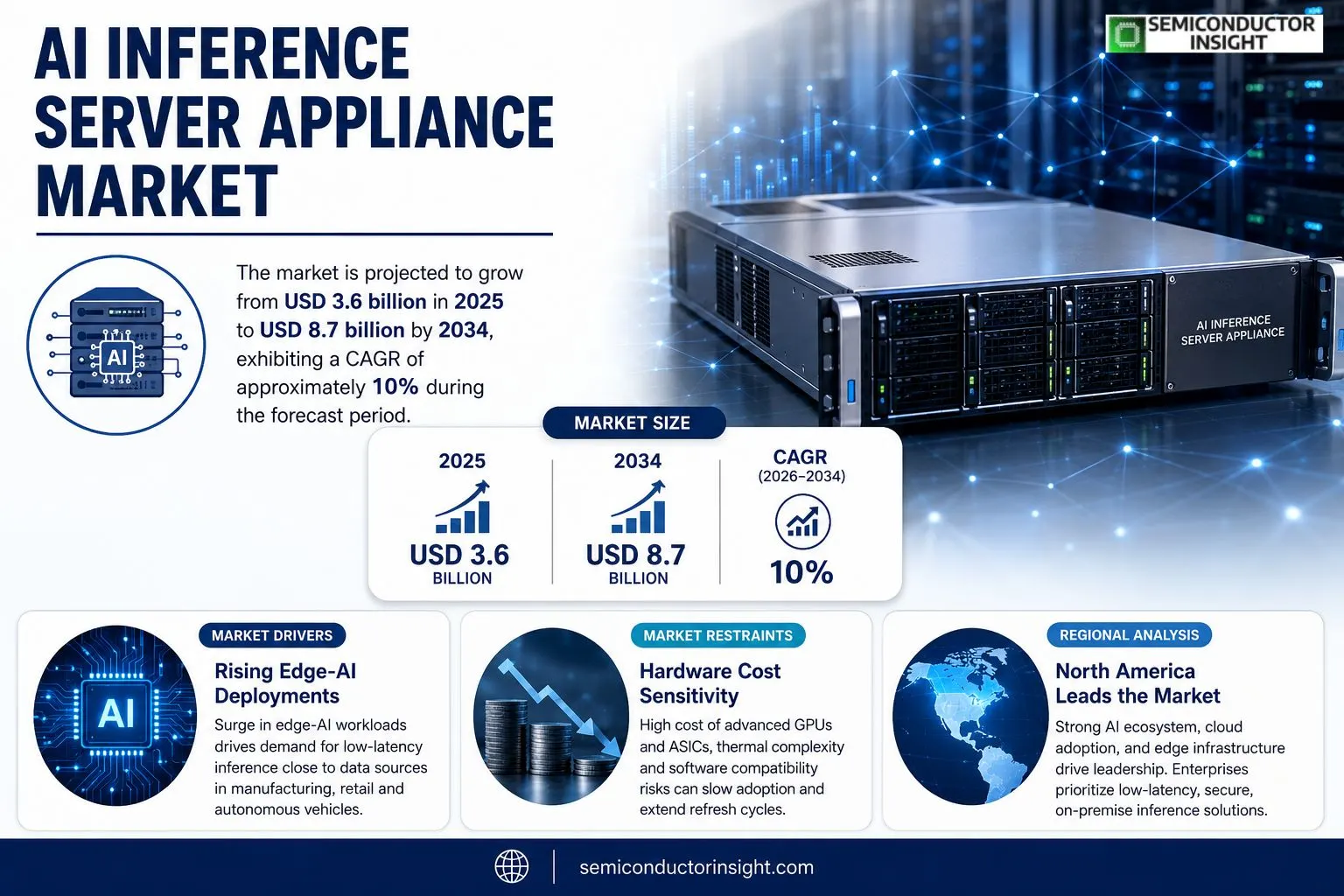
AI inference server appliance market size was valued at USD 3.6 billion in 2025. The market is projected to grow from USD 3.6 billion in 2025 to USD 8.7 billion by 2034, exhibiting a CAGR of approximately 10 % during the forecast period.
An AI inference server appliance combines high‑performance CPUs, GPUs or purpose‑built accelerators with an optimized software stack designed for low‑latency model execution at scale.These turnkey systems target edge data centers, hyperscale clouds and enterprise environments, offering pre‑installed frameworks such as TensorRT or OpenVINO together with remote management tools.The upward trend stems from enterprises moving a larger share of workloads from model training toward real‑time inference, which calls for dedicated hardware rather than shared cloud instances.In addition, the surge of generative‑AI services and stringent latency demands in autonomous vehicles, healthcare imaging and financial fraud detection are prompting vendors tobroaden their appliance portfoliosKey playersincluding NVIDIA (DGX series), Intel (Habana Gaudi), Dell Technologies (PowerEdge AI) and Hewlett Packard Enterprisehave announced new models or strategic collaborations throughout 2023‑24, strengthening supply chains and accelerating deployment cycles.
MARKET DRIVERS
Rising Edge‑AI Deployments
The surge in edge‑AI workloads compels enterprises to relocate inference closer to data sources. By trimming latency, organizations can unlock real‑time decision making in manufacturing, autonomous vehicles, and retail analytics. This shift directly lifts the demand for AI Inference Server Appliance Market as vendors ship purpose‑built boxes that combine GPUs, high‑speed interconnects, and integrated software stacks.
Cloud‑to‑On‑Premise Hybridization
Enterprises increasingly favor hybrid architectures that pair public‑cloud training with on‑premise inference. The rationale is twofold: cost containment for steady‑state inference and compliance with data‑sovereignty regulations. Consequently, firms are allocating capital to rack‑mount or blade‑form inference appliances, reinforcing a steady upward trajectory for the market.
➤ Customers prioritize turnkey solutions that reduce integration effort, prompting OEMs to embed AI‑optimized software frameworks directly into the appliance firmware.
Overall, the convergence of low‑latency requirements, data‑privacy mandates, and the need for predictable OPEX drives a robust ordering pipeline for inference server appliances, setting a clear positive tone for near‑term sales.
MARKET CHALLENGES
Hardware Cost Sensitivity
Despite performance gains, the capital outlay for high‑density GPU or ASIC clusters remains a hurdle for mid‑size firms. Budget constraints force many organizations to extend the lifecycle of legacy inference hardware, slowing the refresh cycle and tempering overall market velocity.
Other Challenges
Thermal Management Complexity
Dense compute packs generate considerable heat, requiring sophisticated cooling solutions. Companies that cannot guarantee reliable thermal design risk downtime, which can erode confidence in appliance adoption.
Software Compatibility Risks
Rapid evolution of AI frameworks creates a moving target for firmware updates. Vendors that lag in supporting emerging model formats may see customers defer purchases until ecosystem alignment is achieved.
MARKET RESTRAINTS
Regulatory Uncertainty
Stringent data‑processing regulations across regions introduce compliance overhead for on‑premise inference. Companies must invest in audit‑ready logging and encryption modules, which inflate bill‑of‑materials and can deter price‑sensitive buyers from moving forward with new appliance acquisitions.
MARKET OPPORTUNITIES
AI‑Optimized ASIC Integration
Emerging ASIC designs tuned for specific inference kernels promise dramatic efficiency gains over general‑purpose GPUs. Early adopters that embed these chips into their appliance lineup can capture premium pricing, while also differentiating on power consumptiona decisive factor for edge deployments.
Managed Inference Services
Vendors are bundling remote monitoring, automated model updates, and SLA‑backed support into a subscription model. This service‑oriented approach reduces upfront CAPEX for customers and creates recurring revenue streams, opening a lucrative expansion avenue for AI Inference Server Appliance Market.
AI Inference Server Appliance Market Trends
Enterprise Migration to Edge‑Optimized Inference
Enterprises are reallocating a larger share of AI workloads from the training phase to continuous, real‑time inference. This shift creates demand for purpose‑built appliances that can deliver sub‑millisecond response times without relying on shared cloud instances. By integrating high‑throughput CPUs, GPUs or dedicated accelerators with a pre‑configured software stack, vendors enable edge data centers and hyperscale clouds to host workloads that were previously constrained by network latency or bandwidth limits. The practical outcome is a reduction in total cost of ownership, because organizations avoid the overhead of scaling generic servers for inference‑only tasks. This trend is reshaping procurement strategies, prompting CIOs to favor turnkey solutions that bundle hardware, frameworks such as TensorRT or OpenVINO, and remote management capabilities.
Other Trends
Generative AI Service Adoption
The rapid emergence of generative‑AI applicationsincluding content creation, code synthesis and conversational agentshas intensified the need for inference appliances that can sustain high request volumes while preserving output quality. Service providers are converting experimental models into production‑grade endpoints, and they require hardware that can maintain deterministic latency under bursty traffic. Appliance manufacturers have responded by expanding their portfolios with modular configurations that allow customers to scale accelerator density in line with usage patterns. This agility reduces the time required to launch new AI‑driven products, giving early adopters a competitive edge in markets where speed-to‑market is paramount.
Hardware Diversification and Vendor Partnerships
Leading players such as NVIDIA, Intel, Dell Technologies and Hewlett Packard Enterprise have announced refreshed product lines and strategic alliances throughout 2023‑24. These collaborations focus on harmonizing silicon innovations with software ecosystems, thereby shortening deployment cycles and improving supply‑chain resilience. For example, joint efforts between GPU manufacturers and system integrators have produced appliances that expose unified APIs, simplifying integration for enterprise IT teams. The broader implication is a market where differentiation increasingly hinges on the ability to deliver end‑to‑end performance guarantees rather than merely on raw processing power. Companies that secure access to diversified hardware options will be better positioned to address the heterogeneous requirements of sectors ranging from autonomous transportation to medical imaging.
COMPETITIVE LANDSCAPE
Key Industry Players
Competitive Dynamics in AI Inference Server Appliances
The AI inference server segment is dominated by a handful of vendors that have leveraged deep‑learning accelerators to deliver turnkey appliances for edge and hyperscale deployments. NVIDIA’s DGX line, built around the latest GPU architecture, remains the reference point for high‑throughput inference workloads, especially in research‑intensive enterprises. Intel’s Habana Gaudi processors have gained traction by offering a balance of power efficiency and matrix‑multiply performance, prompting Dell Technologies to embed Gaudi‑based modules in its PowerEdge AI portfolio. Hewlett Packard Enterprise complements the landscape with modular chassis that integrate both NVIDIA and Intel accelerators, allowing customers to tailor compute density to specific latency targets. These leaders benefit from vertically integrated software stacksTensorRT, OpenVINO, and proprietary orchestration toolsthat reduce integration risk and accelerate time‑to‑value for large‑scale deployments.Beyond the headline makers, a spectrum of specialist and cloud‑native players is reshaping application‑specific niches. IBM Power Systems delivers inference appliances optimized for enterprise‑grade security and mainframe integration, while Cisco’s UCS platform incorporates AI‑focused ASICs for network‑edge analytics. Qualcomm’s Cloud AI 100 empowers low‑latency inference at the telecom edge, and AMD’s Radeon Instinct line targets compute‑heavy visual processing. Cloud providers such as Amazon Web Services (Inf1 instances), Google Cloud (TPU‑based appliances), and Microsoft Azure (FPGA‑enhanced nodes) are extending the appliance concept into on‑demand services, blurring the line between hardware purchase and subscription models. In the Asian market, Baidu’s Kunlun and Alibaba Cloud’s Elastic GPU solutions illustrate how regional champions are leveraging domestic AI ecosystems to capture vertical markets ranging from autonomous driving to medical imaging.
List of Key AI Inference Server Appliance Companies Profiled
- NVIDIA Corporation
- Intel Corporation
- Dell Technologies
- Hewlett Packard Enterprise
- IBM Corporation
- Cisco Systems
- Qualcomm Incorporated
- Advanced Micro Devices (AMD)
- Amazon Web Services
- Google Cloud
- Microsoft Azure
- Baidu, Inc.
- Alibaba Cloud
- Huawei Technologies Co., Ltd.
Segment Analysis:
| Segment Category | Sub-Segments | Key Insights |
| By Type |
|
GPU‑Based Appliances are the dominant choice because:
|
| By Application |
|
Edge Data Center Deployments emerge as a core focus because:
|
| By End User | Telecommunications drive adoption through:
|
|
| By Deployment Model |
|
Managed Service Appliances gain traction because:
|
| By Industry Vertical |
|
Autonomous Vehicles shape requirements through:
|
Regional Analysis: AI Inference Server Appliance Market
North America
Large enterprises are integrating inference appliances into legacy data‑center estates to accelerate AI‑driven business processes, valuing the plug‑and‑play nature that reduces integration friction and staff training requirements.
The proliferation of 5G and IoT endpoints fuels a surge in edge deployments, prompting vendors to shrink high‑performance inference engines into rugged, temperature‑tolerant chassis for remote sites.
Tight coupling of optimized runtimes, such as TensorRT, with bespoke hardware accelerators creates a performance premium that customers are willing to pay for predictable latency guarantees.
OEMs are bundling managed‑service contracts with inference appliances, turning capital expenditure into subscription‑based models that align cost with usage intensity.
Europe
European firms exhibit a cautious yet progressive stance, leveraging strong industrial automation networks to pilot inference appliances in manufacturing and logistics. Data‑privacy directives compel many organizations to keep inference workloads on‑site, reinforcing the demand for turnkey appliances that satisfy GDPR compliance without sacrificing throughput. The region’s fragmented marketspanning the UK’s financial sector, Germany’s automotive clusters, and France’s telecom operatorscreates pockets of rapid uptake where vertical expertise aligns with vendor specialization. Partnerships between chip designers and system integrators are emerging to address language‑specific natural‑language models, a niche that differentiates Europe from other territories.
Asia‑Pacific
The Asia‑Pacific landscape is characterized by a blend of mass‑market scaling and high‑tech experimentation. Countries such as Japan, South Korea, and Singapore invest heavily in autonomous‑driving pilots, requiring inference appliances that can ingest sensor streams with sub‑millisecond latency. Meanwhile, India’s burgeoning AI startup ecosystem adopts cloud‑burst strategies, mixing on‑premise inference boxes with public‑cloud resources to manage cost volatility. Regional supply‑chain efficiencies, especially in Taiwan’s semiconductor fabs, enable competitive pricing, yet the sheer diversity of regulatory environments means vendors must tailor appliance certifications for each market.
South America
In South America, adoption is anchored by the energy and mining sectors, where real‑time anomaly detection relies on inference appliances that can function in harsh, remote conditions. Brazil’s push for digital sovereignty drives a modest but growing preference for locally assembled hardware, prompting multinational vendors to establish assembly lines within the continent. While overall market depth lags behind more mature regions, the strategic importance of resilient, low‑latency inference solutions is prompting a gradual shift from pure cloud reliance to hybrid appliance deployments.
Middle East & Africa
The Middle East & Africa region is emerging as a hub for AI‑enabled surveillance and smart‑city initiatives, especially in the Gulf Cooperation Council states. Government‑led investment in secure, on‑premise inference appliances reflects concerns over data residency and geopolitical risk. In Africa, pilot projects in agriculture and health leverage low‑power inference boxes to process satellite imagery and diagnostic scans at the edge, reducing reliance on intermittent connectivity. The market’s growth trajectory is tied to infrastructure upgrades and the willingness of local partners to co‑develop appliance variants that meet climate and power‑stability constraints.
Report Scope
This market research report provides a comprehensive analysis of the AI Inference Server Appliance Market , covering the forecast period 2026–2034. It offers detailed insights into market dynamics, technological advancements, competitive landscape, and key trends shaping the industry.
Key focus areas of the report include:
- Market Overview: The report begins with an overview outlining its current market scenario, key growth indicators, and industry transformation drivers. It discusses macroeconomic factors, demand–supply balance, regulatory landscape, and the strategic role of semiconductors in powering advancements across industries such as automotive, telecommunications, consumer electronics, and industrial automation.
- Market Size & Forecast: Historical data and future projections for revenue, unit shipments, and market value across major regions and segments.
- Segmentation Analysis: Detailed breakdown by product type, technology, application, and end-user industry to identify high-growth segments and investment opportunities.
- Regional Insights: Insights into market performance across North America, Europe, Asia-Pacific, Latin America, and the Middle East & Africa, including country-level analysis where relevant.
- Competitive Landscape: Profiles of leading market participants, including their product offerings, R&D focus, manufacturing capacity, pricing strategies, and recent developments such as mergers, acquisitions, and partnerships.
- Technology Trends & Innovation: Assessment of emerging technologies, integration of AI/IoT, semiconductor design trends, fabrication techniques, and evolving industry standards.
- Market Drivers & Restraints: Evaluation of factors driving market growth along with challenges, supply chain constraints, regulatory issues, and market-entry barriers.
- Stakeholder Insights: Insights for component suppliers, OEMs, system integrators, investors, and policymakers regarding the evolving ecosystem and strategic opportunities.
Primary and secondary research methods are employed, including interviews with industry experts, data from verified sources, and real‑time market intelligence to ensure the accuracy and reliability of the insights presented.
FREQUENTLY ASKED QUESTIONS:
What is the current market size of AI Inference Server Appliance Market?
-> AI Inference Server Appliance Market was valued at USD 3.6 billion in 2025 and is expected to reach USD 8.7 billion by 2034, reflecting a CAGR of approximately 10 % during the forecast period.
Which key companies operate in AI Inference Server Appliance Market?
-> Key players include NVIDIA, Intel, Dell Technologies, Hewlett Packard Enterprise, among others.
What are the key growth drivers?
-> Key growth drivers include enterprises shifting workloads to real‑time inference, the surge of generative‑AI services, and stringent latency requirements in autonomous vehicles, healthcare imaging, and financial fraud detection.
Which region dominates the market?
-> The reference does not specify a dominant region; the market is presented as a opportunity.
What are the emerging trends?
-> Emerging trends include development of purpose‑built inference accelerators, integration of AI/IoT for edge deployments, and expanding use cases driven by generative‑AI workloads.
Get Sample Report PDF for Exclusive Insights
Report Sample Includes
- Table of Contents
- List of Tables & Figures
- Charts, Research Methodology, and more...
 Download Sample Report PDF