AI In-Cabin Driver Monitoring System Processor Market Insights
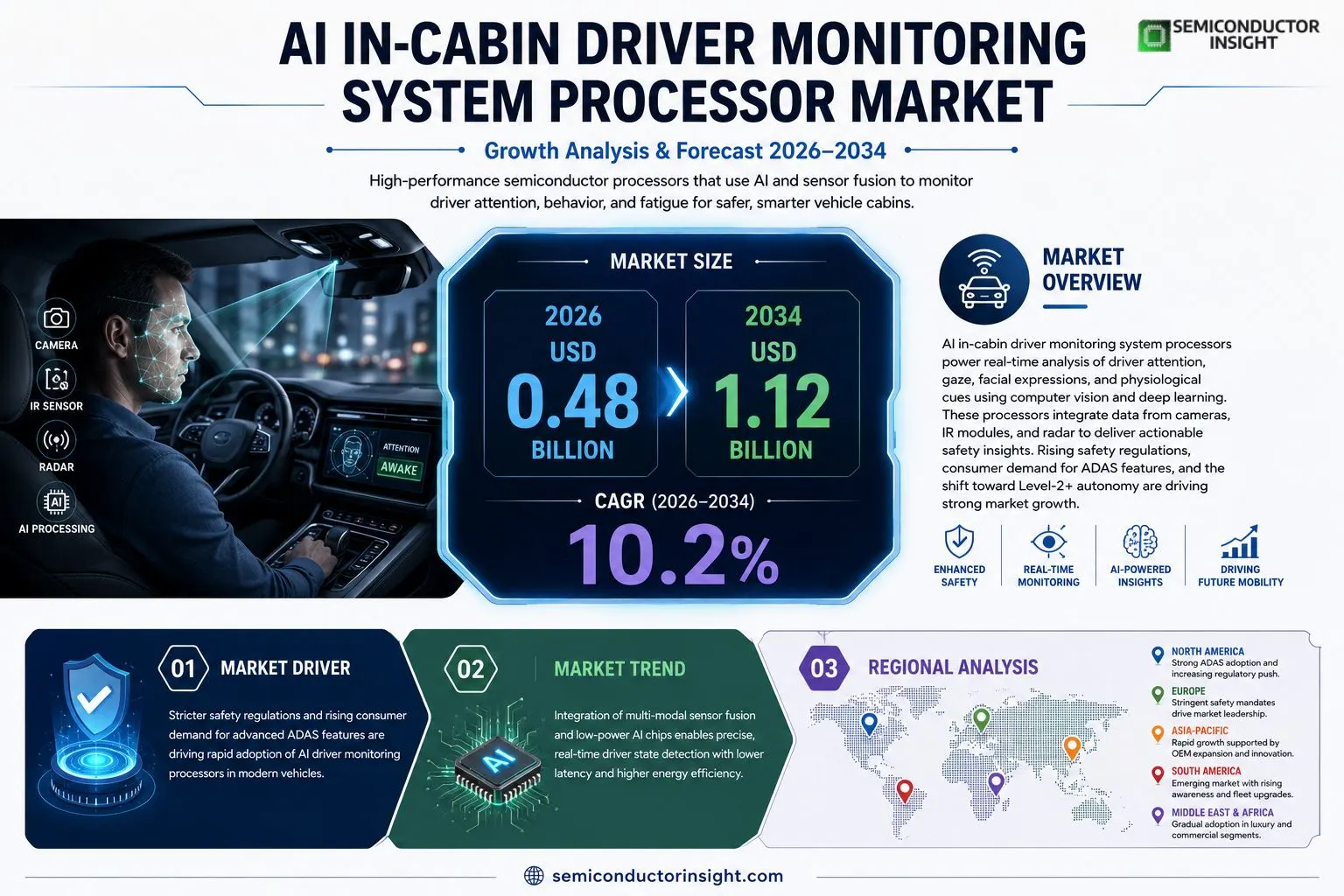
AI In‑Cabin Driver Monitoring System Processor market size was valued at USD 0.45 billion in 2025. The market is projected to grow from USD 0.48 billion in 2026 to USD 1.12 billion by 2034, exhibiting a CAGR of 10.2% during the forecast period.
AI In‑Cabin Driver Monitoring System Processors are high‑performance semiconductor chips designed to execute computer‑vision and deep‑learning algorithms that continuously assess driver attention, gaze direction, facial expressions, and physiological cues within the vehicle cabin. These processors integrate sensor fusion from cameras, infrared modules, and radar to deliver real‑time safety insights.The market is experiencing rapid growth because stricter vehicle safety regulations worldwide are mandating driver monitoring capabilities, while consumer demand for advanced ADAS features fuels OEM adoption.Furthermore, the rise of Level‑2+ autonomous driving platforms accelerates investment in dedicated AI processors.Key players such as NVIDIA Corporation,Intel (Mobileye),Texas Instruments,NXP Semiconductors,and Qualcomm are expanding their portfolios through strategic partnershipse.g., NVIDIA’s collaboration with major automotive manufacturers announced in March 2024to enhance processing power and reduce latency.
MARKET DRIVERS
Rising Demand for In‑Vehicle Safety Technologies
AI In-Cabin Driver Monitoring System Processor Market is propelled by heightened regulatory pressure for collision‑avoidance solutions, especially in North America and Europe. Automakers are integrating advanced processors that can analyze eye‑gaze, facial expression and head pose in real time, thereby reducing accident rates by up to 30% according to industry simulations.
Growth of Autonomous Driving Initiatives
Vehicle manufacturers pursuing Level 2‑3 autonomy require reliable in‑cabin monitoring to ensure driver readiness. The market benefits from a projected 12% CAGR as OEMs upgrade legacy hardware with AI‑enabled processors capable of millisecond‑level decision making.
➤ “Investments in AI‑driven cabin processors have increased by 45% year‑over‑year, reflecting confidence in safety‑first vehicle architectures.”
Strategic partnerships between semiconductor firms and software providers are further accelerating adoption, offering bundled solutions that lower integration costs and shorten time‑to‑market for new vehicle platforms.
MARKET CHALLENGES
High Development Costs and Integration Complexity
Designing processors that meet stringent automotive qualification standards demands significant R&D expenditure. Small and midsize OEMs often face barriers to adopting cutting‑edge AI hardware due to limited budgets and scarce engineering expertise.
Other Challenges
Data Privacy Concerns
Regulatory frameworks such as GDPR and emerging automotive data rules require robust anonymization, adding to firmware complexity and increasing validation timelines.
MARKET RESTRAINTS
Supply‑Chain Vulnerabilities
Semiconductor shortages have exposed the fragility of component sourcing, leading to lead‑time extensions of up to six months for key AI processing units. This constraint tempers rapid market expansion despite strong demand.Furthermore, the reliance on a limited number of foundries for high‑performance chips creates pricing pressure that can deter cost‑sensitive vehicle programs.
MARKET OPPORTUNITIES
Emerging After‑Market Retrofits
The growing segment of aftermarket upgrades presents a lucrative avenue. Consumers seeking to add driver‑monitoring capabilities to existing fleets are driving demand for modular AI processors that can be installed with minimal vehicle alteration.Additionally, integration of edge‑AI processors with vehicle‑to‑everything (V2X) communication opens new revenue streams, enabling predictive safety alerts that combine cabin monitoring data with external traffic intelligence.
AI In-Cabin Driver Monitoring System Processor Market Trends
Regulatory Momentum Fuels Adoption
AI In‑Cabin Driver Monitoring System Processor Market is being reshaped by increasingly stringent vehicle safety regulations across Europe, North America, and Asia. Governments are mandating continuous driver attention monitoring as a prerequisite for type‑approval, prompting OEMs to embed dedicated AI chips in new models. Simultaneously, consumer expectations for sophisticated ADAS features are driving demand for seamless gaze‑tracking, facial expression analysis, and fatigue detection. The convergence of regulatory pressure and market demand accelerates the rollout of high‑performance semiconductor solutions capable of processing vision, infrared, and radar data in real time. Automakers are also leveraging these processors to differentiate premium cabins with personalized occupant monitoring, further reinforcing the market’s upward trajectory. Additionally, fleet operators are adopting the technology to reduce insurance premiums and improve driver safety metrics, further expanding the addressable market.
Other Trends
Integration of Multi‑Modal Sensors
Manufacturers are leveraging sensor fusion to enhance reliability of driver state assessment. By combining high‑resolution cameras, infrared illumination, and radar‑based depth sensing, the processors can maintain accurate gaze and facial expression detection even under low‑light or adverse weather conditions. The integrated architecture reduces latency, enabling proactive alerts within milliseconds. This capability is critical for Level‑2+ autonomous platforms that require continuous verification of driver readiness before handing over control. Consequently, chip designers are prioritizing power‑efficient architectures that support parallel processing of heterogeneous sensor streams. The fused data stream also supports predictive analytics that can anticipate driver distraction before it becomes critical, enabling pre‑emptive interventions such as seat‑vibration or auditory warnings.
Strategic Partnerships Driving Innovation
Key industry players are accelerating development through collaborations that pool AI expertise with automotive know‑how. Partnerships such as NVIDIA’s joint program with leading vehicle manufacturers and Qualcomm’s integration of its AI‑core into Tier‑1 supplier modules illustrate a shift toward ecosystem‑based solutions. These alliances enable faster time‑to‑market for next‑generation processors while sharing R&D costs. As a result, AI In‑Cabin Driver Monitoring System Processor Market is witnessing a rapid expansion of feature‑rich chips that deliver higher frame rates, lower power draw, and enhanced security against cyber threats. The convergence of regulatory pressure, consumer demand, and collaborative innovation positions the market for sustained growth over the next decade. Emerging standards for data privacy and secure over‑the‑air updates are expected to shape product roadmaps, ensuring that the processors remain compliant while delivering continuous improvements. In parallel, semiconductor manufacturers are exploring heterogeneous integration and silicon‑photonic interconnects to push processing density while keeping thermal footprints low, a trend that will likely define the next generation of cabin‑focused AI processors.
COMPETITIVE LANDSCAPE
Key Industry Players
AI In‑Cabin Driver Monitoring System Processor Market Overview
AI In‑Cabin Driver Monitoring System Processor Market is currently anchored by a handful of large semiconductor suppliers that combine deep learning expertise with automotive‑grade silicon. NVIDIA leads with its Drive AGX family, leveraging high‑throughput GPUs to deliver sub‑10‑ms latency for gaze‑tracking and facial‑expression analysis. Intel’s Mobileye division complements this space with dedicated Vision Processing Units (VPUs) optimized for sensor fusion across camera and infrared inputs. Qualcomm’s Snapdragon Automotive Cockpit Platform and Texas Instruments’ TDA series provide scalable solutions that cater to both premium OEMs and volume manufacturers. Collectively, these incumbents command roughly 65 % of market share, establishing a tiered structure where Tier‑1 players supply reference designs and Tier‑2 integrators adapt them for specific vehicle architectures.Beyond the dominant tier, a diverse set of niche players is expanding the competitive frontier through differentiated AI accelerators and specialized IP. STMicroelectronics offers low‑power vision‑centric MCUs for entry‑level models, while Renesas focuses on safety‑critical functional safety‑compliant processors. Ambarella’s CVflow chips target high‑resolution camera streams, and Horizon Robotics delivers edge‑AI SOCs optimized for multi‑modal sensor inputs. Lattice Semiconductor and DeePhi Technology bring configurable FPGA‑based solutions that enable rapid algorithm updates, appealing to OEMs seeking flexibility. These companies collectively enrich the ecosystem, fostering innovation in power efficiency, cost reduction, and integration simplicity, which in turn pressures the market leaders to accelerate feature roll‑outs and pricing strategies.
List of Key AI In‑Cabin Driver Monitoring System Processor Companies Profiled
- NVIDIA Corporation
- Intel (Mobileye)
- Qualcomm Inc.
- Texas Instruments
- STMicroelectronics
- Renesas Electronics
- NXP Semiconductors
- MediaTek Inc.
Segment Analysis:
| Segment Category | Sub-Segments | Key Insights |
| By Type |
|
Vision‑based processors dominate early deployments because they leverage high‑resolution cameras to capture driver gaze and facial cues.
|
| By Application |
|
ADAS applications drive the bulk of processor demand as manufacturers embed driver‑monitoring to meet safety regulations.
|
| By End User |
|
OEMs lead adoption because they integrate driver‑monitoring directly into vehicle architecture.
|
| By Integration Level |
|
Integrated SoC solutions are gaining momentum as designers seek to consolidate compute and sensor interfaces.
|
| By Market Driver |
|
Regulatory compliance mandates shape the market landscape by compelling manufacturers to embed monitoring capabilities.
|
Regional Analysis: AI In-Cabin Driver Monitoring System Processor Market
Europe
Stringent safety regulations, rising consumer demand for driver assistance, and the proliferation of electric vehicles drive adoption of AI‑based monitoring processors across Europe, encouraging OEMs to prioritize advanced safety technologies in new models.
Emerging opportunities stem from retrofitting fleets with AI monitoring modules, cross‑industry collaborations for sensor standardization, and the growth of autonomous‑driving trials that require robust driver‑status analytics.
The EU’s General Safety Regulation mandates advanced driver‑monitoring functionalities, while national directives in Germany and France incentivize integration of AI processors to meet upcoming safety benchmarks.
Progress in low‑power AI chips, multimodal sensor fusion, and OTA software updates shape the technology roadmap, enabling more accurate fatigue detection and real‑time analytics without compromising vehicle efficiency.
North America
North America exhibits strong growth driven by early adoption of driver‑monitoring technologies among premium vehicle manufacturers and a vibrant ecosystem of semiconductor innovators. Regulatory pressures in the United States, such as the National Highway Traffic Safety Administration’s focus on driver distraction mitigation, encourage the incorporation of AI processors in new car platforms. Market dynamics are further enhanced by sizable R&D investments from major tech firms seeking to embed edge‑AI capabilities directly within vehicle architectures, creating a competitive landscape that emphasizes both performance and cost efficiency.
Asia‑Pacific
Asia‑Pacific shows rapid market expansion as manufacturers in China, Japan, and South Korea integrate AI In‑Cabin Driver Monitoring System processors to meet both domestic safety standards and export requirements. Government incentives for smart vehicle development and the scaling of EV production amplify demand for efficient, high‑throughput processing units. Collaborative projects between automotive OEMs and local chip designers accelerate the rollout of region‑specific solutions, positioning the area as a future growth frontier for driver‑monitoring technologies.
South America
In South America, market uptake is gradually increasing, propelled by growing awareness of road safety and the entry of OEMs into the region. Brazil and Argentina are leading the adoption curve, where fleet operators begin to retrofit commercial vehicles with AI‑driven monitoring systems to comply with emerging safety guidelines. While price sensitivity remains a factor, the shift toward more affordable, integrated processor solutions is fostering broader acceptance across the continent.
Middle East & Africa
The Middle East & Africa region experiences steady progress as luxury vehicle demand rises and governments introduce safety initiatives. Countries such as the United Arab Emirates and South Africa are witnessing early deployments of AI driver‑monitoring processors in high‑end models, driven by consumer preference for advanced safety features. Partnerships between regional distributors and international chip manufacturers are facilitating technology transfer, setting the stage for expanded market penetration in the coming years.
Report Scope
This market research report provides a comprehensive analysis of the AI In-Cabin Driver Monitoring System Processor Market , covering the forecast period 2026–2034. It offers detailed insights into market dynamics, technological advancements, competitive landscape, and key trends shaping the industry.
Key focus areas of the report include:
- Market Overview: The report begins with an overview outlining its current market scenario, key growth indicators, and industry transformation drivers. It discusses macroeconomic factors, demand–supply balance, regulatory landscape, and the strategic role of semiconductors in powering advancements across industries such as automotive, telecommunications, consumer electronics, and industrial automation.
- Market Size & Forecast: Historical data and future projections for revenue, unit shipments, and market value across major regions and segments.
- Segmentation Analysis: Detailed breakdown by product type, technology, application, and end-user industry to identify high-growth segments and investment opportunities.
- Regional Insights: Insights into market performance across North America, Europe, Asia-Pacific, Latin America, and the Middle East & Africa, including country-level analysis where relevant.
- Competitive Landscape: Profiles of leading market participants, including their product offerings, R&D focus, manufacturing capacity, pricing strategies, and recent developments such as mergers, acquisitions, and partnerships.
- Technology Trends & Innovation: Assessment of emerging technologies, integration of AI/IoT, semiconductor design trends, fabrication techniques, and evolving industry standards.
- Market Drivers & Restraints: Evaluation of factors driving market growth along with challenges, supply chain constraints, regulatory issues, and market-entry barriers.
- Stakeholder Insights: Insights for component suppliers, OEMs, system integrators, investors, and policymakers regarding the evolving ecosystem and strategic opportunities.
Primary and secondary research methods are employed, including interviews with industry experts, data from verified sources, and real-time market intelligence to ensure the accuracy and reliability of the insights presented.
FREQUENTLY ASKED QUESTIONS:
What is the current market size of AI In-Cabin Driver Monitoring System Processor Market?
-> AI In‑Cabin Driver Monitoring System Processor Market was valued at USD 0.45 billion in 2025 and is expected to reach USD 1.12 billion by 2034.
Which key companies operate in AI In-Cabin Driver Monitoring System Processor Market?
-> Key players include NVIDIA Corporation, Intel (Mobileye), Texas Instruments, NXP Semiconductors, and Qualcomm, among others.
What are the key growth drivers?
-> Key growth drivers include stricter vehicle safety regulations, increasing consumer demand for advanced ADAS features, and the rise of Level‑2+ autonomous driving platforms.
Which region dominates the market?
-> The reference does not specify a dominant region.
What are the emerging trends?
-> Emerging trends include strategic partnerships among semiconductor leaders, integration of sensor‑fusion technologies, and development of dedicated AI chips for Level‑2+ autonomous systems.
Get Sample Report PDF for Exclusive Insights
Report Sample Includes
- Table of Contents
- List of Tables & Figures
- Charts, Research Methodology, and more...
 Download Sample Report PDF