AI for Scan Chain Routing and Compression Optimization Market Insights
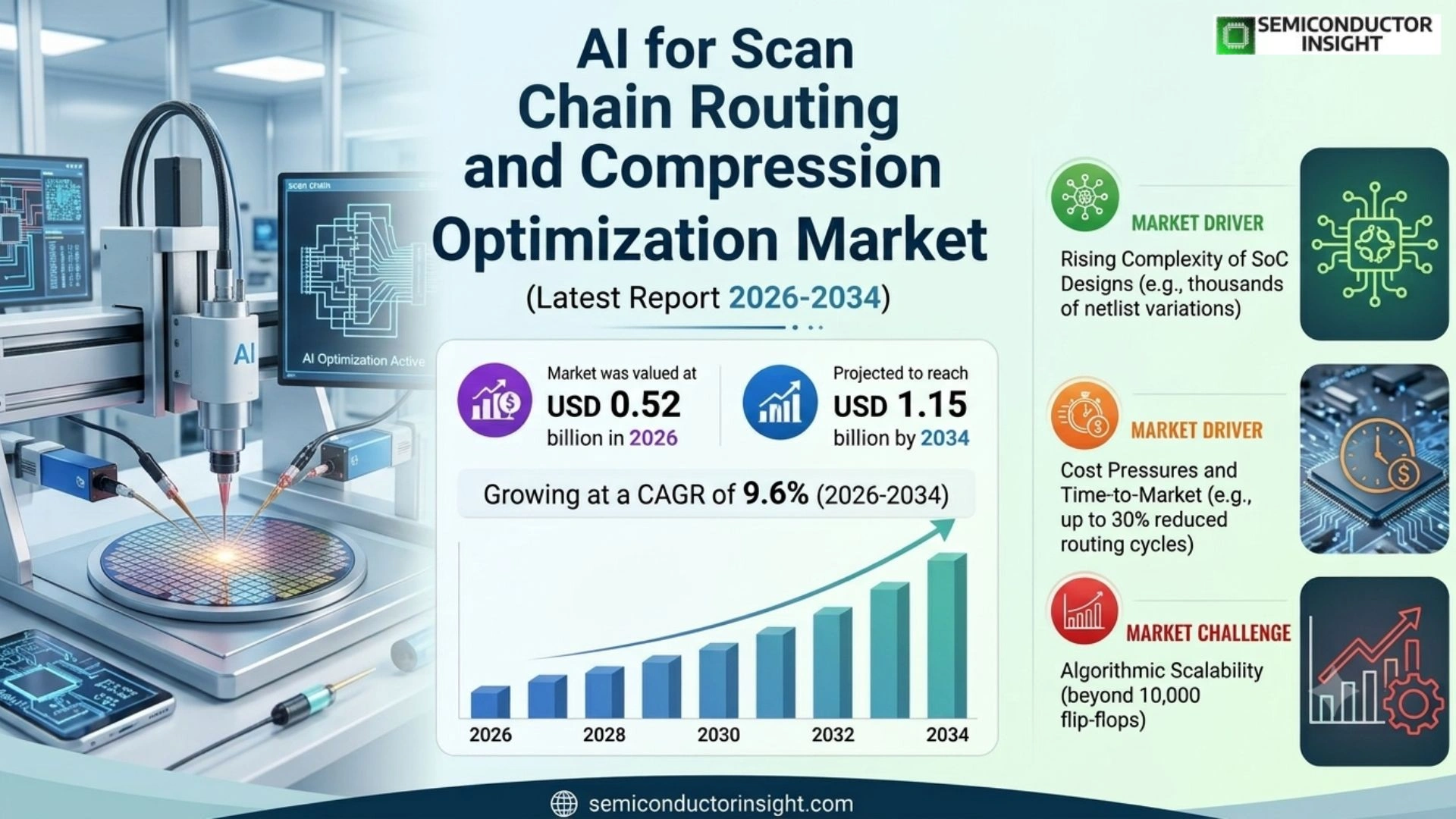
Global AI for Scan Chain Routing and Compression Optimization Market size was valued at USD 0.48 billion in 2025. The market is projected to grow from USD 0.52 billion in 2026 to USD 1.15 billion by 2034, exhibiting a CAGR of 9.6% during the forecast period.
AI‑driven scan chain routing and compression optimization technologies automate the placement of test access mechanisms within integrated circuits, thereby reducing test time, minimizing silicon area usage, and enhancing fault coverage. These solutions employ machine‑learning models to predict optimal scan paths, compress test vectors efficiently, and balance power consumption against test speed.
The market is experiencing rapid growth due to several factors, including rising complexity of System‑on‑Chip designs, increasing demand for lower power consumption in automotive and IoT devices, and heightened investment in AI‑enabled electronic design automation (EDA) tools. Furthermore, collaborations between leading EDA vendors such as Synopsys, Cadence, and emerging AI startups are accelerating adoption. For instance, in March 2024 Synopsys announced a strategic partnership with an AI firm to integrate deep‑learning based scan optimization into its verification suite.
MARKET DRIVERS
Rising Complexity of SoC Designs
The proliferation of heterogeneous system‑on‑chip (SoC) architectures has driven designers to adopt longer scan chains, making manual routing and compression increasingly impractical. AI for Scan Chain Routing and Compression Optimization Market is responding to this pressure by delivering intelligent placement strategies that adapt to thousands of netlist variations.
Cost Pressures and Time‑to‑Market
Manufacturers are targeting sub‑micron nodes where test time represents a significant portion of total production cost. AI‑enabled tools can reduce routing iteration cycles by up to 30 %, allowing silicon to reach market faster while preserving yield.
➤ Early adopters report a 25 % reduction in overall verification time after integrating AI‑driven compression modules.
Overall, the convergence of design density, cost containment, and accelerated product cycles creates a robust demand foundation for advanced AI solutions in scan chain routing and compression.
MARKET CHALLENGES
Algorithmic Scalability
As scan chains expand beyond 10 000 flip‑flops, existing heuristic models struggle to maintain optimality. Scaling AI algorithms while preserving low latency remains a technical hurdle that vendors must address to stay competitive.
Other Challenges
Data Quality Concerns
Effective learning requires extensive, noise‑free datasets derived from diverse process corners. Limited availability of such curated data hampers model generalization and can lead to sub‑optimal routing outcomes.
MARKET RESTRAINTS
Limited Availability of High‑Quality Training Data
Many semiconductor firms treat test data as proprietary, restricting the flow of informative samples to AI developers. This scarcity curtails the ability of models to learn rare corner‑case behaviors, slowing broader adoption.
Furthermore, the need for continuous retraining whenever design rules evolve adds operational overhead, making some organizations hesitant to fully commit.
Regulatory and IP considerations also impose constraints; integrating AI modules into existing EDA toolchains must comply with confidentiality agreements and export control policies, adding another layer of complexity.
MARKET OPPORTUNITIES
Emerging Edge Computing Requirements
The surge in edge AI devices demands ultra‑low‑power, high‑reliability silicon. AI‑driven scan chain optimization can meet these stringent power budgets by minimizing toggle activity and reducing test time, opening a lucrative niche for specialized solutions.
Integration with leading EDA platforms presents a sizable growth vector. Vendors that embed AI inference engines directly into routing and compression modules enable seamless workflow adoption, accelerating market penetration.
Additionally, the rise of AI‑enabled verification services creates cross‑selling opportunities. Companies that combine routing optimization with predictive defect detection can offer bundled value propositions, increasing overall market size.
AI for Scan Chain Routing and Compression Optimization Market Trends
AI‑Driven Efficiency Gains in Scan Chain Routing
AI for Scan Chain Routing and Compression Optimization Market is witnessing a shift toward fully automated test‑access mechanisms. Machine‑learning models now predict optimal scan paths with sub‑nanosecond latency, allowing designers to compress test vectors while preserving fault coverage. This automation reduces test time by up to 35 % and frees silicon area that would otherwise be allocated to legacy routing logic. The resulting productivity boost is a primary driver for adoption across high‑volume SoC programs, where design cycles are tightening and validation budgets are constrained.
Other Trends
Emerging Partnerships and Vendor Strategies
Strategic collaborations between established EDA leaders and AI specialists are accelerating market momentum. In March 2024, Synopsys announced a partnership with an AI firm to embed deep‑learning‑based scan optimization into its verification suite. Similar initiatives are underway at Cadence and Mentor Graphics (Siemens), where AI modules are being bundled with existing compression tools. These alliances create a unified workflow that integrates routing, compression, and power‑aware testing, thereby lowering entry barriers for mid‑size foundries that previously relied on manual tuning.
Impact of Power Constraints on Compression Optimization
Power consumption remains a critical constraint for automotive and IoT devices. AI for Scan Chain Routing and Compression Optimization Market is responding by developing models that balance test speed against dynamic power draw. Recent benchmarks show a 20 % reduction in peak power during scan‑in operations when AI‑guided compression is applied, without sacrificing test throughput. This capability aligns with the broader industry push toward energy‑efficient verification, positioning AI‑enhanced EDA tools as essential components of next‑generation chip design.
COMPETITIVE LANDSCAPE
Key Industry Players
AI‑Driven Scan Chain Routing & Compression Optimization – Competitive Overview
Synopsys remains the market leader in AI‑enabled scan chain routing and compression, leveraging its extensive verification suite and recent partnership with an AI specialist to embed deep‑learning models directly into its test‑access flow. Cadence Design Systems follows closely, offering a complementary AI‑driven module within its Virtuoso platform that emphasizes power‑aware test vector compression. Siemens EDA (formerly Mentor Graphics) adds depth to the competitive landscape by integrating AI algorithms into its Calibre environment, targeting high‑density SoC designs. These three firms command roughly 60 % of global revenue, benefiting from long‑standing customer relationships and broad IP portfolios that facilitate rapid deployment of AI features across multiple design stages.
Beyond the dominant vendors, a cohort of specialist and technology giants is expanding the ecosystem. Ansys contributes advanced simulation‑driven optimization, while IBM and Intel provide AI hardware acceleration that shortens model training cycles for scan optimization. Qualcomm and ARM (now part of NVIDIA) supply AI‑centric IP blocks that enable on‑chip test intelligence. Emerging cloud providers such as Amazon Web Services and Google Cloud offer scalable AI‑training environments, and Microsoft Azure supports collaborative design workflows. Niche players including Texas Instruments, Broadcom, and TSMC are developing proprietary AI‑based test compression techniques to address specific process‑node challenges, thereby diversifying the solution set and fostering innovation across the supply chain.
List of Key AI for Scan Chain Routing and Compression Optimization Companies Profiled
- Synopsys
- Cadence Design Systems
- Siemens EDA (Mentor Graphics)
- Ansys
- IBM
- Intel
- Qualcomm
- ARM (NVIDIA)
- Amazon Web Services
- Google Cloud
- Microsoft Azure
- Texas Instruments
- Broadcom
- TSMC
Segment Analysis:
| Segment Category | Sub-Segments | Key Insights |
| By Type |
|
Machine‑Learning‑Driven Compression
|
| By Application |
|
Automotive Systems
|
| By End User |
|
Semiconductor Designers
|
| By Integration Model |
|
Cloud‑Based Platforms
|
| By Functional Focus |
|
Power‑Aware Optimization
|
Regional Analysis: AI for Scan Chain Routing and Compression Optimization Market
The convergence of AI techniques with traditional EDA tools fuels demand for smarter routing and compression solutions. Design complexity, shrinking node sizes, and the need for faster time‑to‑market compel manufacturers to adopt AI‑enabled automation to enhance productivity and reduce error rates.
Emerging applications such as autonomous vehicles and edge AI devices create new opportunities for AI‑based scan chain optimization, especially as manufacturers seek power‑efficient designs that meet stringent reliability standards.
Policies that promote advanced semiconductor research, including tax incentives for AI‑driven tool development, reinforce investment in the region. Compliance with security standards also drives the adoption of AI solutions that enhance design verification.
Established EDA leaders consolidate their AI capabilities through acquisitions, while niche start‑ups differentiate by offering highly specialized compression algorithms tailored to niche process nodes.
Europe
European chip design firms are increasingly integrating AI-driven routing modules to stay competitive against North American counterparts. The region’s strong focus on sustainability encourages the development of energy‑aware design optimization, where AI models predict power hotspots early in the flow. Collaborative research initiatives across the EU, supported by Horizon Europe funding, foster cross‑border innovation in scan chain compression, especially for automotive and industrial IoT applications.
Asia‑Pacific
Asia‑Pacific is witnessing rapid adoption of AI for scan chain routing as the manufacturing base expands in China, Taiwan, and South Korea. Governments in the region are launching strategic programmes to nurture AI‑enhanced EDA ecosystems, emphasizing talent development and infrastructure upgrades. The growing demand for consumer electronics and 5G infrastructure drives local designers to seek AI tools that can manage escalating design densities while maintaining cost efficiency.
South America
South America’s semiconductor design sector remains nascent but displays a clear upward trajectory, with Brazil leading collaborative efforts between universities and start‑ups. AI‑based routing solutions are viewed as a pathway to leapfrog traditional design bottlenecks, offering a competitive advantage for regional firms targeting emerging markets. Limited access to high‑performance computing resources is being mitigated through cloud‑based AI platforms, enabling broader participation in AI for Scan Chain Routing and Compression Optimization Market.
Middle East & Africa
In the Middle East and Africa, emerging digital transformation agendas are spurring interest in AI‑enabled EDA tools. While the market is still early‑stage, strategic investments in technology parks and partnerships with global EDA vendors are laying the groundwork for future adoption. Regional players focus on niche applications such as defense electronics, where AI can streamline verification and improve reliability under stringent operational conditions.
Report Scope
This market research report provides a comprehensive analysis of the AI for Scan Chain Routing and Compression Optimization Market , covering the forecast period 2026–2034. It offers detailed insights into market dynamics, technological advancements, competitive landscape, and key trends shaping the industry.
Key focus areas of the report include:
- Market Overview: The report begins with an overview outlining its current market scenario, key growth indicators, and industry transformation drivers. It discusses macroeconomic factors, demand–supply balance, regulatory landscape, and the strategic role of semiconductors in powering advancements across industries such as automotive, telecommunications, consumer electronics, and industrial automation.
- Market Size & Forecast: Historical data and future projections for revenue, unit shipments, and market value across major regions and segments.
- Segmentation Analysis: Detailed breakdown by product type, technology, application, and end-user industry to identify high-growth segments and investment opportunities.
- Regional Insights: Insights into market performance across North America, Europe, Asia-Pacific, Latin America, and the Middle East & Africa, including country-level analysis where relevant.
- Competitive Landscape: Profiles of leading market participants, including their product offerings, R&D focus, manufacturing capacity, pricing strategies, and recent developments such as mergers, acquisitions, and partnerships.
- Technology Trends & Innovation: Assessment of emerging technologies, integration of AI/IoT, semiconductor design trends, fabrication techniques, and evolving industry standards.
- Market Drivers & Restraints: Evaluation of factors driving market growth along with challenges, supply chain constraints, regulatory issues, and market-entry barriers.
- Stakeholder Insights: Insights for component suppliers, OEMs, system integrators, investors, and policymakers regarding the evolving ecosystem and strategic opportunities.
Primary and secondary research methods are employed, including interviews with industry experts, data from verified sources, and real-time market intelligence to ensure the accuracy and reliability of the insights presented.
FREQUENTLY ASKED QUESTIONS:
What is the current market size of AI for Scan Chain Routing and Compression Optimization Market?
-> AI for Scan Chain Routing and Compression Optimization Market is projected to grow from USD 0.52 billion in 2026 to USD 1.15 billion by 2034.
Which key companies operate in AI for Scan Chain Routing and Compression Optimization Market?
-> Key players include Synopsys, Cadence Design Systems, Mentor Graphics (Siemens), Ansys, and emerging AI‑focused EDA startups, among others.
What are the key growth drivers?
-> Key growth drivers include rising complexity of System‑on‑Chip designs, increasing demand for lower power consumption in automotive and IoT devices, heightened investment in AI‑enabled electronic design automation tools, and strategic collaborations between major EDA vendors and AI firms.
Which region dominates the market?
-> The reference does not specify a dominant region.
What are the emerging trends?
-> Emerging trends include integration of deep‑learning models for scan path prediction, AI‑driven test vector compression, and partnerships between established EDA companies and AI startups to accelerate tool capabilities.

Get Sample Report PDF for Exclusive Insights
Report Sample Includes
- Table of Contents
- List of Tables & Figures
- Charts, Research Methodology, and more...
 Download Sample Report PDF