AI-Ethernet 800G MAC IP Market Insights
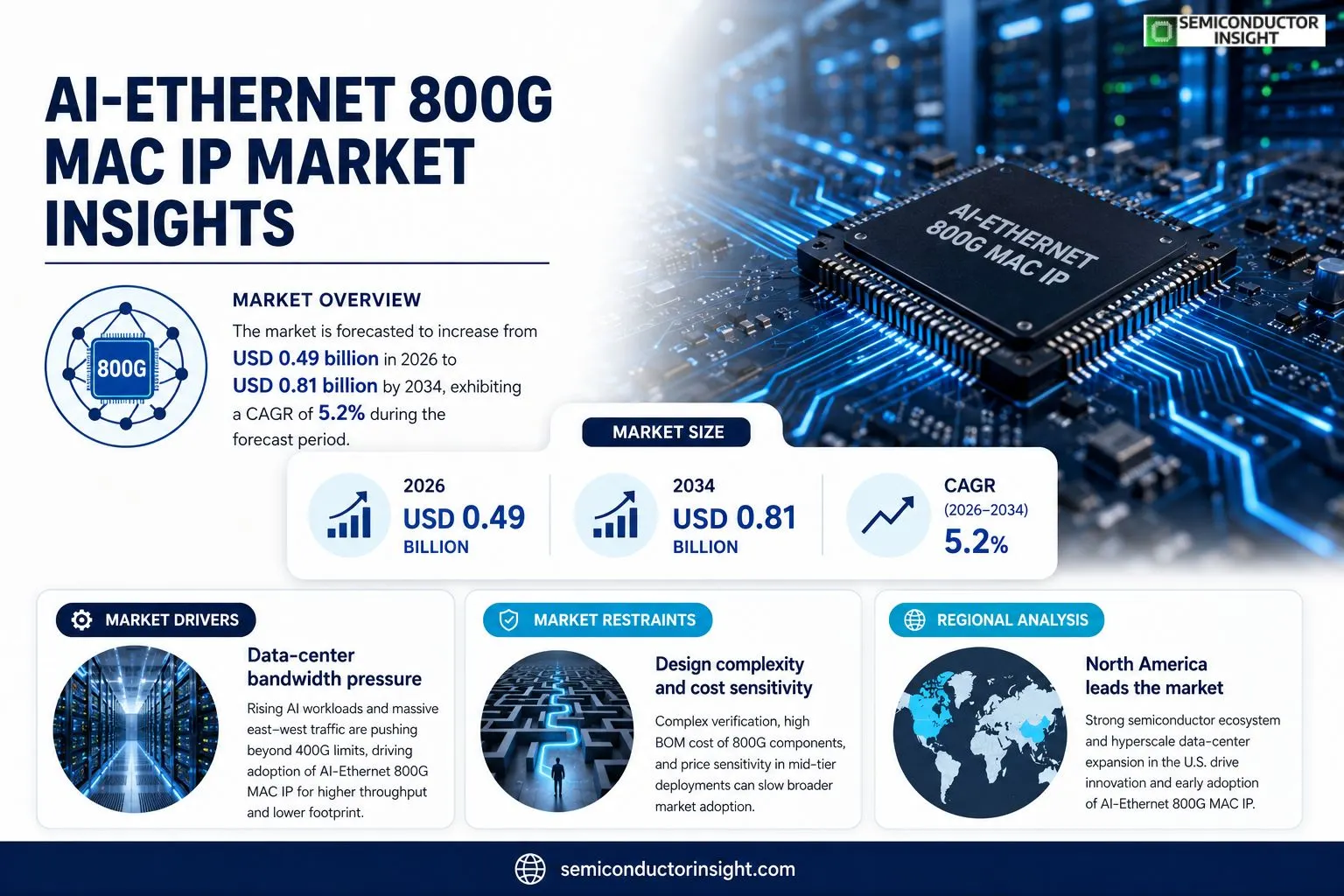
AI-Ethernet 800G MAC IP Market size was valued at USD 0.46 billion in 2025. The market is forecasted to increase from USD 0.49 billion in 2026 to USD 0.81 billion by 2034, exhibiting a CAGR of 5.2 % during the forecast period.
AI‑Ethernet 800G MAC IP refers to the intellectual‑property core that implements the Media Access Control layer for an eight‑hundred‑gigabit Ethernet interface equipped with artificial‑intelligence‑optimized features such as low‑latency packet scheduling and programmable traffic shaping. This IP block enables silicon vendors to integrate ultra‑high‑speed connectivity into ASICs and FPGAs without redesigning the entire Ethernet stack.The market gains momentum because hyperscale data centers are expanding capacity for generative‑AI models, which demand bandwidth beyond the traditional 400 Gbps envelope. Moreover, telecom operators upgrading backbone networks toward terabit‑scale transport create additional demand for modular MAC solutions that can be customized for power‑constrained edge deployments. Companies such as Broadcom, Intel and Marvell have announced new silicon families that embed the AI‑Ethernet 800G MAC IP, reinforcing adoption across cloud and carrier ecosystems.
MARKET DRIVERS
Data‑center bandwidth pressure
Enterprises upgrading to hyperscale infrastructure are encountering a surge in east‑west traffic that exceeds the capacity of legacy 400G solutions. The shift toward AI‑enhanced workloadssuch as large language model training and real‑time video analyticscreates a lattice of high‑throughput demands. Consequently, designers are turning to AI‑Ethernet 800G MAC IP to consolidate lanes and reduce the overall footprint of optical modules.
Standardization momentum
Recent IEEE amendments have clarified signaling envelopes for 800G Ethernet, giving silicon vendors a clearer roadmap. This regulatory clarity shortens time‑to‑market for MAC IP blocks and encourages OEMs to embed the technology in next‑generation ASICs. The alignment of industry consortia around a common PHY specification also lessens integration risk for data‑center operators.
➤ “Adopting 800G MAC IP halves the number of transceiver slots required for a 2.4Tbps fabric, translating into measurable power savings.”
Beyond performance, the energy‑efficiency profile of the 800G MAC core is becoming a decisive factor. By shrinking the number of active lanes, power consumption per bit declines, allowing operators to meet increasingly stringent sustainability targets while preserving capital expenditure budgets.
MARKET CHALLENGES
Design complexity and verification
Integrating an 800G MAC IP into a heterogeneous SoC environment demands rigorous verification across multiple clock domains. The absence of mature, off‑the‑shelf verification kits forces design houses to invest heavily in custom testbenches, stretching development cycles.
Other Challenges
Supply‑chain volatility
The limited number of fabs capable of producing 7‑nm and below nodes for high‑speed MAC designs creates a bottleneck. Fluctuations in wafer allocation can delay volume shipments, prompting OEMs to maintain larger safety stocks.
MARKET RESTRAINTS
Cost sensitivity in mid‑tier deployments
While flagship data centers are willing to absorb the premium associated with 800G MAC IP, mid‑tier operators often prioritize cost per gigabit over raw throughput. The higher bill‑of‑materials for 800G transceivers and supporting cooling infrastructure can deter broader adoption outside the hyperscale segment.
MARKET OPPORTUNITIES
AI‑accelerated edge compute
Edge locations that host inference engines for autonomous vehicles, smart factories, and remote‑sensing arrays are beginning to require bandwidth levels once reserved for core data centers. Offering a scalable 800G MAC IP that can be packaged in smaller form‑factors opens a lucrative niche where latency, bandwidth, and power density converge.
AI-Ethernet 800G MAC IP Market Trends
Surging Demand from Generative‑AI‑Driven Data Centers
The AI‑Ethernet 800G MAC IP market is feeling pressure as hyperscale operators scale out infrastructure for large‑scale generative‑AI workloads. Those models process petabytes of data, and the Ethernet fabric must accommodate packet rates that exceed the 400 Gbps ceiling of prior generations. By inserting a programmable MAC block that supports sub‑microsecond scheduling, silicon designers can meet the latency constraints that AI training pipelines impose. The ripple effect reaches system integrators, who now prioritize designs that embed the 800‑gigabit interface to future‑proof capacity planning. Consequently, vendors that can offer a drop‑in MAC IP are gaining leverage in contract negotiations with cloud providers looking to avoid costly redesigns. The shift also triggers a reevaluation of board‑level thermal budgets, prompting designers to adopt advanced materials that dissipate heat more efficiently.
Other Trends
Edge‑Focused Power Efficiency
Telecom carriers upgrading backbone routes toward terabit‑scale links are also turning to the market for modular solutions that can be stripped down for edge routers with strict power envelopes. The IP’s ability to program traffic shaping avoids over‑provisioning of silicon, which translates into lower TDP per port. In practice, this capability lets operators roll out new aggregation points without a wholesale redesign of cooling infrastructure. The business implication is a reduction in capex for incremental rollout, while maintaining the bandwidth headroom needed for upcoming 5G‑core functions. Furthermore, the modular MAC IP facilitates firmware updates that can adapt to evolving traffic patterns without hardware replacement. As a result, the edge segment is emerging as a secondary growth vector for the market.
Broadening Vendor Adoption and Ecosystem Maturity
Major silicon players such as Broadcom, Intel and Marvell have incorporated the 800G MAC IP into recent ASIC and FPGA families, signaling a shift from niche prototypes to mainstream components. Their roadmaps emphasize a standard‑compatible MAC that can be licensed across multiple process nodes, which simplifies validation for ecosystem partners. For system houses, this translates into shorter time‑to‑market for servers targeting AI workloads, while for OEMs it reduces reliance on custom‑engineered Ethernet stacks. The broader adoption also encourages third‑party IP marketplaces to list complementary PHY and validation suites, fostering a virtuous cycle of innovation. Such ecosystem enrichment is expected to lower entry barriers for emerging fabless firms seeking to differentiate their AI‑centric products. In the near term, the market is likely to see increased cross‑licensing activity as vendors aim to lock in design wins with cloud and carrier customers.
COMPETITIVE LANDSCAPE
Key Industry Players
AI‑Ethernet 800G MAC IP Market Competitive Overview
Broadcom remains the anchor of the AI‑Ethernet 800G MAC IP supply chain, leveraging its extensive Ethernet portfolio to embed the eight‑hundred‑gigabit MAC core across multiple silicon families. Its licensing model combines royalty‑based fees with optional customization services, enabling cloud‑scale silicon vendors to meet bandwidth requirements without reinventing the MAC stack. The market architecture reflects a concentration of power in three to four tier‑one IP licensors, whose design‑win leverage shapes downstream ASIC and FPGA development cycles. These incumbents benefit from deep relationships with hyperscale data‑center builders and carrier backbone providers, translating technical leadership into a defensible position that new entrants find difficult to breach. Consequently, the competitive field is stratified: a handful of large licensors dominate volume licensing, while a broader set of boutique firms target niche segments such as low‑power edge or AI‑accelerator integration.Beyond the dominant trio, a cadre of specialized players is carving out relevance through differentiated features or regional market focus. Xilinx, now part of AMD, supplies an FPGA‑centric MAC IP that emphasizes programmability, appealing to customers who need rapid iteration on AI inference pipelines. Lattice offers a lightweight 800G MAC variant optimized for power‑constrained edge modules, a segment gaining attention as telco operators push compute to the network edge. Cisco’s in‑house IP team delivers a carrier‑grade MAC block tightly aligned with its optical transport roadmap, reinforcing its position in carrier‑network upgrades. Meanwhile, companies such as Huawei, Samsung, and MediaTek are leveraging domestic demand in Asia‑Pacific to launch proprietary MAC cores, often bundling them with system‑on‑chip solutions for AI‑accelerated workloads. Smaller niche firmsQualcomm, Nokia, Dell Technologies, and Alibaba Cloudfocus on integrating the MAC IP within AI accelerator or server platforms, providing a proof point that the ecosystem can support a variety of design philosophies. This mosaic of capabilities ensures that while the market is led by a few, innovation continues across the spectrum, creating pressure on prices and prompting incumbents to extend feature sets.
List of Key AI‑Ethernet 800G MAC IP Companies Profiled
- Broadcom Inc.
- Intel Corporation
- Marvell Technology Group Ltd.
- Cisco Systems, Inc.
- Xilinx (AMD)
- Lattice Semiconductor Corporation
- Advanced Micro Devices, Inc.
- NVIDIA (Mellanox)
- Qualcomm Incorporated
- Huawei Technologies Co., Ltd.
- Samsung Electronics Co., Ltd.
- MediaTek Inc.
- Alibaba Cloud
- Nokia Corporation
- Dell Technologies
Segment Analysis:
| Segment Category | Sub-Segments | Key Insights |
| By Type |
|
ASIC MAC IP is the prevailing choice for AI‑Ethernet 800G deployments because it delivers the highest integration density and deterministic performance.
|
| By Application |
|
Cloud Data Center Interconnect drives adoption as operators seek to scale bandwidth for AI workloads across massive server farms.
|
| By End User |
|
Cloud Service Providers are the leading end‑users, leveraging AI‑Ethernet 800G MAC IP to sustain massive AI model training workloads.
|
| By Deployment Scenario |
|
Core Network Backbone emerges as the primary scenario, where carriers upgrade to 800 Gbps links for terabit‑scale transport.
|
| By Integration Mode |
|
Hard IP Integration dominates because it delivers the most predictable timing and performance for mission‑critical AI workloads.
|
Regional Analysis: AI-Ethernet 800G MAC IP Market
Design teams are compressing development cycles by reusing AI‑optimized IP blocks across multiple product families. This modular approach cuts verification time and enables rapid response to customer requests for customized latency profiles.
Domestic wafer fabs and a diversified fabless network reduce exposure to overseas disruptions, granting North American firms a steadier flow of high‑performance silicon for 800G solutions.
Large hyperscale operators now prioritize energy‑per‑bit figures, prompting vendors to embed AI‑driven power‑management algorithms directly into the MAC IP layer.
Federal incentives for advanced networking infrastructure encourage capital spending on 800G deployments, reinforcing the region’s momentum in the broader AI‑Ethernet ecosystem.
Europe
European manufacturers benefit from a coordinated standards effort led by the European Telecommunications Standards Institute, which streamlines interoperability testing for AI‑Ethernet 800G MAC IP. Countries such as Germany and the Netherlands host a concentration of R&D labs that focus on low‑power MAC architectures, aligning with the continent’s sustainability agenda. Major cloud providers in the EU are already piloting 800G links to support AI workloads that demand deterministic latency, prompting local vendors to tailor their IP portfolios to meet stringent energy‑efficiency criteria. The regulatory climate, while rigorous on data protection, remains favorable for capital investment in high‑performance networking, creating a fertile environment for cross‑border collaborations.
Asia‑Pacific
The Asia‑Pacific region showcases a rapid scaling of AI‑driven traffic, especially in China, Japan, and South Korea, where governmental programs fund next‑generation data‑center construction. Local chip designers are leveraging high‑volume manufacturing capabilities to drive down the cost of 800G MAC IP, making the technology accessible to a broader set of enterprises. However, the market is fragmented, with a mix of home‑grown IP cores and imported solutions vying for market share. Partnerships between regional system integrators and North American IP vendors are increasingly common, allowing Asian customers to integrate proven AI‑optimized MAC designs while customizing for regional network topologies.
South America
In South America, Brazil leads the adoption curve, driven by a surge in AI‑enabled video analytics and edge computing projects. While the overall market remains nascent, telecom operators are experimenting with 800G Ethernet to future‑proof backbone networks in preparation for forthcoming AI services. Local firms are beginning to assemble design teams focused on power‑efficiency, recognizing that energy costs constitute a major barrier to large‑scale deployment. Strategic alliances with established IP providers are emerging, offering a pathway for South American enterprises to access mature AI‑Ethernet MAC technology without extensive in‑house development.
Middle East & Africa
The Middle East & Africa region is characterized by targeted investments in smart‑city infrastructure and sovereign cloud initiatives, which are beginning to create demand for high‑throughput networking. United Arab Emirates and South Africa host pilot projects that integrate AI‑Ethernet 800G MAC IP into campus‑scale data centers, aiming to support AI workloads in finance and oil‑&‑gas sectors. The market’s growth is constrained by limited local semiconductor design talent, prompting operators to rely on licensing agreements with overseas vendors. Nonetheless, governmental incentives for digital transformation are encouraging early adopters to experiment with 800G solutions, laying the groundwork for broader adoption in the coming years.
Report Scope
This market research report provides a comprehensive analysis of the AI-Ethernet 800G MAC IP Market , covering the forecast period 2026–2034. It offers detailed insights into market dynamics, technological advancements, competitive landscape, and key trends shaping the industry.
Key focus areas of the report include:
- Market Overview: The report begins with an overview outlining its current market scenario, key growth indicators, and industry transformation drivers. It discusses macroeconomic factors, demand–supply balance, regulatory landscape, and the strategic role of semiconductors in powering advancements across industries such as automotive, telecommunications, consumer electronics, and industrial automation.
- Market Size & Forecast: Historical data and future projections for revenue, unit shipments, and market value across major regions and segments.
- Segmentation Analysis: Detailed breakdown by product type, technology, application, and end-user industry to identify high-growth segments and investment opportunities.
- Regional Insights: Insights into market performance across North America, Europe, Asia-Pacific, Latin America, and the Middle East & Africa, including country-level analysis where relevant.
- Competitive Landscape: Profiles of leading market participants, including their product offerings, R&D focus, manufacturing capacity, pricing strategies, and recent developments such as mergers, acquisitions, and partnerships.
- Technology Trends & Innovation: Assessment of emerging technologies, integration of AI/IoT, semiconductor design trends, fabrication techniques, and evolving industry standards.
- Market Drivers & Restraints: Evaluation of factors driving market growth along with challenges, supply chain constraints, regulatory issues, and market-entry barriers.
- Stakeholder Insights: Insights for component suppliers, OEMs, system integrators, investors, and policymakers regarding the evolving ecosystem and strategic opportunities.
Primary and secondary research methods are employed, including interviews with industry experts, data from verified sources, and real-time market intelligence to ensure the accuracy and reliability of the insights presented.
FREQUENTLY ASKED QUESTIONS:
What is the current market size of AI-Ethernet 800G MAC IP Market?
-> AI-Ethernet 800G MAC IP Market was valued at USD 0.46 billion in 2025 and is expected to reach USD 0.81 billion by 2034, reflecting a CAGR of 5.2 % over the forecast period.
Which key companies operate in AI-Ethernet 800G MAC IP Market?
-> Key players include Broadcom, Intel, and Marvell, among others that have announced silicon families embedding the AI‑Ethernet 800G MAC IP.
What are the key growth drivers?
-> Key growth drivers include expansion of hyperscale data centers for generative‑AI workloads, telecom operators upgrading backbone networks toward terabit‑scale transport, and demand for modular, power‑efficient MAC solutions for edge deployments.
Which region dominates the market?
-> The reference does not specify a dominant region, therefore regional leadership cannot be confirmed from the available data.
What are the emerging trends?
-> Emerging trends include AI‑optimized low‑latency packet scheduling, programmable traffic shaping, and increased integration of 800G MAC IP into cloud‑scale and carrier‑grade silicon platforms.

Get Sample Report PDF for Exclusive Insights
Report Sample Includes
- Table of Contents
- List of Tables & Figures
- Charts, Research Methodology, and more...
 Download Sample Report PDF