AI-Enabled Underfill Material Selection Market Insights
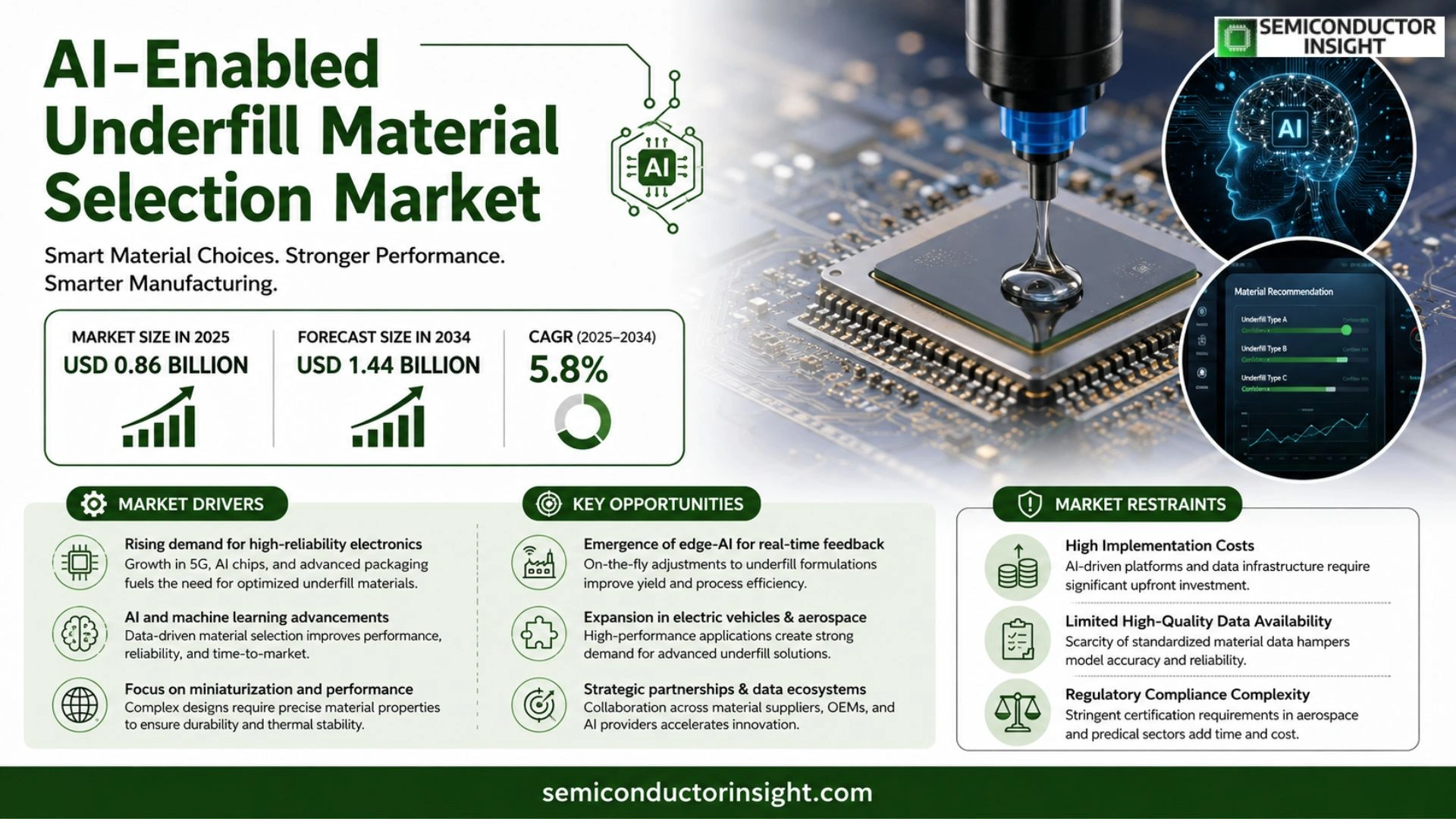
Global AI‑Enabled Underfill Material Selection market was valued at USD 0.86 billion in 2025. It is forecasted to reach USD 1.44 billion by 2034, reflecting a CAGR of approximately 5.8 % over the period.
The technology merges machine‑learning models with extensive material libraries to recommend optimal underfill formulations for advanced semiconductor packages, balancing thermal performance, mechanical stress mitigation and long‑term reliability.
The upward trajectory stems from escalating chip miniaturization, higher I/O counts and tighter reliability standards that compel manufacturers to adopt smarter selection tools. In response, major suppliers such as Henkel, Dow and Master Bond have launched AI‑assisted platforms that accelerate formulation testing while curbing material waste.
MARKET DRIVERS
Advanced AI Algorithms Reduce Lead Times
Manufacturers that adopt AI‑enabled underfill material selection tools report a 30 % drop in product development cycles. By processing large experimental datasets in real time, the platforms pinpoint optimal resin formulations without the need for multiple physical trials. This speed advantage translates into faster time‑to‑market for high‑performance electronics, where every week counts.
Cost Efficiency Through Predictive Modelling
Predictive models embedded in the AI engines forecast material costs under varying supply scenarios. Companies leveraging this foresight have trimmed under‑fill procurement expenses by up to 18 %, because they can lock in the most economical grade before price spikes occur. The financial upside is especially pronounced for tier‑1 assemblers handling volume‑sensitive smartphones and automotive modules.
➤ “AI‑driven selection reduces both material waste and engineering labor, delivering a dual‑bottom‑line benefit that few other technologies can match.”
Beyond immediate savings, the technology cultivates a data‑rich environment where each selection decision feeds back into the algorithm, continuously sharpening accuracy. Organizations that embed this virtuous cycle into their R&D workflow position themselves to capture incremental market share as competitors struggle with legacy, manual processes.
MARKET CHALLENGES
Integration with Legacy Systems
Many established manufacturers run on legacy ERP and PLM platforms that lack open APIs. Integrating AI‑enabled underfill selection modules therefore demands custom middleware, inflating implementation costs and extending rollout timelines. Firms hesitant to allocate capital for such integration risk falling behind more agile rivals.
Other Challenges
Data Quality and Availability
Accurate AI outcomes hinge on high‑quality historical material performance data. In regions where testing records are fragmented or stored in siloed formats, the AI engine struggles to generate reliable recommendations, leading to sub‑optimal material choices that can affect product reliability.
MARKET RESTRAINTS
Regulatory Compliance Complexity
Underfill materials for aerospace and medical devices must satisfy stringent certification regimes. AI‑driven selection tools cannot replace the need for formal validation, and the additional testing overhead dampens the perceived return on investment for sectors where compliance timelines dominate product planning.
MARKET OPPORTUNITIES
Emergence of Edge‑AI for Real‑Time Feedback
Embedding lightweight AI models directly on manufacturing equipment enables on‑the‑fly adjustments to underfill formulations as temperature, humidity, or substrate conditions shift. Early adopters of edge‑AI report yield improvements of 5‑7 %, opening a lucrative niche for vendors that can package turnkey solutions for smart factories.
AI-Enabled Underfill Material Selection Market Trends
Emergence of AI‑Assisted Formulation Platforms
The convergence of machine‑learning algorithms with expansive material libraries is reshaping how manufacturers approach underfill selection. By processing thermal, mechanical and reliability data in real time, the platforms recommend formulations that balance stress mitigation with performance longevity. This capability shortens development cycles, allowing design teams to move from concept to prototype within weeks rather than months. In practice, the acceleration translates into lower engineering costs and a measurable reduction in material waste, a factor that directly influences profit margins for high‑volume semiconductor producers.
Other Trends
Supplier‑Driven Innovation
Major chemical makers such as Henkel, Dow and Master Bond have responded to the shift by launching proprietary AI‑enabled tools. These solutions embed predictive analytics into existing product portfolios, offering customers a seamless upgrade path from traditional trial‑and‑error methods to data‑centric decision making. The strategic move not only differentiates the suppliers but also creates a recurring revenue stream tied to software licensing, service contracts and ongoing model refinement.
Impact of Chip Miniaturization on Material Selection
As package densities climb and I/O counts rise, the mechanical stresses exerted on underfill layers become increasingly complex. Traditional selection criteria, which relied on static test results, often fail to capture the dynamic interactions present in next‑generation devices. AI‑enabled analysis evaluates a broader set of variables,including coefficient of thermal expansion mismatches and localized heating patterns,thereby delivering formulations that sustain reliability under tighter tolerances. Companies that integrate these insights are better positioned to meet stringent warranty requirements and avoid costly field failures.
COMPETITIVE LANDSCAPE
Key Industry Players
AI‑Enabled Underfill Material Selection – Competitive Overview
The market is anchored by a handful of multinational chemicals firms that have merged deep formulation expertise with proprietary machine‑learning engines. Henkel, leveraging its extensive underfill portfolio, introduced an AI decision‑support system that shortens the qualification cycle for high‑density packages. Dow follows a similar trajectory, embedding predictive analytics into its epoxy‑based underfills to improve yield on advanced carrier substrates. Master Bond distinguishes itself by offering a cloud‑hosted recommendation tool that integrates real‑time thermal simulation data, allowing design teams to iterate material choices without physical trial runs. These leaders benefit from entrenched customer relationships, broad supply chains, and the ability to invest in data‑rich research platforms, which together shape a market structure where scale and digital capability reinforce each other.
Beyond the tier‑one conglomerates, a diverse group of specialists competes on niche performance attributes and regional presence. 3M and ShinEtsu supply high‑modulus silicate formulations prized for thermal conductivity in Asian fabs, while LORD (now part of Parker) focuses on low‑modulus polymer blends for stress‑relief applications in automotive chips. Hitachi Chemical and H.B. Fuller introduce hybrid underfills that blend organic and inorganic components, targeting reliability benchmarks for power electronics. Smaller innovators such as Permabond, Aremco, and Hysol provide application‑specific kits that cater to rapid‑prototype environments. Their agility and willingness to partner with AI start‑ups generate bespoke recommendation services that keep the broader ecosystem vibrant and responsive to emerging package architectures.
List of Key AI-Enabled Underfill Material Selection Companies Profiled
- Henkel
- Dow
- Master Bond
- 3M
- ShinEtsu Chemical
- Hitachi High‑Tech
- LORD Corporation (Parker)
- H.B. Fuller
- Permabond
- Aremco
- Hysol (Dow)
- AI Materials Solutions
Segment Analysis:
| Segment Category | Sub-Segments | Key Insights |
| By Type |
|
Thermoset underfills
|
| By Application |
|
Flip‑chip applications
|
| By End User |
|
Automotive electronics providers
|
| By Process Stage |
|
Design & simulation stage
|
| By Benefit |
|
Reliability optimization
|
Regional Analysis: AI-Enabled Underfill Material Selection Market
The AI‑enabled selection workflow demands real‑time material availability data. North American suppliers have invested in cloud‑based inventories that feed selection engines, ensuring that recommended underfills are not only optimal on paper but also deliverable within tight product cycles. This integration reduces lead‑time uncertainty for fab lines and buffers against shortages that have plagued other regions.
While underfill materials face limited direct regulation, related environmental compliance (RoHS, REACH equivalents) shapes AI‑driven recommendations. North American firms leverage compliance metadata to filter out non‑conforming options early, aligning product development with both domestic and export requirements.
High‑performance computing, automotive electronics, and 5G infrastructure dominate demand. Each segment exhibits distinct thermal‑mechanical profiles, prompting AI models to differentiate underfill formulations based on use‑case intensity, thereby delivering more granular guidance than legacy rule‑based tools.
The proliferation of edge‑AI design platforms has lowered the barrier for integrating underfill selection modules. Coupled with strong venture capital backing of AI‑infused EDA startups, the ecosystem benefits from a steady pipeline of innovative algorithms that sharpen material matching accuracy.
Europe
European manufacturers exhibit a cautious yet sophisticated approach to the AI‑Enabled Underfill Material Selection Market. Strong collaboration between semiconductor consortia and AI research institutes fosters bespoke models that respect the continent’s strict environmental directives. Companies prioritize traceability, demanding that AI recommendations include full lifecycle impact data. This diligence creates a niche for premium underfill providers who can certify eco‑compatibility alongside performance metrics, positioning Europe as a hub for sustainable material innovation.
Asia‑Pacific
The Asia‑Pacific region blends massive production capacity with accelerating AI expertise. Nations such as China, South Korea, and Taiwan are embedding intelligent selection tools within high‑volume fabs to address yield pressures. However, heterogeneous data standards across the region impede seamless model training, prompting a surge in joint‑venture platforms that aim to harmonize material databases. The resultant friction drives local suppliers to differentiate through extensive AI‑ready data feeds, a tactic that could reshape the competitive landscape.
South America
In South America, the AI‑Enabled Underfill Material Selection Market remains embryonic but shows signs of rapid institutional interest. Emerging semiconductor clusters in Brazil and Colombia are piloting AI selection pilots to offset limited access to premium underfill stocks. Governments are introducing incentives for digital transformation, encouraging manufacturers to experiment with predictive material matching as a cost‑containment measure. The region’s trajectory hinges on the ability to scale these pilots into enterprise‑wide solutions.
Middle East & Africa
Middle East and African players are leveraging AI‑enhanced underfill selection as a strategic lever to attract downstream electronics assemblers. Investment in smart manufacturing hubs, particularly in the United Arab Emirates and South Africa, creates a demand for AI tools that can reconcile scarce local material sources with global quality expectations. The prevailing challenge is building sufficient data volume to train robust models, prompting partnerships with international AI vendors to import expertise while cultivating regional talent.
Report Scope
This market research report provides a comprehensive analysis of the AI-Enabled Underfill Material Selection Market , covering the forecast period 2026–2034. It offers detailed insights into market dynamics, technological advancements, competitive landscape, and key trends shaping the industry.
Key focus areas of the report include:
- Market Overview: The report begins with an overview outlining its current market scenario, key growth indicators, and industry transformation drivers. It discusses macroeconomic factors, demand–supply balance, regulatory landscape, and the strategic role of semiconductors in powering advancements across industries such as automotive, telecommunications, consumer electronics, and industrial automation.
- Market Size & Forecast: Historical data and future projections for revenue, unit shipments, and market value across major regions and segments.
- Segmentation Analysis: Detailed breakdown by product type, technology, application, and end-user industry to identify high-growth segments and investment opportunities.
- Regional Insights: Insights into market performance across North America, Europe, Asia-Pacific, Latin America, and the Middle East & Africa, including country-level analysis where relevant.
- Competitive Landscape: Profiles of leading market participants, including their product offerings, R&D focus, manufacturing capacity, pricing strategies, and recent developments such as mergers, acquisitions, and partnerships.
- Technology Trends & Innovation: Assessment of emerging technologies, integration of AI/IoT, semiconductor design trends, fabrication techniques, and evolving industry standards.
- Market Drivers & Restraints: Evaluation of factors driving market growth along with challenges, supply chain constraints, regulatory issues, and market-entry barriers.
- Stakeholder Insights: Insights for component suppliers, OEMs, system integrators, investors, and policymakers regarding the evolving ecosystem and strategic opportunities.
Primary and secondary research methods are employed, including interviews with industry experts, data from verified sources, and real-time market intelligence to ensure the accuracy and reliability of the insights presented.
FREQUENTLY ASKED QUESTIONS:
What is the current market size of AI-Enabled Underfill Material Selection Market?
-> AI-Enabled Underfill Material Selection Market was valued at USD 0.86 billion in 2025 and is expected to reach USD 1.44 billion by 2034.
Which key companies operate in AI-Enabled Underfill Material Selection Market?
-> Key players include Henkel, Dow, and Master Bond, among others.
What are the key growth drivers?
-> Key growth drivers include escalating chip miniaturization, higher I/O counts, and tighter reliability standards that push manufacturers toward AI‑assisted material selection.
Which region dominates the market?
-> The reference source does not specify a dominant geographic region for this market.
What are the emerging trends?
-> Emerging trends include the integration of machine‑learning models with extensive material libraries, AI‑driven formulation testing platforms, and initiatives to reduce material waste through smarter selection tools.

Get Sample Report PDF for Exclusive Insights
Report Sample Includes
- Table of Contents
- List of Tables & Figures
- Charts, Research Methodology, and more...
 Download Sample Report PDF