AI-Enabled Backside Power Delivery Network Design Market Insights
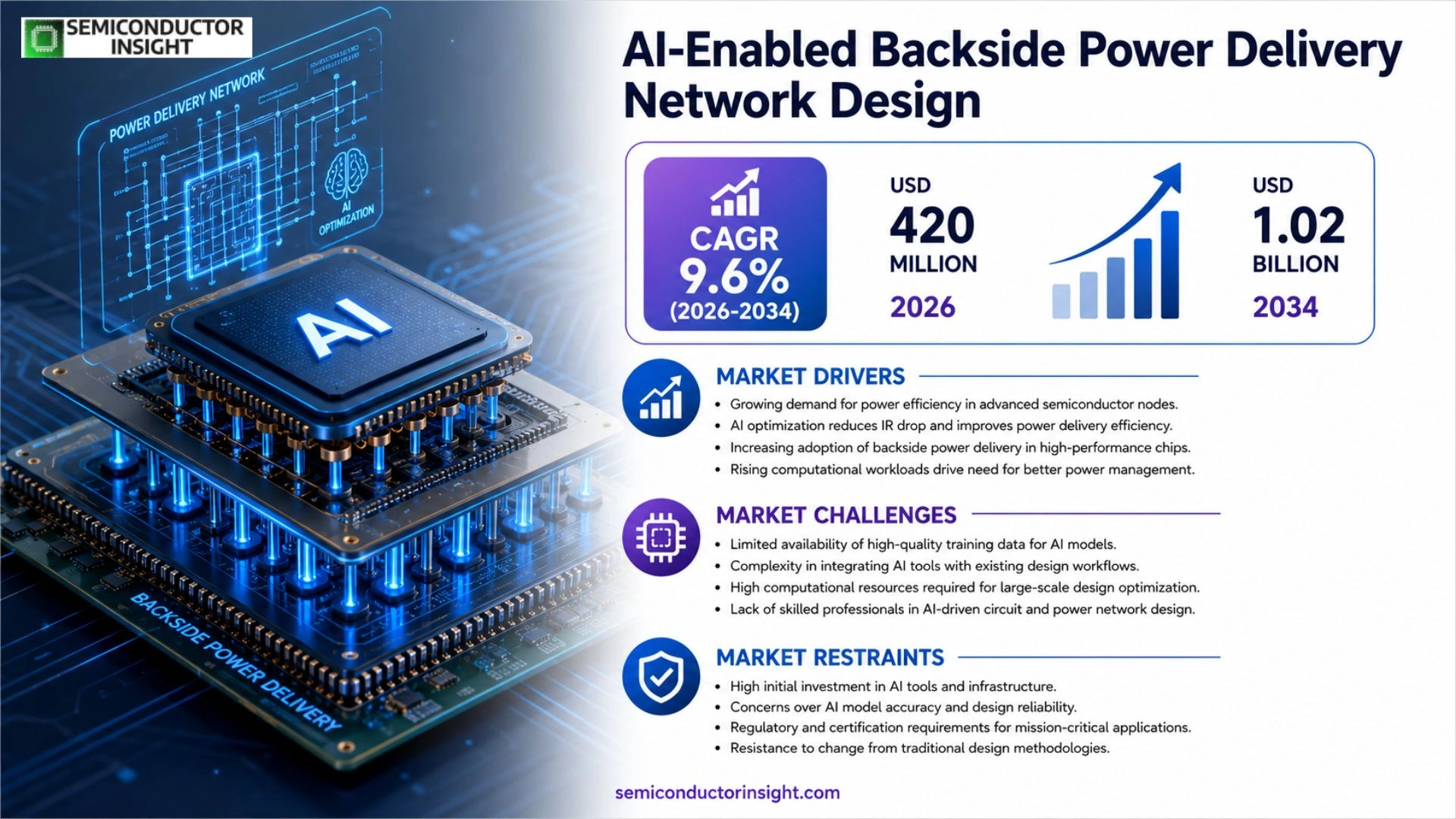
Global AI-Enabled Backside Power Delivery Network Design Market measured USD 420 million in 2025 and is set to climb to USD 1.02 billion by 2034, delivering a compound annual growth rate of approximately 9.6 percent over the forecast horizon.
The solution applies machine‑learning algorithms to automate layout synthesis of backside power delivery networks within advanced semiconductor packages. By forecasting voltage‑drop hotspots and optimizing via placement, AI‑driven tools shorten design cycles while boosting electrical performance and thermal efficiency.
Expansion stems from mounting demand for high‑density interconnects in data‑center processors, automotive electronics embracing heterogeneous integration, and growing adoption of generative‑AI workloads that stress power integrity. Recent collaborations such as Synopsys teaming with NVIDIA’s AI research unit illustrate industry momentum. Prominent suppliers,including Cadence Design Systems, Ansys Inc., and Mentor Graphics,are broadening their portfolios with AI‑centric PDN capabilities.
MARKET DRIVERS
AI Integration Accelerates Design Efficiency
The proliferation of high‑density chips forces board designers to tackle ever‑tighter power‑delivery margins. By embedding machine‑learning models within layout tools, engineers can predict voltage drop hotspots before routing begins, cutting iterative loops that traditionally consumed weeks of effort. Speedier turn‑around times translate directly into faster time‑to‑market for new devices, a factor that many semiconductor firms now regard as decisive.
Cost Pressures Drive Adoption of Intelligent Tools
Manufacturers are contending with escalating material costs and stricter yield requirements. AI‑enabled simulation engines evaluate thousands of layout permutations in a fraction of the time required by conventional solvers, enabling designers to settle on the most material‑efficient stack without compromising performance. The resulting reduction in copper usage and board layers delivers measurable cost savings that resonate across the supply chain.
➤ AI‑augmented simulation trims prototype cycles by up to 30 %.
Beyond the direct financial impact, the ability to forecast thermal and electromagnetic interactions early in the design cycle improves reliability forecasts. Companies that embed these predictive insights are better positioned to negotiate warranty terms and to meet automotive or aerospace certification timelines, where failure rates are scrutinized intensely.
MARKET CHALLENGES
Data Quality and Model Trustworthiness
Effective AI models depend on extensive, high‑fidelity training data derived from previous board iterations. Many midsize OEMs lack the historical datasets needed to calibrate algorithms, leading to skepticism about model outputs. Without a clear validation framework, engineering teams may revert to manual checks, eroding the perceived benefit of automation.
Other Challenges
Talent Gap
The intersection of power‑delivery expertise and data‑science skills remains narrow. Recruiting personnel who can bridge circuit theory with machine‑learning pipelines is a persistent hurdle, forcing firms to invest heavily in upskilling programs or to partner with niche consultancy firms.
MARKET RESTRAINTS
Regulatory and Certification Complexities
Industries such as automotive, medical, and aerospace impose rigorous certification processes for power‑delivery networks. Introducing AI‑driven design steps adds an extra layer of documentation and verification, which can delay adoption. Companies must reconcile algorithmic decision‑making with established safety standards, a process that often prolongs project timelines.
MARKET OPPORTUNITIES
Emerging Edge‑Computing Platforms
The surge in edge‑computing deployments creates a demand for compact, high‑performance boards that operate under constrained power budgets. AI‑enabled backside power delivery network design tools can tailor impedance profiles to the unique thermal envelopes of edge devices, opening a niche where differentiated engineering capability becomes a market advantage. Firms that master this specialization stand to capture a growing slice of AI-Enabled Backside Power Delivery Network Design Market.
AI-Enabled Backside Power Delivery Network Design Market Trends
Automation of Power‑Integrity Analysis
The advent of machine‑learning models that predict voltage‑drop hotspots has reshaped design methodology for backside power delivery networks. By ingesting historical layout data, these tools generate placement suggestions that reduce trial‑and‑error cycles, enabling engineers to lock down a viable PDN configuration within days rather than weeks. The speed advantage translates into shorter time‑to‑market for advanced package families, a factor that is increasingly decisive as OEMs race to qualify silicon for data‑center and automotive platforms.
Other Trends
Integration of Generative‑AI Workloads
Data‑center processors that host generative‑AI inference are placing unprecedented demand on power‑integrity margins. The electrical noise generated by high‑frequency switching amplifies the need for precise via distribution, prompting designers to rely on AI‑driven optimization that can reconcile density constraints with thermal budgets. Suppliers are embedding these capabilities into their EDA suites, allowing customers to simulate worst‑case power scenarios early in the schematic stage.
Strategic Partnerships Accelerating Tool Adoption
Recent collaborations between leading EDA vendors and AI research groups have injected credibility into the emerging workflow. A notable example is the joint effort between a major silicon design software company and an NVIDIA research unit, which combines NVIDIA’s deep‑learning expertise with the vendor’s PDN synthesis engine. Such alliances accelerate the migration from rule‑based scripts to adaptive algorithms, and they also create a channel for feedback from high‑volume manufacturers seeking to standardize AI‑enabled design practices.
COMPETITIVE LANDSCAPE
Key Industry Players
AI-Enabled Backside Power Delivery Network Design Market – Competitive Overview
Synopsys leads the AI‑enabled backside PDN design segment, leveraging its extensive EDA portfolio and the recent partnership with NVIDIA’s AI research unit to embed deep‑learning inference directly into layout synthesis tools. This alliance accelerates voltage‑drop hotspot prediction and via‑placement optimization, giving Synopsys a decisive edge in high‑performance data‑center and automotive processor projects. Cadence Design Systems and ANSYS follow closely, each expanding its simulation suite with generative‑AI modules that blend electromagnetic analysis and thermal modelling. Their breadth across analog, mixed‑signal, and system‑level design creates a tiered market structure where a handful of comprehensive vendors dominate large‑scale contracts, while specialist firms capture niche segments that demand ultra‑fine PDN tuning.
Beyond the top tier, a cohort of focused players is reshaping the competitive set. Siemens EDA (formerly Mentor Graphics) concentrates on AI‑driven rule checks for heterogeneous integration, appealing to chip‑let adopters. Keysight Technologies injects AI‑enhanced test‑and‑measurement data into the design loop, tightening the feedback cycle for power‑integrity engineers. ARM, Qualcomm, and NVIDIA contribute proprietary IP blocks that embed AI inference engines, prompting PDN tools to accommodate new power‑budget constraints. Meanwhile, IBM, Texas Instruments, Broadcom, Samsung Electronics, and TSMC bring deep fabs‑side insight, stimulating tool vendors to tailor algorithms for emerging node challenges. Collectively, these companies diversify the ecosystem, fostering collaborative innovation that shortens time‑to‑market while safeguarding electrical performance.
List of Key AI-Enabled Backside Power Delivery Network Design Companies Profiled
- Synopsys
- Cadence Design Systems
- ANSYS, Inc.
- Siemens EDA (Mentor Graphics)
- Keysight Technologies
- ARM Ltd.
- Qualcomm
- NVIDIA
- IBM
- Texas Instruments
- Broadcom
- Samsung Electronics
- TSMC
Segment Analysis:
| Segment Category | Sub-Segments | Key Insights |
| By Type |
|
Machine‑Learning Algorithms
|
| By Application |
|
Data‑Center Processor Packages
|
| By End User |
|
Semiconductor Design Houses
|
| By Technology |
|
Neural‑Network‑Based PDN Optimizers
|
| By Integration Strategy |
|
Heterogeneous 2.5D/3D Stacking
|
Regional Analysis: AI-Enabled Backside Power Delivery Network Design Market
North America
AI algorithms now generate alternative routing topologies in seconds, allowing designers to explore trade‑offs between inductance, resistance, and area that were previously infeasible to assess manually. This rapid ideation cycle shortens time‑to‑market and creates space for more aggressive power‑density targets.
Coupling AI‑enhanced layout generation with physics‑based simulators produces a feedback loop where each iteration refines both the geometry and the predictive model, sharpening accuracy without escalating computational costs.
As AI reduces design uncertainty, component vendors experience steadier demand forecasts, encouraging tighter collaboration on material specifications and enabling just‑in‑time delivery of high‑purity copper and dielectric substrates.
Emerging standards for electromagnetic compatibility now reference AI‑derived verification metrics, prompting firms to certify their AI pipelines alongside traditional compliance documentation.
Europe
European power‑delivery designers are leveraging AI to address stringent energy‑efficiency directives, particularly within the automotive and aerospace sectors. The regional emphasis on sustainability drives a preference for AI tools that can minimize copper usage while preserving signal integrity, prompting collaborations between OEMs and AI start‑ups. Market participants that align their roadmaps with EU directives on low‑power silicon are likely to secure premium contracts, as regulators increasingly reward demonstrable reductions in board‑level loss.
Asia‑Pacific
In Asia‑Pacific, the surge of fab capacities in Taiwan, South Korea, and China fuels demand for AI‑enabled backside power network solutions capable of handling ultra‑dense interconnects. Local design houses are experimenting with reinforcement‑learning agents that autonomously adapt routing strategies to the idiosyncrasies of each process node. This experimentation translates into a competitive advantage for firms that can translate AI insights into manufacturable guidelines, a factor that will shape supplier negotiations for years to come.
South America
South America remains an emerging arena where AI adoption is paced by a growing pool of engineering talent and governmental incentives for advanced manufacturing. Companies are beginning to pilot AI‑assisted power‑network design to reduce time spent on manual layout in low‑volume specialty chips, especially for telecommunications equipment. Early successes are encouraging regional firms to invest in proprietary AI models, a move that could shift the continent from a cost‑center to a design‑innovation hub.
Middle East & Africa
The Middle East & Africa region is witnessing a nascent but accelerating interest in AI‑driven power delivery design, spurred by diversification strategies that aim to move beyond oil‑centric economies. Nations investing in semiconductor parks are prioritizing AI skill development to attract multinational design services. While the market is still at an exploratory stage, the willingness to fund AI research labs indicates a long‑term commitment to embedding these capabilities into the regional design ecosystem.
Report Scope
This market research report provides a comprehensive analysis of the AI-Enabled Backside Power Delivery Network Design Market , covering the forecast period 2026–2034. It offers detailed insights into market dynamics, technological advancements, competitive landscape, and key trends shaping the industry.
Key focus areas of the report include:
- Market Overview: The report begins with an overview outlining its current market scenario, key growth indicators, and industry transformation drivers. It discusses macroeconomic factors, demand–supply balance, regulatory landscape, and the strategic role of semiconductors in powering advancements across industries such as automotive, telecommunications, consumer electronics, and industrial automation.
- Market Size & Forecast: Historical data and future projections for revenue, unit shipments, and market value across major regions and segments.
- Segmentation Analysis: Detailed breakdown by product type, technology, application, and end-user industry to identify high-growth segments and investment opportunities.
- Regional Insights: Insights into market performance across North America, Europe, Asia-Pacific, Latin America, and the Middle East & Africa, including country-level analysis where relevant.
- Competitive Landscape: Profiles of leading market participants, including their product offerings, R&D focus, manufacturing capacity, pricing strategies, and recent developments such as mergers, acquisitions, and partnerships.
- Technology Trends & Innovation: Assessment of emerging technologies, integration of AI/IoT, semiconductor design trends, fabrication techniques, and evolving industry standards.
- Market Drivers & Restraints: Evaluation of factors driving market growth along with challenges, supply chain constraints, regulatory issues, and market-entry barriers.
- Stakeholder Insights: Insights for component suppliers, OEMs, system integrators, investors, and policymakers regarding the evolving ecosystem and strategic opportunities.
Primary and secondary research methods are employed, including interviews with industry experts, data from verified sources, and real-time market intelligence to ensure the accuracy and reliability of the insights presented.
FREQUENTLY ASKED QUESTIONS:
What is the current market size of AI-Enabled Backside Power Delivery Network Design Market?
-> AI-Enabled Backside Power Delivery Network Design Market measured USD 420 million in 2025 and is set to climb to USD 1.02 billion by 2034.
Which key companies operate in AI-Enabled Backside Power Delivery Network Design Market?
-> Key players include Cadence Design Systems, Ansys Inc., Mentor Graphics, among others.
What are the key growth drivers?
-> Key growth drivers include increasing demand for high‑density interconnects in data‑center processors, automotive electronics adopting heterogeneous integration, and rising generative‑AI workloads stressing power integrity.
Which region dominates the market?
-> Asia-Pacific shows the fastest growth, while North America remains a dominant market.
What are the emerging trends?
-> Emerging trends include AI‑driven layout synthesis, predictive voltage‑drop hotspot forecasting, and integration of AI with traditional PDN design workflows.
Get Sample Report PDF for Exclusive Insights
Report Sample Includes
- Table of Contents
- List of Tables & Figures
- Charts, Research Methodology, and more...
 Download Sample Report PDF