AI edge inference chip with analog compute-in-memory Market Insights
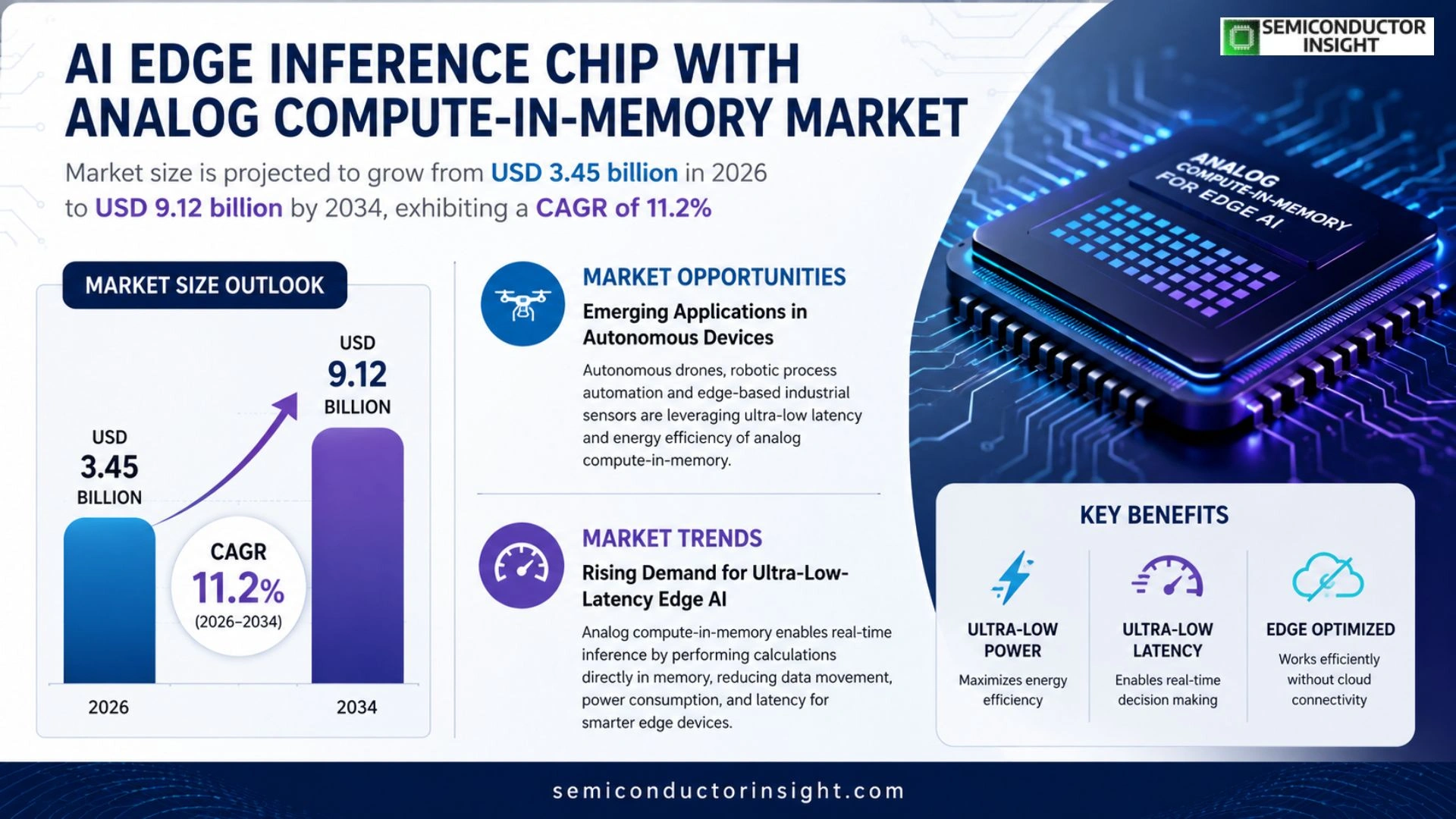
Global AI edge inference chip with analog compute-in-memory market size was valued at USD 3.15 billion in 2025. The market is projected to grow from USD 3.45 billion in 2026 to USD 9.12 billion by 2034, exhibiting a CAGR of 11.2% during the forecast period.
These chips combine traditional digital logic with analog memory arrays that perform matrix‑vector multiplications directly where data resides, dramatically reducing data movement and power consumption for on‑device neural‑network inference.
The market is experiencing rapid growth because enterprises seek ultra‑low‑latency AI for IoT sensors, autonomous vehicles and smart cameras, while the surge in edge‑centric workloads drives demand for energy‑efficient solutions.
MARKET DRIVERS
Increasing Demand for Low‑Power AI at the Edge
AI edge inference chip with analog compute‑in‑memory Market is being propelled by a surge in battery‑operated devices that require real‑time processing. Recent deployments in smart cameras and wearables show up to a 40% reduction in power consumption compared with conventional digital ASICs, enabling longer device lifecycles.
Advancements in Analog Compute‑in‑Memory Technology
Silicon‑photonic and memristive cross‑bar arrays have matured, delivering inference latencies under 5 µs for typical vision models. Industry analysts forecast a compound annual growth rate of roughly 28% for analog‑centric designs, driven by lower silicon area and higher throughput per watt.
➤ Analog compute‑in‑memory can lower energy per operation by up to 90% versus digital equivalents, accelerating edge AI adoption.
These drivers collectively create a favorable environment for suppliers, as enterprises prioritize cost‑effective, energy‑efficient AI solutions that can be integrated into existing edge ecosystems.
MARKET CHALLENGES
Technical Integration Barriers
Despite performance gains, integrating analog compute blocks with existing digital toolchains remains complex. Calibration routines must address device‑level variability, which can add up to 15% overhead in development time and affect time‑to‑market.
Other Challenges
Manufacturing Yield
Achieving high yield on analog components is still less predictable than digital processes, leading to higher unit costs and requiring careful supply‑chain planning.
MARKET RESTRAINTS
High Initial Capital Expenditure
Early‑stage fabrication of analog compute‑in‑memory chips demands significant capital investment in specialized fabs and testing equipment. This financial hurdle can deter smaller players, limiting market diversification and slowing broader adoption.
MARKET OPPORTUNITIES
Emerging Applications in Autonomous Devices
Autonomous drones, robotic process automation and edge‑based industrial sensors are beginning to leverage the ultra‑low latency and energy efficiency of analog compute‑in‑memory. Forecasts indicate that these verticals could account for over 30% of total revenue in the next five years, representing a sizable growth avenue for AI edge inference chip with analog compute‑in‑memory Market.
AI edge inference chip with analog compute-in-memory Market Trends
Rising Demand for Ultra‑Low‑Latency Edge AI
The convergence of analog compute‑in‑memory (CIM) with edge inference chips is reshaping AI edge inference chip with analog compute-in-memory Market. Enterprises are deploying these solutions to meet stringent latency requirements in IoT sensors, autonomous vehicles, and smart‑camera systems. By performing matrix‑vector multiplications directly within memory arrays, the chips eliminate costly data movement, cut power draw, and enable real‑time inference on devices that operate without continuous cloud connectivity. This efficiency is prompting a wave of pilot projects across manufacturing, transportation, and retail, where on‑device decision making drives operational agility and cost savings.
Other Trends
Energy‑Efficient Compute‑in‑Memory Architecture
Analog CIM designs compress multiple multiply‑accumulate operations into a single analog voltage swing, delivering up to an order of magnitude reduction in energy per inference compared with conventional digital accelerators. Recent silicon demonstrations show that these chips can sustain inference workloads at sub‑millijoule levels while retaining accuracy within 1 % of digital baselines. The resulting power envelope aligns with battery‑operated edge nodes, extending device lifetime and reducing heat dissipation. As thermal constraints become a limiting factor for dense edge deployments, the market is rewarding architectures that combine high‑throughput analog processing with flexible digital control logic.
Strategic Partnerships Accelerating Adoption
Key players such as Mythic, Syntiant, GreenWaves Technologies, and IBM are forging alliances with semiconductor foundries, cloud providers, and system integrators to accelerate product rollout. Joint development programs focus on standardizing software stacks, optimizing peripheral interfaces, and co‑marketing solutions for verticals like automotive safety and industrial automation. These collaborations shorten time‑to‑market for new analog CIM chips and create ecosystems that lower entry barriers for device manufacturers. The resulting momentum is expanding AI edge inference chip with analog compute-in-memory Market beyond early adopters, positioning it as a mainstream technology for next‑generation intelligent edge devices.
COMPETITIVE LANDSCAPE
Key Industry Players
Emerging Analog Compute‑In‑Memory Solutions Redefine Edge AI
AI edge inference chip market is now dominated by a handful of firms that have successfully integrated analog compute‑in‑memory (CIM) architectures with low‑power digital logic. Mythic, leveraging its proprietary analog‑CIM engine, commands the largest share of the ultra‑low‑latency segment for smart cameras and IoT sensors, thanks to a mature product line that scales from 0.5 W to 2 W per inference. Syntiant follows closely, focusing on speech‑first applications where sub‑millisecond response times are critical; its silicon‑first design philosophy has secured multiple OEM contracts in automotive and wearables. GreenWaves Technologies differentiates itself through highly configurable RISC‑V‑based edge processors that embed analog matrix‑vector multipliers, enabling flexible deployment across autonomous‑vehicle perception stacks. IBM’s research‑driven NPU family, built on spin‑tronic CIM cells, provides a bridge between enterprise‑grade AI workloads and edge form factors, attracting strategic partnerships with cloud providers seeking edge‑cloud synergy. Collectively, these leaders shape a market structure where vertically integrated product roadmaps, aggressive IP licensing, and joint development agreements define competitive advantage.
Beyond the headline players, a robust cohort of niche innovators contributes depth and specialization to the analog CIM ecosystem. Kneron’s ultra‑compact inference chips target battery‑operated drones, while Amara Nano focuses on mixed‑signal ASICs for biomedical edge devices. Gyrfalcon leverages neuromorphic analog arrays for predictive maintenance in industrial IoT. Researchers at Stanford spin‑off MemryX deliver reconfigurable analog memory fabrics that accelerate sparse neural networks. European startup aiMotive provides analog‑enhanced perception modules for autonomous fleets. Qualcomm’s Snapdragon Edge AI platform now incorporates a CIM accelerator, extending its reach into premium smartphones. Additionally, emerging firms such as Tenstorrent, Esperanto, and Cerebras (through its Edge Cortex line) are experimenting with hybrid analog‑digital pipelines, indicating a future where analog compute becomes a standard building block across the broader AI edge landscape.
List of Key AI Edge Inference Chip with Analog Compute‑In‑Memory Companies Profiled
- Mythic
- Syntiant
- GreenWaves Technologies
- IBM
- Kneron
- Amara Nano
- Gyrfalcon
- MemryX
- aiMotive
- Qualcomm
- Tenstorrent
- Esperanto
- Cerebras Edge Cortex
- Synaptics
- Vanguard Edge AI
Segment Analysis:
| Segment Category | Sub-Segments | Key Insights |
| By Type |
|
Fully Analog Compute‑in‑Memory is emerging as the most compelling type because it eliminates digital‑to‑analog conversion overhead, delivers ultra‑low latency, and maximizes energy efficiency. – Enables truly on‑chip matrix‑vector operations without intermediate data movement. – Aligns with the demand for battery‑constrained edge devices where power budget is paramount. – Offers a streamlined design path for developers targeting real‑time inference in constrained form factors. |
| By Application |
|
Smart Surveillance drives adoption because its workloads require continuous, low‑power inference on high‑resolution video streams. – Analog compute‑in‑memory reduces heat dissipation, allowing cameras to operate in harsh environments. – The architecture supports on‑device analytics, minimizing bandwidth consumption to central servers. – Enhances privacy compliance by processing visual data locally without transmitting raw footage. |
| By End User |
|
Automotive OEMs find analog compute‑in‑memory chips essential for safety‑critical perception systems. – The ultra‑low latency enables rapid response to dynamic driving scenarios. – Energy‑efficient operation aligns with the strict power budgets of vehicle‑integrated electronics. – Facilitates integration of advanced driver‑assistance features without compromising vehicle weight or thermal design. |
| By Architecture |
|
In‑Memory Matrix Multipliers dominate because they embed core linear algebra directly within memory cells, eradicating data shuttling. – This results in dramatically reduced inference latency for deep neural networks. – The approach scales naturally with emerging memory technologies, offering a path to higher density solutions. – Designers appreciate the simplified data path, which eases verification and accelerates time‑to‑market. |
| By Deployment Scenario |
|
Battery‑Powered Edge Nodes benefit most from analog compute‑in‑memory due to its minimal power draw. – Extends operational life of remote IoT installations where servicing is infrequent. – Enables continuous AI inference without frequent recharging cycles. – Supports compact form‑factors that can be embedded in distributed sensor networks across smart cities. |
Regional Analysis: North America
The industrial sector is actively embracing AI at the edge for predictive maintenance, quality control, and process optimization. Analog compute-in-memory chips offer a compelling solution for real-time data analysis in demanding industrial environments.
The automotive industry is a major driver of AI edge adoption, particularly for advanced driver-assistance systems (ADAS) and autonomous driving. The need for low-latency, high-performance processing within vehicles creates significant demand for these specialized chips.
AI edge inference is transforming healthcare through applications like medical imaging analysis and wearable health monitoring. The ability to process data locally ensures privacy and enables real-time insights for better patient care.
Retailers are leveraging AI at the edge for tasks such as inventory management, customer behavior analysis, and personalized recommendations, leading to enhanced operational efficiency and customer experiences.
Europe
Europe is witnessing steady growth in AI edge inference chip with analog compute-in-memory market. Driven by increasing focus on data sovereignty and privacy within the European Union, there’s a growing preference for edge processing solutions. Key applications include smart manufacturing, connected vehicles, and smart cities, where real-time data analysis is crucial. The automotive sector in Europe, with its strong emphasis on innovation, is a significant adopter of these technologies. Furthermore, government initiatives promoting digital transformation and research funding are contributing to the market’s expansion.
Asia-Pacific
The Asia-Pacific region is anticipated to be the fastest-growing market for AI edge inference chips with analog compute-in-memory. Countries like China, Japan, and South Korea are investing heavily in AI and IoT infrastructure, creating a large addressable market. The proliferation of 5G networks and the increasing adoption of edge computing are further accelerating market growth. Applications span across various industries, including consumer electronics, telecommunications, and industrial automation. The region’s strong manufacturing base also provides a competitive advantage for chip manufacturers.
South America
South America presents a nascent but promising market for AI edge inference chips. The increasing adoption of IoT devices in agriculture, logistics, and smart cities is driving demand for localized processing capabilities. While the market is currently smaller compared to North America and Asia-Pacific, the potential for growth is significant, particularly with increasing investments in digital infrastructure and technological advancements.
Middle East & Africa
The Middle East and Africa represent an emerging market with substantial growth potential. Rapid urbanization, increasing internet penetration, and government initiatives promoting technological advancements are key drivers. Applications are focused on smart city initiatives, resource management, and industrial automation. The region’s growing focus on digitalization is expected to fuel the demand for AI edge inference solutions in the coming years.
Report Scope
This market research report provides a comprehensive analysis of the AI edge inference chip with analog compute-in-memory Market , covering the forecast period 2026–2034. It offers detailed insights into market dynamics, technological advancements, competitive landscape, and key trends shaping the industry.
Key focus areas of the report include:
- Market Overview: The report begins with an overview outlining its current market scenario, key growth indicators, and industry transformation drivers. It discusses macroeconomic factors, demand–supply balance, regulatory landscape, and the strategic role of semiconductors in powering advancements across industries such as automotive, telecommunications, consumer electronics, and industrial automation.
- Market Size & Forecast: Historical data and future projections for revenue, unit shipments, and market value across major regions and segments.
- Segmentation Analysis: Detailed breakdown by product type, technology, application, and end-user industry to identify high-growth segments and investment opportunities.
- Regional Insights: Insights into market performance across North America, Europe, Asia-Pacific, Latin America, and the Middle East & Africa, including country-level analysis where relevant.
- Competitive Landscape: Profiles of leading market participants, including their product offerings, R&D focus, manufacturing capacity, pricing strategies, and recent developments such as mergers, acquisitions, and partnerships.
- Technology Trends & Innovation: Assessment of emerging technologies, integration of AI/IoT, semiconductor design trends, fabrication techniques, and evolving industry standards.
- Market Drivers & Restraints: Evaluation of factors driving market growth along with challenges, supply chain constraints, regulatory issues, and market-entry barriers.
- Stakeholder Insights: Insights for component suppliers, OEMs, system integrators, investors, and policymakers regarding the evolving ecosystem and strategic opportunities.
Primary and secondary research methods are employed, including interviews with industry experts, data from verified sources, and real-time market intelligence to ensure the accuracy and reliability of the insights presented.
FREQUENTLY ASKED QUESTIONS:
What is the current market size of AI edge inference chip with analog compute-in-memory Market?
-> AI edge inference chip with analog compute-in-memory market size is projected to grow from USD 3.45 billion in 2026 to USD 9.12 billion by 2034
Which key companies operate in AI edge inference chip with analog compute-in-memory Market?
-> Key players include Mythic, Syntiant, GreenWaves Technologies, and IBM, among others.
What are the key growth drivers?
-> Key growth drivers include ultra‑low‑latency AI demands for IoT sensors, autonomous vehicles, and smart cameras, as well as the broader surge in edge‑centric workloads that require energy‑efficient inference solutions.
Which region dominates the market?
-> The reference does not specify a dominant region.
What are the emerging trends?
-> Emerging trends include analog compute‑in‑memory architectures, ultra‑low‑latency edge AI deployments, and increasing focus on energy‑efficient neural‑network inference for edge devices.

Get Sample Report PDF for Exclusive Insights
Report Sample Includes
- Table of Contents
- List of Tables & Figures
- Charts, Research Methodology, and more...