
AI-Driven Dummy Fill and Metal Density Optimization Market Insights
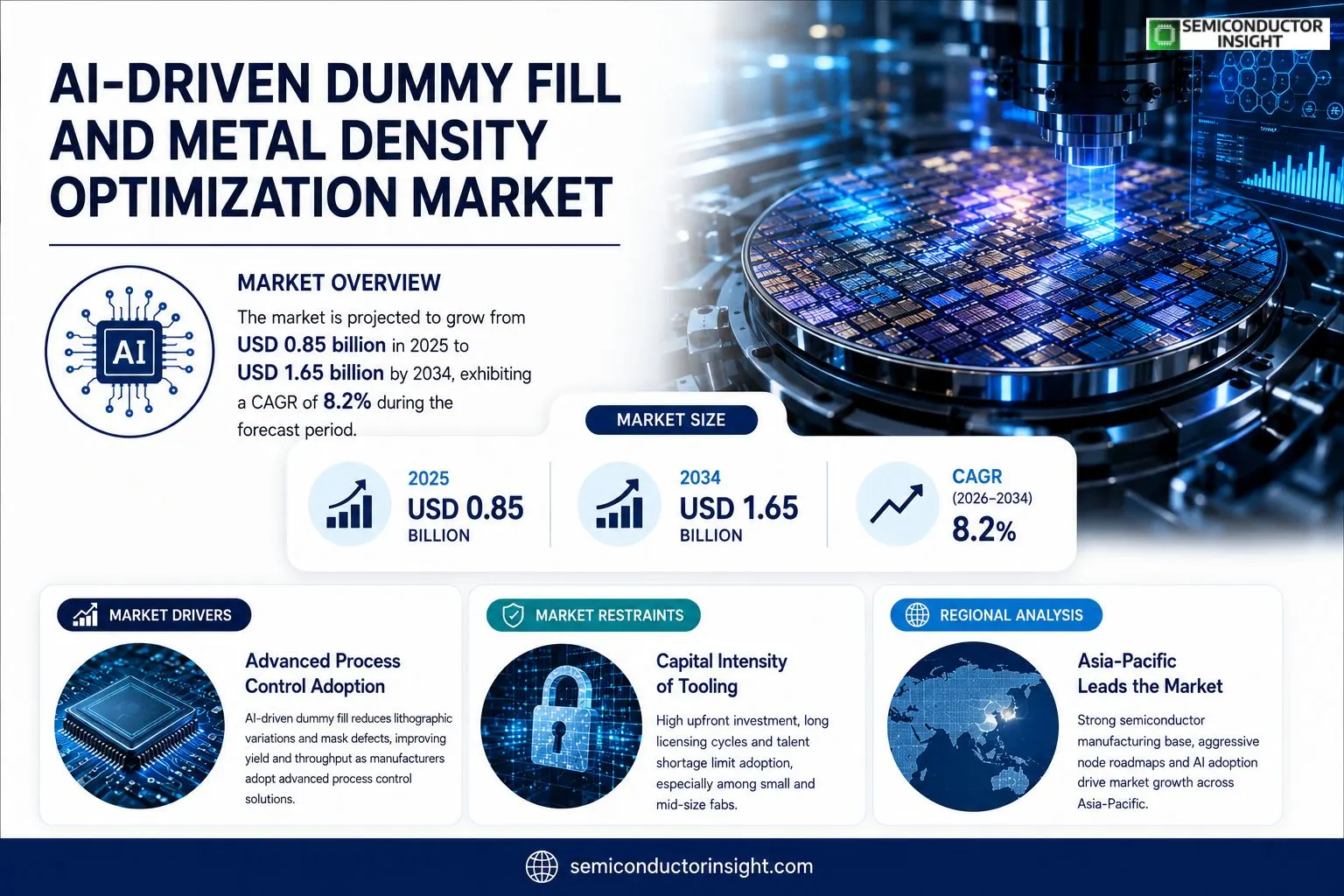
AI-Driven Dummy Fill and Metal Density Optimization Market size was valued at USD 0.78 billion in 2025. The market is projected to grow from USD 0.85 billion in 2025 to USD 1.65 billion by 2034, exhibiting a CAGR of 8.2 % during the forecast period.
AI‑driven dummy fill refers to algorithmically generated non‑functional patterns inserted into semiconductor layouts to balance topography, while metal density optimization uses machine‑learning models to redistribute metal interconnects for uniform density and reduced lithographic distortion. Both techniques are integral to sub‑7 nm node manufacturing, where pattern‑dependent effects can jeopardize yield.The market is gaining momentum because chipmakers face tighter design rules and higher performance targets; consequently, manufacturers invest heavily in advanced process control tools that leverage artificial intelligence. Moreover, the rise of heterogeneous integration has amplified the need for precise density management across diverse material stacks. In March 2024, Applied Materials announced a strategic partnership with Intel to co‑develop AI‑enabled dummy fill workflows that promise up‑to‑15 % reduction in mask defects, underscoring industry confidence.
MARKET DRIVERS
Advanced Process Control Adoption
Manufacturers of high‑performance semiconductors are integrating AI‑driven dummy fill techniques to tighten pattern density tolerances. This shift reduces lithographic variations that historically forced costly re‑work cycles, thereby improving overall yield. The pressure to keep defect rates below 0.5% per wafer has accelerated investment in machine‑learning models that predict optimal metal density distributions.
Cost‑Efficiency Imperatives
Traditional dummy fill design often relies on manual rule‑sets, consuming engineering hours that can be reallocated to product innovation. AI‑enabled optimization cuts design time by roughly 30%, allowing fabs to accelerate time‑to‑market for next‑gen nodes. The resulting labor savings translate into multi‑million‑dollar annual benefits for large‑scale operations.
➤ Companies that have deployed AI‑driven density tools report a 12‑15% reduction in mask‑rewrite incidents, directly boosting throughput.
The convergence of tighter design windows and margin‑pressured cost structures makes sophisticated dummy fill automation a strategic necessity for AI-Driven Dummy Fill and Metal Density Optimization Market.
MARKET CHALLENGES
Data Quality and Model Trustworthiness
Machine‑learning engines depend on high‑resolution process data; gaps in historical wafer metrology can introduce bias. Stakeholders often hesitate to relinquish control to a black‑box algorithm without transparent validation, slowing adoption in risk‑averse environments.
Other Challenges
Integration with Legacy EDA Flows
Most design houses still operate on decades‑old EDA tool chains. Embedding AI modules requires custom APIs and extensive qualification, which can extend project timelines and inflate upfront costs.Additionally, the regulatory environment governing design data exchange across international fabs imposes compliance checkpoints that further complicate seamless AI integration.
MARKET RESTRAINTS
Capital Intensity of Tooling
Acquiring AI‑powered optimization platforms entails multi‑year licensing agreements and hardware upgrades that can exceed $10 million for a full‑fab deployment. Small‑ to medium‑size fabs often lack the balance‑sheet depth to justify such expenditures, limiting market penetration outside the largest players.Furthermore, the learning curve associated with configuring model hyper‑parameters forces firms to recruit data‑science talent, a scarce resource in the semiconductor ecosystem. The combined effect of capital outlay and talent scarcity constrains broader diffusion of AI-Driven Dummy Fill and Metal Density Optimization Market solutions.Finally, fluctuating semiconductor demand cycles can render long‑term ROI projections uncertain, prompting cautious budgeting from potential adopters.
MARKET OPPORTUNITIES
Edge‑Computing Node Optimization
As edge devices require compact, power‑efficient chips, fine‑tuned metal density becomes a competitive differentiator. AI‑driven dummy fill can deliver the uniformity needed for aggressive voltage scaling, opening a niche market for solution providers targeting low‑power applications.Parallel growth in 3‑D integration technologies, such as through‑silicon vias, creates a demand for sophisticated density control across multiple layers. Vendors that extend AI capabilities to multi‑layer optimization stand to capture significant share of future high‑density packaging projects.Strategic alliances between AI startups and established EDA firms are emerging, promising bundled offerings that lower entry barriers for midsize manufacturers. These collaborations could accelerate market expansion and diversify the client base of AI-Driven Dummy Fill and Metal Density Optimization Market.
AI-Driven Dummy Fill and Metal Density Optimization Market Trends
AI Integration Accelerates Process Control in Sub‑7 nm Nodes
The adoption of AI‑driven dummy fill and metal density optimization is reshaping design‑for‑manufacture strategies for sub‑7 nm logic. With pattern‑dependent lithographic distortions threatening yield at these dimensions, chipmakers are turning to machine‑learning models that predict topography‑induced variations in real time. The market, valued at USD 0.78 billion in 2025, reflects the premium placed on tools that can reconcile tighter design rules with performance targets. By continuously adjusting dummy fill patterns and redistributing metal interconnects, AI workflows cut cycle time for mask verification and lower the probability of costly re‑spins. This operational efficiency is a decisive factor for fabs seeking to sustain throughput while navigating the steep cost curve of advanced nodes.
Other Trends
Heterogeneous Integration Drives Density Management Requirements
As manufacturers broaden their portfolios with silicon‑photonic, 3‑D‑stacked, and chip‑on‑wafer solutions, the density landscape becomes fragmented across disparate material stacks. Accurate metal density control now influences not only lithographic fidelity but also thermal budget and signal integrity across heterogeneous interfaces. AI‑enabled optimization engines can ingest layout data from multiple domains and generate a unified density map, ensuring uniform stress distribution and mitigating electromigration risks. This capability is especially valuable for foundries that service both high‑performance compute and low‑power IoT segments, where a single defect can erode market share in highly competitive product windows.
Strategic Partnerships Elevate Tool Ecosystem
The March 2024 collaboration between Applied Materials and Intel exemplifies how joint ventures are catalyzing commercial uptake. By co‑developing an AI‑enhanced dummy‑fill workflow, the partners claim up to a 15 % reduction in mask defects, translating into measurable yield gains for leading‑edge products. This alliance not only validates the technology’s economic merit but also signals to the broader ecosystem that investment in AI‑centric EDA and process‑control suites is no longer optional. Companies that integrate such partnered solutions can differentiate their process nodes, lock in premium pricing, and secure long‑term supply contracts with tier‑1 customers.
COMPETITIVE LANDSCAPE
Key Industry Players
Competitive dynamics in AI‑enabled dummy fill and metal density optimization
The forefront of this niche market is dominated by Applied Materials, whose recent alliance with Intel to co‑engineer AI‑driven dummy fill workflows has set a benchmark for yield improvement. By integrating deep‑learning inference directly into pattern generation stacks, Applied Materials leverages its extensive process‑control portfolio to offer a solution that trims mask defects by double‑digit percentages. This collaboration not only cements Applied Materials’ role as a technology supplier but also signals a shift toward co‑development models where equipment vendors and silicon designers co‑own algorithmic roadmaps. The strategic positioning grants Applied Materials a decisive edge in securing long‑term contracts with leading foundries seeking to meet sub‑7 nm design tolerances.Beyond the market leader, a cluster of specialized firms contributes to a diversified competitive environment. ASML’s lithography platforms incorporate AI modules that feed density‑aware data back into exposure settings, while Cadence Design Systems and Synopsys provide EDA toolchains that embed machine‑learning heuristics for dummy fill insertion. KLA Corporation, Lam Research, and Mentor (Siemens EDA) each deliver inspection or deposition solutions calibrated for metal density uniformity, reinforcing the ecosystem’s end‑to‑end capability. Regional players such as TSMC, Samsung and Foundries operate internal R&D units that tailor AI algorithms to their specific process nodes, illustrating how both equipment manufacturers and semiconductor fabs are investing heavily in proprietary intelligence to stay ahead of pattern‑dependent challenges.
List of Key AI-Driven Dummy Fill and Metal Density Optimization Companies Profiled
- Applied Materials
- ASML
- Intel
- Cadence Design Systems
- Synopsys
- KLA Corporation
- Lam Research
- Mentor (Siemens EDA)
- TSMC
- Samsung Electronics
- Foundries
- Qualcomm
- IBM Research
- Nvidia
- Broadcom
Segment Analysis:
| Segment Category | Sub-Segments | Key Insights |
| By Type |
|
Algorithmic Dummy Fill – Enables precise topography balancing without manual patterning, thereby reducing lithographic hotspots. – Integrates seamlessly with existing electronic design automation flows, fostering faster design iterations. – Enhances yield confidence for sub‑7 nm nodes by proactively counteracting pattern‑dependent effects. |
| By Application |
|
Logic Devices – Drive‑forward demand for AI‑enabled dummy fill as logic blocks demand uniform density for high‑frequency operation. – Supports aggressive transistor scaling by mitigating local density variations that impact timing closure. – Aligns with heterogeneous integration trends where mixed‑material stacks require coordinated density management. |
| By End User |
|
Semiconductor Foundries – Prioritize AI‑driven workflows to meet tight cycle‑time expectations from fab customers. – Leverage dummy fill and density optimization to improve process control across multiple product families. – Foster collaborative ecosystems with EDA vendors, enabling co‑development of intelligent pattern generation tools. |
| By Technology |
|
Deep Learning Models – Provide high‑resolution pattern recognition that captures subtle density fluctuations across the wafer. – Enable rapid adaptation to new design rules through transfer learning, reducing the time to qualify new dummy‑fill strategies. – Offer interpretability hooks that allow process engineers to trace back optimization decisions to physical phenomena. |
| By Process Integration |
|
Front‑End Lithography – Benefits directly from AI‑generated dummy fill that evens out exposure dose variations. – Supports tighter pitch control in advanced patterning techniques such as EUV. – Aligns with metal density optimization to ensure uniform etch resistance across critical layers. |
Regional Analysis: AI-Driven Dummy Fill and Metal Density Optimization Market
North America
Leading EDA vendors have embedded AI‑augmented dummy fill modules into their standard libraries, allowing designers to evaluate density trade‑offs early in the schematic stage. This reduces re‑work cycles and shortens the overall time‑to‑market for advanced nodes.
Partnerships between silicon foundries and AI service providers create shared data platforms where process insights circulate rapidly, enabling more precise fill adjustments without exposing proprietary design intent.
Real‑time metrology feeds are consumed by adaptive algorithms that tweak dummy fill on a per‑lot basis, delivering consistent metal density across heterogeneous wafer batches.
Emerging reliability standards underscore the importance of regulated metal density, prompting OEMs to demand AI‑backed verification that dummy fill does not compromise long‑term device robustness.
Europe
European fabs are capitalising on the region’s strong emphasis on sustainability to justify AI-driven dummy fill approaches. By optimising metal density, manufacturers reduce waste‑related energy consumption, aligning with EU environmental directives. Academic clusters in Germany and the Netherlands feed advanced algorithms into local foundries, fostering a collaborative ecosystem where open‑source datasets accelerate model refinement. The strategic focus on low‑power IoT devices provides a compelling use case, as precise density control translates into measurable gains in battery life and device longevity. Consequently, Europe is evolving into a niche hub for eco‑conscious process optimisation within the broader AI‑driven market.
Asia‑Pacific
In Asia‑Pacific, the sheer volume of semiconductor output creates pressure to extract incremental yield gains through AI‑enhanced dummy fill. Manufacturers in Taiwan, South Korea, and Singapore are piloting hybrid cloud‑edge solutions that process wafer data locally, mitigating latency while preserving data sovereignty. The region’s aggressive node roadmaps demand tighter control over metal density, prompting OEMs to adopt machine‑learning frameworks that predict stress hotspots before mask generation. This proactive stance not only curtails defect rates but also buffers supply‑chain disruptions by stabilising throughput across high‑mix production lines.
South America
South American semiconductor assemblers are leveraging AI‑driven density optimisation to differentiate their services in a cost‑sensitive market. By offering post‑fab tuning that adjusts dummy fill based on real‑time feedback, they add value beyond traditional assembly. Collaborative programmes with North American research institutes provide access to cutting‑edge algorithms, enabling local players to meet the stringent density tolerances required by automotive and aerospace customers who are increasingly sourcing from the region.
Middle East & Africa
The Middle East & Africa region is still nascent in AI‑driven dummy fill adoption, yet strategic investments in smart manufacturing hubs are laying groundwork for future uptake. Government‑sponsored innovation labs are experimenting with AI models that align metal density adjustments with localized climate considerations, such as temperature‑induced stress variations. Early pilots suggest that even modest improvements in fill efficiency can enhance the reliability of defense‑grade chips produced under harsh operating conditions, positioning the region as an emerging testbed for resilience‑focused optimisation.
Report Scope
This market research report provides a comprehensive analysis of the AI-Driven Dummy Fill and Metal Density Optimization Market , covering the forecast period 2026–2034. It offers detailed insights into market dynamics, technological advancements, competitive landscape, and key trends shaping the industry.
Key focus areas of the report include:
- Market Overview: The report begins with an overview outlining its current market scenario, key growth indicators, and industry transformation drivers. It discusses macroeconomic factors, demand–supply balance, regulatory landscape, and the strategic role of semiconductors in powering advancements across industries such as automotive, telecommunications, consumer electronics, and industrial automation.
- Market Size & Forecast: Historical data and future projections for revenue, unit shipments, and market value across major regions and segments.
- Segmentation Analysis: Detailed breakdown by product type, technology, application, and end-user industry to identify high-growth segments and investment opportunities.
- Regional Insights: Insights into market performance across North America, Europe, Asia-Pacific, Latin America, and the Middle East & Africa, including country-level analysis where relevant.
- Competitive Landscape: Profiles of leading market participants, including their product offerings, R&D focus, manufacturing capacity, pricing strategies, and recent developments such as mergers, acquisitions, and partnerships.
- Technology Trends & Innovation: Assessment of emerging technologies, integration of AI/IoT, semiconductor design trends, fabrication techniques, and evolving industry standards.
- Market Drivers & Restraints: Evaluation of factors driving market growth along with challenges, supply chain constraints, regulatory issues, and market-entry barriers.
- Stakeholder Insights: Insights for component suppliers, OEMs, system integrators, investors, and policymakers regarding the evolving ecosystem and strategic opportunities.
Primary and secondary research methods are employed, including interviews with industry experts, data from verified sources, and real-time market intelligence to ensure the accuracy and reliability of the insights presented.
FREQUENTLY ASKED QUESTIONS:
What is the current market size of AI-Driven Dummy Fill and Metal Density Optimization Market?
-> AI-Driven Dummy Fill and Metal Density Optimization Market was valued at USD 0.78 billion in 2025 and is expected to reach USD 1.65 billion by 2034.
Which key companies operate in AI-Driven Dummy Fill and Metal Density Optimization Market?
-> Key players include Axalta Coating Systems, AkzoNobel, BASF SE, PPG, Sherwin-Williams, and 3M, among others.
What are the key growth drivers?
-> Key growth drivers include railway infrastructure investments, urbanization, and demand for durable coatings.
Which region dominates the market?
-> Asia-Pacific is the fastest-growing region, while Europe remains a dominant market.
What are the emerging trends?
-> Emerging trends include bio-based coatings, smart coatings, and sustainable rail solutions.
Get Sample Report PDF for Exclusive Insights
Report Sample Includes
- Table of Contents
- List of Tables & Figures
- Charts, Research Methodology, and more...
 Download Sample Report PDF


