AI Digital Signage Media Player Chip Market Insights
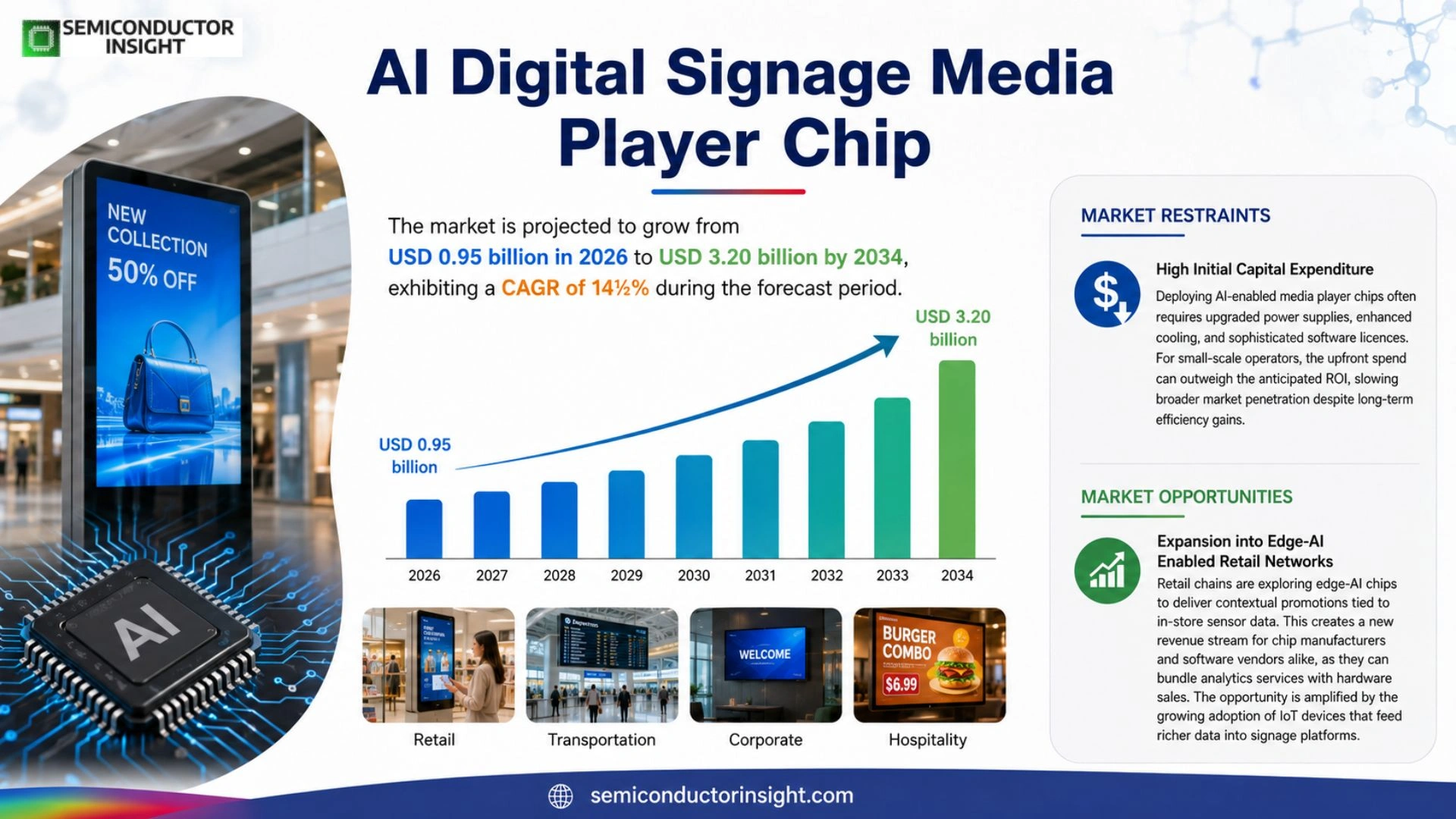
Global AI Digital Signage Media Player Chip Market size is projected to grow from USD 0.95 billion in 2025 to USD 3.20 billion by 2034, exhibiting a CAGR of 14½ % during the forecast period.
AI Digital Signage Media Player Chips are purpose‑built system‑on‑chips that combine high‑performance graphics processing with on‑board artificial‑intelligence inference engines, enabling real‑time content personalization, facial recognition and dynamic ad placement on digital displays.
The market is experiencing rapid expansion because advertisers are seeking more engaging experiences, retailers are adopting interactive kiosks, and public venues are upgrading to smart signage ecosystems powered by edge AI.
Furthermore, rising adoption of cloud‑based content management platforms and decreasing cost of semiconductor fabrication are lowering barriers to entry.
MARKET DRIVERS
Rising Demand for Real‑Time Content Personalization
AI Digital Signage Media Player Chip Market is being propelled by advertisers’ need to deliver hyper‑targeted messages based on audience demographics and behavior. Intelligent chips enable on‑device inference, reducing latency and allowing content to adapt instantly to foot‑traffic patterns. This capability improves conversion rates for retailers and enhances passenger experience in transportation hubs.
Advancements in Low‑Power Chip Architectures
Recent silicon breakthroughs have cut power consumption by up to 45 % while maintaining high inference throughput. Energy‑efficient designs make it feasible to deploy AI‑enabled players in remote or battery‑operated signage without costly rewiring. Consequently, owners can expand network reach while controlling operational expenses.
➤ Edge‑AI integration shortens the decision loop, turning passive displays into interactive revenue generators.
Overall, the convergence of data‑driven marketing strategies and cost‑effective hardware is creating a robust growth tail for AI Digital Signage Media Player Chip Market, encouraging both OEMs and system integrators to accelerate product roll‑outs.
MARKET CHALLENGES
Integration Complexity with Existing Infrastructure
Many legacy signage networks rely on proprietary firmware that is not readily compatible with modern AI chips. Upgrading requires coordinated firmware updates, staff training, and sometimes re‑cabling, which can delay deployments and increase upfront costs. Operators must balance the benefits of AI against the disruption to current workflows.
Other Challenges
Supply Chain Volatility
Global semiconductor shortages and fluctuating raw‑material prices create lead‑time uncertainties for manufacturers. This volatility can compress profit margins and force customers to defer investment until component availability stabilizes.
MARKET RESTRAINTS
High Initial Capital Expenditure
Deploying AI‑enabled media player chips often requires upgraded power supplies, enhanced cooling, and sophisticated software licences. For small‑scale operators, the upfront spend can outweigh the anticipated ROI, slowing broader market penetration despite long‑term efficiency gains.
MARKET OPPORTUNITIES
Expansion into Edge‑AI Enabled Retail Networks
Retail chains are exploring edge‑AI chips to deliver contextual promotions tied to in‑store sensor data. This creates a new revenue stream for chip manufacturers and software vendors alike, as they can bundle analytics services with hardware sales. The opportunity is amplified by the growing adoption of IoT devices that feed richer data into signage platforms.
AI Digital Signage Media Player Chip Market Trends
Edge AI Integration Fuels Market Expansion
AI Digital Signage Media Player Chip Market is accelerating as advertisers demand real‑time personalization and retailers seek interactive experiences. System‑on‑chips that embed high‑performance graphics with on‑board AI inference enable dynamic ad placement, facial recognition, and content adaptation without relying on central servers. This edge‑centric capability reduces latency, improves privacy compliance, and supports a growing portfolio of cloud‑based content‑management solutions. Consequently, deployment rates in shopping malls, airports, and stadiums have risen sharply, with many operators reporting a 30 % increase in viewer engagement within the first six months of adoption.
Other Trends
Cost Reduction and Cloud Enablement
Semiconductor fabrication costs have fallen thanks to mature 7‑nm and 5‑nm process nodes, allowing manufacturers to price AI‑accelerated chips more competitively. At the same time, cloud‑native content workflows lower the total cost of ownership for end‑users by offloading large model updates to centralized services while keeping inference on the device. This dual pressure creates a virtuous cycle: lower hardware prices drive broader rollout, which in turn expands the ecosystem of cloud tools and development kits. OEMs such as Intel, NVIDIA, Qualcomm and Ambarella are responding with bundled software stacks that further shrink time‑to‑market for new signage solutions.
Competitive Landscape Evolution
Key players are differentiating through dedicated AI acceleration blocks and ecosystem partnerships. Intel’s latest Xe‑core chips focus on mixed‑precision inference, while NVIDIA’s Jetson series emphasizes developer accessibility. Qualcomm’s Snapdragon platform integrates vision‑AI pipelines directly into its SoC, and Ambarella’s CVflow architecture targets ultra‑low‑power edge devices. These strategic moves are reinforcing demand across verticals, as manufacturers can now deliver higher resolution displays with advanced analytics at a lower bill of materials. The cumulative effect is a sustained, high‑velocity growth trajectory that aligns with broader digital transformation initiatives across the retail and public‑space sectors.
COMPETITIVE LANDSCAPE
Key Industry Players
AI Digital Signage Media Player Chip Market: Competitive Overview
AI Digital Signage Media Player Chip Market is dominated by a handful of semiconductor leaders that have integrated high‑performance graphics pipelines with specialized AI inference engines. Intel’s Xe‑based edge processors, NVIDIA’s Jetson platform, Qualcomm’s Snapdragon 845 AI‑enhanced SoC, and Ambarella’s CVflow 3.0 series each provide configurable acceleration blocks that enable real‑time content personalization, facial recognition, and dynamic ad placement. These incumbents benefit from extensive OEM development kits, robust software ecosystems, and deep relationships with system integrators, creating a tier‑one supply chain that shapes market structure. Their ability to fuse GPU‑centric graphics with dedicated tensor cores positions them as the primary enablers of next‑generation smart signage, driving the forecasted CAGR of over 14 % through 2034.
Beyond the tier‑one cohort, a diverse set of niche and emerging players contributes specialized IP that broadens the ecosystem. MediaTek leverages its cost‑effective AI ML SoC portfolio to target price‑sensitive retail deployments, while Texas Instruments offers low‑power vision‑accelerated MCUs for edge kiosks. Xilinx (now part of AMD) supplies programmable logic that can be tailored for custom AI pipelines, and Renesas provides automotive‑grade reliability for public‑venue signage. Samsung Electronics and LG Innotek supply display‑centric integration platforms, STMicroelectronics delivers mixed‑signal chips for sensor fusion, and Realtek and Rockchip focus on compact, high‑density modules for indoor networks. This layered supplier base ensures competitive pressure across performance, power, and price dimensions, fostering rapid innovation and enabling OEMs to select solutions aligned with specific deployment scenarios.
List of Key AI Digital Signage Media Player Chip Companies Profiled
- Intel Corporation
- NVIDIA Corporation
- Qualcomm Incorporated
- Ambarella, Inc.
- MediaTek Inc.
- Texas Instruments Incorporated
- Xilinx (AMD)
- Renesas Electronics Corporation
- Samsung Electronics Co., Ltd.
- LG Innotek Co., Ltd.
- STMicroelectronics N.V.
- Realtek Semiconductor Corp.
- Rockchip Electronics Co., Ltd.
Segment Analysis:
| Segment Category | Sub-Segments | Key Insights |
| By Type |
|
AI‑Accelerated SoC drives the market by delivering on‑board inference capabilities that eliminate latency, enabling real‑time personalization of signage content.
|
| By Application |
|
Retail Interactive Displays emerge as the leading application, driven by the need for dynamic, AI‑curated promotions that react to shopper behavior.
|
| By End User |
|
Retail Chains dominate end‑user adoption as they seek to differentiate the in‑store experience and capture higher dwell time.
|
| By Deployment Environment |
|
Edge‑Localized Installations are preferred because they minimize latency and protect sensitive data.
|
| By Functional Capability |
|
Content Personalization Engines lead functional demand, allowing advertisers to tailor messages dynamically.
|
Regional Analysis: AI Digital Signage Media Player Chip Market
The North American segment exhibits a broad range of AI‑enabled media player chip applications, from small‑format displays in retail aisles to large‑scale installations in stadiums. The breadth of deployment reflects a sophisticated market that values both high performance and energy efficiency, reinforcing the region’s leadership status.
Key catalysts include the convergence of edge computing with AI, heightened demand for personalized advertising, and the rapid rollout of 5G connectivity. These forces enable real‑time analytics and content optimization, prompting firms to adopt advanced chip solutions at an accelerated pace.
The region hosts a blend of established semiconductor leaders and agile startups. Strategic partnerships, joint development agreements, and targeted acquisitions are common as companies seek to broaden their AI portfolios and enhance chip capabilities for signage markets.
Players are investing heavily in software‑defined radio platforms, low‑power AI accelerators, and robust security frameworks. These initiatives aim to future‑proof deployments, ensuring seamless integration with emerging IoT ecosystems and content management platforms.
Europe
Europe’s AI Digital Signage Media Player Chip Market is shaped by a strong emphasis on sustainability and data privacy. Brands across fashion, tourism, and public transport leverage AI chips to deliver context‑aware messaging while adhering to stringent GDPR regulations. Collaborative research hubs in Germany and the Nordic region drive innovations focused on low‑power consumption, aligning with the EU’s green technology agenda. As cities adopt smart‑city frameworks, the demand for adaptive signage solutions that can process local analytics in real time continues to rise, positioning Europe as a significant growth corridor.
Asia‑Pacific
In the Asia‑Pacific, rapid urbanization and expanding digital infrastructure create fertile ground for AI Digital Signage Media Player Chip adoption. Markets such as China, India, and South Korea witness a surge in retail and transportation projects that integrate AI‑driven content personalization. While cost considerations remain paramount, manufacturers respond with scalable chip architectures that balance performance and affordability. The region’s openness to emerging technologies, coupled with government incentives for smart‑city initiatives, accelerates the diffusion of intelligent signage across diverse consumer touchpoints.
South America
South America’s market dynamics are influenced by growing consumer engagement in retail and public venues. Companies are experimenting with AI chips that enable dynamic language selection and culturally relevant content, enhancing audience resonance. Although economic fluctuations pose challenges, strategic collaborations with multinational chipset providers bring advanced solutions to local markets. The focus on improving customer experience in tourism hotspots and emerging e‑commerce platforms drives a steady increase in AI‑enabled digital signage deployments.
Middle East & Africa
The Middle East & Africa region is witnessing nascent but accelerating interest in AI Digital Signage Media Player Chips, particularly in premium retail environments and high‑traffic airports. Investments in AI‑capable hardware reflect a desire to create immersive brand experiences that adapt to diverse visitor demographics. While the market is still developing, partnerships with global semiconductor firms and regional technology incubators are fostering knowledge transfer and tailored chip solutions that address climate resilience and energy efficiency concerns.
Report Scope
This market research report provides a comprehensive analysis of the AI Digital Signage Media Player Chip Market , covering the forecast period 2026–2034. It offers detailed insights into market dynamics, technological advancements, competitive landscape, and key trends shaping the industry.
Key focus areas of the report include:
- Market Overview: The report begins with an overview outlining its current market scenario, key growth indicators, and industry transformation drivers. It discusses macroeconomic factors, demand–supply balance, regulatory landscape, and the strategic role of semiconductors in powering advancements across industries such as automotive, telecommunications, consumer electronics, and industrial automation.
- Market Size & Forecast: Historical data and future projections for revenue, unit shipments, and market value across major regions and segments.
- Segmentation Analysis: Detailed breakdown by product type, technology, application, and end-user industry to identify high-growth segments and investment opportunities.
- Regional Insights: Insights into market performance across North America, Europe, Asia-Pacific, Latin America, and the Middle East & Africa, including country-level analysis where relevant.
- Competitive Landscape: Profiles of leading market participants, including their product offerings, R&D focus, manufacturing capacity, pricing strategies, and recent developments such as mergers, acquisitions, and partnerships.
- Technology Trends & Innovation: Assessment of emerging technologies, integration of AI/IoT, semiconductor design trends, fabrication techniques, and evolving industry standards.
- Market Drivers & Restraints: Evaluation of factors driving market growth along with challenges, supply chain constraints, regulatory issues, and market-entry barriers.
- Stakeholder Insights: Insights for component suppliers, OEMs, system integrators, investors, and policymakers regarding the evolving ecosystem and strategic opportunities.
Primary and secondary research methods are employed, including interviews with industry experts, data from verified sources, and real-time market intelligence to ensure the accuracy and reliability of the insights presented.
FREQUENTLY ASKED QUESTIONS:
What is the current market size of AI Digital Signage Media Player Chip Market?
-> AI Digital Signage Media Player Chip Market was valued at USD 0.95 billion in 2025 and is expected to reach USD 3.20 billion by 2034.
Which key companies operate in AI Digital Signage Media Player Chip Market?
-> Key players include Intel, NVIDIA, Qualcomm, and Ambarella.
What are the key growth drivers?
-> Key growth drivers include rising demand for engaging digital advertising, adoption of interactive kiosks by retailers, deployment of smart signage in public venues, increasing use of cloud‑based content management platforms, and decreasing semiconductor fabrication costs.
Which region dominates the market?
-> The reference does not specify a dominant region.
What are the emerging trends?
-> Emerging trends include integration of on‑chip AI inference engines, edge AI processing for real‑time content personalization, and development of dedicated AI acceleration blocks.

Get Sample Report PDF for Exclusive Insights
Report Sample Includes
- Table of Contents
- List of Tables & Figures
- Charts, Research Methodology, and more...
 Download Sample Report PDF